Azerbaijan Insulated Glass Market Size, Share & Growth Rate
The Azerbaijan Insulated Glass Market was estimated at USD 1215 Million in 2025 and is projected to reach USD 2082 Million by 2032, growing at a CAGR of 8.0% from 2026 to 2032. This growth trajectory is primarily driven by escalating construction activities, which are fueled by urbanization and government initiatives promoting energy efficiency. As awareness about sustainable building practices increases, the demand for high-performance insulated glass is expected to surge, positioning the market for significant expansion.
Azerbaijan Insulated Glass Market Year-wise Growth Rate and Key Drivers
This graph highlights how the Azerbaijan Insulated Glass Market has steadily grown over the years, supported by major growth factors.
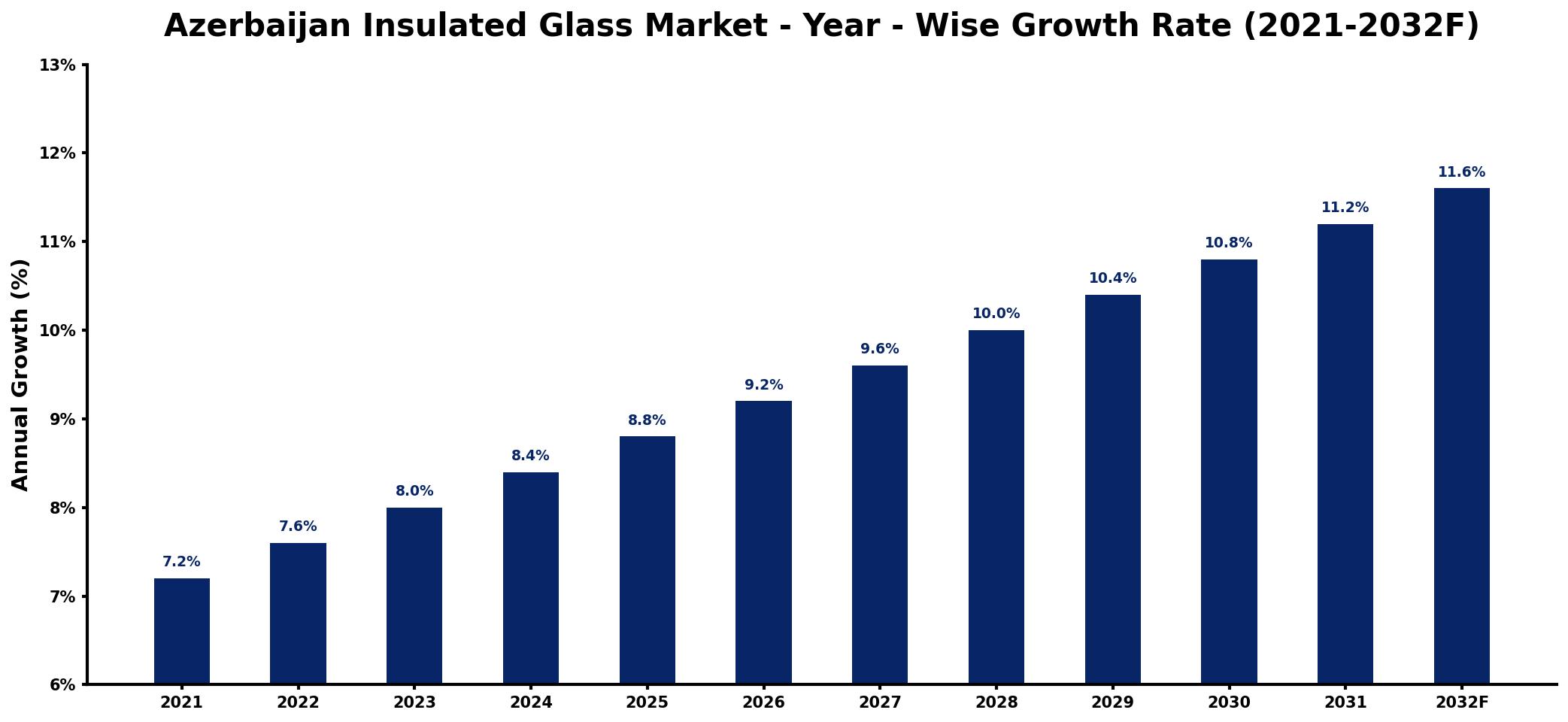
The table below presents the year‑wise growth rates along with the key drivers influencing the market
| Year | Growth Rate | Major Drivers |
| 2021 | 7.2% | increased construction activity nationwide |
| 2022 | 7.6% | growing energy efficiency regulations |
| 2023 | 8.0% | rising consumer demand for sustainability |
| 2024 | 8.4% | expansion of residential projects |
| 2025 | 8.8% | increased investment in infrastructure |
| 2026 | 9.2% | growing popularity of green buildings |
| 2027 | 9.6% | enhanced focus on thermal performance |
| 2028 | 10.0% | stronger partnerships with architects |
| 2029 | 10.4% | increased urbanization and development |
| 2030 | 10.8% | growing emphasis on design aesthetics |
| 2031 | 11.2% | growing downstream application demand |
| 2032 | 11.6% | rising demand for building renovations |
Note: Market size estimations and growth projections presented in this report are based on 6Wresearch's proprietary forecasting methodology, utilizing the latest available industry data, government publications, and primary research inputs.
Azerbaijan Insulated Glass Market Synopsis
The strongest force shaping the Azerbaijan insulated glass market is the ongoing growth in the construction sector. With increasing investments in residential and commercial buildings, insulated glass has become an essential element due to its energy-saving and aesthetic advantages.
Additionally, the rising awareness of energy-efficient solutions among consumers is propelling demand. The integration of innovative technologies and design improvements has positioned insulated glass as a key contributor to modern architectural projects across the nation.
Azerbaijan Insulated Glass Market Key Takeaways
- The market is benefiting from an increase in construction projects driven by urbanization and economic development.
- Technological advancements, such as low-emissivity coatings, are enhancing product performance and appeal.
- Consumer awareness regarding energy efficiency and building sustainability is at an all-time high.
- Investment opportunities are abundant in manufacturing and supplying insulated glass products.
- Government policies aimed at sustainability and energy conservation are fostering market growth.
Evaluation of Restraints in Azerbaijan Insulated Glass Market
Despite its promising trajectory, the Azerbaijan insulated glass market faces several challenges that could hinder growth. Competition from domestic and international manufacturers is fierce, leading to price fluctuations and quality variability. The absence of standardized regulations may affect consumer trust and product consistency. Additionally, economic factors, including currency fluctuations and geopolitical tensions, pose risks that manufacturers must navigate effectively to sustain their market positions.
Azerbaijan Insulated Glass Market Trends
Emerging trends in the Azerbaijan insulated glass market include a marked shift towards advanced technologies that enhance performance. Low-emissivity coatings and gas-filled panes are gaining traction, improving energy efficiency and sound insulation. Furthermore, the growing consumer preference for customizable and aesthetically pleasing designs is prompting manufacturers to innovate continuously, creating products that meet diverse architectural demands.
Azerbaijan Insulated Glass Market Opportunities
Investment prospects in the Azerbaijan insulated glass market are abundant, particularly with the increasing focus on sustainable building practices. Opportunities exist in both manufacturing and distribution, where businesses can tap into the surging demand for energy-efficient materials in residential, commercial, and industrial sectors. Collaborations with construction firms to develop tailored solutions could further enhance market positions and foster growth.
Government Initiatives in the Azerbaijan Insulated Glass Market
The Azerbaijani government has enacted various policies to bolster the insulated glass market, primarily focusing on promoting energy efficiency within the construction sector. Incentives and subsidies are provided to encourage the use of insulated glass, thereby minimizing energy consumption and supporting environmental sustainability. These initiatives aim to enhance the overall quality of construction projects and boost consumer confidence in locally produced products.
Future Insights of the Azerbaijan Insulated Glass Market
Looking ahead to the period from 2026 to 2032, the Azerbaijan insulated glass market is anticipated to flourish. As construction activities ramp up, coupled with an increasing emphasis on energy efficiency, the demand for insulated glass is set to rise sharply. With ongoing advancements in technology and supportive government initiatives, manufacturers are likely to introduce innovative products that align with consumer preferences, further driving market growth.
Azerbaijan Insulated Glass Market Latest Developments (2025 - 2026)
In the recent period, the Azerbaijan insulated glass market has seen a push towards modernization, with several local manufacturers investing in advanced production technologies. This has led to improved efficiency and product quality, positioning firms to better compete with imported alternatives. Additionally, collaborations between manufacturers and construction firms are emerging, aimed at developing tailored solutions that meet specific project requirements, further enhancing the market landscape.
Azerbaijan Insulated Glass Market - Key Attractiveness of the Report
- 10 Years of Market Numbers
- Historical Data Starting from 2022 to 2025
- Base Year: 2025
- Forecast Data until 2032
- Key Performance Indicators Impacting the Market
- Major Upcoming Developments and Projects
Key Highlights of the Report:
- Azerbaijan Insulated Glass Market Outlook
- Market Size of Azerbaijan Insulated Glass Market, 2025
- Forecast of Azerbaijan Insulated Glass Market, 2032
- Historical Data and Forecast of Azerbaijan Insulated Glass Revenues & Volume for the Period 2022-2032F
- Azerbaijan Insulated Glass Market Trend Evolution
- Azerbaijan Insulated Glass Market Drivers and Challenges
- Azerbaijan Insulated Glass Price Trends
- Azerbaijan Insulated Glass Porter's Five Forces
- Azerbaijan Insulated Glass Industry Life Cycle
- Historical Data and Forecast of Azerbaijan Insulated Glass Market Revenues & Volume By Type for the Period 2022-2032F
- Historical Data and Forecast of Azerbaijan Insulated Glass Market Revenues & Volume By Heated Insulating Glass for the Period 2022-2032F
- Historical Data and Forecast of Azerbaijan Insulated Glass Market Revenues & Volume By Tempering Insulating Glass for the Period 2022-2032F
- Historical Data and Forecast of Azerbaijan Insulated Glass Market Revenues & Volume By Custom Insulated Glass for the Period 2022-2032F
- Historical Data and Forecast of Azerbaijan Insulated Glass Market Revenues & Volume By Other Glasses for the Period 2022-2032F
- Historical Data and Forecast of Azerbaijan Insulated Glass Market Revenues & Volume By Application for the Period 2022-2032F
- Historical Data and Forecast of Azerbaijan Insulated Glass Market Revenues & Volume By Doors & Partitions for the Period 2022-2032F
- Historical Data and Forecast of Azerbaijan Insulated Glass Market Revenues & Volume By Kitchen Appliances & Cabinets for the Period 2022-2032F
- Historical Data and Forecast of Azerbaijan Insulated Glass Market Revenues & Volume By Floors & Ceilings for the Period 2022-2032F
- Historical Data and Forecast of Azerbaijan Insulated Glass Market Revenues & Volume By Furniture & Curtain Walls for the Period 2022-2032F
- Historical Data and Forecast of Azerbaijan Insulated Glass Market Revenues & Volume By Railings & Bolted Structures for the Period 2022-2032F
- Historical Data and Forecast of Azerbaijan Insulated Glass Market Revenues & Volume By Automotive Glasses for the Period 2022-2032F
- Historical Data and Forecast of Azerbaijan Insulated Glass Market Revenues & Volume By End User for the Period 2022-2032F
- Historical Data and Forecast of Azerbaijan Insulated Glass Market Revenues & Volume By Residential Buildings for the Period 2022-2032F
- Historical Data and Forecast of Azerbaijan Insulated Glass Market Revenues & Volume By Commercial & Institutional Buildings for the Period 2022-2032F
- Historical Data and Forecast of Azerbaijan Insulated Glass Market Revenues & Volume By Industrial Users for the Period 2022-2032F
- Azerbaijan Insulated Glass Import Export Trade Statistics
- Market Opportunity Assessment By Type
- Market Opportunity Assessment By Application
- Market Opportunity Assessment By End User
- Azerbaijan Insulated Glass Top Companies Market Share
- Azerbaijan Insulated Glass Competitive Benchmarking By Technical and Operational Parameters
- Azerbaijan Insulated Glass Company Profiles
- Azerbaijan Insulated Glass Key Strategic Recommendations






































