Azerbaijan LED Traffic Signs and Signals Market Size, Share & Growth Rate
The Azerbaijan LED Traffic Signs and Signals Market was estimated at USD 316 Million in 2025 and is projected to reach USD 565 Million by 2032, growing at a CAGR of 8.7% from 2026 to 2032. This growth is being driven by rapid urbanization and significant infrastructure investments within the country, as Azerbaijan seeks to enhance its transportation systems and improve road safety. Furthermore, the shift towards smart city initiatives and the implementation of advanced traffic management technologies are catalyzing demand for efficient LED solutions in urban environments.
Azerbaijan LED Traffic Signs and Signals Market Year-wise Growth Rate and Key Drivers
This graph highlights how the Azerbaijan LED Traffic Signs and Signals Market has steadily grown over the years, supported by major growth factors.
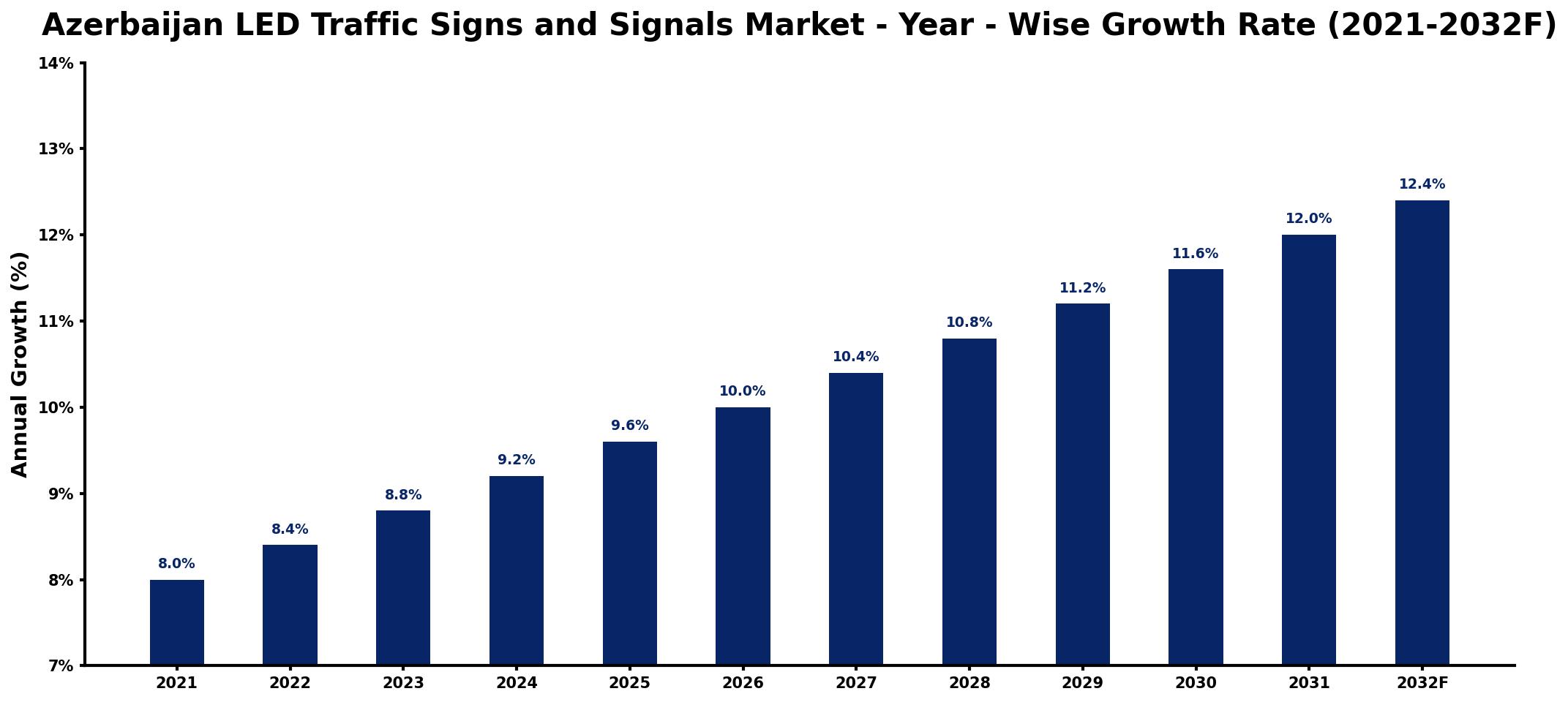
The table below presents the year‑wise growth rates along with the key drivers influencing the market
| Year | Growth Rate | Major Drivers |
| 2021 | 8.0% | Urban infrastructure development projects increase |
| 2022 | 8.4% | Government investment in smart cities |
| 2023 | 8.8% | Rising demand for energy efficiency |
| 2024 | 9.2% | Growing public safety initiatives |
| 2025 | 9.6% | Technological advancements in automation |
| 2026 | 10.0% | Expansion of urban mobility solutions |
| 2027 | 10.4% | Increase in public transportation upgrades |
| 2028 | 10.8% | Focus on environmental sustainability efforts |
| 2029 | 11.2% | Urban population growth driving needs |
| 2030 | 11.6% | Enhanced regulations for road safety |
| 2031 | 12.0% | Investment in modernized urban planning |
| 2032 | 12.4% | Collaboration between private sectors |
Note: Market size estimations and growth projections presented in this report are based on 6Wresearch's proprietary forecasting methodology, utilizing the latest available industry data, government publications, and primary research inputs.
Azerbaijan LED Traffic Signs and Signals Market Synopsis
The Azerbaijan LED Traffic Signs and Signals Market is undergoing a transformation, marked by increasing reliance on energy-efficient traffic management systems. The integration of LED technology is becoming essential for municipalities seeking to enhance visibility and communication, particularly in urban areas.
As the government pushes for modernization, LED traffic solutions are being favored due to their long lifespan and minimal maintenance needs. This proactive approach supports Azerbaijan's broader vision of creating smart cities and sustainable transport systems.
Azerbaijan LED Traffic Signs and Signals Market Key Takeaways
- The market is projected to grow significantly due to urbanization and infrastructure initiatives.
- LED technology adoption is rising, fueled by its energy efficiency and visibility advantages.
- Dynamic message signs are gaining traction, providing real-time information to enhance road safety.
- Government policies are encouraging the transition to modern LED systems, bolstering market growth.
- Investment opportunities are emerging for suppliers and local manufacturers focusing on smart traffic solutions.
Evaluation of Restraints in Azerbaijan LED Traffic Signs and Signals Market
Despite the positive growth trajectory, the Azerbaijan LED Traffic Signs and Signals Market faces several restraints. Regulatory hurdles concerning the standards and specifications for traffic control equipment complicate market entry. Furthermore, there's a limited awareness of LED technology among local authorities, which can hinder adoption rates. The high initial costs associated with upgrading to LED systems remain a concern, as does the need for trained personnel for installation and maintenance, particularly in challenging weather conditions. These challenges require coordinated efforts from industry stakeholders and government entities to enhance infrastructure and promote education on the benefits of LED traffic management systems.
Azerbaijan LED Traffic Signs and Signals Market Trends
A notable trend within the Azerbaijan LED Traffic Signs and Signals Market is the increasing integration of smart technologies into traffic management solutions. As cities evolve towards intelligent transportation systems, there is a growing demand for customizable LED signs and smart traffic signals that enhance traffic flow and safety. The shift towards dynamic message signs is particularly relevant, allowing for real-time updates to drivers regarding road conditions or safety alerts. Additionally, energy efficiency continues to be a driving force, with stakeholders seeking sustainable solutions to reduce energy consumption and operational costs.
Azerbaijan LED Traffic Signs and Signals Market Opportunities
The market offers lucrative investment opportunities as Azerbaijan invests in modernizing its infrastructure. Companies have the potential to supply LED traffic signs to governmental agencies or participate in large-scale infrastructure projects. Additionally, there is a growing need for maintenance and support services as more municipalities adopt LED technologies. Collaborating with local manufacturers can further enhance market access and distribution efficiency, positioning investors favorably in a rapidly evolving landscape focused on improved road safety and traffic management.
Government Initiatives in the Azerbaijan LED Traffic Signs and Signals Market
The Azerbaijani government is proactively promoting the use of LED traffic signs and signals to enhance road safety and reduce energy consumption. Policies are being established to streamline the adoption of modern traffic management solutions, which include setting regulations and standards for the effective installation and maintenance of LED systems. The government is also providing incentives for municipalities and businesses to invest in LED technologies, aiming to expedite the transition from traditional systems to more efficient solutions that align with broader sustainability goals.
Future Insights of the Azerbaijan LED Traffic Signs and Signals Market
Looking forward to 2026-2032, the Azerbaijan LED Traffic Signs and Signals Market is poised for substantial growth. Continued urbanization and government investments in transportation infrastructure will remain primary drivers. The anticipated advancements in intelligent traffic management solutions, alongside rising awareness of the benefits of LED technology, will further accelerate market expansion. With a commitment to smart city initiatives and sustainable development, the environment is ripe for innovation and investment within this sector.
Azerbaijan LED Traffic Signs and Signals Market Latest Developments (2025 - 2026)
Recent developments in the Azerbaijan LED Traffic Signs and Signals Market indicate a concerted effort to incorporate more technology-driven solutions in urban environments. Discussions surrounding public-private partnerships are becoming more common, as stakeholders seek collaborative approaches to address infrastructure needs. Additionally, there has been an increased focus on training programs to enhance local technical skills for installation and maintenance of LED systems, highlighting the industrys commitment to sustainable growth and operational efficiency.
Azerbaijan LED Traffic Signs and Signals Market - Key Attractiveness of the Report
- 10 Years of Market Numbers
- Historical Data Starting from 2022 to 2025
- Base Year: 2025
- Forecast Data until 2032
- Key Performance Indicators Impacting the Market
- Major Upcoming Developments and Projects
Key Highlights of the Report:
- Azerbaijan LED Traffic Signs and Signals Market Outlook
- Market Size of Azerbaijan LED Traffic Signs and Signals Market, 2025
- Forecast of Azerbaijan LED Traffic Signs and Signals Market, 2032
- Historical Data and Forecast of Azerbaijan LED Traffic Signs and Signals Revenues & Volume for the Period 2022-2032F
- Azerbaijan LED Traffic Signs and Signals Market Trend Evolution
- Azerbaijan LED Traffic Signs and Signals Market Drivers and Challenges
- Azerbaijan LED Traffic Signs and Signals Price Trends
- Azerbaijan LED Traffic Signs and Signals Porter's Five Forces
- Azerbaijan LED Traffic Signs and Signals Industry Life Cycle
- Historical Data and Forecast of Azerbaijan LED Traffic Signs and Signals Market Revenues & Volume By Product for the Period 2022-2032F
- Historical Data and Forecast of Azerbaijan LED Traffic Signs and Signals Market Revenues & Volume By LED Traffic Signals for the Period 2022-2032F
- Historical Data and Forecast of Azerbaijan LED Traffic Signs and Signals Market Revenues & Volume By LED Traffic Signs for the Period 2022-2032F
- Azerbaijan LED Traffic Signs and Signals Import Export Trade Statistics
- Market Opportunity Assessment By Product
- Azerbaijan LED Traffic Signs and Signals Top Companies Market Share
- Azerbaijan LED Traffic Signs and Signals Competitive Benchmarking By Technical and Operational Parameters
- Azerbaijan LED Traffic Signs and Signals Company Profiles
- Azerbaijan LED Traffic Signs and Signals Key Strategic Recommendations






































