Azerbaijan Livestock Market Size, Share & Growth Rate
The Azerbaijan Livestock Market was estimated at USD 1147 Million in 2025 and is projected to reach USD 2145 Million by 2032, growing at a CAGR of 9.4% from 2026 to 2032. This growth trajectory is significantly driven by the rising domestic demand for meat and dairy products, fueled by a growing population and increasing disposable incomes. The governments commitment to modernizing agricultural practices and improving productivity will further bolster this sectors expansion.
Azerbaijan Livestock Market Year-wise Growth Rate and Key Drivers
This graph highlights how the Azerbaijan Livestock Market has steadily grown over the years, supported by major growth factors.
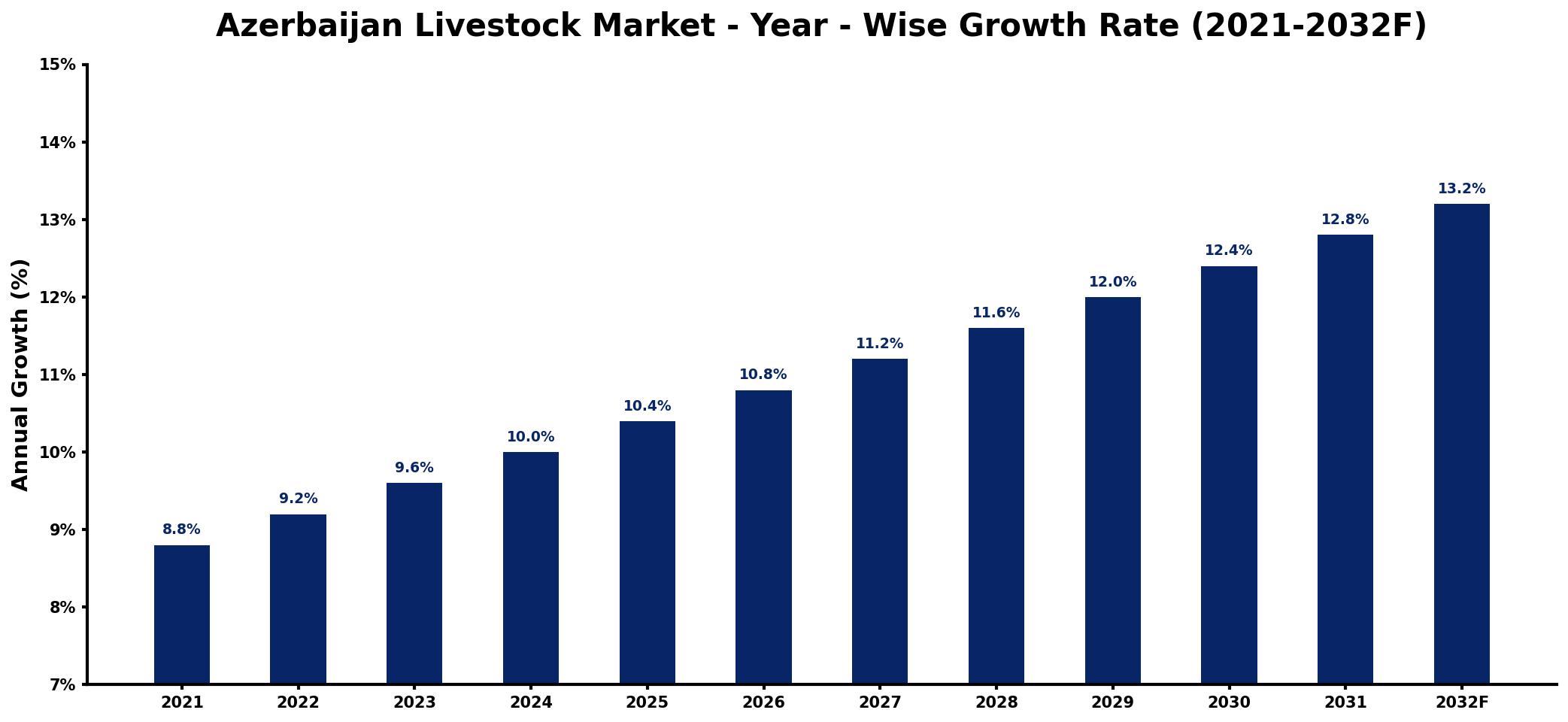
The table below presents the year‑wise growth rates along with the key drivers influencing the market
| Year | Growth Rate | Major Drivers |
| 2021 | 8.8% | increased consumer demand for protein |
| 2022 | 9.2% | expansion of rural farming initiatives |
| 2023 | 9.6% | rising investment in agricultural technology |
| 2024 | 10.0% | growth in export opportunities abroad |
| 2025 | 10.4% | enhanced veterinary healthcare services |
| 2026 | 10.8% | development of sustainable farming practices |
| 2027 | 11.2% | government subsidies for farmers |
| 2028 | 11.6% | increased access to financing options |
| 2029 | 12.0% | growing interest in organic products |
| 2030 | 12.4% | strengthening of supply chain infrastructure |
| 2031 | 12.8% | increased collaboration with agricultural universities |
| 2032 | 13.2% | rising awareness of food security |
Note: Market size estimations and growth projections presented in this report are based on 6Wresearch's proprietary forecasting methodology, utilizing the latest available industry data, government publications, and primary research inputs.
Azerbaijan Livestock Market Synopsis
The Azerbaijan Livestock Market is a crucial element of the nations economy, primarily driven by the production of cattle, sheep, and poultry. Livestock farming not only supports local food security but also provides income for numerous families engaged in this traditional sector.
Amidst a landscape where small-scale farms coexist with larger commercial operations, the market is progressively adopting modern farming techniques. Enhanced breeding practices and improved health standards are becoming prevalent, shaping a more efficient and productive industry.
Azerbaijan Livestock Market Key Takeaways
- The market is transitioning towards sustainable and organic livestock production practices.
- Government initiatives are providing critical support to enhance productivity and infrastructure.
- Modern technologies in breeding and healthcare management are increasingly being adopted by farmers.
- There is a notable increase in consumer demand for ethically produced meat and dairy products.
- Investments in niche markets like organic meats present lucrative opportunities for growth.
Evaluation of Restraints in Azerbaijan Livestock Market
The Azerbaijan Livestock Market faces several critical constraints that hinder its growth potential. Insufficient infrastructure remains a pervasive issue, complicating logistics and reducing efficiency in livestock transport and storage. Furthermore, outdated farming practices and limited access to modern veterinary services exacerbate productivity challenges. Fluctuations in feed prices and the threat of disease outbreaks introduce significant risks, making it essential for the sector to prioritize infrastructure investment and adopt modern farming techniques.
Azerbaijan Livestock Market Trends
An emerging trend in the Azerbaijan Livestock Market is the increasing consumer awareness regarding animal welfare and sustainable farming. Farmers are not only enhancing their practices to meet these ethical standards but are also leveraging modern technology to optimize livestock care and management. The shift towards organic farming is evident as consumers increasingly prefer products that are ethically sourced, creating a favorable environment for those willing to invest in sustainable practices.
Azerbaijan Livestock Market Opportunities
Investment opportunities within the Azerbaijan Livestock Market are both numerous and promising. Modernizing existing farms through technological advancements, such as automated feeding systems and data analytics, can significantly enhance production capabilities. Additionally, niche markets, especially organic and specialty meats, are ripe for exploration, catering to the evolving preferences of health-conscious consumers. Collaborating with local farmers and cooperatives to build sustainable supply chains can also yield substantial returns on investment.
Government Initiatives in the Azerbaijan Livestock Market
The Azerbaijani government has implemented a variety of policies aimed at fostering the growth of the livestock sector. These include financial subsidies to livestock farmers, intended to bolster productivity and ensure food security for the population. Furthermore, regulatory frameworks have been established to maintain livestock quality and safeguard consumer health. Measures against disease transmission, such as mandatory vaccinations, reflect the government's commitment to a robust and sustainable livestock industry.
Future Insights of the Azerbaijan Livestock Market
Looking ahead to the years 2026 to 2032, the Azerbaijan Livestock Market is poised for significant growth driven by an increasing demand for quality meat and dairy products in both domestic and neighboring international markets. Continued governmental support for the agricultural sector, alongside investments in infrastructure and technology, will be critical in overcoming existing barriers. While challenges related to disease management and climate change remain, the overall outlook appears optimistic, with a potential for substantial market expansion.
Azerbaijan Livestock Market Latest Developments (2025 - 2026)
Recent developments in the Azerbaijan Livestock Market indicate a strong push towards modernization. Initiatives aimed at enhancing breeding techniques and improving livestock health standards have gained traction, with farmers increasingly adopting innovative technologies. Additionally, the government's ongoing efforts to establish better infrastructure are being recognized as essential for improving market efficiency and output.
Azerbaijan Livestock Market - Key Attractiveness of the Report
- 10 Years of Market Numbers
- Historical Data Starting from 2022 to 2025
- Base Year: 2025
- Forecast Data until 2032
- Key Performance Indicators Impacting the Market
- Major Upcoming Developments and Projects
Key Highlights of the Report:
- Azerbaijan Livestock Market Outlook
- Market Size of Azerbaijan Livestock Market, 2025
- Forecast of Azerbaijan Livestock Market, 2032
- Historical Data and Forecast of Azerbaijan Livestock Revenues & Volume for the Period 2022-2032F
- Azerbaijan Livestock Market Trend Evolution
- Azerbaijan Livestock Market Drivers and Challenges
- Azerbaijan Livestock Price Trends
- Azerbaijan Livestock Porter's Five Forces
- Azerbaijan Livestock Industry Life Cycle
- Historical Data and Forecast of Azerbaijan Livestock Market Revenues & Volume By Animal Type for the Period 2022-2032F
- Historical Data and Forecast of Azerbaijan Livestock Market Revenues & Volume By Ruminants for the Period 2022-2032F
- Historical Data and Forecast of Azerbaijan Livestock Market Revenues & Volume By Poultry for the Period 2022-2032F
- Historical Data and Forecast of Azerbaijan Livestock Market Revenues & Volume By Swine for the Period 2022-2032F
- Historical Data and Forecast of Azerbaijan Livestock Market Revenues & Volume By Aquaculture for the Period 2022-2032F
- Azerbaijan Livestock Import Export Trade Statistics
- Market Opportunity Assessment By Animal Type
- Azerbaijan Livestock Top Companies Market Share
- Azerbaijan Livestock Competitive Benchmarking By Technical and Operational Parameters
- Azerbaijan Livestock Company Profiles
- Azerbaijan Livestock Key Strategic Recommendations






































