Azerbaijan LTE IoT Market Size & Growth Rate (2026-2032)
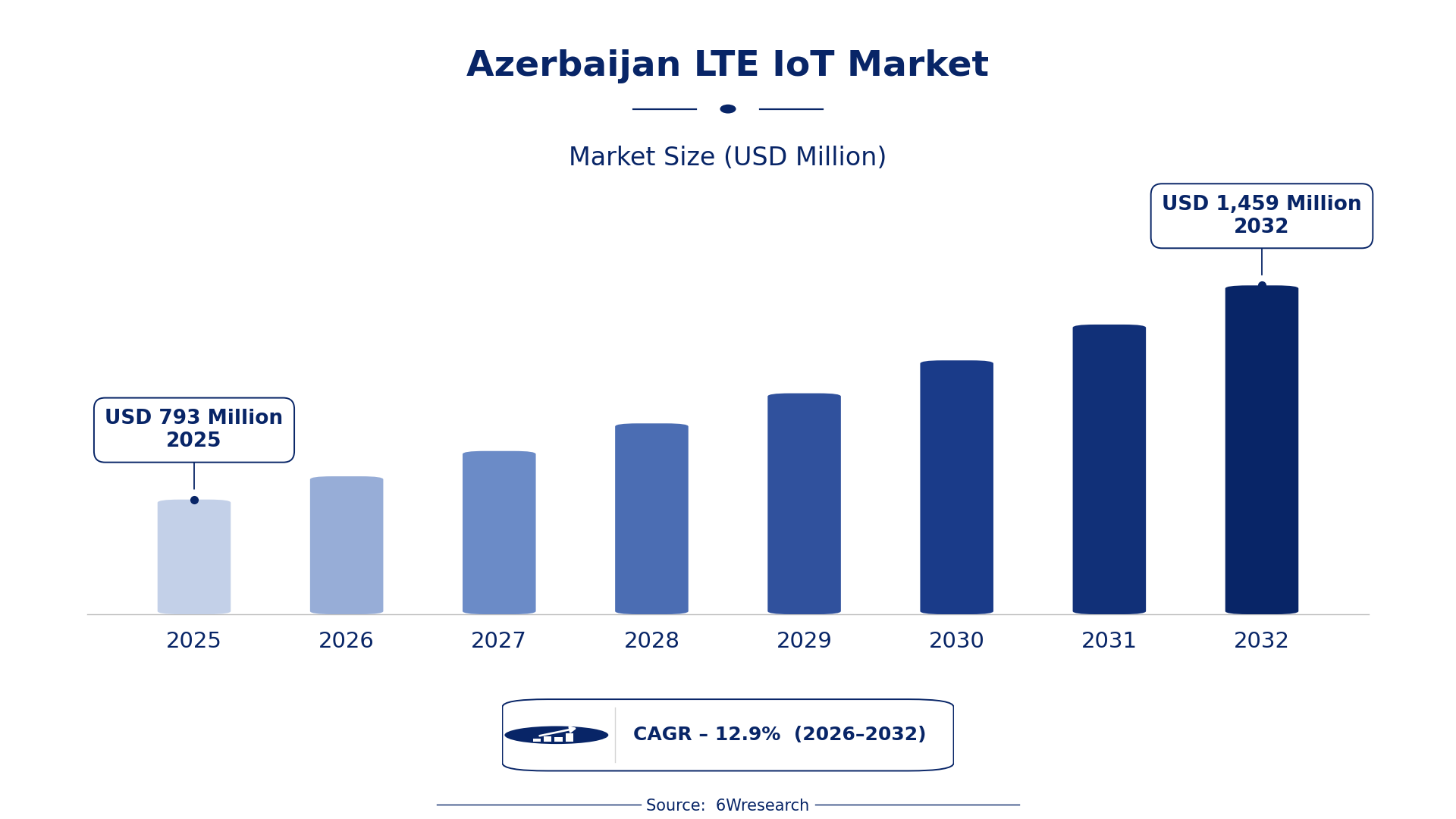
The Azerbaijan LTE IoT Market was estimated at USD 793 Million in 2025 and is projected to reach USD 1459 Million by 2032, growing at a CAGR of 12.9% from 2026 to 2032.
Azerbaijan LTE IoT Market Synopsis
The Azerbaijan LTE IoT market is currently propelled by the increasing integration of IoT solutions across various sectors, especially in manufacturing, agriculture, and healthcare. This technological shift is fostering a demand for enhanced connectivity and smart applications, further supported by the government's push for digital transformation.
As businesses strive for greater operational efficiency, the deployment of LTE IoT networks is making it possible to implement solutions that promise lower power consumption and improved data security. These advancements not only offer competitive advantages but also align with the government’s commitment to building smart cities.
Azerbaijan LTE IoT Market Year-wise Growth Rate and Key Drivers
This graph illustrates the annual growth rates of the Azerbaijan LTE IoT Market from 2021 to 2032, highlighting a steady upward trajectory and projected expansion over the forecast period.
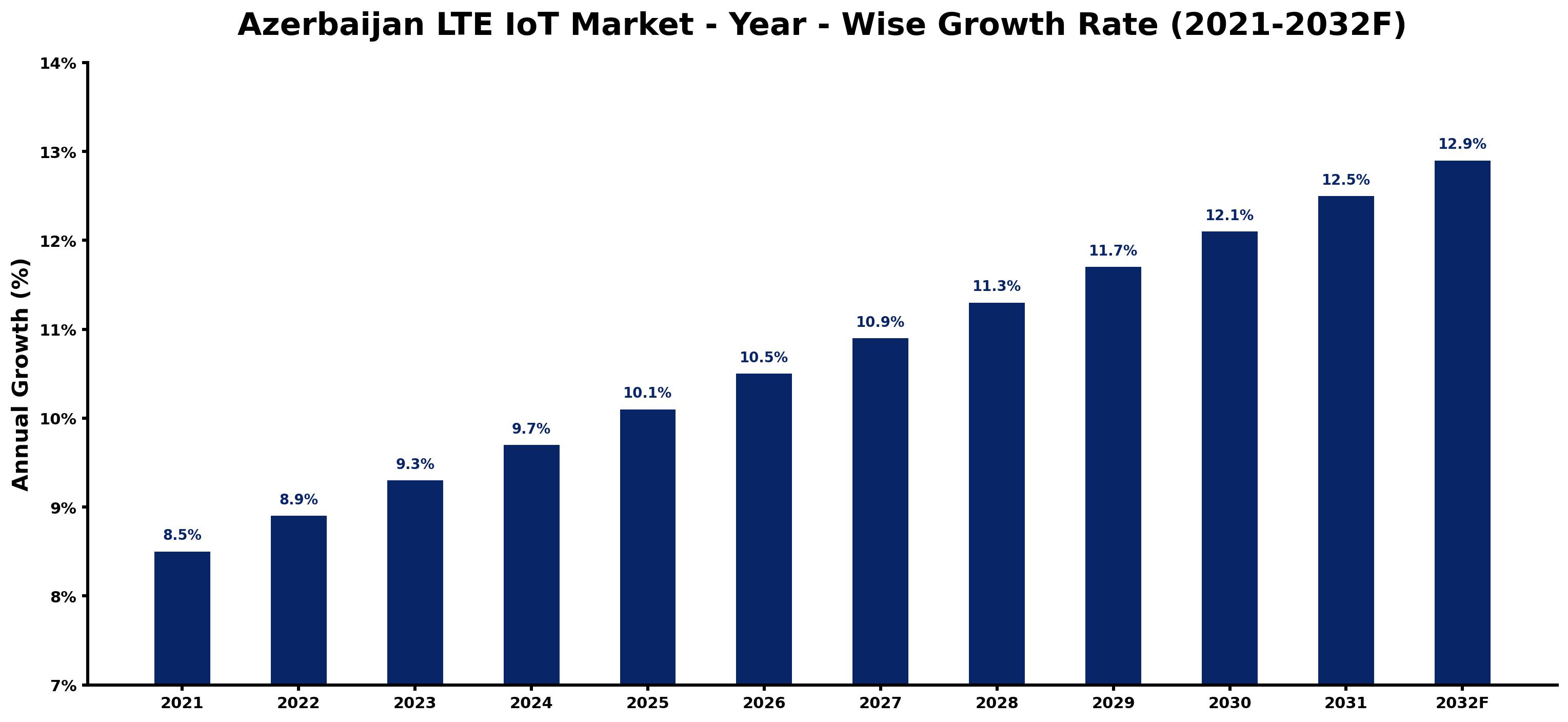
The table below presents the year‑wise growth rates along with the key drivers influencing the market
| Year | Growth Rate | Major Drivers |
| 2021 | 8.5% | Azerbaijan's Digital Transformation Strategy supports IoT development |
| 2022 | 8.9% | Increased investment in agricultural IoT solutions for efficiency |
| 2023 | 9.3% | Enhanced 5G infrastructure rollout facilitating IoT connectivity |
| 2024 | 9.7% | Government subsidies promoting smart meters adoption nationwide |
| 2025 | 10.1% | Rising urbanization driving demand for IoT-enabled services |
| 2026 | 10.5% | Regulatory framework encouraging innovation in IoT startups |
| 2027 | 10.9% | Partnerships between telecoms and energy firms for grid IoT |
| 2028 | 11.3% | Focus on environmental monitoring boosting IoT system uptake |
| 2029 | 11.7% | Local demand for smart logistics solutions in transportation |
| 2030 | 12.1% | Growing use of IoT in Azerbaijan’s rapidly modernizing agriculture |
| 2031 | 12.5% | Promotion of IoT in disaster management by government |
| 2032 | 12.9% | Increased consumer interest in smart home technologies |
Note: Market size estimations and growth projections presented in this report are based on 6Wresearch's proprietary forecasting methodology, utilizing the latest available industry data, government publications, and primary research inputs.
Azerbaijan LTE IoT Market Key Takeaways
Below are some of the specific key takeaways from the market, including:
- The market is benefiting from significant government initiatives aimed at fostering digital innovation.
- Key industries driving growth include agriculture, healthcare, and manufacturing.
- Rising demand for IoT applications in asset tracking and smart metering is notable.
- Telecom operators are expanding IoT services, creating more competition and innovation.
- Advancements in LTE-M and NB-IoT technologies are enhancing device connectivity options.
Evaluation of Restraints in Azerbaijan LTE IoT Market
Despite its growth trajectory, the Azerbaijan LTE IoT market faces several challenges that can impede progress. A primary concern is the limited network coverage in rural areas, making it difficult for IoT solutions to be adopted universally. Additionally, interoperability issues between various IoT devices can hinder seamless integration, affecting user experience and operational efficiency. Data privacy and security continue to be critical concerns, as the lack of standardized regulations may deter investment. High initial costs and the need for skilled professionals pose further barriers to widespread implementation.
Azerbaijan LTE IoT Market Trends
The Azerbaijan LTE IoT market is witnessing a notable trend towards deploying low-power wide-area network technologies, particularly LTE-M and NB-IoT. These technologies facilitate long battery life for devices, which is a critical factor for numerous applications, including environmental monitoring and smart metering. There is also an increasing focus on developing smart city projects, wherein IoT solutions will play a vital role in enhancing urban living standards.
Azerbaijan LTE IoT Market Opportunities
Opportunities abound in the Azerbaijan LTE IoT market, especially in sectors such as agriculture, where IoT can optimize resource usage. The transportation industry stands to benefit significantly from enhanced IoT applications for fleet management. Smart city initiatives are an exciting frontier, representing a convergence of technologies that can transform urban infrastructure. Investors should consider partnerships with local enterprises and government entities to tap into these promising avenues.
Government Initiatives in the Azerbaijan LTE IoT Market
The Azerbaijani government is actively shaping the LTE IoT market through various initiatives aimed at enhancing the regulatory framework and promoting industry growth. This proactive approach creates a conducive environment for IoT solutions, which is critical for attracting investment and innovation.
- A national digital infrastructure upgrade programme launched in early 2025 focuses on expanding IoT connectivity across urban and rural areas.
- Currently ongoing is a public-private initiative to develop smart city infrastructure, enhancing the deployment of IoT applications.
- A regulatory framework introduced in 2026 is set to establish guidelines for data privacy and security in IoT systems.
- Recent efforts include funding programs aimed at fostering innovation and collaboration among local tech startups and established businesses.
- Plans for a national awareness campaign in 2027 will promote the benefits of IoT adoption among businesses and the general public.
Future Insights of the Azerbaijan LTE IoT Market
Looking ahead to 2026-2032, the Azerbaijan LTE IoT market is expected to grow steadily. Increased government support and advancements in network technologies will drive further adoption across sectors like healthcare and agriculture. As businesses increasingly seek to enhance their operational efficiency, the demand for innovative IoT solutions will only intensify. The government's commitment to digital transformation suggests that the necessary infrastructure will continue to evolve, paving the way for expanded IoT applications.
Azerbaijan LTE IoT Market Latest Developments
Over the past year, the Azerbaijan LTE IoT market has seen significant developments that underline its growth trajectory. With increasing investments and technological advancements, various stakeholders are actively contributing to the evolution of IoT solutions.
- A major technology vendor initiated an IoT solution rollout in Q1 2025 aimed at enhancing agricultural productivity through smart farming technologies.
- A leading regional operator is currently partnering with local businesses to create an IoT platform designed for smart city applications, which remains underway.
- In mid-2026, a pilot project for smart metering in urban areas is expected to launch, focusing on energy efficiency.
- A telecommunications company completed a significant expansion of its IoT network infrastructure by late 2025, improving connectivity in previously underserved regions.
- Upcoming in 2027, a nationwide conference will be hosted to showcase IoT innovations and foster collaboration among industry stakeholders.
Azerbaijan LTE IoT Market - Key Attractiveness of the Report
- 10 Years of Market Numbers
- Historical Data Starting from 2022 to 2025
- Base Year: 2025
- Forecast Data until 2032
- Key Performance Indicators Impacting the Market
- Major Upcoming Developments and Projects
Key Highlights of the Report:
- Azerbaijan LTE IoT Market Outlook
- Market Size of Azerbaijan LTE IoT Market, 2025
- Forecast of Azerbaijan LTE IoT Market, 2032
- Historical Data and Forecast of Azerbaijan LTE IoT Revenues & Volume for the Period 2022-2032F
- Azerbaijan LTE IoT Market Trend Evolution
- Azerbaijan LTE IoT Market Drivers and Challenges
- Azerbaijan LTE IoT Price Trends
- Azerbaijan LTE IoT Porter's Five Forces
- Azerbaijan LTE IoT Industry Life Cycle
- Historical Data and Forecast of Azerbaijan LTE IoT Market Revenues & Volume By Technology for the Period 2022-2032F
- Historical Data and Forecast of Azerbaijan LTE IoT Market Revenues & Volume By NB-IoT for the Period 2022-2032F
- Historical Data and Forecast of Azerbaijan LTE IoT Market Revenues & Volume By LTE-M for the Period 2022-2032F
- Historical Data and Forecast of Azerbaijan LTE IoT Market Revenues & Volume By Service for the Period 2022-2032F
- Historical Data and Forecast of Azerbaijan LTE IoT Market Revenues & Volume By Professional Services for the Period 2022-2032F
- Historical Data and Forecast of Azerbaijan LTE IoT Market Revenues & Volume By Managed Services for the Period 2022-2032F
- Historical Data and Forecast of Azerbaijan LTE IoT Market Revenues & Volume By Industry for the Period 2022-2032F
- Historical Data and Forecast of Azerbaijan LTE IoT Market Revenues & Volume By Manufacturing for the Period 2022-2032F
- Historical Data and Forecast of Azerbaijan LTE IoT Market Revenues & Volume By Energy and utilities for the Period 2022-2032F
- Historical Data and Forecast of Azerbaijan LTE IoT Market Revenues & Volume By Transportation and logistics for the Period 2022-2032F
- Historical Data and Forecast of Azerbaijan LTE IoT Market Revenues & Volume By Healthcare for the Period 2022-2032F
- Historical Data and Forecast of Azerbaijan LTE IoT Market Revenues & Volume By Agriculture for the Period 2022-2032F
- Azerbaijan LTE IoT Import Export Trade Statistics
- Market Opportunity Assessment By Technology
- Market Opportunity Assessment By Service
- Market Opportunity Assessment By Industry
- Azerbaijan LTE IoT Top Companies Market Share
- Azerbaijan LTE IoT Competitive Benchmarking By Technical and Operational Parameters
- Azerbaijan LTE IoT Company Profiles
- Azerbaijan LTE IoT Key Strategic Recommendations






































