Azerbaijan Meat Packaging Market Summary
The azerbaijan meat packaging market was estimated at USD 638 Million in 2025 and is projected to reach USD 1111 Million by 2032, growing at a CAGR of 9.5% from 2026 to 2032.
Azerbaijan Meat Packaging Market Year-wise Growth Rate and Key Drivers
This graph highlights how the Azerbaijan Meat Packaging Market has steadily grown over the past five years, supported by major growth factors.
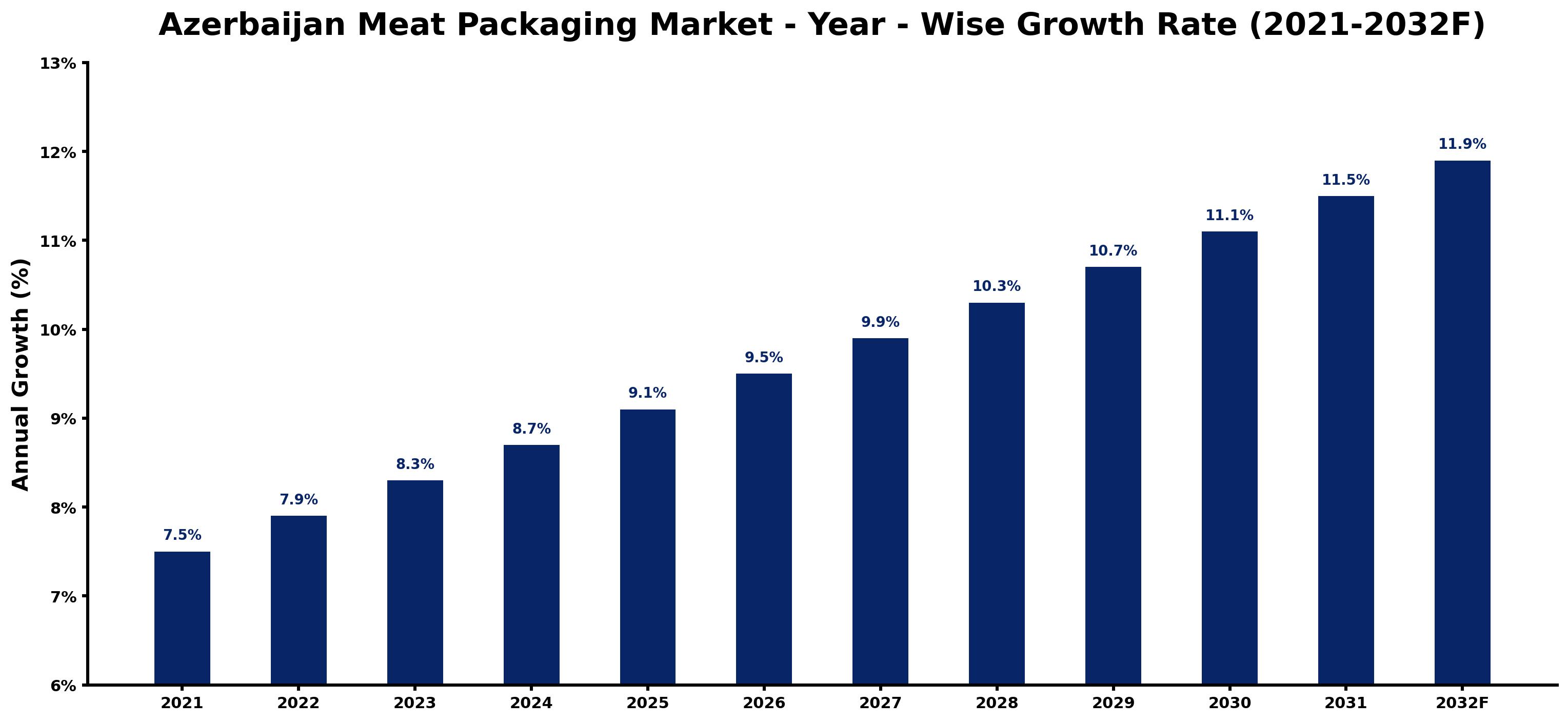
The table below presents the year wise growth rates along with the key drivers influencing the market
| Year | Growth Rate | Major Drivers |
| 2021 | 7.5% | Consumer preferences continue shifting towards locally sourced and organic meat products. |
| 2022 | 7.9% | E-commerce platforms enhance accessibility of packaged meat for urban consumers. |
| 2023 | 8.3% | Innovative packaging technologies help extend the shelf life of meat products significantly. |
| 2024 | 8.7% | Increased investments in cold chain logistics boost overall distribution efficiency. |
| 2025 | 9.1% | Health-conscious trends favor low-fat and high-protein meat packaging options. |
| 2026 | 9.5% | Azerbaijan's growing urban population demands convenient and ready-to-eat meat solutions. |
| 2027 | 9.9% | Collaboration with international suppliers enhances quality standards in packaging materials. |
| 2028 | 10.3% | Local meat producers adopt sustainable practices, appealing to environmentally aware consumers. |
| 2029 | 10.7% | Emerging food safety standards drive demand for advanced meat packaging innovations. |
| 2030 | 11.1% | Cross-border trade agreements facilitate the import of diverse meat packaging solutions. |
| 2031 | 11.5% | Technological integration in production streamlines operations, reducing costs for manufacturers. |
| 2032 | 11.9% | Consumer interest in gourmet and specialty meats creates niche packaging markets. |
Note - Market size estimations and growth projections presented in this report are based on 6Wresearch's advanced forecasting approach, validated with industry datasets as of June 2026.
Azerbaijan Meat Packaging Market Synopsis
The Azerbaijan Meat Packaging Market is projected to reach 9.5% and witness significant growth during the forecast period (2026-2032). This growth can be attributed to shifting consumer preferences towards packaged meat products, driven by an increasing awareness of food safety and hygiene. As consumers demand greater convenience and sustainability in food packaging, innovative solutions are becoming crucial for maintaining the quality and extending the shelf life of meat products.
Azerbaijan Meat Packaging Market Growth Drivers
Several factors are fueling expansion in the Azerbaijan Meat Packaging Market. First, the changing consumer lifestyle, particularly in urban areas, is prompting a shift to convenient and ready-to-eat meat products. Second, there is an increasing focus on food safety that necessitates advanced packaging technology. Third, rising disposable incomes enable consumers to opt for premium packaged meat options. Furthermore, government regulations emphasizing food safety standards stimulate investment in sophisticated packaging solutions. Lastly, global trends towards environmental sustainability are pushing the industry towards using eco-friendly packaging materials.
Azerbaijan Meat Packaging Market Trends and Opportunities
The Azerbaijan Meat Packaging Market is adapting to new consumer demands by embracing several key trends:
- There is a marked shift towards sustainable packaging solutions, as consumers increasingly prefer recyclable, biodegradable options that reduce food waste.
- Technological advancements are leading to innovations in packaging, such as vacuum and modified atmosphere packaging, which extend product freshness and enhance food safety.
- Ready-to-eat and portion-controlled meat products are gaining popularity, necessitating the development of new packaging formats that cater specifically to these market segments.
- Increased consumer awareness surrounding health and nutrition is driving demand for clear labeling and transparency in meat packaging.
- Collaboration between meat producers and packaging manufacturers is becoming essential to ensure quality and consistency in the supply chain.
Azerbaijan Meat Packaging Market Challenges and Restraints
Despite its growth potential, the Azerbaijan Meat Packaging Market faces several formidable challenges. Maintaining product freshness during distribution and storage is critical, especially given the diverse climate conditions across the region. Additionally, navigating complex supply chain dynamics while adhering to stringent food safety regulations can be cumbersome for companies. The market is also confronted with rising competition from imported packaged meat products, which often come with lower prices. Fluctuating raw material costs pose yet another challenge, impacting the overall profitability of packaging solutions. These factors compel companies to invest in innovative technologies and rigorous quality control measures to remain competitive.
Azerbaijan Meat Packaging Market Investment Opportunities
Investment opportunities abound in the Azerbaijan Meat Packaging Market as both local and international investors eye the emerging demand for packaged meat products. Opportunities include:
- Investing in advanced packaging technologies that can improve product shelf-life and quality, thus meeting evolving consumer expectations.
- The establishment of facilities dedicated to sustainable packaging solutions, reflecting a global trend towards eco-friendliness.
- Collaborating with local meat producers to create a robust supply chain capable of delivering high-quality packaged meat products.
- Exploring innovative packaging designs that enhance convenience, catering to the rising consumer preference for ready-to-eat options.
- Investing in market research to stay abreast of changing consumer preferences and adapt business strategies accordingly.
Azerbaijan Meat Packaging Market Government Investment and Initiatives
The Azerbaijani government has implemented crucial policies that directly influence the meat packaging market. The State Food Safety Agency plays a pivotal role in regulating food production, particularly in establishing quality standards for meat packaging. Efforts to promote food safety include stringent hygiene practices, accurate labeling, and traceability measures, which enhance consumer protection. Import restrictions on low-quality meat products aim to safeguard local producers and ensure a competitive marketplace. Moreover, public funding towards modernizing food processing infrastructure supports the growth of the meat packaging sector, improving efficiency and safety across the supply chain.
Azerbaijan Meat Packaging Market Latest Developments (May 2025 - June 2026)
Recent developments within the Azerbaijan Meat Packaging Market highlight a trajectory of growth and innovation. The industry is likely to see an increased emphasis on sustainable practices, with many stakeholders shifting towards eco-friendly materials as consumer demand for transparency and environmental responsibility grows. Technological advancements in packaging, such as smart packaging solutions that monitor freshness, are also gaining traction. Government support, including initiatives to enhance food safety standards and modernize processing technologies, further positions the market for robust growth. Overall, these developments reflect the market's responsiveness to both consumer needs and regulatory requirements.
Azerbaijan Meat Packaging Market Future Outlook
Looking ahead, the Azerbaijan Meat Packaging Market is set to continue its growth trajectory, bolstered by an evolving retail landscape and increasing consumer income levels. The demand for packaged and processed meat products is expected to rise, fueling an ongoing need for innovative packaging solutions that ensure food safety and extend product longevity. Government initiatives aimed at modernizing the food processing sector, coupled with heightened consumer awareness of sustainability, will play a pivotal role in shaping future market dynamics. As a result, companies that leverage advanced technologies and maintain a commitment to quality will be well-positioned to thrive in this expanding market.
Azerbaijan Meat Packaging Market - Key Attractiveness of the Report
- 10 Years of Market Numbers
- Historical Data Starting from 2022 to 2025
- Base Year: 2025
- Forecast Data until 2032
- Key Performance Indicators Impacting the Market
- Major Upcoming Developments and Projects
Key Highlights of the Report:
- Azerbaijan Meat Packaging Market Outlook
- Market Size of Azerbaijan Meat Packaging Market, 2025
- Forecast of Azerbaijan Meat Packaging Market, 2032F
- Historical Data and Forecast of Azerbaijan Meat Packaging Revenues & Volume for the Period 2022-2032F
- Azerbaijan Meat Packaging Market Trend Evolution
- Azerbaijan Meat Packaging Market Drivers and Challenges
- Azerbaijan Meat Packaging Price Trends
- Azerbaijan Meat Packaging Porter's Five Forces
- Azerbaijan Meat Packaging Industry Life Cycle
- Historical Data and Forecast of Azerbaijan Meat Packaging Market Revenues & Volume By Material Type for the Period 2022-2032F
- Historical Data and Forecast of Azerbaijan Meat Packaging Market Revenues & Volume By Plastic for the Period 2022-2032F
- Historical Data and Forecast of Azerbaijan Meat Packaging Market Revenues & Volume By Rigid? for the Period 2022-2032F
- Historical Data and Forecast of Azerbaijan Meat Packaging Market Revenues & Volume By Metal for the Period 2022-2032F
- Historical Data and Forecast of Azerbaijan Meat Packaging Market Revenues & Volume By Meat Type for the Period 2022-2032F
- Historical Data and Forecast of Azerbaijan Meat Packaging Market Revenues & Volume By Fresh and Frozen for the Period 2022-2032F
- Historical Data and Forecast of Azerbaijan Meat Packaging Market Revenues & Volume By Processed for the Period 2022-2032F
- Historical Data and Forecast of Azerbaijan Meat Packaging Market Revenues & Volume By Ready to Eat for the Period 2022-2032F
- Azerbaijan Meat Packaging Import Export Trade Statistics
- Market Opportunity Assessment By Material Type
- Market Opportunity Assessment By Meat Type
- Azerbaijan Meat Packaging Top Companies Market Share
- Azerbaijan Meat Packaging Competitive Benchmarking By Technical and Operational Parameters
- Azerbaijan Meat Packaging Company Profiles
- Azerbaijan Meat Packaging Key Strategic Recommendations






































