Azerbaijan Medical Tubing Market Size, Share & Growth Rate
The Azerbaijan Medical Tubing Market was estimated at USD 1017 Million in 2025 and is projected to reach USD 1871 Million by 2032, growing at a CAGR of 9.1% from 2026 to 2032. This growth trajectory is propelled by the escalating demand for advanced medical devices, a burgeoning elderly population in need of care, and substantial investments in healthcare infrastructure. As healthcare facilities evolve to incorporate modern technologies, the demand for specialized medical tubing is set to increase significantly.
Azerbaijan Medical Tubing Market Year-wise Growth Rate and Key Drivers
This graph highlights how the Azerbaijan Medical Tubing Market has steadily grown over the years, supported by major growth factors.
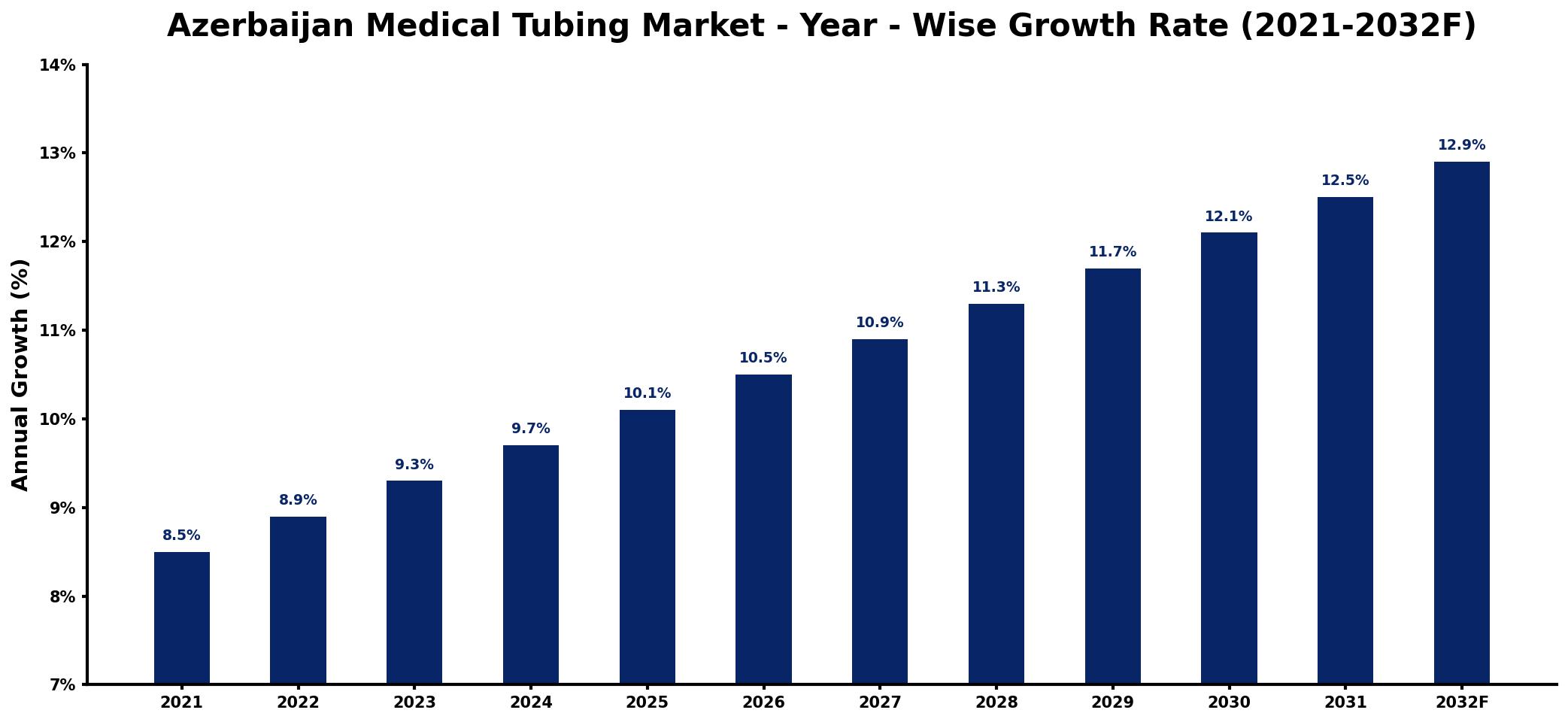
The table below presents the year‑wise growth rates along with the key drivers influencing the market
| Year | Growth Rate | Major Drivers |
| 2021 | 8.5% | rising healthcare infrastructure investments |
| 2022 | 8.9% | increased demand for healthcare services |
| 2023 | 9.3% | expansion of biotechnology research initiatives |
| 2024 | 9.7% | improved processing technologies adoption |
| 2025 | 10.1% | enhanced regulatory standards for safety |
| 2026 | 10.5% | surge in chronic disease prevalence |
| 2027 | 10.9% | growth in aging population demographics |
| 2028 | 11.3% | development of innovative healthcare technologies |
| 2029 | 11.7% | increased focus on preventive healthcare |
| 2030 | 12.1% | rising export shipment volumes |
| 2031 | 12.5% | rising consumer awareness of health |
| 2032 | 12.9% | enhanced supply chain efficiencies |
Note: Market size estimations and growth projections presented in this report are based on 6Wresearch's proprietary forecasting methodology, utilizing the latest available industry data, government publications, and primary research inputs.
Azerbaijan Medical Tubing Market Synopsis
The Azerbaijan Medical Tubing Market has recently gained momentum, driven by advancements in medical technology and a marked increase in healthcare facility development. Looking ahead, the market is positioned for sustained growth, as the demand for high-quality medical tubing continues to escalate amidst a rapidly evolving healthcare landscape.
The market features a diverse array of products including catheters, intravenous (IV) tubes, and respiratory tubes. Local manufacturing is on the rise, complementing the ongoing imports to satisfy market needs, while a clear focus on innovation and compliance with rigorous regulatory standards defines the competitive landscape.
Azerbaijan Medical Tubing Market Key Takeaways
- The market is witnessing a transition toward disposable medical tubing to enhance patient safety and infection control.
- Local manufacturers are expanding capabilities to meet the increasing demand for high-quality medical tubing products.
- Advanced materials with improved biocompatibility and flexibility are gaining traction in product development.
- Government policies are evolving to ensure product quality and compliance in the medical tubing sector.
- Investment opportunities are ripe as healthcare infrastructure continues to develop and the need for advanced medical devices grows.
Evaluation of Restraints in Azerbaijan Medical Tubing Market
Despite the robust growth, the Azerbaijan Medical Tubing Market faces several restraints that could inhibit its potential. Limited access to advanced manufacturing technology can compromise the quality of locally produced tubing, while a shortage of skilled labor hampers production efficiency. Moreover, regulatory complexities can create obstacles for compliance with international standards, affecting the overall competitiveness of the market. Additionally, reliance on imported raw materials, coupled with fluctuating exchange rates, poses challenges to cost management and price stability.
Azerbaijan Medical Tubing Market Trends
Current trends indicate a strong shift toward minimally invasive procedures, propelling the demand for innovative medical tubing solutions. With advancements in technology, manufacturers are exploring new materials that enhance product performance while addressing the need for disposability to mitigate infection risks. Furthermore, there is an increasing focus on creating specialized tubing that can withstand harsh conditions, elevating both patient safety and operational efficacy in healthcare settings.
Azerbaijan Medical Tubing Market Opportunities
Investment opportunities in the Azerbaijan Medical Tubing Market are plentiful, given the governments emphasis on improving healthcare infrastructure. The growing prevalence of chronic diseases and the rising geriatric population underscore the need for a wide range of medical tubing products, such as catheters and IV lines. Strategic partnerships with local healthcare providers can provide essential market access, creating pathways for new entrants aiming to capture this expanding market share. Overall, the demand for high-quality medical tubing solutions is set to rise significantly.
Government Initiatives in the Azerbaijan Medical Tubing Market
The Azerbaijani government has implemented various policies aimed at enhancing the quality and safety of medical tubing products. Regulatory frameworks governing manufacturing standards and import controls are in place, ensuring that only compliant products reach the market. These initiatives support not only the quality assurance processes but also aim to facilitate better healthcare outcomes for consumers by safeguarding against substandard medical tubing.
Future Insights of the Azerbaijan Medical Tubing Market
Looking toward 2026-2032, the Azerbaijan Medical Tubing Market is anticipated to witness robust expansion, driven by continuous advancements in medical technology and rising healthcare demands. The emphasis on minimally invasive surgical techniques and the necessity for superior quality materials will likely shape future product offerings. Moreover, ongoing collaborations among industry stakeholders to innovate and meet stringent regulatory standards are expected to play a crucial role in the market's evolution.
Azerbaijan Medical Tubing Market Latest Developments (2025 - 2026)
Recent developments in the Azerbaijan Medical Tubing Market indicate a trend towards heightened collaboration between local manufacturers and international suppliers. Efforts are underway to improve local production capabilities and address existing quality gaps. Furthermore, advancements in manufacturing technologies are being explored, focusing on enhancing efficiency and reducing costs. The sector is also witnessing increased attention toward sustainable practices in the production of medical tubing to align with global standards.
Azerbaijan Medical Tubing Market - Key Attractiveness of the Report
- 10 Years of Market Numbers
- Historical Data Starting from 2022 to 2025
- Base Year: 2025
- Forecast Data until 2032
- Key Performance Indicators Impacting the Market
- Major Upcoming Developments and Projects
Key Highlights of the Report:
- Azerbaijan Medical Tubing Market Outlook
- Market Size of Azerbaijan Medical Tubing Market, 2025
- Forecast of Azerbaijan Medical Tubing Market, 2032
- Historical Data and Forecast of Azerbaijan Medical Tubing Revenues & Volume for the Period 2022-2032F
- Azerbaijan Medical Tubing Market Trend Evolution
- Azerbaijan Medical Tubing Market Drivers and Challenges
- Azerbaijan Medical Tubing Price Trends
- Azerbaijan Medical Tubing Porter's Five Forces
- Azerbaijan Medical Tubing Industry Life Cycle
- Historical Data and Forecast of Azerbaijan Medical Tubing Market Revenues & Volume By Material for the Period 2022-2032F
- Historical Data and Forecast of Azerbaijan Medical Tubing Market Revenues & Volume By Plastics for the Period 2022-2032F
- Historical Data and Forecast of Azerbaijan Medical Tubing Market Revenues & Volume By Rubbers for the Period 2022-2032F
- Historical Data and Forecast of Azerbaijan Medical Tubing Market Revenues & Volume By Specialty Polymers for the Period 2022-2032F
- Historical Data and Forecast of Azerbaijan Medical Tubing Market Revenues & Volume By Structure for the Period 2022-2032F
- Historical Data and Forecast of Azerbaijan Medical Tubing Market Revenues & Volume By Single-lumen for the Period 2022-2032F
- Historical Data and Forecast of Azerbaijan Medical Tubing Market Revenues & Volume By Co-extruded for the Period 2022-2032F
- Historical Data and Forecast of Azerbaijan Medical Tubing Market Revenues & Volume By Multi-lumen for the Period 2022-2032F
- Historical Data and Forecast of Azerbaijan Medical Tubing Market Revenues & Volume By Tapered Or Bump Tubing for the Period 2022-2032F
- Historical Data and Forecast of Azerbaijan Medical Tubing Market Revenues & Volume By Braided Tubing for the Period 2022-2032F
- Historical Data and Forecast of Azerbaijan Medical Tubing Market Revenues & Volume By Application for the Period 2022-2032F
- Historical Data and Forecast of Azerbaijan Medical Tubing Market Revenues & Volume By Bulk Disposable Tubing for the Period 2022-2032F
- Historical Data and Forecast of Azerbaijan Medical Tubing Market Revenues & Volume By Catheters & Cannulas for the Period 2022-2032F
- Historical Data and Forecast of Azerbaijan Medical Tubing Market Revenues & Volume By Drug Delivery System for the Period 2022-2032F
- Historical Data and Forecast of Azerbaijan Medical Tubing Market Revenues & Volume By Special Applications for the Period 2022-2032F
- Azerbaijan Medical Tubing Import Export Trade Statistics
- Market Opportunity Assessment By Material
- Market Opportunity Assessment By Structure
- Market Opportunity Assessment By Application
- Azerbaijan Medical Tubing Top Companies Market Share
- Azerbaijan Medical Tubing Competitive Benchmarking By Technical and Operational Parameters
- Azerbaijan Medical Tubing Company Profiles
- Azerbaijan Medical Tubing Key Strategic Recommendations






































