Azerbaijan Microlearning Market Size & Growth Rate (2026-2032)
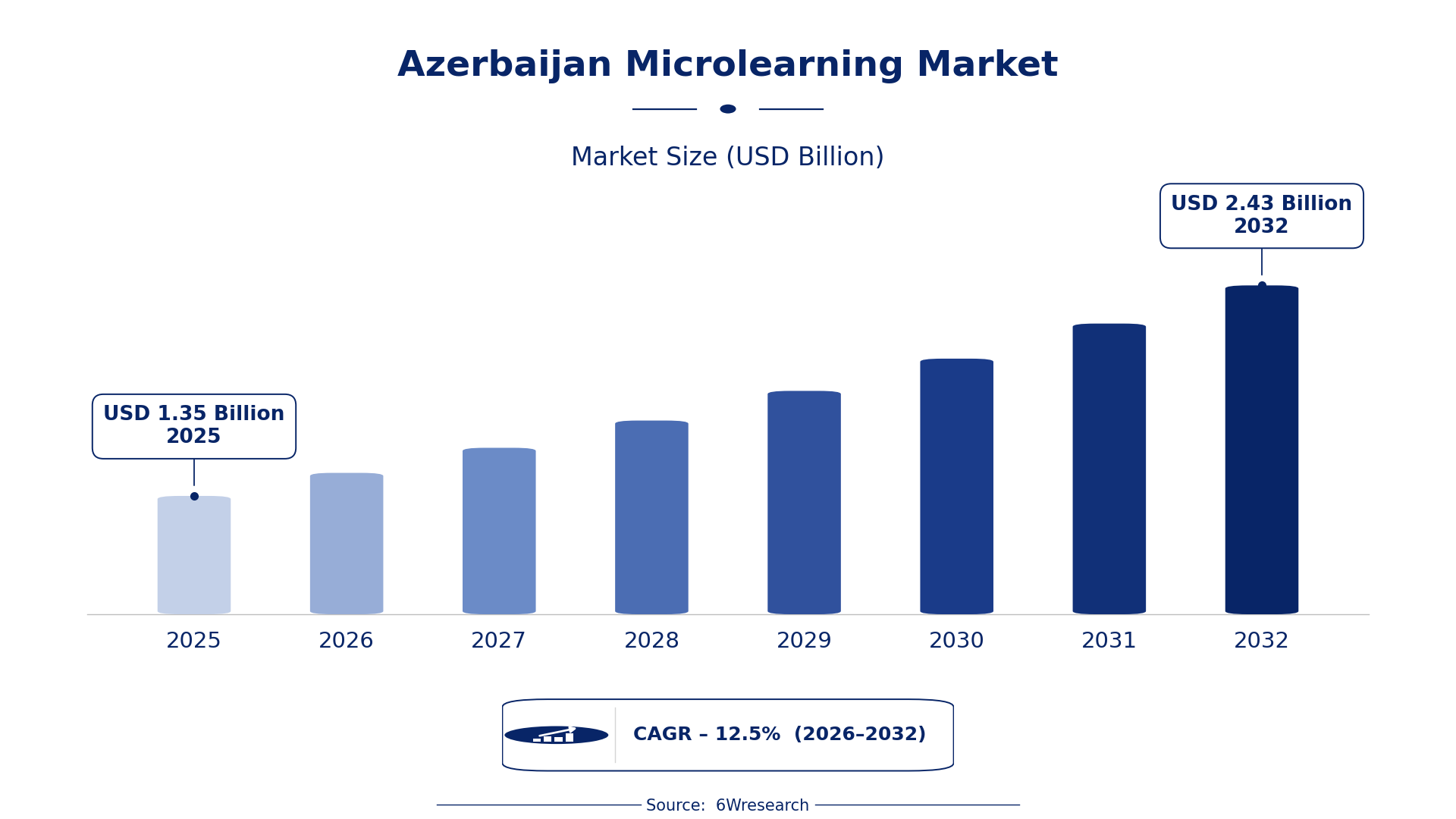
The Azerbaijan Microlearning Market was estimated at USD 1349 Million in 2025 and is projected to reach USD 2429 Million by 2032, growing at a CAGR of 12.5% from 2026 to 2032.
Azerbaijan Microlearning Market Synopsis
A surge in demand for efficient training solutions is driving the microlearning market in Azerbaijan. Organizations across various sectors are recognizing the value of short, focused learning modules that can be seamlessly integrated into their workforce development strategies.
As the workforce adapts to a hybrid model of remote and in-person work, the need for accessible learning resources has never been more critical. Microlearning is becoming the preferred choice for companies looking to enhance employee skills and knowledge retention without overwhelming them with information.
Azerbaijan Microlearning Market Year-wise Growth Rate and Key Drivers
This graph illustrates the annual growth rates of the Azerbaijan Microlearning Market from 2021 to 2032, highlighting a steady upward trajectory and projected expansion over the forecast period.
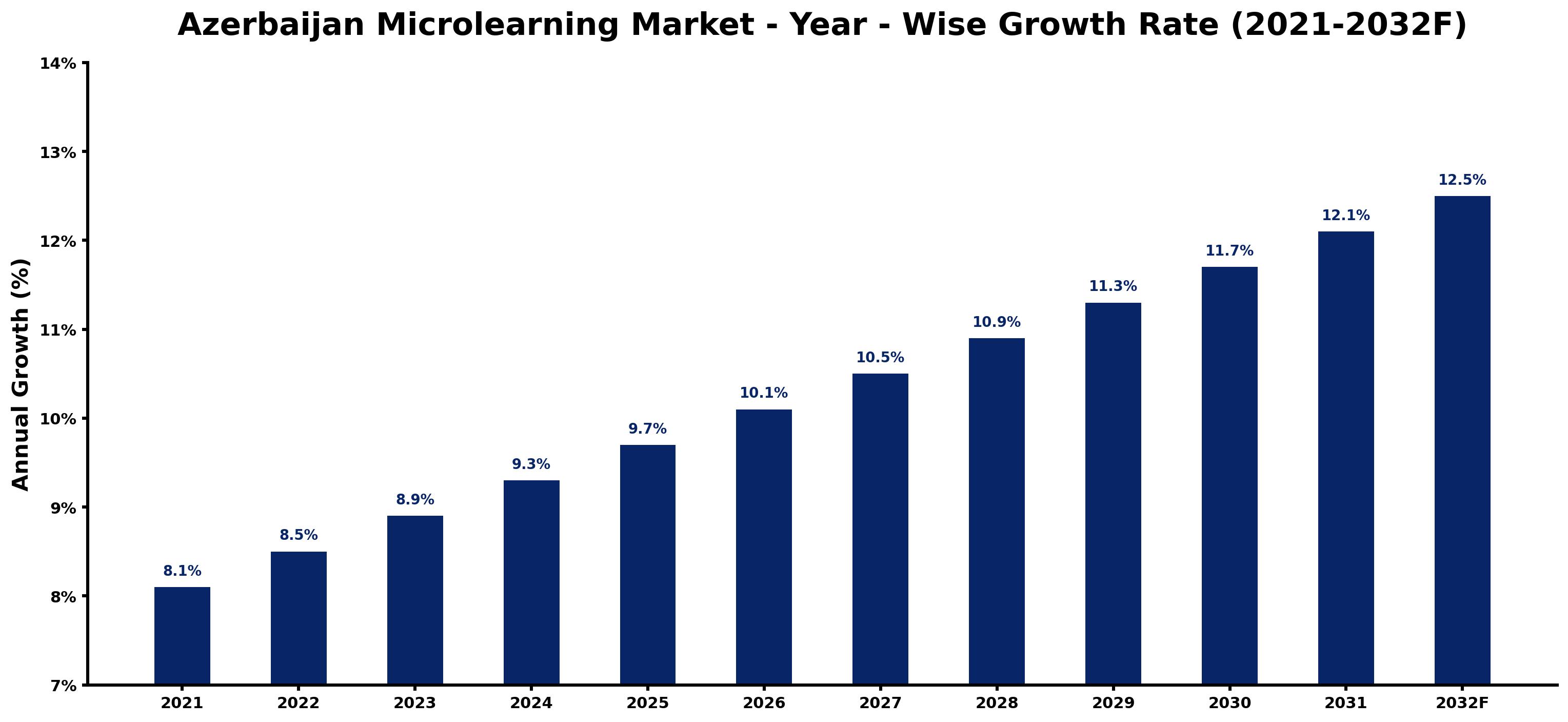
The table below presents the year‑wise growth rates along with the key drivers influencing the market
| Year | Growth Rate | Major Drivers |
| 2021 | 8.1% | Government's emphasis on digital skills development initiatives. |
| 2022 | 8.5% | Increased adoption of mobile learning applications in education. |
| 2023 | 8.9% | Growing youth population driving demand for flexible learning. |
| 2024 | 9.3% | Azerbaijan's education sector focusing on competency-based training. |
| 2025 | 9.7% | Partnerships between local universities and tech companies expanding offerings. |
| 2026 | 10.1% | Investment in online platforms by the Ministry of Education. |
| 2027 | 10.5% | Rising popularity of gamification in workplace training programs. |
| 2028 | 10.9% | Integration of Azerbaijani language content in online courses. |
| 2029 | 11.3% | Corporate training programs increasingly utilizing microlearning solutions. |
| 2030 | 11.7% | Enhanced internet connectivity facilitating remote learning opportunities. |
| 2031 | 12.1% | Government incentives for startups in the edtech sector. |
| 2032 | 12.5% | Popularity of social media platforms as learning tools. |
Note: Market size estimations and growth projections presented in this report are based on 6Wresearch's proprietary forecasting methodology, utilizing the latest available industry data, government publications, and primary research inputs.
Azerbaijan Microlearning Market Key Takeaways
Below are some of the specific key takeaways from the market, including:
- The microlearning approach is gaining traction across corporate, academic, and professional settings in Azerbaijan.
- Digital literacy and internet accessibility are pivotal for the successful implementation of microlearning initiatives.
- Customized learning experiences are increasingly demanded by both employers and educational institutions.
- Government support is instrumental in fostering the growth of microlearning through infrastructure investments.
- Challenges remain in the form of traditional educational frameworks that resist adopting new methodologies.
Evaluation of Restraints in Azerbaijan Microlearning Market
Several factors are constraining the growth of the microlearning market in Azerbaijan. A notable issue is the digital divide, which limits access to necessary technology for many individuals. A significant part of the population lacks reliable internet connectivity, which hinders engagement with microlearning platforms. Additionally, entrenched educational practices present resistance to the adoption of microlearning strategies. Institutions often cling to traditional teaching methodologies, which complicates the integration of innovative learning solutions. The quality of available microlearning content also poses a challenge, as users must navigate a saturated market to find credible and effective resources.
Azerbaijan Microlearning Market Trends
Emerging trends indicate a growing preference for personalized learning experiences that cater to the unique needs of learners. Organizations are increasingly adopting microlearning as a solution to address skill gaps quickly. The integration of mobile technology into educational strategies is gaining momentum, enabling learners to access content on the go. Additionally, companies are looking at data analytics to track learning progress and tailor content effectively. As organizations recognize the importance of continuous learning, microlearning is set to play a crucial role in workforce development.
Azerbaijan Microlearning Market Opportunities
There are substantial opportunities for growth within the Azerbaijan microlearning market. Educational institutions are beginning to explore partnerships with technology providers to enhance learning delivery. Companies are encouraged to invest in digital content development tailored to specific industries, which can lead to more engaging learning experiences. on top of that, with government initiatives aimed at improving digital literacy, there's potential for increased market penetration in remote areas. The emphasis on upskilling and reskilling employees will continue to drive demand for microlearning solutions across various sectors.
Government Initiatives in the Azerbaijan Microlearning Market
The Azerbaijani government is actively working to modernize its education sector, focusing on integrating microlearning methodologies. This commitment is crucial for enhancing learning outcomes and ensuring that educational content is accessible to all students. Government policies prioritize the use of technology in education, supporting initiatives that aim to bridge the digital divide.
- A recently completed national digital literacy program aimed at training educators to implement microlearning strategies effectively.
- An ongoing initiative to upgrade internet infrastructure in rural areas to facilitate better access to online learning resources.
- A planned public-private partnership expected to launch in 2026 to develop tailored microlearning content for vocational training.
- Current efforts to provide funding to educational institutions for the development of digital content and platforms.
- Introduction of regulatory frameworks designed to encourage the adoption of innovative teaching methodologies in schools and universities.
Future Insights of the Azerbaijan Microlearning Market
Looking ahead to 2026-2032, the Azerbaijan microlearning market is set for substantial growth, driven by increasing recognition of its benefits. As organizations seek to stay competitive, the demand for flexible learning solutions will rise. The educational sector will likely see a shift towards adopting microlearning as a mainstream strategy, supported by government initiatives aimed at enhancing digital access. The focus on personalized and targeted training will shape content development, leading to a more engaged and skilled workforce.
Azerbaijan Microlearning Market Latest Developments
In the past year, the Azerbaijan microlearning market has witnessed notable developments that signal a move toward greater adoption of digital learning solutions. Educational institutions and businesses are increasingly recognizing the potential of microlearning to enhance training efficacy.
- A major technology vendor launched a suite of microlearning modules tailored for corporate training in early 2025, receiving positive feedback from users.
- An ongoing collaboration between educational institutions and tech companies aims to create a comprehensive microlearning platform to facilitate remote learning, started in Q2 2025.
- A new initiative announced in late 2025 is set to provide grants for the development of microlearning content aimed at specific industries.
- A project to integrate artificial intelligence in microlearning systems is currently underway, focused on personalizing learning paths based on user data.
- Plans for a national conference in early 2026 will showcase innovative microlearning practices and provide a platform for stakeholders to exchange ideas.
Azerbaijan Microlearning Market - Key Attractiveness of the Report
- 10 Years of Market Numbers
- Historical Data Starting from 2022 to 2025
- Base Year: 2025
- Forecast Data until 2032
- Key Performance Indicators Impacting the Market
- Major Upcoming Developments and Projects
Key Highlights of the Report:
- Azerbaijan Microlearning Market Outlook
- Market Size of Azerbaijan Microlearning Market, 2025
- Forecast of Azerbaijan Microlearning Market, 2032
- Historical Data and Forecast of Azerbaijan Microlearning Revenues & Volume for the Period 2022-2032F
- Azerbaijan Microlearning Market Trend Evolution
- Azerbaijan Microlearning Market Drivers and Challenges
- Azerbaijan Microlearning Price Trends
- Azerbaijan Microlearning Porter's Five Forces
- Azerbaijan Microlearning Industry Life Cycle
- Historical Data and Forecast of Azerbaijan Microlearning Market Revenues & Volume By Component for the Period 2022-2032F
- Historical Data and Forecast of Azerbaijan Microlearning Market Revenues & Volume By Solution for the Period 2022-2032F
- Historical Data and Forecast of Azerbaijan Microlearning Market Revenues & Volume By Services for the Period 2022-2032F
- Historical Data and Forecast of Azerbaijan Microlearning Market Revenues & Volume By Industry for the Period 2022-2032F
- Historical Data and Forecast of Azerbaijan Microlearning Market Revenues & Volume By Retail for the Period 2022-2032F
- Historical Data and Forecast of Azerbaijan Microlearning Market Revenues & Volume By Manufacturing for the Period 2022-2032F
- Historical Data and Forecast of Azerbaijan Microlearning Market Revenues & Volume By Logistics for the Period 2022-2032F
- Historical Data and Forecast of Azerbaijan Microlearning Market Revenues & Volume By BFSI for the Period 2022-2032F
- Historical Data and Forecast of Azerbaijan Microlearning Market Revenues & Volume By Telecom for the Period 2022-2032F
- Historical Data and Forecast of Azerbaijan Microlearning Market Revenues & Volume By IT for the Period 2022-2032F
- Historical Data and Forecast of Azerbaijan Microlearning Market Revenues & Volume By Healthcare for the Period 2022-2032F
- Historical Data and Forecast of Azerbaijan Microlearning Market Revenues & Volume By Life Sciences for the Period 2022-2032F
- Historical Data and Forecast of Azerbaijan Microlearning Market Revenues & Volume By Deployment Type for the Period 2022-2032F
- Historical Data and Forecast of Azerbaijan Microlearning Market Revenues & Volume By On-Premises for the Period 2022-2032F
- Historical Data and Forecast of Azerbaijan Microlearning Market Revenues & Volume By Cloud for the Period 2022-2032F
- Historical Data and Forecast of Azerbaijan Microlearning Market Revenues & Volume By Organization Size for the Period 2022-2032F
- Historical Data and Forecast of Azerbaijan Microlearning Market Revenues & Volume By SMEs for the Period 2022-2032F
- Historical Data and Forecast of Azerbaijan Microlearning Market Revenues & Volume By Large Enterprises for the Period 2022-2032F
- Azerbaijan Microlearning Import Export Trade Statistics
- Market Opportunity Assessment By Component
- Market Opportunity Assessment By Industry
- Market Opportunity Assessment By Deployment Type
- Market Opportunity Assessment By Organization Size
- Azerbaijan Microlearning Top Companies Market Share
- Azerbaijan Microlearning Competitive Benchmarking By Technical and Operational Parameters
- Azerbaijan Microlearning Company Profiles
- Azerbaijan Microlearning Key Strategic Recommendations






































