Azerbaijan Microprocessor Market Size, Share & Growth Rate
The Azerbaijan Microprocessor Market was estimated at USD 1095 Million in 2025 and is projected to reach USD 1866 Million by 2032, growing at a CAGR of 7.9% from 2026 to 2032. This growth is primarily fueled by the rising demand for high-performance computing solutions across multiple sectors, including telecommunications and consumer electronics. With an increasing reliance on smart technologies and IoT applications, the market is poised for robust expansion in the coming years.
Azerbaijan Microprocessor Market Year-wise Growth Rate and Key Drivers
This graph highlights how the Azerbaijan Microprocessor Market has steadily grown over the years, supported by major growth factors.
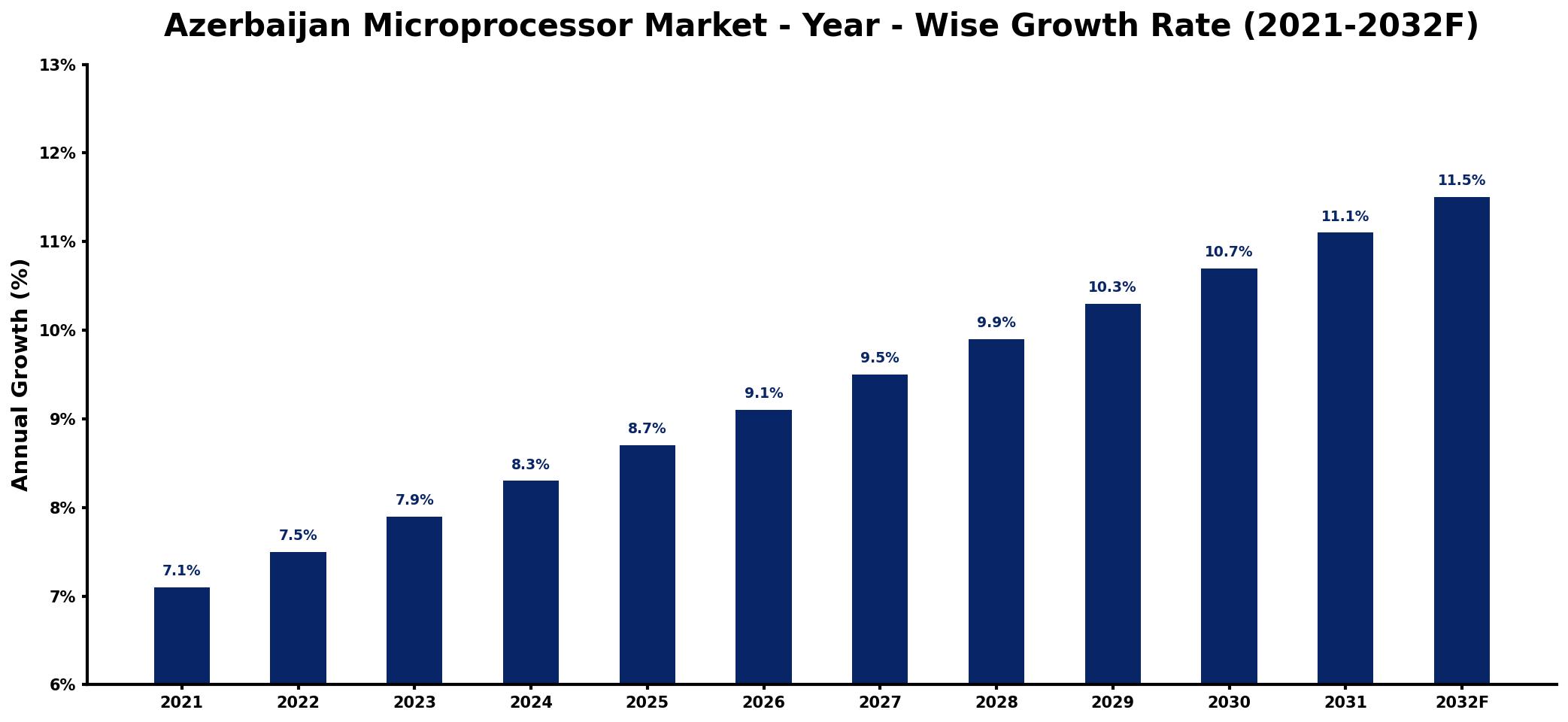
The table below presents the year‑wise growth rates along with the key drivers influencing the market
| Year | Growth Rate | Major Drivers |
| 2021 | 7.1% | increased demand for consumer electronics |
| 2022 | 7.5% | growth in telecommunications infrastructure investment |
| 2023 | 7.9% | expansion of automotive technology applications |
| 2024 | 8.3% | increased pharmaceutical industry usage |
| 2025 | 8.7% | surge in cloud computing services |
| 2026 | 9.1% | advancements in artificial intelligence integration |
| 2027 | 9.5% | growing interest in IoT solutions |
| 2028 | 9.9% | increased funding for tech startups |
| 2029 | 10.3% | higher demand for wearable technology |
| 2030 | 10.7% | expanding industrial usage applications |
| 2031 | 11.1% | growing e-commerce platform requirements |
| 2032 | 11.5% | rise in data center investments |
Note: Market size estimations and growth projections presented in this report are based on 6Wresearch's proprietary forecasting methodology, utilizing the latest available industry data, government publications, and primary research inputs.
Azerbaijan Microprocessor Market Synopsis
The strongest force currently shaping the Azerbaijan microprocessor market is the accelerating demand for energy-efficient and high-performance processors. This demand is driven largely by the evolving landscape of technology adoption, particularly in smart devices and IoT applications that require advanced processing capabilities.
As the government emphasizes digital infrastructure development, industries such as telecommunications, automotive, and consumer electronics are increasingly relying on cutting-edge microprocessor technology. The intersection of innovation and investment within these sectors positions Azerbaijan as a growing market for microprocessor applications.
Azerbaijan Microprocessor Market Key Takeaways
- The microprocessor market is expected to see a substantial increase in demand due to the rise in smart devices and IoT technology.
- A focus on energy efficiency and performance is transforming the design and production of microprocessors.
- Government initiatives are enhancing technological advancements and local innovation in the microprocessor sector.
- The market faces challenges such as reliance on imports and currency fluctuations impacting pricing.
- Investment opportunities are emerging in custom solutions and semiconductor manufacturing infrastructure development.
Evaluation of Restraints in Azerbaijan Microprocessor Market
Despite the promising outlook, the Azerbaijan microprocessor market faces significant restraints that can impede growth. A major concern is the limited domestic production capacity, necessitating a heavy reliance on imports to meet local demand. This dependency creates vulnerabilities, particularly in the context of fluctuating currency exchange rates that can adversely affect pricing and profitability. Furthermore, the market's reliance on foreign suppliers for advanced chip designs limits the development of local expertise and innovation. Addressing these constraints will require strategic partnerships and substantial investments in domestic capabilities.
Azerbaijan Microprocessor Market Trends
A notable trend within the Azerbaijan microprocessor market is the shift toward more energy-efficient and powerful processors that support the increasing sophistication of smart devices and IoT applications. As artificial intelligence and machine learning capabilities become essential for enhancing computing performance, key market players are investing heavily in research and development to innovate products that cater specifically to local needs. Additionally, the growing adoption of cloud computing and data center services is stimulating demand for high-performance microprocessors across various sectors.
Azerbaijan Microprocessor Market Opportunities
The Azerbaijan microprocessor market presents several lucrative investment opportunities stemming from its burgeoning technology sector. Collaborative efforts with local tech firms to create tailored microprocessor solutions can significantly enhance market presence. Furthermore, investing in R&D initiatives promises to drive innovation, while supplying high-performance microprocessors to government agencies and businesses positions investors favorably within the expanding landscape. Developing the local semiconductor manufacturing infrastructure offers another avenue for capitalizing on the market's growth potential.
Government Initiatives in the Azerbaijan Microprocessor Market
The Azerbaijani government is actively promoting the microprocessor market through various supportive policies. Initiatives include incentives for local production and financial backing for research and development efforts. By fostering collaboration between industry players and academic institutions, the government aims to cultivate a culture of innovation. Additionally, measures to attract foreign investment and create a conducive environment for business operations are being prioritized, demonstrating a clear commitment to advancing the microprocessor landscape.
Future Insights of the Azerbaijan Microprocessor Market
Looking ahead to the period from 2026 to 2032, the Azerbaijan microprocessor market is expected to maintain a steady growth trajectory. Factors such as escalating demand for advanced computing technologies across diverse industries—including telecommunications, automotive, and healthcare—will drive this expansion. The rising prevalence of IoT devices and a heightened focus on digitalization will necessitate the development of powerful, energy-efficient microprocessors. Furthermore, anticipated partnerships between local firms and international semiconductor companies will foster technological advancements, strengthening the competitive landscape.
Azerbaijan Microprocessor Market Latest Developments (2025 - 2026)
In recent months, the Azerbaijan microprocessor market has been witnessing a number of positive developments. There has been a notable increase in collaboration between technology companies and educational institutions aimed at nurturing local talent and fostering innovation. Moreover, recent policy initiatives have encouraged investments in R&D, enhancing the overall technological capabilities within the country. These developments signify a commitment to advancing the microprocessor sector and aligning with global technological trends.
Azerbaijan Microprocessor Market - Key Attractiveness of the Report
- 10 Years of Market Numbers
- Historical Data Starting from 2022 to 2025
- Base Year: 2025
- Forecast Data until 2032
- Key Performance Indicators Impacting the Market
- Major Upcoming Developments and Projects
Key Highlights of the Report:
- Azerbaijan Microprocessor Market Outlook
- Market Size of Azerbaijan Microprocessor Market, 2025
- Forecast of Azerbaijan Microprocessor Market, 2032
- Historical Data and Forecast of Azerbaijan Microprocessor Revenues & Volume for the Period 2022-2032F
- Azerbaijan Microprocessor Market Trend Evolution
- Azerbaijan Microprocessor Market Drivers and Challenges
- Azerbaijan Microprocessor Price Trends
- Azerbaijan Microprocessor Porter's Five Forces
- Azerbaijan Microprocessor Industry Life Cycle
- Historical Data and Forecast of Azerbaijan Microprocessor Market Revenues & Volume By Technology for the Period 2022-2032F
- Historical Data and Forecast of Azerbaijan Microprocessor Market Revenues & Volume By CISC for the Period 2022-2032F
- Historical Data and Forecast of Azerbaijan Microprocessor Market Revenues & Volume By RISC for the Period 2022-2032F
- Historical Data and Forecast of Azerbaijan Microprocessor Market Revenues & Volume By ASIC for the Period 2022-2032F
- Historical Data and Forecast of Azerbaijan Microprocessor Market Revenues & Volume By Superscalar for the Period 2022-2032F
- Historical Data and Forecast of Azerbaijan Microprocessor Market Revenues & Volume By DSP for the Period 2022-2032F
- Historical Data and Forecast of Azerbaijan Microprocessor Market Revenues & Volume By Application for the Period 2022-2032F
- Historical Data and Forecast of Azerbaijan Microprocessor Market Revenues & Volume By Smartphones for the Period 2022-2032F
- Historical Data and Forecast of Azerbaijan Microprocessor Market Revenues & Volume By Personal Computers for the Period 2022-2032F
- Historical Data and Forecast of Azerbaijan Microprocessor Market Revenues & Volume By Servers for the Period 2022-2032F
- Historical Data and Forecast of Azerbaijan Microprocessor Market Revenues & Volume By Tablets for the Period 2022-2032F
- Historical Data and Forecast of Azerbaijan Microprocessor Market Revenues & Volume By Embedded Devices for the Period 2022-2032F
- Historical Data and Forecast of Azerbaijan Microprocessor Market Revenues & Volume By Others for the Period 2022-2032F
- Azerbaijan Microprocessor Import Export Trade Statistics
- Market Opportunity Assessment By Technology
- Market Opportunity Assessment By Application
- Azerbaijan Microprocessor Top Companies Market Share
- Azerbaijan Microprocessor Competitive Benchmarking By Technical and Operational Parameters
- Azerbaijan Microprocessor Company Profiles
- Azerbaijan Microprocessor Key Strategic Recommendations






































