Azerbaijan Military Laser Rangefinder Market Size, Share & Growth Rate
The Azerbaijan Military Laser Rangefinder Market was estimated at USD 969 Million in 2025 and is projected to reach USD 1792 Million by 2032, growing at a CAGR of 9.2% from 2026 to 2032. This growth trajectory is primarily fueled by the increasing demand for enhanced precision in military operations, particularly in target acquisition and artillery fire control. The government's commitment to modernizing its defense capabilities further underpins the market's expansion, as advanced laser rangefinding systems become integral to national security strategies.
Azerbaijan Military Laser Rangefinder Market Year-wise Growth Rate and Key Drivers
This graph highlights how the Azerbaijan Military Laser Rangefinder Market has steadily grown over the years, supported by major growth factors.
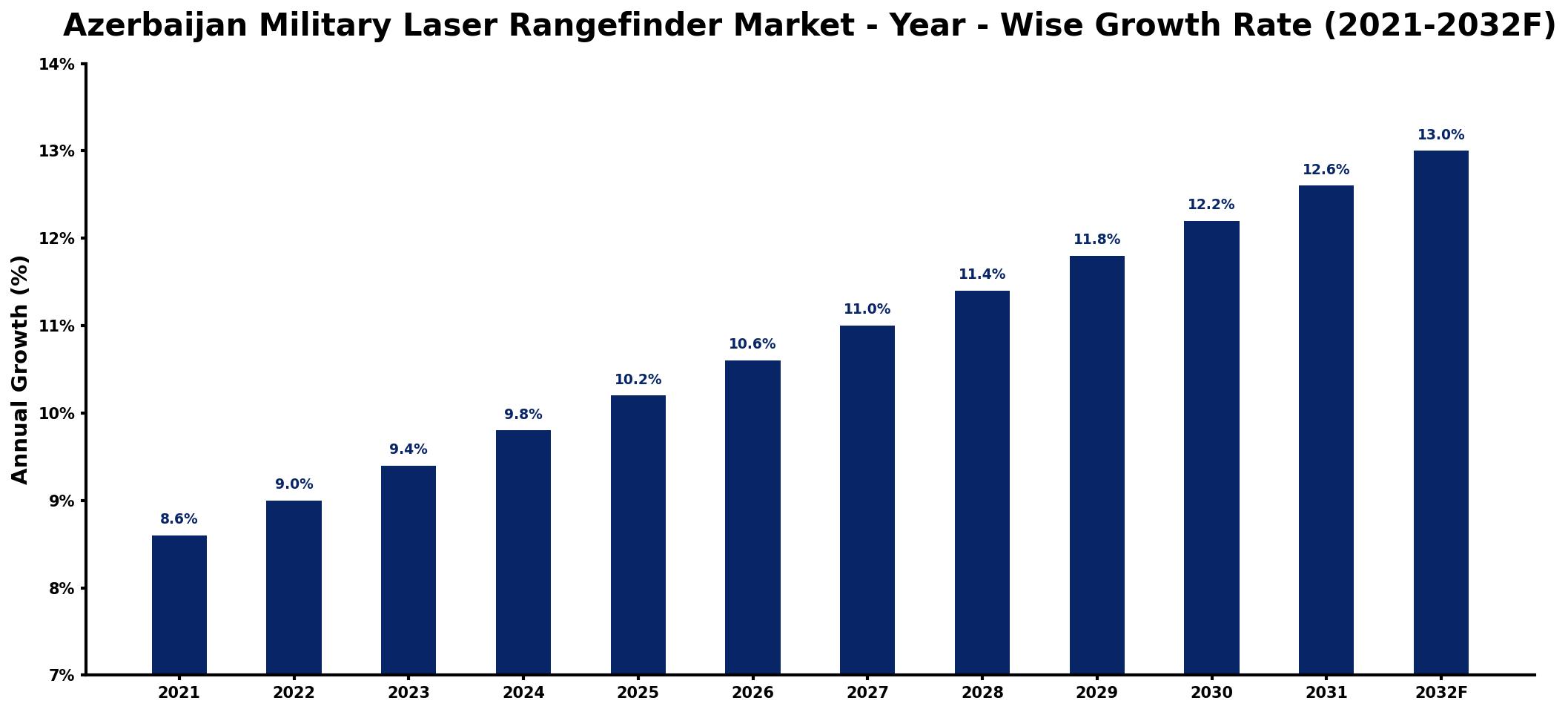
The table below presents the year‑wise growth rates along with the key drivers influencing the market
| Year | Growth Rate | Major Drivers |
| 2021 | 8.6% | expanding manufacturing base activity |
| 2022 | 9.0% | growing demand for precision targeting |
| 2023 | 9.4% | expansion of defense modernization programs |
| 2024 | 9.8% | rising interest in advanced technologies |
| 2025 | 10.2% | increased production capacity utilization |
| 2026 | 10.6% | growing partnerships with defense contractors |
| 2027 | 11.0% | enhanced focus on border security |
| 2028 | 11.4% | development of new tactical strategies |
| 2029 | 11.8% | increased international defense collaborations |
| 2030 | 12.2% | rising investments in defense infrastructure |
| 2031 | 12.6% | growing emphasis on situational awareness |
| 2032 | 13.0% | growing emerging market penetration |
Note: Market size estimations and growth projections presented in this report are based on 6Wresearch's proprietary forecasting methodology, utilizing the latest available industry data, government publications, and primary research inputs.
Azerbaijan Military Laser Rangefinder Market Synopsis
The critical force currently shaping the Azerbaijan Military Laser Rangefinder Market is the urgent need for accurate target acquisition in modern combat scenarios. As military engagements evolve, the ability to accurately assess distances and enhance situational awareness has never been more crucial. This demand is being echoed in various defense applications, driving investments into advanced laser rangefinder technologies.
In addition to defense applications such as artillery and missile guidance, the rangefinder systems are also being incorporated into reconnaissance missions. These sophisticated devices are not only improving the tactical efficiency of the Azerbaijani military but also fostering a shift toward more integrated and versatile military capabilities.
Azerbaijan Military Laser Rangefinder Market Key Takeaways
- The market is driven by the demand for precise range measurement capabilities in various defense applications.
- Government initiatives are facilitating the development and deployment of advanced laser rangefinder systems.
- Investments in R&D and collaboration with international partners are crucial for technological advancement.
- Challenges include interoperability with existing systems and budget constraints affecting procurement.
- The emphasis on education and training enhances the skill set of personnel in the military sector.
Evaluation of Restraints in Azerbaijan Military Laser Rangefinder Market
Despite the optimistic outlook, the Azerbaijan Military Laser Rangefinder Market encounters real constraints that could impede its growth. A primary concern is the limited availability of cutting-edge laser rangefinder technologies customized for the specific operational needs of the Azerbaijani military. This scarcity hinders the optimization of military capabilities, particularly when confronting complex battlefield dynamics. Additionally, ensuring that these systems can seamlessly integrate with existing weaponry poses a significant technical challenge, necessitating extensive validation and testing. Lastly, fiscal limitations and competing military priorities can restrict budget allocations for new technology acquisitions, which are essential for maintaining a competitive edge.
Azerbaijan Military Laser Rangefinder Market Trends
Current trends indicate a growing inclination toward multi-platform compatibility among military laser rangefinders. This shift is driven by the need for integrated systems that can function across various military platforms, including ground vehicles, naval vessels, and aerial assets. Furthermore, advancements in sensor technology are leading to improvements in accuracy and measurement ranges, addressing critical operational needs. The incorporation of artificial intelligence and data analytics is also emerging, enhancing real-time decision-making capabilities during missions.
Azerbaijan Military Laser Rangefinder Market Opportunities
There exist significant growth opportunities within the Azerbaijan Military Laser Rangefinder Market, particularly in enhancing partnerships with global defense contractors. Engaging in technology transfer agreements and collaborative research initiatives can accelerate the development of advanced systems tailored to local military requirements. Additionally, the expansion of local manufacturing capabilities offers a path to reduce dependence on international suppliers, promoting self-sufficiency and potentially lowering costs. Investments in training programs aimed at improving the proficiency of military personnel in utilizing these sophisticated systems will also create a more capable defense framework.
Government Initiatives in the Azerbaijan Military Laser Rangefinder Market
The Azerbaijani government is actively fostering the growth of its military laser rangefinder market through a suite of supportive policies. These include various investment incentives aimed at both domestic and foreign defense contractors, alongside research grants that stimulate innovation in laser technology. Regulatory frameworks are being developed to uphold high standards of accuracy and reliability for military applications. Moreover, the government's commitment to education and training programs ensures that the workforce is equipped with the skills necessary to effectively operate and maintain advanced military rangefinder systems.
Future Insights of the Azerbaijan Military Laser Rangefinder Market
Looking forward to the period of 2026-2032, the Azerbaijan Military Laser Rangefinder Market is poised for substantial advancements driven by both technological innovation and strategic policy initiatives. The increasing complexity of military operations will necessitate greater reliance on precise targeting and situational awareness systems. As the government prioritizes the modernization of defense capabilities, ongoing investments in laser rangefinder technologies are expected. This evolution will not only enhance operational effectiveness but also position Azerbaijan as a more formidable player in regional security dynamics.
Azerbaijan Military Laser Rangefinder Market Latest Developments (2025 - 2026)
Recent developments in the Azerbaijan Military Laser Rangefinder Market have been characterized by a heightened focus on technological advancements and increased collaborations between domestic entities and international defense firms. Efforts to integrate state-of-the-art laser rangefinding systems into existing military platforms have gained momentum. Additionally, initiatives aimed at bolstering the local defense industry through government-backed programs have become more prominent, reflecting a strategic approach to enhancing national security capabilities.
Azerbaijan Military Laser Rangefinder Market - Key Attractiveness of the Report
- 10 Years of Market Numbers
- Historical Data Starting from 2022 to 2025
- Base Year: 2025
- Forecast Data until 2032
- Key Performance Indicators Impacting the Market
- Major Upcoming Developments and Projects
Key Highlights of the Report:
- Azerbaijan Military Laser Rangefinder Market Outlook
- Market Size of Azerbaijan Military Laser Rangefinder Market, 2025
- Forecast of Azerbaijan Military Laser Rangefinder Market, 2032
- Historical Data and Forecast of Azerbaijan Military Laser Rangefinder Revenues & Volume for the Period 2022-2032F
- Azerbaijan Military Laser Rangefinder Market Trend Evolution
- Azerbaijan Military Laser Rangefinder Market Drivers and Challenges
- Azerbaijan Military Laser Rangefinder Price Trends
- Azerbaijan Military Laser Rangefinder Porter's Five Forces
- Azerbaijan Military Laser Rangefinder Industry Life Cycle
- Historical Data and Forecast of Azerbaijan Military Laser Rangefinder Market Revenues & Volume By Type for the Period 2022-2032F
- Historical Data and Forecast of Azerbaijan Military Laser Rangefinder Market Revenues & Volume By Man-Portable for the Period 2022-2032F
- Historical Data and Forecast of Azerbaijan Military Laser Rangefinder Market Revenues & Volume By Vehicle-Mounted for the Period 2022-2032F
- Historical Data and Forecast of Azerbaijan Military Laser Rangefinder Market Revenues & Volume By Application for the Period 2022-2032F
- Historical Data and Forecast of Azerbaijan Military Laser Rangefinder Market Revenues & Volume By Weapon Guidance for the Period 2022-2032F
- Historical Data and Forecast of Azerbaijan Military Laser Rangefinder Market Revenues & Volume By Detection for the Period 2022-2032F
- Azerbaijan Military Laser Rangefinder Import Export Trade Statistics
- Market Opportunity Assessment By Type
- Market Opportunity Assessment By Application
- Azerbaijan Military Laser Rangefinder Top Companies Market Share
- Azerbaijan Military Laser Rangefinder Competitive Benchmarking By Technical and Operational Parameters
- Azerbaijan Military Laser Rangefinder Company Profiles
- Azerbaijan Military Laser Rangefinder Key Strategic Recommendations






































