Azerbaijan Molecular Spectroscopy Market Size, Share & Growth Rate
The Azerbaijan Molecular Spectroscopy Market was estimated at USD 1071 Million in 2025 and is projected to reach USD 1856 Million by 2032, growing at a CAGR of 8.2% from 2026 to 2032. This growth trajectory is fueled by a surge in research and development investments, particularly within the pharmaceutical and biotechnology sectors. A pivotal demand for advanced spectroscopy instruments, including UV-Visible, Infrared, and Nuclear Magnetic Resonance (NMR) spectrometers, is driving innovation and application diversity across various industries.
Azerbaijan Molecular Spectroscopy Market Year-wise Growth Rate and Key Drivers
This graph highlights how the Azerbaijan Molecular Spectroscopy Market has steadily grown over the years, supported by major growth factors.
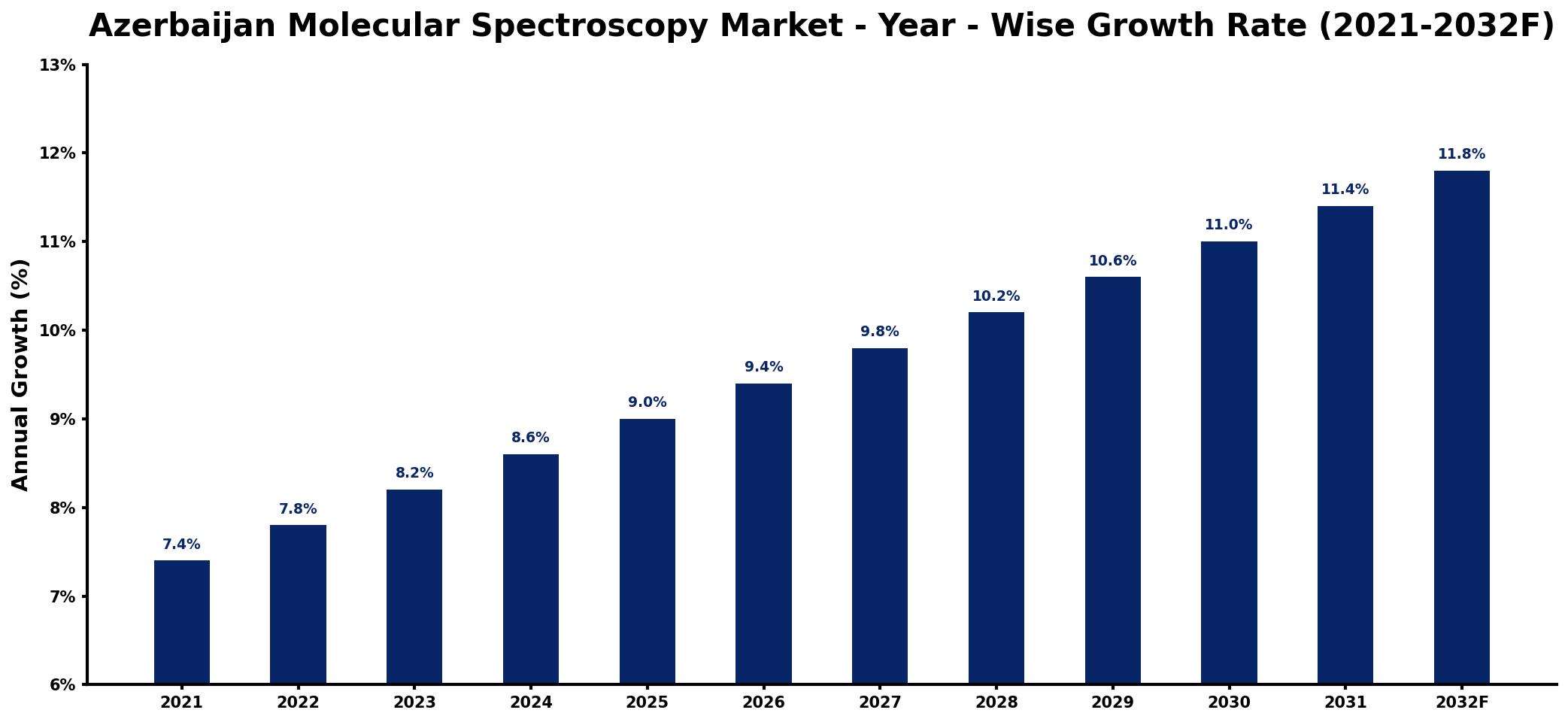
The table below presents the year‑wise growth rates along with the key drivers influencing the market
| Year | Growth Rate | Major Drivers |
| 2021 | 7.4% | Rising demand in healthcare applications |
| 2022 | 7.8% | Increased investment in research facilities |
| 2023 | 8.2% | Growth in environmental monitoring projects |
| 2024 | 8.6% | Expansion of educational programs available |
| 2025 | 9.0% | Emerging technologies enhancing data analysis |
| 2026 | 9.4% | Collaborations between industries and academia |
| 2027 | 9.8% | Surge in pharmaceutical development activities |
| 2028 | 10.2% | growing regional consumption patterns |
| 2029 | 10.6% | Advancements in diagnostic imaging techniques |
| 2030 | 11.0% | Increased funding for scientific research |
| 2031 | 11.4% | Boost in public health initiatives |
| 2032 | 11.8% | growing automotive sector requirements |
Note: Market size estimations and growth projections presented in this report are based on 6Wresearch's proprietary forecasting methodology, utilizing the latest available industry data, government publications, and primary research inputs.
Azerbaijan Molecular Spectroscopy Market Synopsis
In Azerbaijan, the molecular spectroscopy market is increasingly characterized by a rising demand for portable and handheld devices, which allow for convenient on-site measurements. This trend is essential in applications ranging from environmental monitoring to quality control in pharmaceuticals. Furthermore, investments in infrastructure development signify a commitment to enhancing the technological capabilities of this sector.
As a result of government initiatives, the market is witnessing growth in collaborations between academic institutions and the private sector, aimed at fostering innovation. The focus on advanced analytical techniques has made molecular spectroscopy a critical tool in drug development and environmental analysis, thereby driving market expansion in Azerbaijan.
Azerbaijan Molecular Spectroscopy Market Key Takeaways
- The demand for portable spectroscopy devices is on the rise, driven by their ease of use in field applications.
- Key applications in pharmaceuticals and biotechnology are propelling market growth, alongside environmental monitoring needs.
- Investments in R&D and infrastructure are essential for advancing the capabilities of the molecular spectroscopy sector.
- Technological innovation is a priority for manufacturers looking to meet the evolving demands of end-users.
- Government policies are supportive, facilitating partnerships that enhance research and technological advancements.
Evaluation of Restraints in Azerbaijan Molecular Spectroscopy Market
Despite the promising growth, several restraints hinder the full potential of the Azerbaijan Molecular Spectroscopy Market. One notable challenge is the high cost associated with advanced spectroscopy equipment, which can deter investment from smaller businesses or research institutions. Additionally, there exists a knowledge gap regarding the benefits of molecular spectroscopy techniques among potential end-users. This limited awareness can slow down market penetration. Further compounding these issues is the scarcity of skilled professionals trained in the use of such sophisticated instruments. Addressing these obstacles will be crucial for sustainable growth in the sector.
Azerbaijan Molecular Spectroscopy Market Trends
Current trends in the Azerbaijan Molecular Spectroscopy Market highlight a noticeable shift towards the adoption of advanced spectroscopic techniques, including Raman and infrared spectroscopy. Industries such as food and beverage are increasingly integrating these technologies for quality assurance and compliance purposes. Moreover, there is a heightened emphasis on implementing these techniques within research and development frameworks, enhancing both product quality and efficiency. The movement towards integrating automation and data analytics in spectroscopic applications reflects a broader trend towards innovation and enhanced operational effectiveness.
Azerbaijan Molecular Spectroscopy Market Opportunities
The market landscape is ripe with investment opportunities, particularly in segments like infrared spectroscopy, UV-Visible spectroscopy, and Nuclear Magnetic Resonance (NMR) technology. As research activities continue to expand across the pharmaceutical and environmental monitoring sectors, the demand for cutting-edge spectroscopy tools will only intensify. Investors can explore avenues in providing not only the instrumentation but also related services such as maintenance, calibration, and specialized training programs aimed at building expertise within the workforce. Collaborating with local research institutions and government bodies could further enhance market penetration and foster innovation.
Government Initiatives in the Azerbaijan Molecular Spectroscopy Market
The Azerbaijani government plays a pivotal role in nurturing the molecular spectroscopy market through various supportive policies. These include financial incentives aimed at companies investing in research and development, as well as tax benefits for engaging in innovative practices. Collaborative initiatives with academic institutions are encouraged to boost innovation, facilitating knowledge transfer and fostering an ecosystem conducive to technological advancement. Furthermore, existing regulations ensure the safety and quality of spectroscopy products while promoting fair competition within the market.
Future Insights of the Azerbaijan Molecular Spectroscopy Market
Looking ahead, the Azerbaijan Molecular Spectroscopy Market is poised for continuous growth, driven by escalating investments in research and development activities. The expanding pharmaceutical and biotechnology industries are expected to further stimulate demand for sophisticated analytical techniques. With technological advancements, especially in infrared and Raman spectroscopy, the market is set to enhance its capabilities significantly. Additionally, the rising prevalence of chronic diseases will likely accelerate the adoption of molecular spectroscopy in healthcare applications, ensuring a dynamic future for the sector.
Azerbaijan Molecular Spectroscopy Market Latest Developments (2025 - 2026)
Recent developments within the Azerbaijan Molecular Spectroscopy Market indicate a strong trajectory towards innovation and collaboration. Enhanced focus on portable devices has emerged, facilitating on-site measurements that cater to diverse industries. Furthermore, industry stakeholders have been engaged in active discussions with government entities to streamline regulations, thereby fostering a more conducive environment for growth. Partnerships aimed at integrating advanced analytical techniques into existing frameworks are also on the rise, reflecting a commitment to improving product quality and operational efficiency across sectors.
Azerbaijan Molecular Spectroscopy Market - Key Attractiveness of the Report
- 10 Years of Market Numbers
- Historical Data Starting from 2022 to 2025
- Base Year: 2025
- Forecast Data until 2032
- Key Performance Indicators Impacting the Market
- Major Upcoming Developments and Projects
Key Highlights of the Report:
- Azerbaijan Molecular Spectroscopy Market Outlook
- Market Size of Azerbaijan Molecular Spectroscopy Market, 2025
- Forecast of Azerbaijan Molecular Spectroscopy Market, 2032
- Historical Data and Forecast of Azerbaijan Molecular Spectroscopy Revenues & Volume for the Period 2022-2032F
- Azerbaijan Molecular Spectroscopy Market Trend Evolution
- Azerbaijan Molecular Spectroscopy Market Drivers and Challenges
- Azerbaijan Molecular Spectroscopy Price Trends
- Azerbaijan Molecular Spectroscopy Porter's Five Forces
- Azerbaijan Molecular Spectroscopy Industry Life Cycle
- Historical Data and Forecast of Azerbaijan Molecular Spectroscopy Market Revenues & Volume By Type of Spectroscopy for the Period 2022-2032F
- Historical Data and Forecast of Azerbaijan Molecular Spectroscopy Market Revenues & Volume By NMR Spectroscopy for the Period 2022-2032F
- Historical Data and Forecast of Azerbaijan Molecular Spectroscopy Market Revenues & Volume By Raman Spectroscopy for the Period 2022-2032F
- Historical Data and Forecast of Azerbaijan Molecular Spectroscopy Market Revenues & Volume By UV-visible Spectroscopy for the Period 2022-2032F
- Historical Data and Forecast of Azerbaijan Molecular Spectroscopy Market Revenues & Volume By Mass Spectroscopy for the Period 2022-2032F
- Historical Data and Forecast of Azerbaijan Molecular Spectroscopy Market Revenues & Volume By Infrared Spectroscopy for the Period 2022-2032F
- Historical Data and Forecast of Azerbaijan Molecular Spectroscopy Market Revenues & Volume By Near-infrared Spectroscopy for the Period 2022-2032F
- Historical Data and Forecast of Azerbaijan Molecular Spectroscopy Market Revenues & Volume By Others for the Period 2022-2032F
- Historical Data and Forecast of Azerbaijan Molecular Spectroscopy Market Revenues & Volume By Application for the Period 2022-2032F
- Historical Data and Forecast of Azerbaijan Molecular Spectroscopy Market Revenues & Volume By Pharmaceutical Applications for the Period 2022-2032F
- Historical Data and Forecast of Azerbaijan Molecular Spectroscopy Market Revenues & Volume By Food and Beverage Testing for the Period 2022-2032F
- Historical Data and Forecast of Azerbaijan Molecular Spectroscopy Market Revenues & Volume By Biotechnology and Biopharmaceutical Applications for the Period 2022-2032F
- Historical Data and Forecast of Azerbaijan Molecular Spectroscopy Market Revenues & Volume By Environmental Testing for the Period 2022-2032F
- Historical Data and Forecast of Azerbaijan Molecular Spectroscopy Market Revenues & Volume By Academic Research for the Period 2022-2032F
- Historical Data and Forecast of Azerbaijan Molecular Spectroscopy Market Revenues & Volume By Other for the Period 2022-2032F
- Azerbaijan Molecular Spectroscopy Import Export Trade Statistics
- Market Opportunity Assessment By Type of Spectroscopy
- Market Opportunity Assessment By Application
- Azerbaijan Molecular Spectroscopy Top Companies Market Share
- Azerbaijan Molecular Spectroscopy Competitive Benchmarking By Technical and Operational Parameters
- Azerbaijan Molecular Spectroscopy Company Profiles
- Azerbaijan Molecular Spectroscopy Key Strategic Recommendations






































