Azerbaijan Mortar Market Summary
The azerbaijan mortar market was estimated at USD 823 Million in 2025 and is projected to reach USD 1539 Million by 2032, growing at a CAGR of 10.8% from 2026 to 2032.
Azerbaijan Mortar Market Year-wise Growth Rate and Key Drivers
This graph highlights how the Azerbaijan Mortar Market has steadily grown over the past five years, supported by major growth factors.
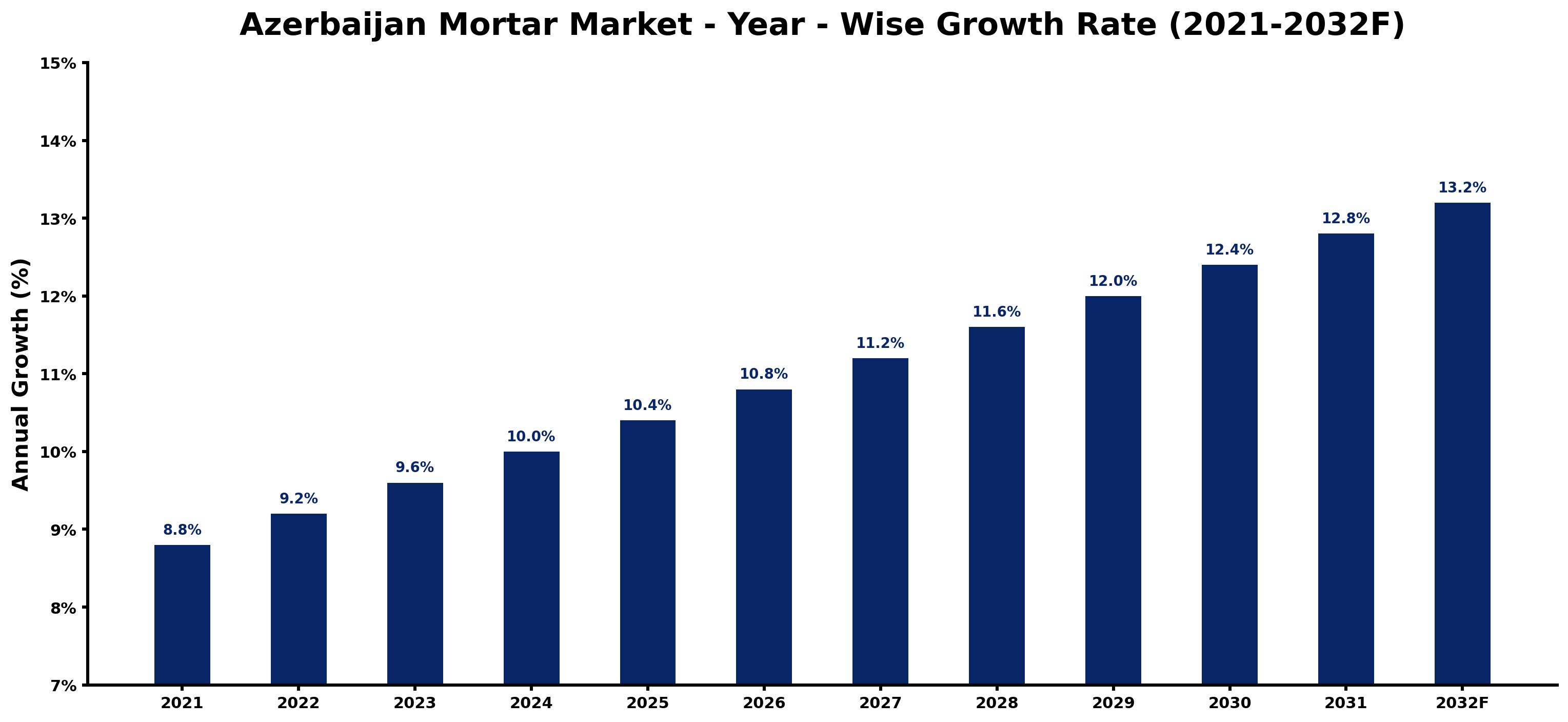
The table below presents the year wise growth rates along with the key drivers influencing the market
| Year | Growth Rate | Major Drivers |
| 2021 | 8.8% | Azerbaijan's infrastructure projects initiated by the state fostered mortar demand. |
| 2022 | 9.2% | Construction growth surged due to international investment in oil and gas sectors. |
| 2023 | 9.6% | A resurgence in urban development projects enhanced the need for quality mortar solutions. |
| 2024 | 10.0% | Local manufacturers began optimizing production techniques, improving cost efficiency significantly. |
| 2025 | 10.4% | Emerging trends in eco-friendly construction materials attracted market interest. |
| 2026 | 10.8% | International construction firms entering the market increased competition and innovation. |
| 2027 | 11.2% | Government focus shifted towards sustainable cities, elevating mortar specifications and standards. |
| 2028 | 11.6% | Technological advancements in production methods streamlined operations for local manufacturers. |
| 2029 | 12.0% | Post-pandemic recovery saw a significant uptick in residential construction projects. |
| 2030 | 12.4% | Growing regional trade partnerships enhanced supply chain efficiency in mortar distribution. |
| 2031 | 12.8% | Elevated foreign direct investment in construction led to a flourishing construction ecosystem. |
| 2032 | 13.2% | Public-private partnerships emerged, driving extensive infrastructure development across Azerbaijan. |
Note - Market size estimations and growth projections presented in this report are based on 6Wresearch's advanced forecasting approach, validated with industry datasets as of June 2026.
Azerbaijan Mortar Market Synopsis
The Azerbaijan Mortar Market is projected to reach 10.8% and witness significant growth during the forecast period (2026-2032). This growth is largely fueled by a surge in construction activities across the nation, driven by urbanization and government initiatives aimed at enhancing infrastructure development. Mortar serves as a vital component in construction, used for laying bricks, stones, and tiles, thereby supporting a broad spectrum of residential, commercial, and public projects.
Azerbaijan Mortar Market Growth Drivers
Several factors contribute to the growth trajectory of the Azerbaijan Mortar Market, underscoring its critical role in the construction sector.
- Increasing urbanization is a primary driver, with more individuals migrating to urban areas, amplifying the demand for housing and associated infrastructure.
- Government initiatives aimed at improving national infrastructure, including roads, bridges, and public transport systems, are significantly influencing market dynamics.
- The growing economy and rising disposable incomes are enabling greater investments in both residential and commercial real estate, further propelling demand for mortar products.
- Local and international manufacturers are focusing on product innovation, thereby enhancing mortar quality and expanding product offerings to meet diverse consumer needs.
- Sustainable building practices are gaining traction, with an increasing emphasis on eco-friendly products that could further elevate demand for specialized mortar types.
Azerbaijan Mortar Market Trends and Opportunities
The Azerbaijan Mortar Market is witnessing notable trends that present various opportunities for manufacturers and suppliers.
- There is an observable shift towards ready-mix mortars, which are preferred by construction companies for their convenience, consistency, and reduced labor requirements on-site.
- Specialty mortars such as colored and polymer-modified options are increasingly in demand as they offer improved aesthetic appeal and performance for specific construction applications.
- The focus on sustainable practices is steering the market towards the development of low-emission and eco-friendly mortar products, creating a niche for environmentally conscious consumers.
- Investment in innovative technologies for mortar production can differentiate products in a competitive landscape, attracting clients seeking enhanced performance.
- Collaborative ventures with local contractors offer entry points for foreign manufacturers, enabling them to penetrate the market effectively.
Azerbaijan Mortar Market Challenges and Restraints
Despite its growth potential, the Azerbaijan Mortar Market faces several challenges that could impede progress.
- Intense competition among both local and international manufacturers can compress profit margins and challenge pricing strategies.
- Fluctuating raw material prices can affect production costs, creating uncertainty in supply chain management and profitability.
- There exists limited awareness regarding the advantages of utilizing specific mortar products, necessitating improved marketing strategies to educate contractors and consumers alike.
- Political and economic instability in the region can delay or disrupt infrastructure projects, further complicating market outcomes.
- Ensuring compliance with quality standards and regulations is paramount, as non-compliance could result in legal challenges and damage to brand reputation.
Azerbaijan Mortar Market Investment Opportunities
The ongoing expansion of the construction sector in Azerbaijan provides fertile ground for investment opportunities within the mortar market.
- There is significant demand for diverse mortar types, including cement and lime mortars, allowing investors to explore various manufacturing options.
- Investing in the development of eco-friendly mortar products aligns with global sustainability trends, offering a competitive edge in the marketplace.
- Utilizing innovative mortar technologies can attract clients seeking enhancements in product durability and performance, marking a key differentiator.
- Strategic partnerships with local construction firms can enhance market access and facilitate growth within the competitive landscape.
- Public initiatives for infrastructure modernization present opportunities for producing high-quality, compliant mortar products for government projects.
Azerbaijan Mortar Market Government Investment and Initiatives
The Azerbaijan government has taken proactive measures to regulate and promote the mortar market, focusing on quality assurance and fair competition.
- Licensing requirements for manufacturers and distributors have been established to ensure standards are maintained across the sector.
- Quality standards that mortar products must comply with protect consumers and elevate industry expectations.
- Safety regulations are in place to safeguard users, fostering a sense of confidence among builders and contractors.
- Strategies to prevent price manipulation are being enforced to promote fair pricing practices, benefiting both consumers and businesses.
- Government incentives encourage the adoption of innovative and sustainable practices within the mortar industry, promoting long-term viability.
Azerbaijan Mortar Market Latest Developments (May 2025 - June 2026)
In the period from May 2025 to June 2026, the Azerbaijan Mortar Market has seen several key developments that shape its future direction.
- There has been an increasing focus on the adoption of eco-friendly mortars, reflecting a broader industry trend towards sustainability in construction.
- Manufacturers are investing in advanced production technologies to enhance efficiency and product quality, responding to competitive pressures.
- Public spending on infrastructure projects has risen, directly increasing the demand for reliable mortar products across various sectors.
- Collaborative efforts between industry stakeholders have been emphasized, aiming to enhance educational initiatives regarding mortar applications and benefits.
- The government continues to play an active role in regulating the market and ensuring compliance with safety and quality standards.
Azerbaijan Mortar Market - Key Attractiveness of the Report
- 10 Years of Market Numbers
- Historical Data Starting from 2022 to 2025
- Base Year: 2025
- Forecast Data until 2032
- Key Performance Indicators Impacting the Market
- Major Upcoming Developments and Projects
Key Highlights of the Report:
- Azerbaijan Mortar Market Outlook
- Market Size of Azerbaijan Mortar Market, 2025
- Forecast of Azerbaijan Mortar Market, 2032F
- Historical Data and Forecast of Azerbaijan Mortar Revenues & Volume for the Period 2022-2032F
- Azerbaijan Mortar Market Trend Evolution
- Azerbaijan Mortar Market Drivers and Challenges
- Azerbaijan Mortar Price Trends
- Azerbaijan Mortar Porter's Five Forces
- Azerbaijan Mortar Industry Life Cycle
- Historical Data and Forecast of Azerbaijan Mortar Market Revenues & Volume By Type for the Period 2022-2032F
- Historical Data and Forecast of Azerbaijan Mortar Market Revenues & Volume By Wet Mixed Mortar for the Period 2022-2032F
- Historical Data and Forecast of Azerbaijan Mortar Market Revenues & Volume By Dry Mortar for the Period 2022-2032F
- Historical Data and Forecast of Azerbaijan Mortar Market Revenues & Volume By Application for the Period 2022-2032F
- Historical Data and Forecast of Azerbaijan Mortar Market Revenues & Volume By Construction Industry for the Period 2022-2032F
- Historical Data and Forecast of Azerbaijan Mortar Market Revenues & Volume By Home Decoration Industry for the Period 2022-2032F
- Historical Data and Forecast of Azerbaijan Mortar Market Revenues & Volume By Others for the Period 2022-2032F
- Azerbaijan Mortar Import Export Trade Statistics
- Market Opportunity Assessment By Type
- Market Opportunity Assessment By Application
- Azerbaijan Mortar Top Companies Market Share
- Azerbaijan Mortar Competitive Benchmarking By Technical and Operational Parameters
- Azerbaijan Mortar Company Profiles
- Azerbaijan Mortar Key Strategic Recommendations






































