Azerbaijan Multichannel Order Management Market Size & Growth Rate (2026-2032)
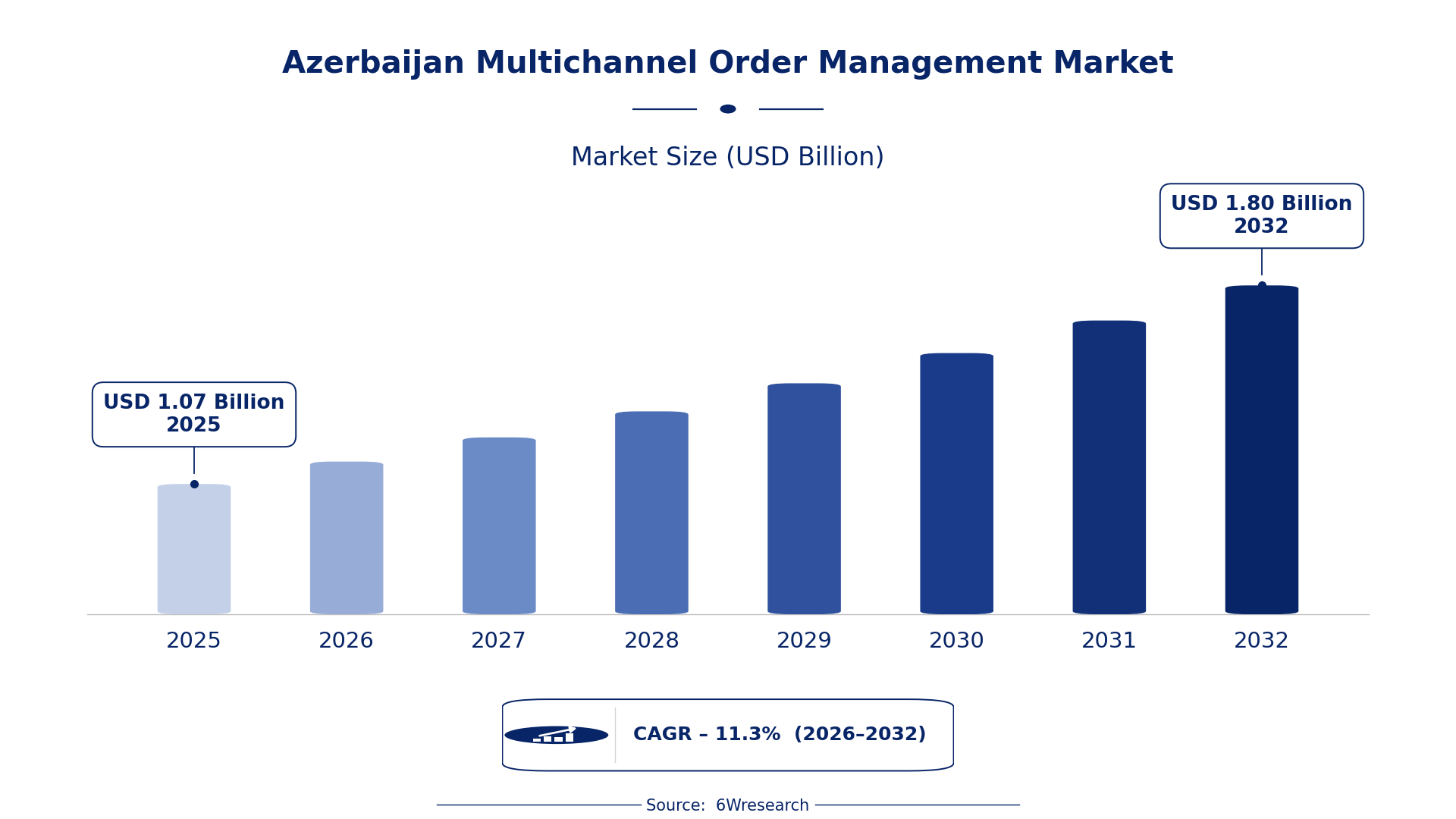
The Azerbaijan Multichannel Order Management Market was estimated at USD 1070 Million in 2025 and is projected to reach USD 1804 Million by 2032, growing at a CAGR of 11.3% from 2026 to 2032.
Azerbaijan Multichannel Order Management Market Synopsis
The Azerbaijan Multichannel Order Management Market is currently experiencing a surge in demand as businesses increasingly recognize the value of streamlined order processing across various sales platforms. With e-commerce rapidly gaining traction, the necessity for effective inventory management and customer fulfillment is more critical than ever.
Looking ahead, the market is set to evolve significantly, driven by advancements in technology and increasing consumer expectations for seamless shopping experiences. As retailers adapt to these demands, the adoption of integrated order management systems is likely to accelerate, positioning the market for robust growth.
Azerbaijan Multichannel Order Management Market Year-wise Growth Rate and Key Drivers
This graph illustrates the annual growth rates of the Azerbaijan Multichannel Order Management Market from 2021 to 2032, highlighting a steady upward trajectory and projected expansion over the forecast period.
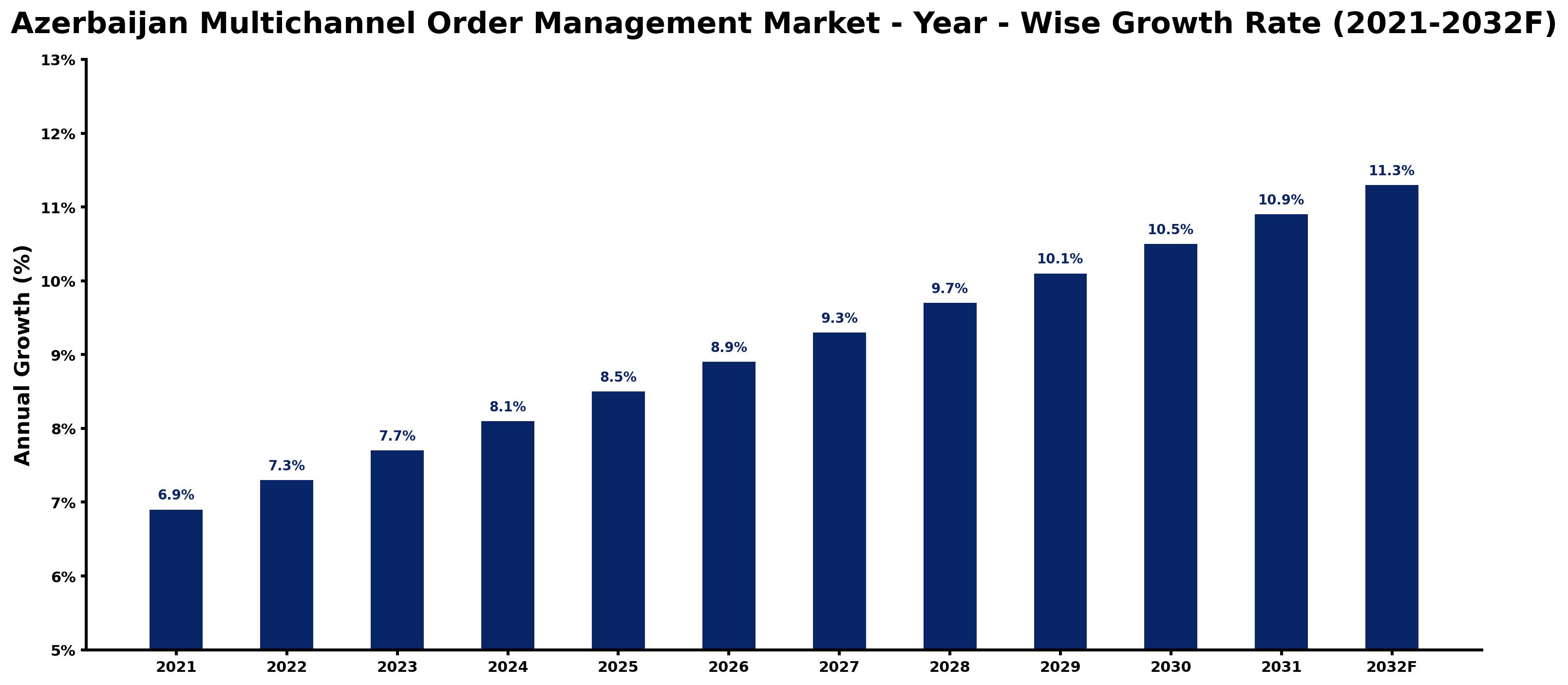
The table below presents the year‑wise growth rates along with the key drivers influencing the market
| Year | Growth Rate | Major Drivers |
| 2021 | 6.9% | Increased consumer shift to online shopping channels. |
| 2022 | 7.3% | Government incentives for digital retail transformation initiatives. |
| 2023 | 7.7% | Rise in mobile payment adoption among consumers. |
| 2024 | 8.1% | Emergence of new e-commerce regulations enhancing market access. |
| 2025 | 8.5% | Growing urban population driving multichannel retail integration. |
| 2026 | 8.9% | Investment in logistics infrastructure supporting order fulfillment. |
| 2027 | 9.3% | Partnerships between retailers and tech firms boosting efficiency. |
| 2028 | 9.7% | Consumer preference for personalized shopping experiences increasing. |
| 2029 | 10.1% | Integration of AI tools to optimize inventory management. |
| 2030 | 10.5% | Increase in local SMEs expanding into multichannel operations. |
| 2031 | 10.9% | Enhanced cybersecurity measures encouraging online transaction confidence. |
| 2032 | 11.3% | Supportive government policies promoting e-commerce innovations. |
Note: Market size estimations and growth projections presented in this report are based on 6Wresearch's proprietary forecasting methodology, utilizing the latest available industry data, government publications, and primary research inputs.
Azerbaijan Multichannel Order Management Market Key Takeaways
Below are some of the specific key takeaways from the market, including:
- Growing demand for efficient order processing solutions driven by e-commerce expansion.
- Increased emphasis on inventory visibility and management across multiple sales channels.
- Challenges related to data synchronization and inventory accuracy remain critical.
- Government initiatives aim to enhance the multichannel order management framework.
- Investment in technology is essential for retailers to remain competitive in the market.
Evaluation of Restraints in Azerbaijan Multichannel Order Management Market
The Azerbaijan Multichannel Order Management Market faces several challenges that hinder its full potential. A notable restraint is the limited availability of tailored order management solutions that cater specifically to the unique complexities of multichannel retail environments. Retailers often struggle with disparate systems that fail to integrate effectively, leading to issues like data discrepancies and inefficient fulfillment processes. on top of that, the economic climate poses constraints on investments, making it crucial for businesses to clearly understand the long-term benefits of adopting integrated solutions to justify the upfront costs.
Azerbaijan Multichannel Order Management Market Trends
Several trends are shaping the Azerbaijan Multichannel Order Management Market. One significant trend is the shift towards omnichannel retailing, where businesses are increasingly focused on providing a unified shopping experience across all platforms. This trend is driving the need for advanced order orchestration capabilities that can manage inventory and fulfillment efficiently.
Additionally, the rise of artificial intelligence and machine learning is influencing how retailers analyze customer data and optimize inventory management. Companies are looking to leverage these technologies to enhance decision-making processes and improve customer engagement.
Azerbaijan Multichannel Order Management Market Opportunities
The opportunities for growth in the Azerbaijan Multichannel Order Management Market are plentiful. As businesses continue to invest in e-commerce, there's a significant chance for vendors to develop innovative solutions that address the specific needs of local retailers. on top of that, the increasing demand for real-time data analytics presents an avenue for companies to offer cutting-edge tools that enable better inventory management and customer insights.
Partnerships between technology providers and retailers can also foster development, particularly in enhancing the integration of order management systems with existing platforms. This synergy could lead to improved operational efficiency and a stronger competitive edge for retailers.
Government Initiatives in the Azerbaijan Multichannel Order Management Market
Government policy plays a crucial role in shaping the multichannel order management market in Azerbaijan. Recent initiatives reflect a commitment to enhancing e-commerce operations and promoting technological adoption among retailers. These policies aim to streamline order fulfillment processes and encourage businesses to implement effective management systems.
- A national program launched in early 2023 to support cross-border e-commerce transactions and improve operational efficiency.
- Current initiatives focus on developing interoperable order management systems to facilitate integration across various sales channels.
- Incentives for businesses to adopt efficient order fulfillment processes are underway, promoting technological investments.
- A planned regulatory framework expected to be introduced in 2026 aims to enhance data synchronization and inventory accuracy standards.
Future Insights of the Azerbaijan Multichannel Order Management Market
From 2026 to 2032, the Azerbaijan Multichannel Order Management Market is anticipated to experience transformative growth. This period will likely see an influx of advanced technologies that improve operational efficiency and customer satisfaction. Retailers will increasingly prioritize integrated solutions that provide real-time visibility into inventory and order status, facilitating quicker decision-making and responsiveness to market changes.
As consumer expectations rise, the emphasis on seamless shopping experiences will drive further investment in multichannel order management systems. Consequently, businesses that adapt to these trends and leverage new technologies will position themselves favorably in an increasingly competitive market.
Azerbaijan Multichannel Order Management Market Latest Developments
In the past year, activity in the Azerbaijan Multichannel Order Management Market has intensified as businesses seek to refine their operations amidst a growing e-commerce landscape. Retailers are recognizing the necessity of adopting comprehensive order management systems to address the complexities of multichannel sales.
- A major technology vendor launched a new order management platform in Q2 2023, designed to integrate seamlessly with existing e-commerce infrastructures.
- An ongoing pilot program initiated in early 2023 aims to test real-time inventory tracking solutions among select retailers.
- A collaborative effort between local businesses and technology firms to enhance logistics capabilities is currently underway and expected to improve order fulfillment efficiency.
- Upcoming initiatives are planned for late 2024, focusing on expanding digital infrastructure to support multichannel sales growth.
Azerbaijan Multichannel Order Management Market - Key Attractiveness of the Report
- 10 Years of Market Numbers
- Historical Data Starting from 2022 to 2025
- Base Year: 2025
- Forecast Data until 2032
- Key Performance Indicators Impacting the Market
- Major Upcoming Developments and Projects
Key Highlights of the Report:
- Azerbaijan Multichannel Order Management Market Outlook
- Market Size of Azerbaijan Multichannel Order Management Market, 2025
- Forecast of Azerbaijan Multichannel Order Management Market, 2032
- Historical Data and Forecast of Azerbaijan Multichannel Order Management Revenues & Volume for the Period 2022-2032F
- Azerbaijan Multichannel Order Management Market Trend Evolution
- Azerbaijan Multichannel Order Management Market Drivers and Challenges
- Azerbaijan Multichannel Order Management Price Trends
- Azerbaijan Multichannel Order Management Porter's Five Forces
- Azerbaijan Multichannel Order Management Industry Life Cycle
- Historical Data and Forecast of Azerbaijan Multichannel Order Management Market Revenues & Volume By Component for the Period 2022-2032F
- Historical Data and Forecast of Azerbaijan Multichannel Order Management Market Revenues & Volume By Software for the Period 2022-2032F
- Historical Data and Forecast of Azerbaijan Multichannel Order Management Market Revenues & Volume By Services for the Period 2022-2032F
- Historical Data and Forecast of Azerbaijan Multichannel Order Management Market Revenues & Volume By Vertical for the Period 2022-2032F
- Historical Data and Forecast of Azerbaijan Multichannel Order Management Market Revenues & Volume By Retail for the Period 2022-2032F
- Historical Data and Forecast of Azerbaijan Multichannel Order Management Market Revenues & Volume By e-commerce for the Period 2022-2032F
- Historical Data and Forecast of Azerbaijan Multichannel Order Management Market Revenues & Volume By Wholesale for the Period 2022-2032F
- Historical Data and Forecast of Azerbaijan Multichannel Order Management Market Revenues & Volume By Manufacturing for the Period 2022-2032F
- Historical Data and Forecast of Azerbaijan Multichannel Order Management Market Revenues & Volume By Transportation & Logistics for the Period 2022-2032F
- Historical Data and Forecast of Azerbaijan Multichannel Order Management Market Revenues & Volume By Application for the Period 2022-2032F
- Historical Data and Forecast of Azerbaijan Multichannel Order Management Market Revenues & Volume By Order Fulfillment for the Period 2022-2032F
- Historical Data and Forecast of Azerbaijan Multichannel Order Management Market Revenues & Volume By Inventory Management for the Period 2022-2032F
- Historical Data and Forecast of Azerbaijan Multichannel Order Management Market Revenues & Volume By Channel Integration for the Period 2022-2032F
- Historical Data and Forecast of Azerbaijan Multichannel Order Management Market Revenues & Volume By Workflow Automation for the Period 2022-2032F
- Historical Data and Forecast of Azerbaijan Multichannel Order Management Market Revenues & Volume By Integrated POS for the Period 2022-2032F
- Historical Data and Forecast of Azerbaijan Multichannel Order Management Market Revenues & Volume By Deployment Mode for the Period 2022-2032F
- Historical Data and Forecast of Azerbaijan Multichannel Order Management Market Revenues & Volume By On-premises for the Period 2022-2032F
- Historical Data and Forecast of Azerbaijan Multichannel Order Management Market Revenues & Volume By Cloud for the Period 2022-2032F
- Historical Data and Forecast of Azerbaijan Multichannel Order Management Market Revenues & Volume By Organization Size for the Period 2022-2032F
- Historical Data and Forecast of Azerbaijan Multichannel Order Management Market Revenues & Volume By Large Enterprises for the Period 2022-2032F
- Historical Data and Forecast of Azerbaijan Multichannel Order Management Market Revenues & Volume By SMEs for the Period 2022-2032F
- Azerbaijan Multichannel Order Management Import Export Trade Statistics
- Market Opportunity Assessment By Component
- Market Opportunity Assessment By Vertical
- Market Opportunity Assessment By Application
- Market Opportunity Assessment By Deployment Mode
- Market Opportunity Assessment By Organization Size
- Azerbaijan Multichannel Order Management Top Companies Market Share
- Azerbaijan Multichannel Order Management Competitive Benchmarking By Technical and Operational Parameters
- Azerbaijan Multichannel Order Management Company Profiles
- Azerbaijan Multichannel Order Management Key Strategic Recommendations






































