Azerbaijan MVNO Market Size & Growth Rate (2026-2032)
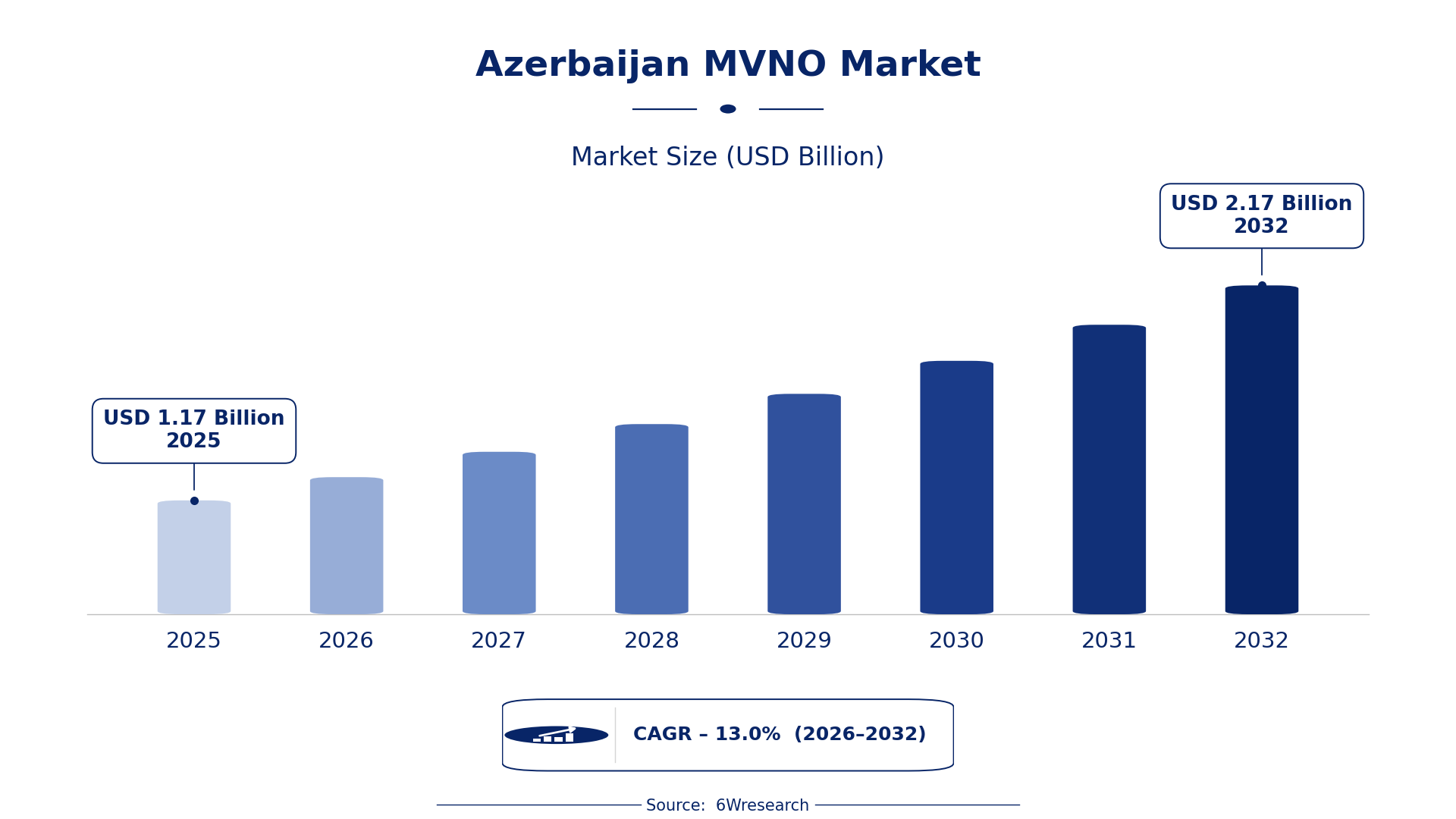
The Azerbaijan MVNO Market was estimated at USD 1171 Million in 2025 and is projected to reach USD 2166 Million by 2032, growing at a CAGR of 13.0% from 2026 to 2032.
Azerbaijan MVNO Market Synopsis
The Azerbaijan MVNO market, while relatively small, is demonstrating a notable trajectory of growth. Competition is intensifying as established mobile network operators (MNOs) face pressure from new entrants aiming to capture niche segments with tailored offerings.
MVNOs are seizing opportunities to innovate, focusing on cost-effective plans and digital services. With a favorable regulatory environment, there’s ample room for these virtual operators to carve out their unique positions in the market.
Azerbaijan MVNO Market Year-wise Growth Rate and Key Drivers
This graph illustrates the annual growth rates of the Azerbaijan MVNO Market from 2021 to 2032, highlighting a steady upward trajectory and projected expansion over the forecast period.
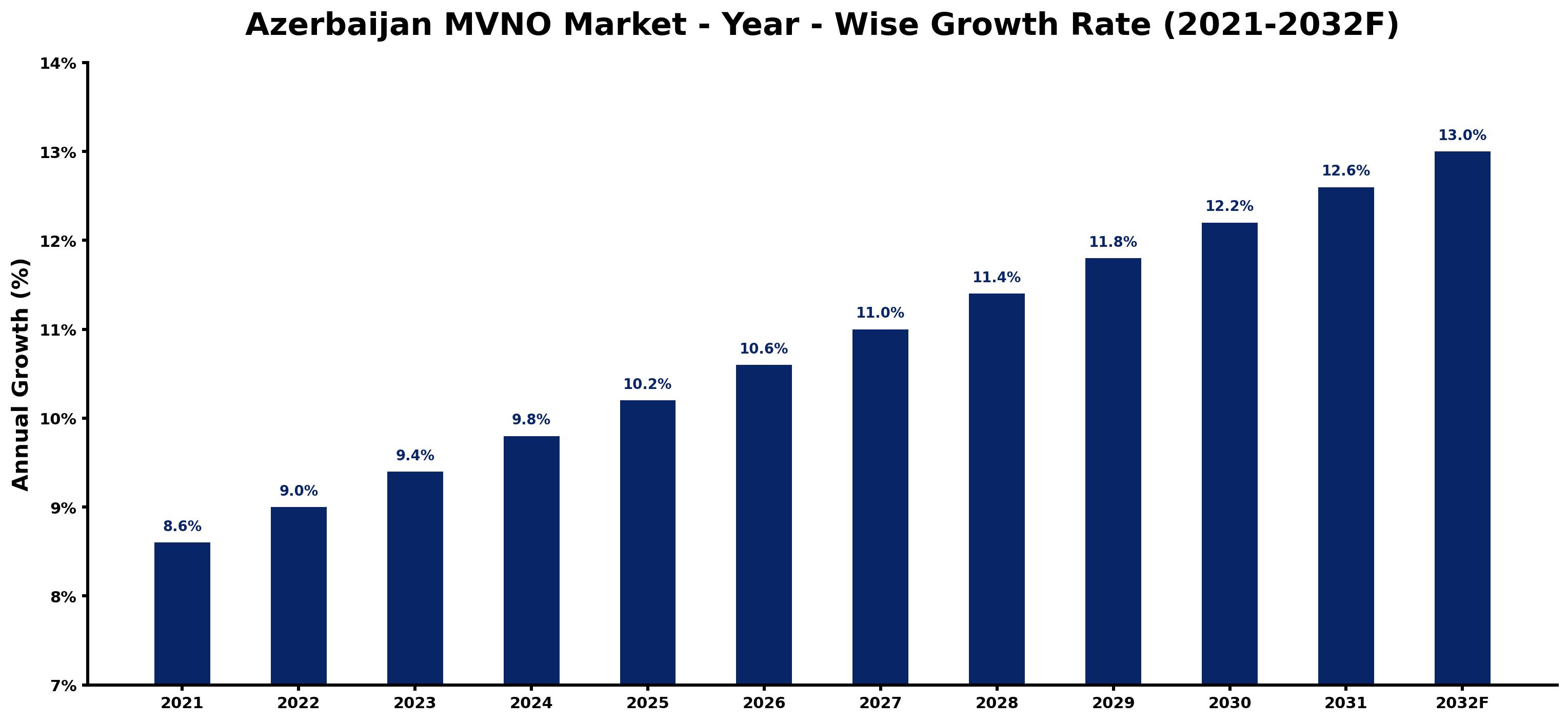
The table below presents the year‑wise growth rates along with the key drivers influencing the market
| Year | Growth Rate | Major Drivers |
| 2021 | 8.6% | Launch of new regulations by Azercell for MVNOs. |
| 2022 | 9.0% | Increased smartphone penetration boosting mobile service demand. |
| 2023 | 9.4% | Government support for digital economy expansion initiatives. |
| 2024 | 9.8% | Rising youth population driving mobile usage growth. |
| 2025 | 10.2% | Emergence of competitive pricing strategies among MVNOs. |
| 2026 | 10.6% | Adoption of 5G technology enhancing service offerings. |
| 2027 | 11.0% | Incentives from Ministry of Digital Development for startups. |
| 2028 | 11.4% | Growing e-commerce industry increasing mobile service subscriptions. |
| 2029 | 11.8% | Popularity of affordable SIM-only plans attracting consumers. |
| 2030 | 12.2% | Technological partnerships enhancing MVNO service capabilities. |
| 2031 | 12.6% | Improved infrastructure for better mobile service delivery. |
| 2032 | 13.0% | Increased consumer demand for data-driven mobile solutions. |
Note: Market size estimations and growth projections presented in this report are based on 6Wresearch's proprietary forecasting methodology, utilizing the latest available industry data, government publications, and primary research inputs.
Azerbaijan MVNO Market Key Takeaways
Below are some of the specific key takeaways from the market, including:
- The MVNO sector is witnessing a rapid increase in market players targeting specific consumer needs.
- Regulatory support is encouraging the establishment and growth of new MVNOs.
- Innovation in service offerings is critical for differentiation among operators.
- Strategic partnerships with MNOs are essential for enhancing service capabilities and market reach.
- The demand for digital services is driving MVNOs to explore collaborations with tech firms.
Evaluation of Restraints in Azerbaijan MVNO Market
Several factors are constraining growth in the Azerbaijan MVNO market. Notably, regulatory complexities can act as barriers for new entrants. These restrictions may limit MVNOs’ ability to negotiate favorable terms for network access. Additionally, the absence of comprehensive infrastructure sharing agreements curtails their operational capabilities. on top of that, established MNOs possess significant advantages, including loyal customer bases and extensive market knowledge, making it challenging for newcomers to gain traction.
Azerbaijan MVNO Market Trends
A competitive spirit is becoming increasingly evident among MVNOs in Azerbaijan. Operators are launching innovative packages to entice consumers, emphasizing personalized service and affordability. on top of that, collaborations with MNOs are on the rise, allowing MVNOs to broaden their service offerings and improve network quality.
The surge in demand for digital services—ranging from mobile banking to streaming—forces MVNOs to adapt quickly. This adaptability is essential as consumer preferences evolve, driving operators to enhance their value-added services.
Azerbaijan MVNO Market Opportunities
The Azerbaijan MVNO market is rich with investment potential. With current mobile penetration rates still on the rise, new operators can effectively tap into underserved segments. There exists a unique opportunity to introduce innovative services that cater specifically to local consumer preferences. Lower capital requirements for MVNOs, compared to building full mobile networks, further sweeten the deal for potential investors.
Government Initiatives in the Azerbaijan MVNO Market
The Azerbaijani government is actively shaping the MVNO market through a series of supportive policies. By facilitating a regulatory framework that encourages competition, authorities are paving the way for innovation and improved consumer choice. This proactive stance is vital for fostering a dynamic telecommunications environment where new players can thrive.
- A regulatory framework established in 2016 allows MVNOs to operate, enhancing competition in the telecom sector.
- Currently ongoing initiatives aim to improve infrastructure sharing agreements, enabling better resource access for MVNOs.
- A planned public initiative is set to expand digital literacy and service access by 2027, further supporting MVNO growth.
- Consumer protection measures are being refined to ensure MVNOs maintain quality service standards.
- Recently completed efforts include the launch of a licensing program that streamlines the entry process for new MVNOs.
Future Insights of the Azerbaijan MVNO Market
Looking ahead to 2026-2032, the Azerbaijan MVNO market is likely to experience considerable expansion. The anticipated influx of new MVNOs will not only enhance competition but also diversify the range of services available to consumers. As mobile services evolve alongside technological advancements, MVNOs are expected to capitalize on niche markets, tailoring their offerings to meet specific consumer demands.
Azerbaijan MVNO Market Latest Developments
Recent activity in the Azerbaijan MVNO market reflects a trend toward increased innovation and collaboration. Over the past year, players have been focused on leveraging partnerships and enhancing service portfolios to stay competitive.
- An initiative launched in early 2025 has seen multiple MVNOs partnering with local fintech companies to offer integrated financial services.
- A major technology vendor is currently rolling out an advanced data analytics platform aimed at improving service personalization for MVNOs.
- Several MVNOs are in the process of expanding their digital service offerings, with a significant rollout expected in late 2026.
- In mid-2025, a collaborative project was initiated to develop a unified customer service platform, enhancing user experience across multiple MVNOs.
- Upcoming in 2027, a comprehensive marketing campaign is planned to boost awareness of MVNO services among consumers.
Azerbaijan MVNO Market - Key Attractiveness of the Report
- 10 Years of Market Numbers
- Historical Data Starting from 2022 to 2025
- Base Year: 2025
- Forecast Data until 2032
- Key Performance Indicators Impacting the Market
- Major Upcoming Developments and Projects
Key Highlights of the Report:
- Azerbaijan MVNO Market Outlook
- Market Size of Azerbaijan MVNO Market, 2025
- Forecast of Azerbaijan MVNO Market, 2032
- Historical Data and Forecast of Azerbaijan MVNO Revenues & Volume for the Period 2022-2032F
- Azerbaijan MVNO Market Trend Evolution
- Azerbaijan MVNO Market Drivers and Challenges
- Azerbaijan MVNO Price Trends
- Azerbaijan MVNO Porter's Five Forces
- Azerbaijan MVNO Industry Life Cycle
- Historical Data and Forecast of Azerbaijan MVNO Market Revenues & Volume By Operational Model for the Period 2022-2032F
- Historical Data and Forecast of Azerbaijan MVNO Market Revenues & Volume By Reseller for the Period 2022-2032F
- Historical Data and Forecast of Azerbaijan MVNO Market Revenues & Volume By Service Operator for the Period 2022-2032F
- Historical Data and Forecast of Azerbaijan MVNO Market Revenues & Volume By Full MVNO for the Period 2022-2032F
- Historical Data and Forecast of Azerbaijan MVNO Market Revenues & Volume By Organization Size for the Period 2022-2032F
- Historical Data and Forecast of Azerbaijan MVNO Market Revenues & Volume By SMES for the Period 2022-2032F
- Historical Data and Forecast of Azerbaijan MVNO Market Revenues & Volume By Large Enterprise for the Period 2022-2032F
- Historical Data and Forecast of Azerbaijan MVNO Market Revenues & Volume By Subscriber for the Period 2022-2032F
- Historical Data and Forecast of Azerbaijan MVNO Market Revenues & Volume By Consumer for the Period 2022-2032F
- Historical Data and Forecast of Azerbaijan MVNO Market Revenues & Volume By Enterprise for the Period 2022-2032F
- Azerbaijan MVNO Import Export Trade Statistics
- Market Opportunity Assessment By Operational Model
- Market Opportunity Assessment By Organization Size
- Market Opportunity Assessment By Subscriber
- Azerbaijan MVNO Top Companies Market Share
- Azerbaijan MVNO Competitive Benchmarking By Technical and Operational Parameters
- Azerbaijan MVNO Company Profiles
- Azerbaijan MVNO Key Strategic Recommendations






































