Azerbaijan Natural Fragrance Market Size, Share & Growth Rate
The Azerbaijan Natural Fragrance Market was estimated at USD 738 Million in 2025 and is projected to reach USD 1224 Million by 2032, growing at a CAGR of 7.5% from 2026 to 2032. This growth trajectory is driven by an increasing consumer preference for natural ingredients over synthetic ones, reflecting a broader trend in the personal care industry toward sustainability and eco-friendliness. Furthermore, the proliferation of e-commerce platforms is enhancing accessibility, making natural fragrances more readily available to a diverse consumer base.
Azerbaijan Natural Fragrance Market Year-wise Growth Rate and Key Drivers
This graph highlights how the Azerbaijan Natural Fragrance Market has steadily grown over the years, supported by major growth factors.
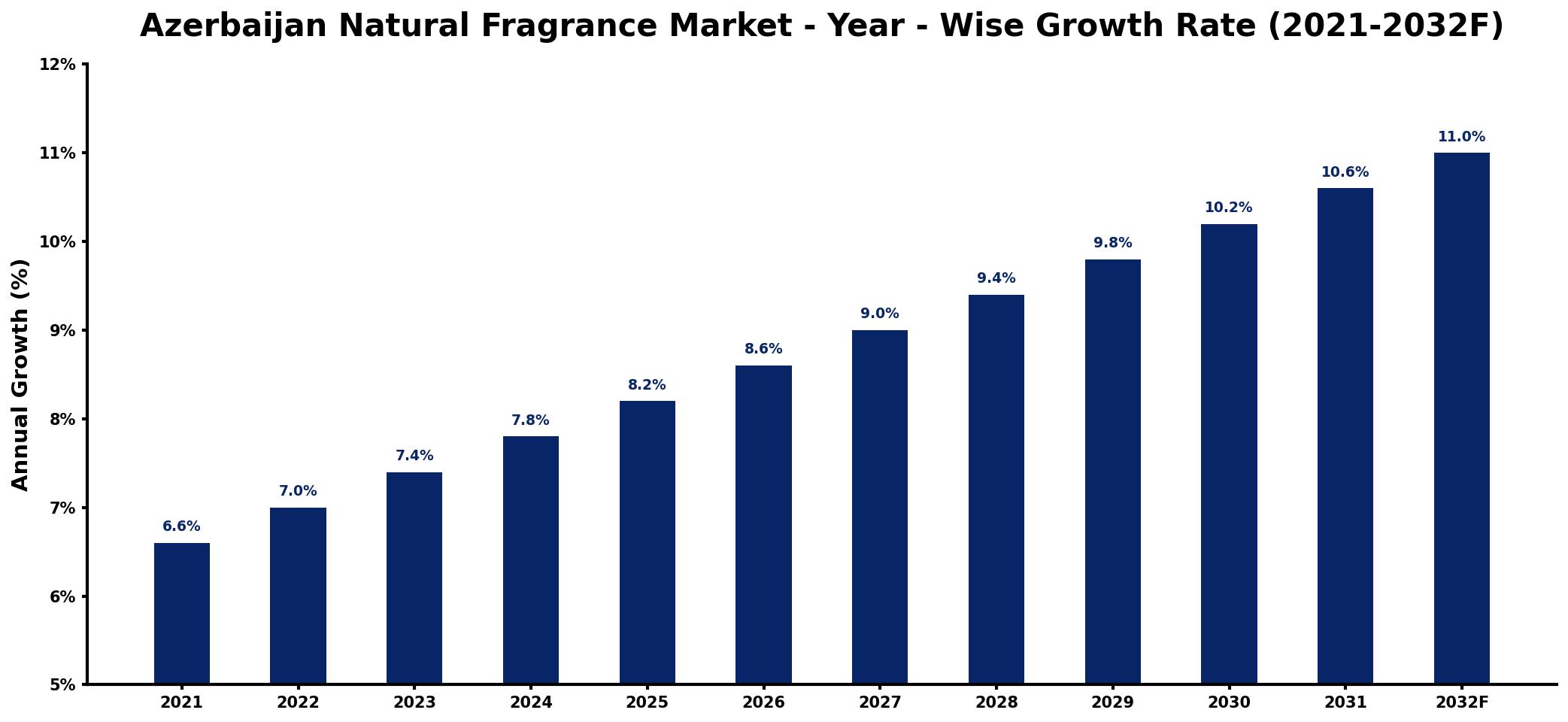
The table below presents the year‑wise growth rates along with the key drivers influencing the market
| Year | Growth Rate | Major Drivers |
| 2021 | 6.6% | increased consumer awareness sustainability |
| 2022 | 7.0% | rising interest organic ingredients |
| 2023 | 7.4% | growing demand eco-friendly products |
| 2024 | 7.8% | expansion retail distribution channels |
| 2025 | 8.2% | enhanced marketing digital platforms |
| 2026 | 8.6% | increased investment research development |
| 2027 | 9.0% | growing popularity wellness trends |
| 2028 | 9.4% | expansion international market presence |
| 2029 | 9.8% | rising disposable income consumers |
| 2030 | 10.2% | increased collaboration industry partners |
| 2031 | 10.6% | growing focus personalized experiences |
| 2032 | 11.0% | expansion product variety offerings |
Note: Market size estimations and growth projections presented in this report are based on 6Wresearch's proprietary forecasting methodology, utilizing the latest available industry data, government publications, and primary research inputs.
Azerbaijan Natural Fragrance Market Synopsis
The Azerbaijani natural fragrance market is witnessing a transformative phase, where consumers are increasingly demanding clean and sustainable beauty solutions. In response, manufacturers are investing in the creation of fragrances derived from essential oils and botanical extracts, aligning their offerings with the growing wellness movement.
As the beauty industry shifts towards organic products, the popularity of natural fragrances in Azerbaijan is poised for significant growth. This trend is further amplified by heightened consumer awareness of the health implications tied to synthetic alternatives, leading to an intensified focus on product authenticity and ingredient transparency.
Azerbaijan Natural Fragrance Market Key Takeaways
- The market is experiencing robust growth fueled by the rise in consumer preference for natural ingredients.
- Innovative fragrance profiles derived from unique botanicals are increasingly capturing consumer interest.
- The expansion of e-commerce has made natural fragrances more accessible to a wider audience.
- Regulatory support is being introduced to promote sustainable sourcing practices.
- Challenges in local ingredient availability are prompting initiatives for domestic cultivation and extraction.
Evaluation of Restraints in Azerbaijan Natural Fragrance Market
Despite the burgeoning demand for natural fragrances, several constraints hinder the market's potential. The limited availability of quality natural fragrance ingredients poses a significant challenge for manufacturers. Investment in local botanical cultivation and extraction technologies is essential to build a robust supply chain. Furthermore, ensuring the authenticity and quality of natural products remains a crucial hurdle for gaining consumer trust. Economic factors may also limit access to distribution channels, affecting the affordability and market penetration of natural fragrances.
Azerbaijan Natural Fragrance Market Trends
Current trends in the Azerbaijan natural fragrance market highlight a growing inclination towards personalized and bespoke fragrance solutions. Consumers are now seeking unique scent profiles that resonate with their individual identities. Additionally, the integration of aromatherapy principles into fragrance formulations is gaining traction, as customers look for holistic benefits beyond mere scent. The rise of eco-conscious consumers also drives brands to adopt transparent and sustainable practices, further influencing product development.
Azerbaijan Natural Fragrance Market Opportunities
The Azerbaijan natural fragrance market presents various opportunities for growth and investment. Companies can capitalize on the increasing demand for sustainably sourced ingredients by establishing local cultivation initiatives. Collaborations with artisanal producers can also foster unique product offerings, appealing to consumers seeking exclusivity. Furthermore, as digital shopping continues to expand, optimizing online presence and e-commerce strategies will be critical in tapping into this lucrative market segment.
Government Initiatives in the Azerbaijan Natural Fragrance Market
The Azerbaijani government is taking proactive steps to bolster the natural fragrance market. Initiatives focus on the sustainable sourcing of ingredients, ensuring that local producers are equipped with the necessary resources to thrive. There are incentives for businesses that develop environmentally friendly fragrance formulations, alongside programs aimed at promoting Azerbaijani natural fragrances both domestically and on international platforms. Such support is crucial for the markets sustainable growth and international competitiveness.
Future Insights of the Azerbaijan Natural Fragrance Market
Looking ahead to the 2026-2032 period, the Azerbaijan natural fragrance market is poised for significant evolution. As consumer awareness of health and environmental issues continues to rise, the demand for clean, natural products will intensify. Brands that successfully align their offerings with ethical and sustainable practices are likely to thrive. Furthermore, innovations in sourcing and formulation technologies may pave the way for unique products that meet diverse consumer preferences, thus enhancing market attractiveness.
Azerbaijan Natural Fragrance Market Latest Developments (2025 - 2026)
Recent developments in the Azerbaijan natural fragrance market indicate a shift towards increased local production capabilities. Various stakeholders are collaborating to enhance the availability of natural ingredients, focusing on organic cultivation and sustainable harvesting practices. Additionally, brands are launching new collections that highlight the unique aromatic profiles of local botanicals, appealing to both domestic consumers and international markets. This strategic focus on local sourcing and product innovation is expected to foster robust growth.
Azerbaijan Natural Fragrance Market - Key Attractiveness of the Report
- 10 Years of Market Numbers
- Historical Data Starting from 2022 to 2025
- Base Year: 2025
- Forecast Data until 2032
- Key Performance Indicators Impacting the Market
- Major Upcoming Developments and Projects
Key Highlights of the Report:
- Azerbaijan Natural Fragrance Market Outlook
- Market Size of Azerbaijan Natural Fragrance Market, 2025
- Forecast of Azerbaijan Natural Fragrance Market, 2032
- Historical Data and Forecast of Azerbaijan Natural Fragrance Revenues & Volume for the Period 2022-2032F
- Azerbaijan Natural Fragrance Market Trend Evolution
- Azerbaijan Natural Fragrance Market Drivers and Challenges
- Azerbaijan Natural Fragrance Price Trends
- Azerbaijan Natural Fragrance Porter's Five Forces
- Azerbaijan Natural Fragrance Industry Life Cycle
- Historical Data and Forecast of Azerbaijan Natural Fragrance Market Revenues & Volume By Ingredient for the Period 2022-2032F
- Historical Data and Forecast of Azerbaijan Natural Fragrance Market Revenues & Volume By Essential Oils for the Period 2022-2032F
- Historical Data and Forecast of Azerbaijan Natural Fragrance Market Revenues & Volume By Natural Extracts for the Period 2022-2032F
- Historical Data and Forecast of Azerbaijan Natural Fragrance Market Revenues & Volume By Type for the Period 2022-2032F
- Historical Data and Forecast of Azerbaijan Natural Fragrance Market Revenues & Volume By Top note for the Period 2022-2032F
- Historical Data and Forecast of Azerbaijan Natural Fragrance Market Revenues & Volume By Middle Note for the Period 2022-2032F
- Historical Data and Forecast of Azerbaijan Natural Fragrance Market Revenues & Volume By Base Note for the Period 2022-2032F
- Historical Data and Forecast of Azerbaijan Natural Fragrance Market Revenues & Volume By Application for the Period 2022-2032F
- Historical Data and Forecast of Azerbaijan Natural Fragrance Market Revenues & Volume By Fine Fragrances for the Period 2022-2032F
- Historical Data and Forecast of Azerbaijan Natural Fragrance Market Revenues & Volume By Personal Care & Cosmetics for the Period 2022-2032F
- Historical Data and Forecast of Azerbaijan Natural Fragrance Market Revenues & Volume By Household Care for the Period 2022-2032F
- Azerbaijan Natural Fragrance Import Export Trade Statistics
- Market Opportunity Assessment By Ingredient
- Market Opportunity Assessment By Type
- Market Opportunity Assessment By Application
- Azerbaijan Natural Fragrance Top Companies Market Share
- Azerbaijan Natural Fragrance Competitive Benchmarking By Technical and Operational Parameters
- Azerbaijan Natural Fragrance Company Profiles
- Azerbaijan Natural Fragrance Key Strategic Recommendations






































