Azerbaijan Network Slicing Market Size, Share & Growth Rate
The Azerbaijan Network Slicing Market was estimated at USD 1368 Million in 2025 and is projected to reach USD 2450 Million by 2032, growing at a CAGR of 8.7% from 2026 to 2032. This impressive trajectory is propelled primarily by the ongoing rollout of 5G technology across the region, which necessitates dynamic and tailored networking solutions. Furthermore, the increasing demand for efficient resource allocation among various industry verticals enhances the need for innovative network slicing strategies.
Azerbaijan Network Slicing Market Year-wise Growth Rate and Key Drivers
This graph highlights how the Azerbaijan Network Slicing Market has steadily grown over the years, supported by major growth factors.
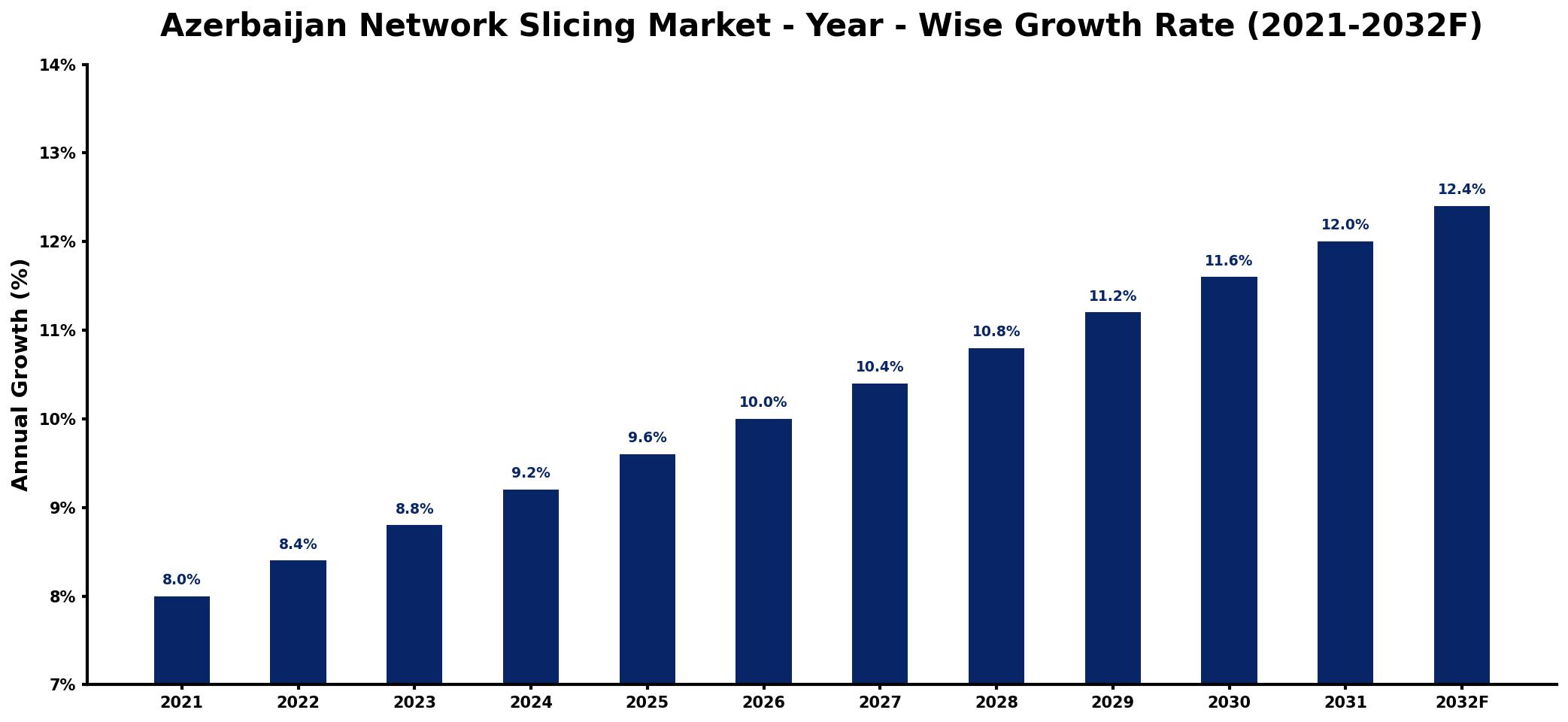
The table below presents the year‑wise growth rates along with the key drivers influencing the market
| Year | Growth Rate | Major Drivers |
| 2021 | 8.0% | rising demand for connectivity solutions |
| 2022 | 8.4% | increased investment in telecommunications infrastructure |
| 2023 | 8.8% | growing emphasis on digital transformation |
| 2024 | 9.2% | expansion of 5G technology deployment |
| 2025 | 9.6% | surge in IoT device adoption |
| 2026 | 10.0% | enhanced focus on customer experience |
| 2027 | 10.4% | development of smart city initiatives |
| 2028 | 10.8% | growing interest in edge computing |
| 2029 | 11.2% | expanding healthcare application demand |
| 2030 | 11.6% | increased funding for tech startups |
| 2031 | 12.0% | increased production capacity utilization |
| 2032 | 12.4% | advancements in machine learning applications |
Note: Market size estimations and growth projections presented in this report are based on 6Wresearch's proprietary forecasting methodology, utilizing the latest available industry data, government publications, and primary research inputs.
Azerbaijan Network Slicing Market Synopsis
Azerbaijan's digital ecosystem is embracing network slicing as a solution to efficiently manage the growing complexity of network demands. With its capacity to create multiple virtual networks from a single physical infrastructure, network slicing is set to revolutionize service delivery in various sectors including automotive and healthcare.
As enterprises increasingly adopt IoT technologies, the necessity for customized networking solutions becomes evident. Network slicing provides a pathway to ensure that distinct applications and users can operate without interference, thereby optimizing overall network performance.
Azerbaijan Network Slicing Market Key Takeaways
- The market is witnessing a robust shift due to the adoption of 5G technology.
- Enterprise demands for flexibility in network performance are driving innovation in network slicing solutions.
- Regional growth is supported by increasing investment in telecommunications infrastructure.
- Collaboration between network operators and service providers is essential for maximizing the benefits of network slicing.
- The convergence of IoT and edge computing continues to fuel the development of network slicing applications.
Evaluation of Restraints in Azerbaijan Network Slicing Market
Despite the potential of network slicing in Azerbaijan, several restraints hinder its growth. A significant challenge is the limited infrastructure and expertise related to the implementation of network slicing technologies. Building robust software-defined networking (SDN) and network function virtualization (NFV) capabilities is essential for realizing the full benefits of network slicing. Moreover, concerns over interoperability can stifle market adoption, as existing network architectures must seamlessly integrate with emerging slicing technologies. Additionally, economic factors may restrict investment in this area, necessitating strong advocacy to communicate the strategic importance of network slicing for future service differentiation.
Azerbaijan Network Slicing Market Trends
Several notable trends are shaping the Azerbaijan Network Slicing Market. The rapid deployment of 5G is at the forefront, driving demand for more nuanced network solutions that can cater to diverse applications. Furthermore, as industries continue to digitize, there's a marked trend toward integrating network slicing with IoT frameworks, enhancing operational efficiencies. The rise of edge computing also plays a pivotal role, as it necessitates the creation of localized virtual networks capable of supporting real-time data processing and analytics.
Azerbaijan Network Slicing Market Opportunities
Opportunities abound within the Azerbaijan Network Slicing Market as enterprises seek tailored networking solutions to address unique challenges. Industries like automotive and healthcare are prime candidates for bespoke network slices that enhance service delivery and operational efficiency. Additionally, the increasing interconnectivity of devices via IoT presents a vast opportunity for service providers to create specialized networks that cater to specific applications, ensuring they can meet varied service level agreements (SLAs) while optimizing resource utilization.
Government Initiatives in the Azerbaijan Network Slicing Market
The Azerbaijani government has proactively introduced policies designed to foster growth in the network slicing market. These initiatives include establishing regulatory frameworks that facilitate the implementation of network slicing technologies and encouraging investments in network virtualization. By promoting collaboration between network operators and service providers, the government aims to streamline the deployment of sliced networks, enhancing the overall telecommunications landscape in the country.
Future Insights of the Azerbaijan Network Slicing Market
Looking ahead to 2026-2032, the Azerbaijan Network Slicing Market is poised for significant expansion as the demand for 5G connectivity continues to rise. The landscape will likely become increasingly competitive, with service providers innovating their offerings to meet the unique needs of various sectors. As infrastructure improves and more players enter the market, we can expect to see advanced solutions that leverage AI and machine learning to optimize network slicing capabilities, paving the way for unparalleled user experiences.
Azerbaijan Network Slicing Market Latest Developments (2025 - 2026)
Recent months have seen a flurry of activity in the Azerbaijan Network Slicing Market, with new projects focused on integrating advanced technologies into existing frameworks. Stakeholders are increasingly collaborating to create dynamic network solutions that address industry-specific requirements. Moreover, as 5G networks continue to expand, discussions around interoperability and standardization have gained momentum, reflecting a shared commitment to fostering a cohesive digital ecosystem.
Azerbaijan Network Slicing Market - Key Attractiveness of the Report
- 10 Years of Market Numbers
- Historical Data Starting from 2022 to 2025
- Base Year: 2025
- Forecast Data until 2032
- Key Performance Indicators Impacting the Market
- Major Upcoming Developments and Projects
Key Highlights of the Report:
- Azerbaijan Network Slicing Market Outlook
- Market Size of Azerbaijan Network Slicing Market, 2025
- Forecast of Azerbaijan Network Slicing Market, 2032
- Historical Data and Forecast of Azerbaijan Network Slicing Revenues & Volume for the Period 2022-2032F
- Azerbaijan Network Slicing Market Trend Evolution
- Azerbaijan Network Slicing Market Drivers and Challenges
- Azerbaijan Network Slicing Price Trends
- Azerbaijan Network Slicing Porter's Five Forces
- Azerbaijan Network Slicing Industry Life Cycle
- Historical Data and Forecast of Azerbaijan Network Slicing Market Revenues & Volume By Component for the Period 2022-2032F
- Historical Data and Forecast of Azerbaijan Network Slicing Market Revenues & Volume By Solution for the Period 2022-2032F
- Historical Data and Forecast of Azerbaijan Network Slicing Market Revenues & Volume By Services (Professional & Managed) for the Period 2022-2032F
- Historical Data and Forecast of Azerbaijan Network Slicing Market Revenues & Volume By End User for the Period 2022-2032F
- Historical Data and Forecast of Azerbaijan Network Slicing Market Revenues & Volume By Telecom Operators for the Period 2022-2032F
- Historical Data and Forecast of Azerbaijan Network Slicing Market Revenues & Volume By Enterprises for the Period 2022-2032F
- Historical Data and Forecast of Azerbaijan Network Slicing Market Revenues & Volume By Application for the Period 2022-2032F
- Historical Data and Forecast of Azerbaijan Network Slicing Market Revenues & Volume By Manufacturing for the Period 2022-2032F
- Historical Data and Forecast of Azerbaijan Network Slicing Market Revenues & Volume By Government for the Period 2022-2032F
- Historical Data and Forecast of Azerbaijan Network Slicing Market Revenues & Volume By Automotive for the Period 2022-2032F
- Historical Data and Forecast of Azerbaijan Network Slicing Market Revenues & Volume By Media and Entertainment for the Period 2022-2032F
- Azerbaijan Network Slicing Import Export Trade Statistics
- Market Opportunity Assessment By Component
- Market Opportunity Assessment By End User
- Market Opportunity Assessment By Application
- Azerbaijan Network Slicing Top Companies Market Share
- Azerbaijan Network Slicing Competitive Benchmarking By Technical and Operational Parameters
- Azerbaijan Network Slicing Company Profiles
- Azerbaijan Network Slicing Key Strategic Recommendations






































