Azerbaijan Nylon Filament Yarn Market Size, Share & Growth Rate
The Azerbaijan Nylon Filament Yarn Market was estimated at USD 1090 Million in 2025 and is projected to reach USD 1808 Million by 2032, growing at a CAGR of 7.5% from 2026 to 2032. This robust growth trajectory is primarily driven by the burgeoning textile industry, which is increasingly adopting nylon filament yarn for various applications such as fabrics, ropes, and more. Additionally, the expanding automotive sector's reliance on nylon yarn for critical components like seat belts and airbags further underscores the market's positive outlook.
Azerbaijan Nylon Filament Yarn Market Year-wise Growth Rate and Key Drivers
This graph highlights how the Azerbaijan Nylon Filament Yarn Market has steadily grown over the years, supported by major growth factors.
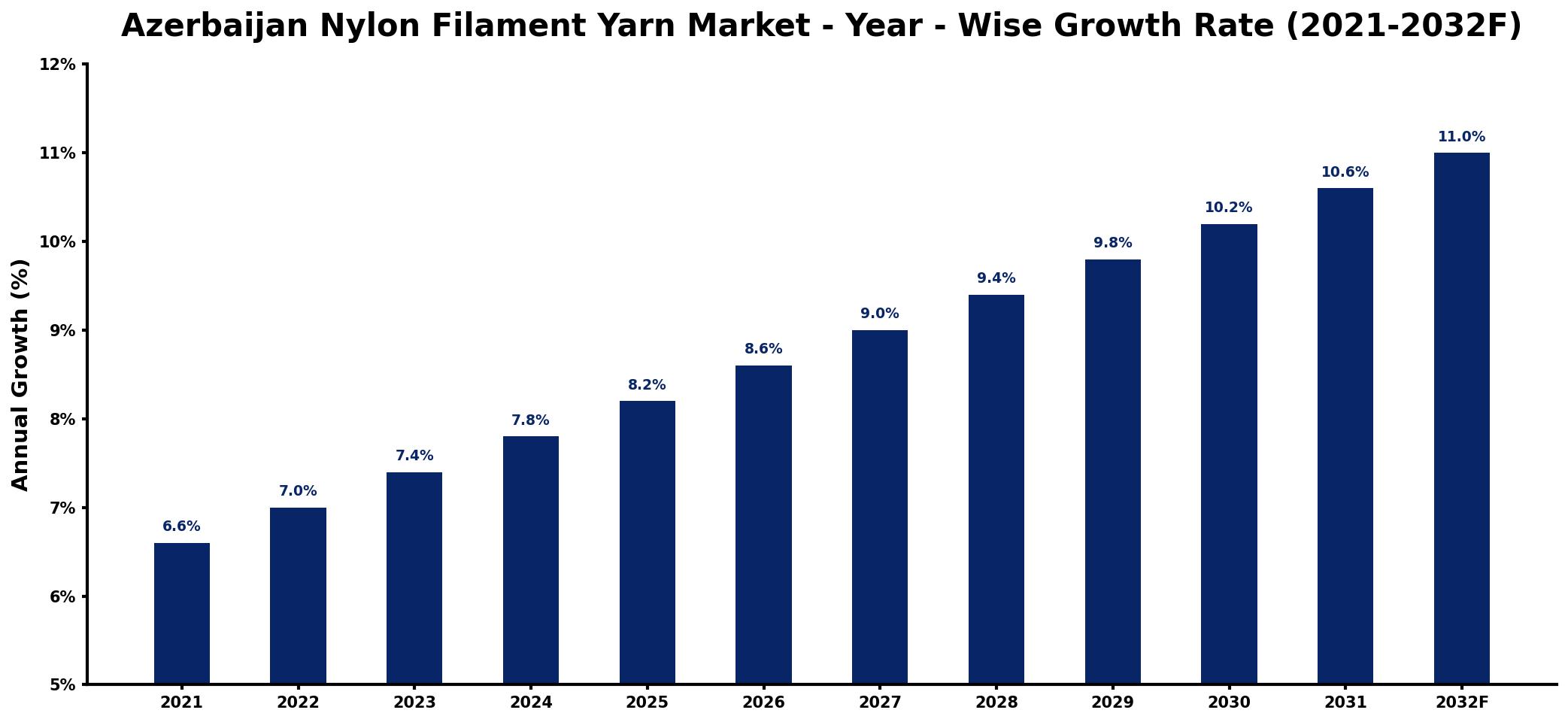
The table below presents the year‑wise growth rates along with the key drivers influencing the market
| Year | Growth Rate | Major Drivers |
| 2021 | 6.6% | Rising demand from apparel industry |
| 2022 | 7.0% | Increased investments in manufacturing |
| 2023 | 7.4% | Expansion of textile production facilities |
| 2024 | 7.8% | Growth in automotive sector applications |
| 2025 | 8.2% | Surge in construction materials usage |
| 2026 | 8.6% | Boost in sportswear market demand |
| 2027 | 9.0% | Technological advancements in production |
| 2028 | 9.4% | Emergence of eco-friendly alternatives |
| 2029 | 9.8% | Strengthening export opportunities abroad |
| 2030 | 10.2% | Growing popularity of home textiles |
| 2031 | 10.6% | Increased focus on sustainable practices |
| 2032 | 11.0% | Rising consumer preference for durability |
Note: Market size estimations and growth projections presented in this report are based on 6Wresearch's proprietary forecasting methodology, utilizing the latest available industry data, government publications, and primary research inputs.
Azerbaijan Nylon Filament Yarn Market Synopsis
The Azerbaijan Nylon Filament Yarn Market is currently witnessing steady growth, fueled by rising demand from various end-use industries including textiles, automotive, and packaging. Domestic manufacturers dominate the landscape, offering a diverse array of nylon filament yarn products tailored to the specific needs of customers across these sectors.
In particular, the textile industry stands as a key driver for this market, leveraging the properties of nylon filament yarn for high-performance fabric production. Moreover, as environmental concerns gain traction, the increasing demand for eco-friendly yarn solutions is anticipated to reshape product offerings in the coming years.
Azerbaijan Nylon Filament Yarn Market Key Takeaways
- The market is experiencing growth driven by diverse end-use sectors, particularly textiles and automotive.
- Domestic manufacturers are focusing on innovation and sustainability to meet evolving customer preferences.
- There is a notable shift towards eco-friendly nylon filament yarn products, driven by consumer environmental awareness.
- Technological advancements are enhancing the quality and versatility of nylon filament yarn, expanding its application range.
- Government policies support local production, reducing reliance on imports and bolstering market competitiveness.
Evaluation of Restraints in Azerbaijan Nylon Filament Yarn Market
While the Azerbaijan Nylon Filament Yarn Market is poised for growth, it faces several key restraints. Increasing competition from low-cost imports poses a significant threat to domestic manufacturers, potentially leading to price wars that could impact profit margins. Furthermore, fluctuations in raw material prices create uncertainty in production costs, making it difficult for companies to maintain stable pricing. Additionally, logistical challenges in transportation may hinder distribution efficiency, complicating market access for local players. Companies must navigate these obstacles while striving to innovate and enhance product quality to remain competitive.
Azerbaijan Nylon Filament Yarn Market Trends
The market is currently influenced by several significant trends. One of the most prominent is the increasing demand for sustainable and bio-based nylon filament yarns, which is being driven by rising consumer awareness regarding environmental issues. Companies are investing in R&D to develop innovative products that meet this eco-friendly criterion. Additionally, there is a trend towards customization, as manufacturers are offering a wide variety of colors, textures, and functionalities tailored to meet specific industry needs. Technological advancements in production techniques are also enabling enhanced quality and performance in yarn products, contributing to their versatile application across various sectors.
Azerbaijan Nylon Filament Yarn Market Opportunities
Numerous investment opportunities exist within the Azerbaijan Nylon Filament Yarn market. Expanding production capacity to accommodate the increasing demand from sectors such as textiles and automotive presents a viable growth strategy. Furthermore, investing in research and development can yield innovative products that cater to evolving consumer preferences and improve existing offerings. Leveraging advanced manufacturing technologies not only streamlines processes but can also lead to cost reductions. Moreover, exploring export opportunities to neighboring markets can significantly enhance revenue potential, allowing companies to diversify their business and capitalize on a broader customer base.
Government Initiatives in the Azerbaijan Nylon Filament Yarn Market
Government initiatives aimed at promoting the Azerbaijan Nylon Filament Yarn Market focus on supporting domestic production and reducing import dependency. Policies have been implemented to provide subsidies, tax incentives, and infrastructure improvements for local manufacturers. Quality standards are enforced to enhance competitiveness on both domestic and international fronts. Moreover, there is an emphasis on fostering innovation and research within the sector, encouraging advancements in production processes and product quality. These measures create a favorable environment for the growth and sustainability of the nylon filament yarn industry in Azerbaijan.
Future Insights of the Azerbaijan Nylon Filament Yarn Market
Looking ahead to the period from 2026 to 2032, the Azerbaijan Nylon Filament Yarn Market is expected to witness positive momentum. The combination of rising disposable incomes and an expanding manufacturing sector will likely fuel demand for nylon filament yarn across multiple industries. Sustainability will continue to be a critical focus, as the industry adapts to consumer preferences for recycled and eco-friendly materials. While challenges such as raw material price volatility and competition from alternative materials may arise, the overall outlook remains optimistic, with potential for steady market expansion.
Azerbaijan Nylon Filament Yarn Market Latest Developments (2025 - 2026)
In recent months, the Azerbaijan Nylon Filament Yarn Market has been witnessing a surge in innovation, particularly in developing sustainable and high-performance yarns. Manufacturers are increasingly focusing on enhancing production processes to improve efficiency while maintaining product quality. Additionally, collaborations between local producers and research institutions are paving the way for groundbreaking advancements in product offerings. Furthermore, as global demand for eco-friendly materials grows, local manufacturers are adapting their strategies to meet both domestic and international market requirements, positioning themselves favorably for future opportunities.
Azerbaijan Nylon Filament Yarn Market - Key Attractiveness of the Report
- 10 Years of Market Numbers
- Historical Data Starting from 2022 to 2025
- Base Year: 2025
- Forecast Data until 2032
- Key Performance Indicators Impacting the Market
- Major Upcoming Developments and Projects
Key Highlights of the Report:
- Azerbaijan Nylon Filament Yarn Market Outlook
- Market Size of Azerbaijan Nylon Filament Yarn Market, 2025
- Forecast of Azerbaijan Nylon Filament Yarn Market, 2032
- Historical Data and Forecast of Azerbaijan Nylon Filament Yarn Revenues & Volume for the Period 2022-2032F
- Azerbaijan Nylon Filament Yarn Market Trend Evolution
- Azerbaijan Nylon Filament Yarn Market Drivers and Challenges
- Azerbaijan Nylon Filament Yarn Price Trends
- Azerbaijan Nylon Filament Yarn Porter's Five Forces
- Azerbaijan Nylon Filament Yarn Industry Life Cycle
- Historical Data and Forecast of Azerbaijan Nylon Filament Yarn Market Revenues & Volume By Grade for the Period 2022-2032F
- Historical Data and Forecast of Azerbaijan Nylon Filament Yarn Market Revenues & Volume By Flat Yarn for the Period 2022-2032F
- Historical Data and Forecast of Azerbaijan Nylon Filament Yarn Market Revenues & Volume By Textured Yarn for the Period 2022-2032F
- Historical Data and Forecast of Azerbaijan Nylon Filament Yarn Market Revenues & Volume By Partially Oriented Yarn for the Period 2022-2032F
- Historical Data and Forecast of Azerbaijan Nylon Filament Yarn Market Revenues & Volume By Fully Drawn Yarn for the Period 2022-2032F
- Historical Data and Forecast of Azerbaijan Nylon Filament Yarn Market Revenues & Volume By Dyed Yarns for the Period 2022-2032F
- Historical Data and Forecast of Azerbaijan Nylon Filament Yarn Market Revenues & Volume By Application for the Period 2022-2032F
- Historical Data and Forecast of Azerbaijan Nylon Filament Yarn Market Revenues & Volume By Textiles for the Period 2022-2032F
- Historical Data and Forecast of Azerbaijan Nylon Filament Yarn Market Revenues & Volume By Sports Apparels for the Period 2022-2032F
- Historical Data and Forecast of Azerbaijan Nylon Filament Yarn Market Revenues & Volume By Sports and Adventure Equipment for the Period 2022-2032F
- Historical Data and Forecast of Azerbaijan Nylon Filament Yarn Market Revenues & Volume By Travel Accessories for the Period 2022-2032F
- Historical Data and Forecast of Azerbaijan Nylon Filament Yarn Market Revenues & Volume By Fishing Nets for the Period 2022-2032F
- Historical Data and Forecast of Azerbaijan Nylon Filament Yarn Market Revenues & Volume By Fabric for the Period 2022-2032F
- Historical Data and Forecast of Azerbaijan Nylon Filament Yarn Market Revenues & Volume By Sales Channel for the Period 2022-2032F
- Historical Data and Forecast of Azerbaijan Nylon Filament Yarn Market Revenues & Volume By Direct Company Sale for the Period 2022-2032F
- Historical Data and Forecast of Azerbaijan Nylon Filament Yarn Market Revenues & Volume By Direct Import for the Period 2022-2032F
- Historical Data and Forecast of Azerbaijan Nylon Filament Yarn Market Revenues & Volume By Distributors & Traders for the Period 2022-2032F
- Historical Data and Forecast of Azerbaijan Nylon Filament Yarn Market Revenues & Volume By Retailers for the Period 2022-2032F
- Azerbaijan Nylon Filament Yarn Import Export Trade Statistics
- Market Opportunity Assessment By Grade
- Market Opportunity Assessment By Application
- Market Opportunity Assessment By Sales Channel
- Azerbaijan Nylon Filament Yarn Top Companies Market Share
- Azerbaijan Nylon Filament Yarn Competitive Benchmarking By Technical and Operational Parameters
- Azerbaijan Nylon Filament Yarn Company Profiles
- Azerbaijan Nylon Filament Yarn Key Strategic Recommendations






































