Azerbaijan Optical Glass Market Size, Share & Growth Rate
The Azerbaijan Optical Glass Market was estimated at USD 588 Million in 2025 and is projected to reach USD 991 Million by 2032, growing at a CAGR of 7.7% from 2026 to 2032. This impressive growth trajectory is largely fueled by the escalating demand for sophisticated optical components across the telecommunications, automotive, and healthcare sectors. Moreover, the increasing reliance on advanced optical technologies, such as sensors and medical devices, positions this market for robust expansion.
Azerbaijan Optical Glass Market Year-wise Growth Rate and Key Drivers
This graph highlights how the Azerbaijan Optical Glass Market has steadily grown over the years, supported by major growth factors.
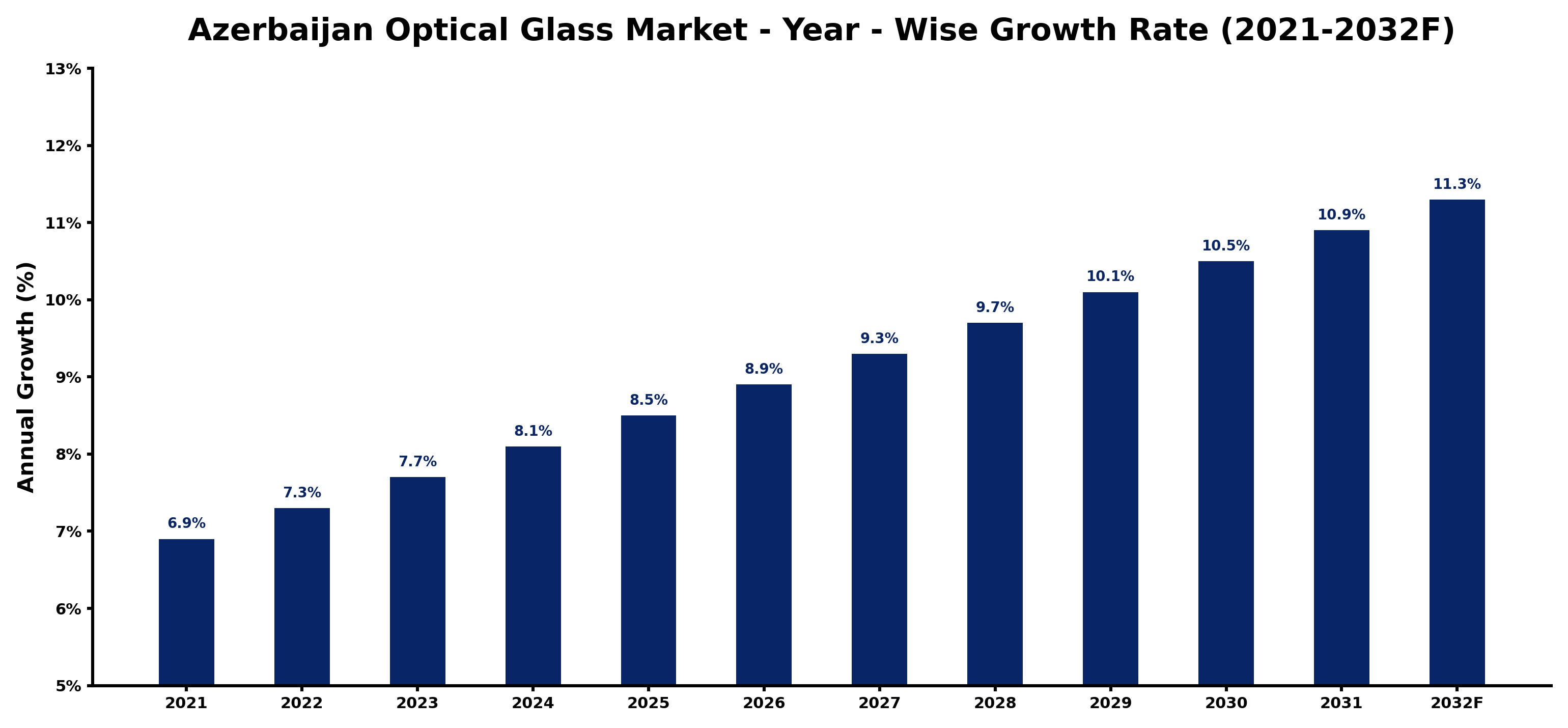
The table below presents the year‑wise growth rates along with the key drivers influencing the market
| Year | Growth Rate | Major Drivers |
| 2021 | 6.9% | Increased domestic optical glass manufacturing boosts local supply chain efficiency |
| 2022 | 7.3% | Local manufacturers enhance capabilities with new optical glass machinery |
| 2023 | 7.7% | Investment in advanced manufacturing technology boosts optical glass production capacity |
| 2024 | 8.1% | New infrastructure projects boosted local demand for optical glass products |
| 2025 | 8.5% | Export driven technology integration boosted local optical glass production efficiency |
| 2026 | 8.9% | New manufacturing facilities boosted optical glass production capacity |
| 2027 | 9.3% | Local manufacturers invest in advanced equipment for precision optics |
| 2028 | 9.7% | Local optical glass manufacturers increase investment in advanced production techniques |
| 2029 | 10.1% | Digital tracking systems improved optical glass production quality assurance |
| 2030 | 10.5% | Infrastructure investments boosted optical glass manufacturing capabilities in Azerbaijan |
| 2031 | 10.9% | Optimized glass production lines boosted output and reduced waste |
| 2032 | 11.3% | Improved manufacturing investments boosted local optical glass production capabilities |
Note - Market size estimations and growth projections presented in this report are based on 6Wresearch's advanced forecasting approach, validated with industry datasets as of June 2026.
Azerbaijan Optical Glass Market Synopsis
The Azerbaijan Optical Glass Market is witnessing a significant uptick in demand for optical lenses and filters, critical for telecommunications and healthcare applications. This surge is supported by local manufacturers investing in technology to meet the evolving needs of high-quality optical glass.
Furthermore, the market is beginning to see an influx of innovative optical glass materials, emphasizing durability and superior optical properties. This innovation trend is driving not only product development but also a re-evaluation of existing offerings within the Azerbaijan Optical Glass Market.
Azerbaijan Optical Glass Market Key Takeaways
- Steady market growth driven by demand in telecommunications, automotive, and healthcare sectors.
- Significant investments in advanced optical technologies boosting market potential.
- Emergence of specialty optical glasses catering to niche applications.
- Government initiatives aimed at promoting research and development are enhancing market dynamics.
- Strategic partnerships and local manufacturing are key to capitalizing on emerging opportunities.
Evaluation of Restraints in Azerbaijan Optical Glass Market
Despite its growth potential, the Azerbaijan Optical Glass Market faces several constraints. A notable challenge is the reliance on imports, stemming from limited local production capabilities. This dependence exposes the market to vulnerabilities, including fluctuations in exchange rates and disruptions in global supply chains. Additionally, the scarcity of a skilled workforce with specialized knowledge in optical glass manufacturing hampers operational efficiency. Regulatory hurdles and stringent quality standards further complicate compliance, posing additional challenges for local players striving to gain a competitive edge.
Azerbaijan Optical Glass Market Trends
Current trends indicate a growing preference for advanced optical glass materials that deliver enhanced optical properties and reliability. Additionally, the rise of precision glass molding and coating techniques is revolutionizing production processes within the market. As industries seek innovative solutions for applications such as medical devices and automotive systems, manufacturers are increasingly focused on product development to meet these evolving requirements.
Azerbaijan Optical Glass Market Opportunities
Investment opportunities in the Azerbaijan Optical Glass Market are promising, driven by the burgeoning demand across various sectors. With the government's emphasis on developing infrastructure and technological capabilities, there's an increasing necessity for high-quality optical components like lenses and prisms. Establishing manufacturing facilities or distribution networks within Azerbaijan can prove lucrative, especially given its strategic geographical position connecting Europe and Asia. Collaborations with local entities further enhance market entry and expansion potential.
Government Initiatives in the Azerbaijan Optical Glass Market
While there are no specific policies targeting the optical glass market directly, the Azerbaijani government is actively implementing broader industrial policies aimed at economic diversification and attracting foreign investment. The establishment of free trade zones and special economic zones encourages industrial growth and export capabilities. By enhancing the business environment through regulatory reforms and incentives, the government indirectly supports the optical glass sector's development.
Future Insights of the Azerbaijan Optical Glass Market
The future of the Azerbaijan Optical Glass Market is set to be characterized by continuous growth, propelled by rising demands in healthcare, defense, and telecommunications. Increased investments in R&D and the adoption of optical glass in emerging technologies, such as sensors and advanced imaging systems, are expected to drive market dynamics. Government initiatives to foster the optical industry will further catalyze expansion, creating a thriving environment for both domestic and international players.
Azerbaijan Optical Glass Market Latest Developments (May 2025 - June 2026)
Recent developments within the Azerbaijan Optical Glass Market reveal a trend toward increased innovation in product offerings, with several manufacturers focusing on specialty optical glasses to meet niche demands. Moreover, advancements in production techniques are enhancing the quality and efficiency of optical glass manufacturing. The evolving landscape indicates a strong commitment from local companies to adopt cutting-edge technologies, further solidifying the market's growth trajectory.
Azerbaijan Optical Glass Market - Key Attractiveness of the Report
- 10 Years of Market Numbers
- Historical Data Starting from 2022 to 2025
- Base Year: 2025
- Forecast Data until 2032
- Key Performance Indicators Impacting the Market
- Major Upcoming Developments and Projects
Key Highlights of the Report:
- Azerbaijan Optical Glass Market Outlook
- Market Size of Azerbaijan Optical Glass Market, 2025
- Forecast of Azerbaijan Optical Glass Market, 2032
- Historical Data and Forecast of Azerbaijan Optical Glass Revenues & Volume for the Period 2022-2032F
- Azerbaijan Optical Glass Market Trend Evolution
- Azerbaijan Optical Glass Market Drivers and Challenges
- Azerbaijan Optical Glass Price Trends
- Azerbaijan Optical Glass Porter's Five Forces
- Azerbaijan Optical Glass Industry Life Cycle
- Historical Data and Forecast of Azerbaijan Optical Glass Market Revenues & Volume By Type for the Period 2022-2032F
- Historical Data and Forecast of Azerbaijan Optical Glass Market Revenues & Volume By Colorless for the Period 2022-2032F
- Historical Data and Forecast of Azerbaijan Optical Glass Market Revenues & Volume By Colored for the Period 2022-2032F
- Historical Data and Forecast of Azerbaijan Optical Glass Market Revenues & Volume By Supply Form for the Period 2022-2032F
- Historical Data and Forecast of Azerbaijan Optical Glass Market Revenues & Volume By Plate for the Period 2022-2032F
- Historical Data and Forecast of Azerbaijan Optical Glass Market Revenues & Volume By Round Plate for the Period 2022-2032F
- Historical Data and Forecast of Azerbaijan Optical Glass Market Revenues & Volume By Worked Rod for the Period 2022-2032F
- Historical Data and Forecast of Azerbaijan Optical Glass Market Revenues & Volume By Prism for the Period 2022-2032F
- Historical Data and Forecast of Azerbaijan Optical Glass Market Revenues & Volume By Others for the Period 2022-2032F
- Historical Data and Forecast of Azerbaijan Optical Glass Market Revenues & Volume By Application for the Period 2022-2032F
- Historical Data and Forecast of Azerbaijan Optical Glass Market Revenues & Volume By Consumer Optics for the Period 2022-2032F
- Historical Data and Forecast of Azerbaijan Optical Glass Market Revenues & Volume By Astronomy for the Period 2022-2032F
- Historical Data and Forecast of Azerbaijan Optical Glass Market Revenues & Volume By Industrial Equipment for the Period 2022-2032F
- Historical Data and Forecast of Azerbaijan Optical Glass Market Revenues & Volume By Medical & Biotech for the Period 2022-2032F
- Historical Data and Forecast of Azerbaijan Optical Glass Market Revenues & Volume By Electronics & Semiconductors for the Period 2022-2032F
- Historical Data and Forecast of Azerbaijan Optical Glass Market Revenues & Volume By Others for the Period 2022-2032F
- Azerbaijan Optical Glass Import Export Trade Statistics
- Market Opportunity Assessment By Type
- Market Opportunity Assessment By Supply Form
- Market Opportunity Assessment By Application
- Azerbaijan Optical Glass Top Companies Market Share
- Azerbaijan Optical Glass Competitive Benchmarking By Technical and Operational Parameters
- Azerbaijan Optical Glass Company Profiles
- Azerbaijan Optical Glass Key Strategic Recommendations






































