Azerbaijan Palladium Market Size, Share & Growth Rate
The Azerbaijan Palladium Market was estimated at USD 1488 Million in 2025 and is projected to reach USD 2768 Million by 2032, growing at a CAGR of 9.3% from 2026 to 2032. This growth is primarily fueled by increasing demand from the automotive sector, where stricter emissions regulations necessitate higher palladium utilization in catalytic converters. Additionally, the rising awareness of environmental sustainability and advancements in related technologies are further driving this robust market trajectory.
Azerbaijan Palladium Market Year-wise Growth Rate and Key Drivers
This graph highlights how the Azerbaijan Palladium Market has steadily grown over the years, supported by major growth factors.
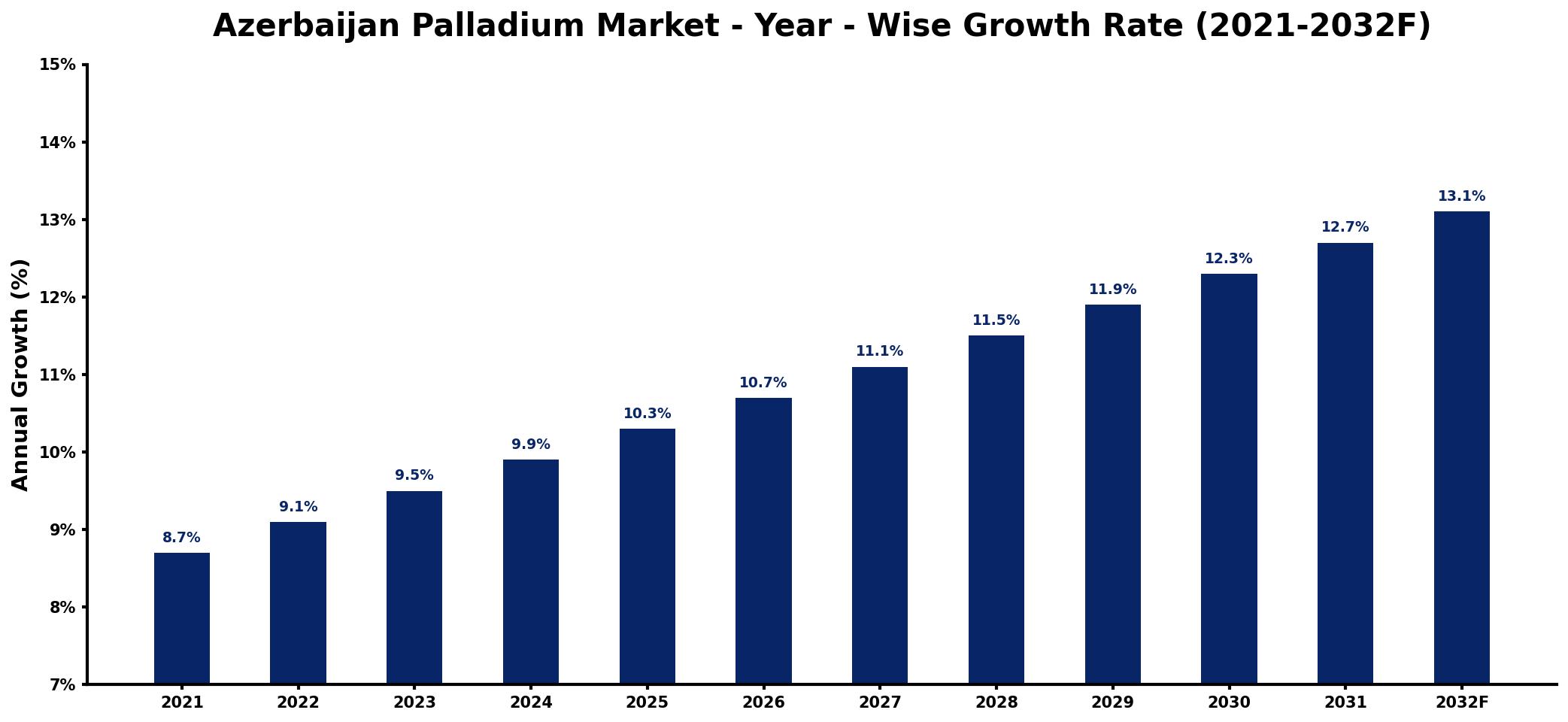
The table below presents the year‑wise growth rates along with the key drivers influencing the market
| Year | Growth Rate | Major Drivers |
| 2021 | 8.7% | Rising automotive catalytic converter demand |
| 2022 | 9.1% | Increased investment in green technologies |
| 2023 | 9.5% | Growing electronics manufacturing requirements |
| 2024 | 9.9% | Expansion of hydrogen fuel cells |
| 2025 | 10.3% | Boost in jewelry market interest |
| 2026 | 10.7% | Surge in industrial applications growth |
| 2027 | 11.1% | Increased aerospace industry utilization |
| 2028 | 11.5% | Enhanced demand for dental alloys |
| 2029 | 11.9% | Growth in renewable energy sectors |
| 2030 | 12.3% | Rising global industrial production levels |
| 2031 | 12.7% | increased overall sector activity |
| 2032 | 13.1% | Increased production of premium goods |
Note: Market size estimations and growth projections presented in this report are based on 6Wresearch's proprietary forecasting methodology, utilizing the latest available industry data, government publications, and primary research inputs.
Azerbaijan Palladium Market Synopsis
The Azerbaijan Palladium Market has gained significant momentum in recent years, largely due to the automotive sector's shift towards cleaner technologies. However, as global dynamics evolve, the market faces an inflection point where demand may fluctuate in response to regulatory changes and the rising trend of electric vehicles.
While the market shows promising growth, challenges such as reliance on imports and external price pressures remain critical factors influencing future stability. Stakeholders must navigate these complexities to capitalize on emerging opportunities and ensure sustainable development in this niche segment.
Azerbaijan Palladium Market Key Takeaways
- The market is heavily influenced by global palladium prices and the automotive industry's regulatory landscape.
- Increased demand for palladium in catalytic converters is propelling market growth.
- Investment in mining operations and futures trading presents significant opportunities for stakeholders.
- Government policies aim to foster a competitive and transparent market environment.
- The potential transition to electric vehicles may reshape future demand dynamics.
Evaluation of Restraints in Azerbaijan Palladium Market
The Azerbaijan Palladium Market is hindered by its limited domestic production capacity, resulting in a reliance on imports that exposes the market to price volatility. Furthermore, fluctuations in global palladium prices complicate cost predictions, making it difficult for local businesses to strategize effectively. There's also a concerning lack of awareness regarding palladium's potential as both an industrial metal and an investment, which stifles market expansion. Regulatory complexities and trade restrictions add another layer of challenges for businesses looking to enter or grow within the market.
Azerbaijan Palladium Market Trends
Current trends indicate a surge in palladium usage driven by global emissions standards, prompting manufacturers to integrate more of the metal into catalytic converters. Additionally, advancements in catalytic converter technology are likely to enhance the efficiency of palladium utilization, further supporting demand. Meanwhile, a growing emphasis on sustainable practices, coupled with the rise of electric vehicles, may eventually lead to a reevaluation of palladium's role within the automotive and related industries.
Azerbaijan Palladium Market Opportunities
The Azerbaijan Palladium Market presents several investment opportunities, particularly as the demand from the automotive sector continues to escalate. Stakeholders can explore avenues in palladium mining operations or consider investments in trading palladium futures and exchange-traded funds (ETFs). With the increasing regulatory focus on environmental sustainability, there is a long-term growth potential for investors looking to enter this market. Moreover, as Azerbaijan enhances its mining capabilities, opportunities for increased production and export could become lucrative.
Government Initiatives in the Azerbaijan Palladium Market
The Azerbaijani government has implemented policies designed to regulate and develop the palladium market. These include stringent licensing requirements for mining activities to ensure environmentally sustainable practices. Export controls are also in place to stabilize the market and prevent illegal trade. Furthermore, the government offers incentives, such as tax breaks, to attract foreign investment into the palladium sector, aligning its strategies with global best practices.
Future Insights of the Azerbaijan Palladium Market
The outlook for the Azerbaijan Palladium Market remains optimistic through 2026-2032, primarily driven by escalating global demand across industries such as automotive and electronics. Azerbaijan's considerable palladium reserves position it well for growth, particularly as the government continues to seek foreign investments. The anticipated shift toward greener technologies will likely bolster the demand for palladium in catalytic converters, sustaining its market relevance. However, stakeholders should be vigilant regarding potential geopolitical risks and environmental concerns that could shape future growth trajectories.
Azerbaijan Palladium Market Latest Developments (2025 - 2026)
Recent developments indicate a shift in industry focus towards sustainability within the Azerbaijan Palladium Market. Efforts are being made to enhance local mining capabilities and streamline regulatory processes, thereby attracting more investment. Simultaneously, industry stakeholders are closely monitoring global price trends and supply chain dynamics to better position themselves in the market. Partnerships with international organizations may also be explored to foster technological advancements and improve production methods.
Azerbaijan Palladium Market - Key Attractiveness of the Report
- 10 Years of Market Numbers
- Historical Data Starting from 2022 to 2025
- Base Year: 2025
- Forecast Data until 2032
- Key Performance Indicators Impacting the Market
- Major Upcoming Developments and Projects
Key Highlights of the Report:
- Azerbaijan Palladium Market Outlook
- Market Size of Azerbaijan Palladium Market, 2025
- Forecast of Azerbaijan Palladium Market, 2032
- Historical Data and Forecast of Azerbaijan Palladium Revenues & Volume for the Period 2022-2032F
- Azerbaijan Palladium Market Trend Evolution
- Azerbaijan Palladium Market Drivers and Challenges
- Azerbaijan Palladium Price Trends
- Azerbaijan Palladium Porter's Five Forces
- Azerbaijan Palladium Industry Life Cycle
- Historical Data and Forecast of Azerbaijan Palladium Market Revenues & Volume By Application for the Period 2022-2032F
- Historical Data and Forecast of Azerbaijan Palladium Market Revenues & Volume By Automotive for the Period 2022-2032F
- Historical Data and Forecast of Azerbaijan Palladium Market Revenues & Volume By Chemicals for the Period 2022-2032F
- Historical Data and Forecast of Azerbaijan Palladium Market Revenues & Volume By Electronics for the Period 2022-2032F
- Historical Data and Forecast of Azerbaijan Palladium Market Revenues & Volume By Medical for the Period 2022-2032F
- Historical Data and Forecast of Azerbaijan Palladium Market Revenues & Volume By Water Treatment for the Period 2022-2032F
- Azerbaijan Palladium Import Export Trade Statistics
- Market Opportunity Assessment By Application
- Azerbaijan Palladium Top Companies Market Share
- Azerbaijan Palladium Competitive Benchmarking By Technical and Operational Parameters
- Azerbaijan Palladium Company Profiles
- Azerbaijan Palladium Key Strategic Recommendations






































