Azerbaijan Perchloroethylene Market Size, Share & Growth Rate
The Azerbaijan Perchloroethylene Market was estimated at USD 449 Million in 2025 and is projected to reach USD 804 Million by 2032, growing at a CAGR of 8.7% from 2026 to 2032. This growth trajectory is predominantly driven by the expanding applications in the dry cleaning and industrial sectors, bolstered by Azerbaijans strategic position as a vital supplier to neighboring regions. Furthermore, increasing industrialization and technological advancements in production techniques are likely to enhance the market's appeal.
Azerbaijan Perchloroethylene Market Year-wise Growth Rate and Key Drivers
This graph highlights how the Azerbaijan Perchloroethylene Market has steadily grown over the years, supported by major growth factors.
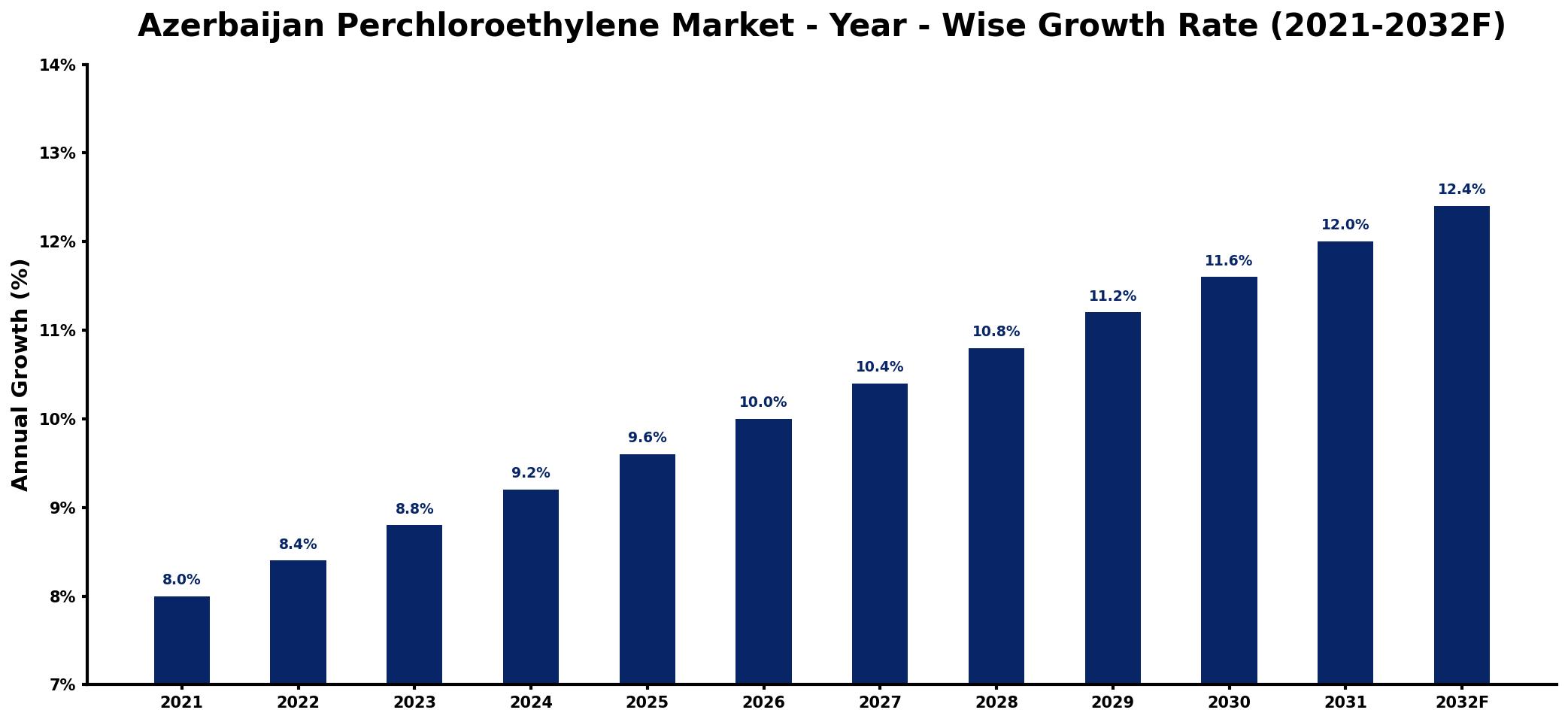
The table below presents the year‑wise growth rates along with the key drivers influencing the market
| Year | Growth Rate | Major Drivers |
| 2021 | 8.0% | Rising demand in cleaning industry |
| 2022 | 8.4% | Increased industrial manufacturing activities |
| 2023 | 8.8% | Growth in textile processing sector |
| 2024 | 9.2% | Expansion of automotive maintenance services |
| 2025 | 9.6% | Surge in electronics manufacturing needs |
| 2026 | 10.0% | Growing investments in chemical sector |
| 2027 | 10.4% | rising procurement volume requirements |
| 2028 | 10.8% | Higher demand for solvent applications |
| 2029 | 11.2% | Emerging markets driving consumption |
| 2030 | 11.6% | Technological advancements in production |
| 2031 | 12.0% | Strengthening regulatory frameworks supporting growth |
| 2032 | 12.4% | Increased focus on sustainability initiatives |
Note: Market size estimations and growth projections presented in this report are based on 6Wresearch's proprietary forecasting methodology, utilizing the latest available industry data, government publications, and primary research inputs.
Azerbaijan Perchloroethylene Market Synopsis
Azerbaijans Perchloroethylene market benefits significantly from its robust dry cleaning sector, which remains a primary consumer of this solvent. The countrys evolving textile and automotive industries are also emerging as noteworthy contributors to demand, showcasing a diverse utilization of perchloroethylene across various applications.
Moreover, the market landscape is characterized by a few dominant players who provide high-quality perchloroethylene products, catering to the specific requirements of industrial users. This consolidation allows for better quality control and innovation, further stimulating market growth in the coming years.
Azerbaijan Perchloroethylene Market Key Takeaways
- Robust growth driven by demand in dry cleaning and industrial applications.
- Strategic location enhances Azerbaijans role as a supplier to European and Asian markets.
- Growing investment in R&D to improve efficiency and reduce environmental impact.
- Government policies promoting sustainable practices and local production.
- Emergence of eco-friendly alternatives influencing market dynamics.
Evaluation of Restraints in Azerbaijan Perchloroethylene Market
Despite its growth potential, the Azerbaijan Perchloroethylene market faces several restraints, primarily stemming from stringent environmental regulations. The potential health risks associated with perchloroethylene usage have raised concerns among consumers and regulators alike. This environment could hinder market expansion as companies explore cleaner alternatives. Additionally, fluctuating raw material prices may affect profitability and operational stability, challenging industry players to adapt their strategies accordingly.
Azerbaijan Perchloroethylene Market Trends
A notable trend within the Azerbaijan Perchloroethylene market is the increasing shift towards sustainable and environmentally friendly practices. Stakeholders are actively seeking out eco-friendly alternatives, driven by growing consumer awareness and regulatory pressures. Technological advancements are facilitating the development of safer chemicals that align with these sustainable goals, ultimately influencing market preferences. Moreover, the rise in digital platforms for chemical transactions is streamlining the supply chain and improving market accessibility.
Azerbaijan Perchloroethylene Market Opportunities
The market presents lucrative investment opportunities, particularly in the realms of manufacturing and distribution networks. As Azerbaijan's industrial landscape continues to evolve, there is significant potential for new entrants to establish manufacturing facilities that cater specifically to the burgeoning demand from various sectors. Additionally, collaborations with local enterprises could enhance market penetration and operational efficiency. Investors should strategically navigate regulatory environments to capitalize on these opportunities for long-term growth.
Government Initiatives in the Azerbaijan Perchloroethylene Market
The Azerbaijani government is committed to fostering a competitive perchloroethylene market through a series of regulations and initiatives. By establishing quality standards for production and utilization, the government ensures that both environmental and health safety are prioritized. Incentives for local manufacturers are also in place, aimed at bolstering domestic production capabilities and reducing reliance on imports. Monitoring systems to oversee the transportation and disposal of perchloroethylene further demonstrate the government's dedication to sustainable industry practices.
Future Insights of the Azerbaijan Perchloroethylene Market
Looking ahead, the Azerbaijan Perchloroethylene market is poised for promising growth as the industrial sector expands. The ongoing demand from the textile, automotive, and dry cleaning industries is likely to sustain momentum in the coming years. Additionally, with a governmental focus on industrial diversification and foreign investment attraction, the market could see significant enhancements in production capabilities. Innovations and adherence to sustainable practices will play pivotal roles in shaping the future landscape of this market.
Azerbaijan Perchloroethylene Market Latest Developments (2025 - 2026)
In recent months, the Azerbaijan Perchloroethylene market has seen increased investments directed towards research and development efforts aimed at refining product safety and efficiency. Concurrently, various local enterprises are exploring partnerships to enhance their distribution capabilities, reflecting a growing trend toward collaborative business models. Additionally, environmental assessments are becoming more prevalent, aiming to align industry practices with sustainable standards.
Azerbaijan Perchloroethylene Market - Key Attractiveness of the Report
- 10 Years of Market Numbers
- Historical Data Starting from 2022 to 2025
- Base Year: 2025
- Forecast Data until 2032
- Key Performance Indicators Impacting the Market
- Major Upcoming Developments and Projects
Key Highlights of the Report:
- Azerbaijan Perchloroethylene Market Outlook
- Market Size of Azerbaijan Perchloroethylene Market, 2025
- Forecast of Azerbaijan Perchloroethylene Market, 2032
- Historical Data and Forecast of Azerbaijan Perchloroethylene Revenues & Volume for the Period 2022-2032F
- Azerbaijan Perchloroethylene Market Trend Evolution
- Azerbaijan Perchloroethylene Market Drivers and Challenges
- Azerbaijan Perchloroethylene Price Trends
- Azerbaijan Perchloroethylene Porter's Five Forces
- Azerbaijan Perchloroethylene Industry Life Cycle
- Historical Data and Forecast of Azerbaijan Perchloroethylene Market Revenues & Volume By Type for the Period 2022-2032F
- Historical Data and Forecast of Azerbaijan Perchloroethylene Market Revenues & Volume By Ethylene Oxychlorination for the Period 2022-2032F
- Historical Data and Forecast of Azerbaijan Perchloroethylene Market Revenues & Volume By Acetylene Method for the Period 2022-2032F
- Historical Data and Forecast of Azerbaijan Perchloroethylene Market Revenues & Volume By Ethylene Direct Chlorination for the Period 2022-2032F
- Historical Data and Forecast of Azerbaijan Perchloroethylene Market Revenues & Volume By End-use for the Period 2022-2032F
- Historical Data and Forecast of Azerbaijan Perchloroethylene Market Revenues & Volume By Dry Cleaning Agent for the Period 2022-2032F
- Historical Data and Forecast of Azerbaijan Perchloroethylene Market Revenues & Volume By Solvent for the Period 2022-2032F
- Historical Data and Forecast of Azerbaijan Perchloroethylene Market Revenues & Volume By Others for the Period 2022-2032F
- Azerbaijan Perchloroethylene Import Export Trade Statistics
- Market Opportunity Assessment By Type
- Market Opportunity Assessment By End-use
- Azerbaijan Perchloroethylene Top Companies Market Share
- Azerbaijan Perchloroethylene Competitive Benchmarking By Technical and Operational Parameters
- Azerbaijan Perchloroethylene Company Profiles
- Azerbaijan Perchloroethylene Key Strategic Recommendations






































