Azerbaijan Piano Market Size, Share & Growth Rate
The Azerbaijan Piano Market was estimated at USD 710 Million in 2025 and is projected to reach USD 1292 Million by 2032, growing at a CAGR of 8.9% from 2026 to 2032. This upward trajectory is significantly driven by a burgeoning interest in musical education and cultural activities, particularly among urban populations. As disposable incomes rise, both households and educational institutions are increasingly investing in high-quality pianos, further contributing to the market's expansion.
Azerbaijan Piano Market Year-wise Growth Rate and Key Drivers
This graph highlights how the Azerbaijan Piano Market has steadily grown over the years, supported by major growth factors.
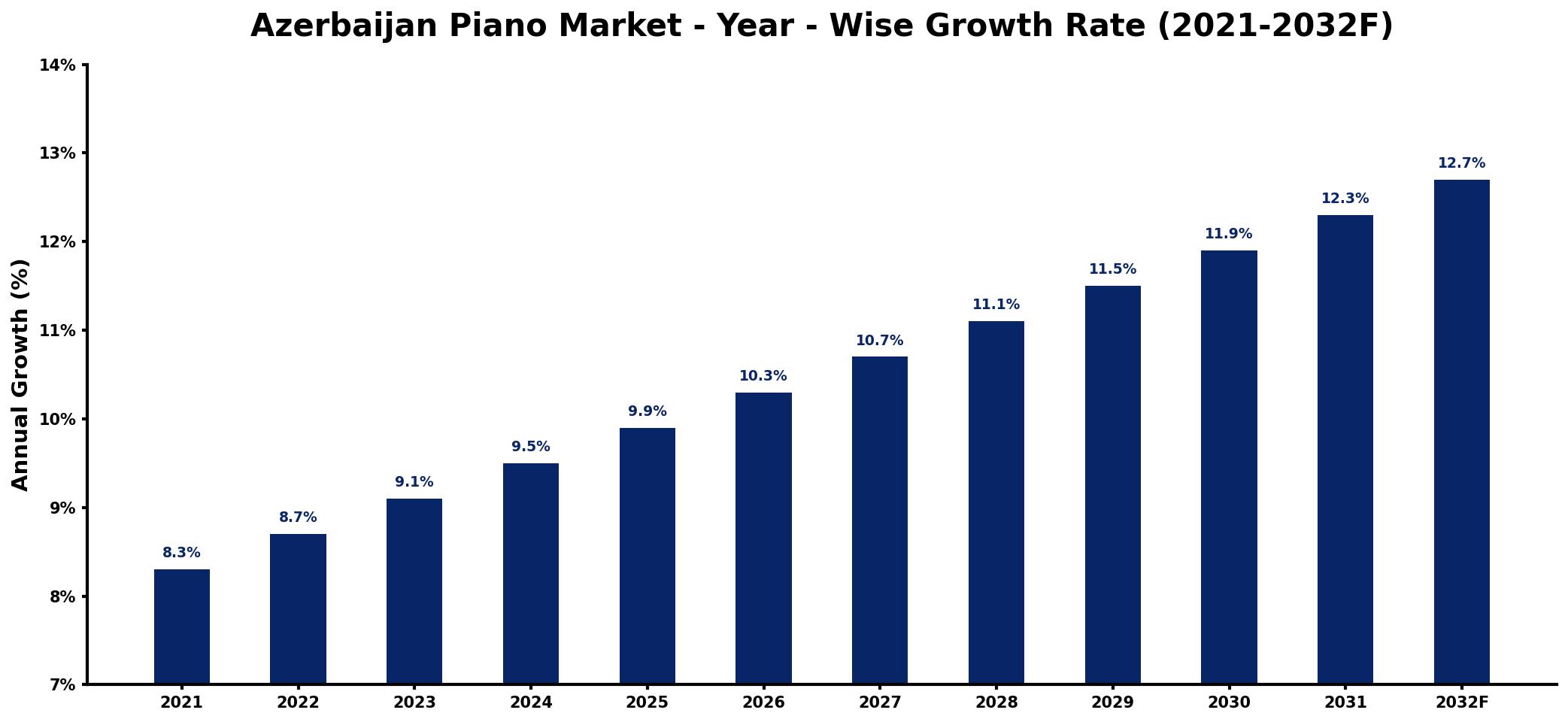
The table below presents the year‑wise growth rates along with the key drivers influencing the market
| Year | Growth Rate | Major Drivers |
| 2021 | 8.3% | rising interest in music education |
| 2022 | 8.7% | increased disposable income consumers |
| 2023 | 9.1% | growth in online music lessons |
| 2024 | 9.5% | expansion of music retail stores |
| 2025 | 9.9% | growing popularity of music events |
| 2026 | 10.3% | influx of foreign investments music |
| 2027 | 10.7% | emergence of music technology startups |
| 2028 | 11.1% | enhanced consumer awareness music benefits |
| 2029 | 11.5% | collaboration with educational institutions |
| 2030 | 11.9% | growth of home entertainment systems |
| 2031 | 12.3% | increase in cultural music festivals |
| 2032 | 12.7% | development of innovative music apps |
Note: Market size estimations and growth projections presented in this report are based on 6Wresearch's proprietary forecasting methodology, utilizing the latest available industry data, government publications, and primary research inputs.
Azerbaijan Piano Market Synopsis
The Azerbaijan Piano Market is uniquely characterized by a distinct demand for both traditional acoustic pianos and modern digital alternatives. Music schools and conservatories play a critical role in this dynamic, continually fostering a love for music among younger generations, thereby generating demand for quality instruments.
Additionally, affluent households show a keen interest in investing in pianos, viewing them as a symbol of cultural appreciation and personal enrichment. This cultural shift is coupled with an increasing awareness of the benefits of learning music, positioning the piano market as a vibrant sector within Azerbaijan's musical landscape.
Azerbaijan Piano Market Key Takeaways
- The market is driven by music education, with increasing enrollment in music schools and conservatories.
- Consumers show a rising preference for digital pianos due to their versatility and modern technology.
- Affluent households are investing in high-quality instruments, leading to a growing market for luxury pianos.
- Government initiatives supporting the arts are positively impacting consumer awareness and access to musical instruments.
- Online sales channels are expanding, allowing broader access to both digital and acoustic pianos.
Evaluation of Restraints in Azerbaijan Piano Market
Despite the promising outlook, the Azerbaijan Piano Market faces several constraints that could limit growth. Geographical barriers make the importation of high-quality instruments costly, resulting in higher retail prices that can deter potential buyers. Moreover, in certain regions, there is a notable lack of awareness regarding the cultural significance of classical music and pianos. This disconnect can hamper overall demand, particularly among younger demographics who may lean more towards contemporary music genres. Addressing these constraints through education and improved distribution channels will be crucial for unlocking the market's full potential.
Azerbaijan Piano Market Trends
Currently, the market is witnessing a surge in interest toward digital pianos, primarily due to their multifunctionality and the array of features they offer. As consumers seek portability and connectivity options, traditional acoustic pianos are experiencing increased competition. Furthermore, there is a growing trend toward sustainability; more buyers are actively seeking pianos made from ethically sourced materials. This not only caters to environmental concerns but also aligns with the emerging consumer preference for sustainable products.
Azerbaijan Piano Market Opportunities
Investment opportunities in the Azerbaijan Piano Market are ripe for those looking to capitalize on the increasing interest in musical education. With a burgeoning middle class and rising disposable incomes, importing and distributing high-quality instruments from established international brands presents a lucrative venture. Additionally, offering education and maintenance services can further enhance revenue streams. Strategic partnerships with local music schools for specialized programs can attract a wider customer base and strengthen community ties, creating long-term benefits for all stakeholders.
Government Initiatives in the Azerbaijan Piano Market
Government policies affecting the Azerbaijan Piano Market include import regulations and taxation policies that govern how musical instruments are brought into the country. Quality control measures ensure that pianos meet performance and safety standards, fostering consumer trust. Additionally, initiatives aimed at promoting the arts and supporting local cultural activities may include subsidies for music education, which indirectly boosts the demand for pianos. These policies are instrumental in shaping the market's landscape, influencing aspects such as pricing and product accessibility.
Future Insights of the Azerbaijan Piano Market
Looking ahead to 2026-2032, the Azerbaijan Piano Market is poised for steady growth. Urbanization and the expanding middle class will continue to drive demand for musical instruments, particularly in metropolitan areas. Enhanced government support for music education in schools will play a crucial role in fostering an appreciation for pianos and classical music. As international brands solidify their presence and local manufacturing capabilities improve, consumers will enjoy a diverse range of options, stimulating further competition and innovation within the market.
Azerbaijan Piano Market Latest Developments (2025 - 2026)
Recent developments in the Azerbaijan Piano Market indicate a shift towards digital marketing strategies, as retailers increasingly leverage online platforms to engage a broader audience. Additionally, collaborative efforts between music schools and manufacturers are on the rise, aimed at enhancing consumer education regarding the benefits of investing in quality pianos. These initiatives are expected to bolster community interest in musical activities and encourage greater participation in the arts.
Azerbaijan Piano Market - Key Attractiveness of the Report
- 10 Years of Market Numbers
- Historical Data Starting from 2022 to 2025
- Base Year: 2025
- Forecast Data until 2032
- Key Performance Indicators Impacting the Market
- Major Upcoming Developments and Projects
Key Highlights of the Report:
- Azerbaijan Piano Market Outlook
- Market Size of Azerbaijan Piano Market, 2025
- Forecast of Azerbaijan Piano Market, 2032
- Historical Data and Forecast of Azerbaijan Piano Revenues & Volume for the Period 2022-2032F
- Azerbaijan Piano Market Trend Evolution
- Azerbaijan Piano Market Drivers and Challenges
- Azerbaijan Piano Price Trends
- Azerbaijan Piano Porter's Five Forces
- Azerbaijan Piano Industry Life Cycle
- Historical Data and Forecast of Azerbaijan Piano Market Revenues & Volume By Type for the Period 2022-2032F
- Historical Data and Forecast of Azerbaijan Piano Market Revenues & Volume By Grand Piano for the Period 2022-2032F
- Historical Data and Forecast of Azerbaijan Piano Market Revenues & Volume By Upright Piano for the Period 2022-2032F
- Historical Data and Forecast of Azerbaijan Piano Market Revenues & Volume By Application for the Period 2022-2032F
- Historical Data and Forecast of Azerbaijan Piano Market Revenues & Volume By Learning and Teaching for the Period 2022-2032F
- Historical Data and Forecast of Azerbaijan Piano Market Revenues & Volume By Entertainment for the Period 2022-2032F
- Historical Data and Forecast of Azerbaijan Piano Market Revenues & Volume By Other for the Period 2022-2032F
- Azerbaijan Piano Import Export Trade Statistics
- Market Opportunity Assessment By Type
- Market Opportunity Assessment By Application
- Azerbaijan Piano Top Companies Market Share
- Azerbaijan Piano Competitive Benchmarking By Technical and Operational Parameters
- Azerbaijan Piano Company Profiles
- Azerbaijan Piano Key Strategic Recommendations






































