Azerbaijan Planting Equipment Market Size, Share & Growth Rate
The Azerbaijan Planting Equipment Market was estimated at USD 931 Million in 2025 and is projected to reach USD 1722 Million by 2032, growing at a CAGR of 9.2% from 2026 to 2032. This growth trajectory is primarily fueled by the increasing mechanization of agriculture and the government's push towards adopting modern farming practices. The demand for high-quality crops and the integration of digital technologies into planting processes further augment this upward momentum.
Azerbaijan Planting Equipment Market Year-wise Growth Rate and Key Drivers
This graph highlights how the Azerbaijan Planting Equipment Market has steadily grown over the years, supported by major growth factors.
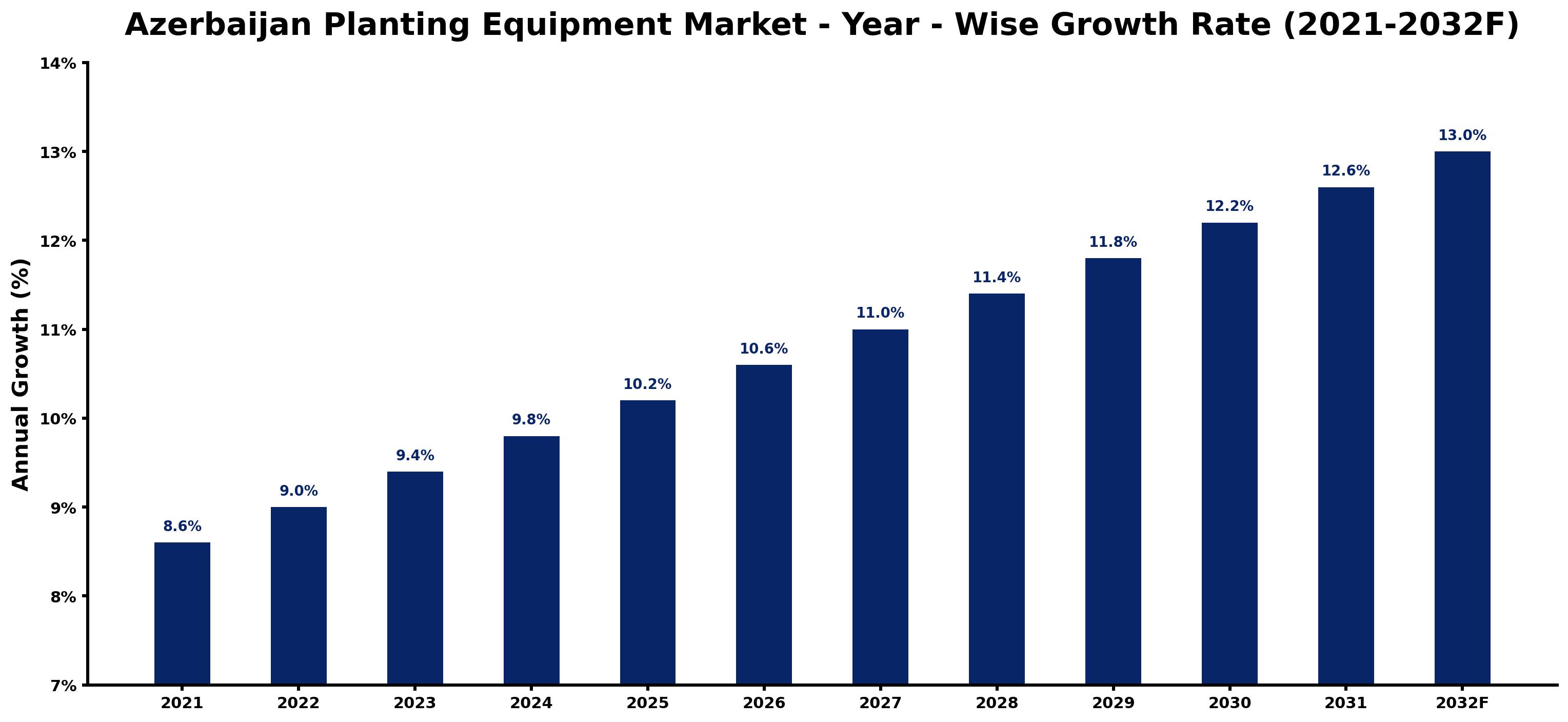
The table below presents the year‑wise growth rates along with the key drivers influencing the market
| Year | Growth Rate | Major Drivers |
| 2021 | 8.6% | Increasing smart city development projects |
| 2022 | 9.0% | Expansion of commercial construction activities |
| 2023 | 9.4% | Government infrastructure modernization initiatives |
| 2024 | 9.8% | Government infrastructure modernization initiatives |
| 2025 | 10.2% | Increasing industrial infrastructure investments |
| 2026 | 10.6% | Growing renewable energy integration projects |
| 2027 | 11.0% | Increasing smart city development projects |
| 2028 | 11.4% | Increasing smart city development projects |
| 2029 | 11.8% | Growing renewable energy integration projects |
| 2030 | 12.2% | Growing renewable energy integration projects |
| 2031 | 12.6% | Increasing industrial infrastructure investments |
| 2032 | 13.0% | Growing renewable energy integration projects |
Note - Market size estimations and growth projections presented in this report are based on 6Wresearch's advanced forecasting approach, validated with industry datasets as of June 2026.
Azerbaijan Planting Equipment Market Synopsis
The most significant force shaping the Azerbaijan Planting Equipment Market is the ongoing transition towards modern agricultural practices. Farmers are increasingly recognizing the value of advanced planting equipment, which enhances crop yields and efficiency while reducing labor reliance.
In addition to mechanization, digitalization plays a pivotal role in transforming planting operations. The trend towards precision agriculture is gaining traction, enabling farmers to optimize planting through data analytics and automated systems.
Azerbaijan Planting Equipment Market Key Takeaways
- The market is witnessing a shift towards precision planting technologies, driven by farmer demand for efficiency.
- Government initiatives are crucial in promoting mechanization and modern agricultural practices.
- Digitalization and automation are becoming key components of planting equipment, enhancing operational accuracy.
- Sustainability concerns are influencing equipment design, with a focus on minimizing soil compaction and chemical use.
- Investment opportunities exist in providing innovative and advanced planting solutions tailored to local needs.
Evaluation of Restraints in Azerbaijan Planting Equipment Market
Despite the promising outlook, the Azerbaijan Planting Equipment Market faces several restraints that could impede growth. Limited access to advanced technologies and modern machinery hampers farmers' ability to transition from traditional methods. Additionally, inadequate infrastructure and high acquisition costs of mechanized equipment create barriers for widespread adoption. Coupled with fluctuating weather patterns and a shortage of skilled labor, these challenges could slow the progress needed for increased efficiency in agricultural practices.
Azerbaijan Planting Equipment Market Trends
Current trends in the Azerbaijan Planting Equipment Market highlight a growing preference for innovative machinery designed for precision agriculture. Farmers are increasingly seeking equipment that allows for accurate seed placement, optimized fertilizer application, and reduced environmental impact. Furthermore, the integration of smart technologies and data analytics systems into planting equipment is poised to revolutionize agricultural efficiency, enabling farmers to make informed decisions based on real-time data.
Azerbaijan Planting Equipment Market Opportunities
Significant investment opportunities exist within the Azerbaijan Planting Equipment Market, particularly as the country seeks to modernize its agricultural sector. The demand for advanced planting machinery presents avenues for investment in high-quality manufacturing and distribution of precision equipment. Additionally, providing financial solutions such as leasing or financing options could cater to the needs of farmers hesitant to invest upfront. Collaborating with local agricultural businesses and government initiatives offers promising potential for successful market entry.
Government Initiatives in the Azerbaijan Planting Equipment Market
The Azerbaijani government has implemented several initiatives aimed at revitalizing the agriculture sector through modern equipment. These policies include financial support and subsidies for farmers investing in advanced planting machinery, promoting technological adoption, and enhancing credit accessibility for equipment purchases. Furthermore, the government is committed to improving agricultural infrastructure and training programs to support efficient utilization of planting technologies, ultimately fostering a robust environment for growth in the planting equipment market.
Future Insights of the Azerbaijan Planting Equipment Market
Looking ahead to 2026-2032, the Azerbaijan Planting Equipment Market is on track for sustained growth. The increasing mechanization of agriculture, coupled with rising demand for efficient and high-yield farming techniques, will drive market expansion. Moreover, technological advancements, particularly in precision planting and smart farming solutions, are set to revolutionize planting operations. As government initiatives continue to support modernization, the landscape for planting equipment is poised for exciting developments in the coming years.
Azerbaijan Planting Equipment Market Latest Developments (May 2025 - June 2026)
In recent months, the Azerbaijan Planting Equipment Market has seen a notable increase in the introduction of precision agricultural technologies. Companies are launching new models of planting machinery that integrate advanced analytics and automation features. Additionally, public-private partnerships are being established to improve infrastructure and provide training for farmers on the latest equipment usage. The focus on sustainability is also gaining traction, with manufacturers developing eco-friendly planting solutions that align with environmental goals.
Azerbaijan Planting Equipment Market - Key Attractiveness of the Report
- 10 Years of Market Numbers
- Historical Data Starting from 2022 to 2025
- Base Year: 2025
- Forecast Data until 2032
- Key Performance Indicators Impacting the Market
- Major Upcoming Developments and Projects
Key Highlights of the Report:
- Azerbaijan Planting Equipment Market Outlook
- Market Size of Azerbaijan Planting Equipment Market, 2025
- Forecast of Azerbaijan Planting Equipment Market, 2032
- Historical Data and Forecast of Azerbaijan Planting Equipment Revenues & Volume for the Period 2022-2032F
- Azerbaijan Planting Equipment Market Trend Evolution
- Azerbaijan Planting Equipment Market Drivers and Challenges
- Azerbaijan Planting Equipment Price Trends
- Azerbaijan Planting Equipment Porter's Five Forces
- Azerbaijan Planting Equipment Industry Life Cycle
- Historical Data and Forecast of Azerbaijan Planting Equipment Market Revenues & Volume By Type for the Period 2022-2032F
- Historical Data and Forecast of Azerbaijan Planting Equipment Market Revenues & Volume By Air seeders for the Period 2022-2032F
- Historical Data and Forecast of Azerbaijan Planting Equipment Market Revenues & Volume By Seed drills for the Period 2022-2032F
- Historical Data and Forecast of Azerbaijan Planting Equipment Market Revenues & Volume By Planters for the Period 2022-2032F
- Historical Data and Forecast of Azerbaijan Planting Equipment Market Revenues & Volume By Others for the Period 2022-2032F
- Historical Data and Forecast of Azerbaijan Planting Equipment Market Revenues & Volume By Design for the Period 2022-2032F
- Historical Data and Forecast of Azerbaijan Planting Equipment Market Revenues & Volume By Mechanical for the Period 2022-2032F
- Historical Data and Forecast of Azerbaijan Planting Equipment Market Revenues & Volume By Automatic for the Period 2022-2032F
- Historical Data and Forecast of Azerbaijan Planting Equipment Market Revenues & Volume By Crop Type for the Period 2022-2032F
- Historical Data and Forecast of Azerbaijan Planting Equipment Market Revenues & Volume By Cereals & grains for the Period 2022-2032F
- Historical Data and Forecast of Azerbaijan Planting Equipment Market Revenues & Volume By Oilseeds & pulses for the Period 2022-2032F
- Historical Data and Forecast of Azerbaijan Planting Equipment Market Revenues & Volume By Fruits & vegetables for the Period 2022-2032F
- Historical Data and Forecast of Azerbaijan Planting Equipment Market Revenues & Volume By Others for the Period 2022-2032F
- Azerbaijan Planting Equipment Import Export Trade Statistics
- Market Opportunity Assessment By Type
- Market Opportunity Assessment By Design
- Market Opportunity Assessment By Crop Type
- Azerbaijan Planting Equipment Top Companies Market Share
- Azerbaijan Planting Equipment Competitive Benchmarking By Technical and Operational Parameters
- Azerbaijan Planting Equipment Company Profiles
- Azerbaijan Planting Equipment Key Strategic Recommendations






































