Azerbaijan Ploughing and Cultivating Machinery Market Size, Share & Growth Rate
The Azerbaijan Ploughing and Cultivating Machinery Market was estimated at USD 433 Million in 2025 and is projected to reach USD 805 Million by 2032, growing at a CAGR of 9.3% from 2026 to 2032. This upward trajectory is underpinned by the increasing mechanization of agriculture, bolstered by government incentives aimed at modernizing the agricultural sector. Furthermore, the growing demand for efficiency, productivity, and environmentally sustainable practices among Azerbaijani farmers is significantly propelling market expansion.
Azerbaijan Ploughing and Cultivating Machinery Market Year-wise Growth Rate and Key Drivers
This graph highlights how the Azerbaijan Ploughing and Cultivating Machinery Market has steadily grown over the years, supported by major growth factors.
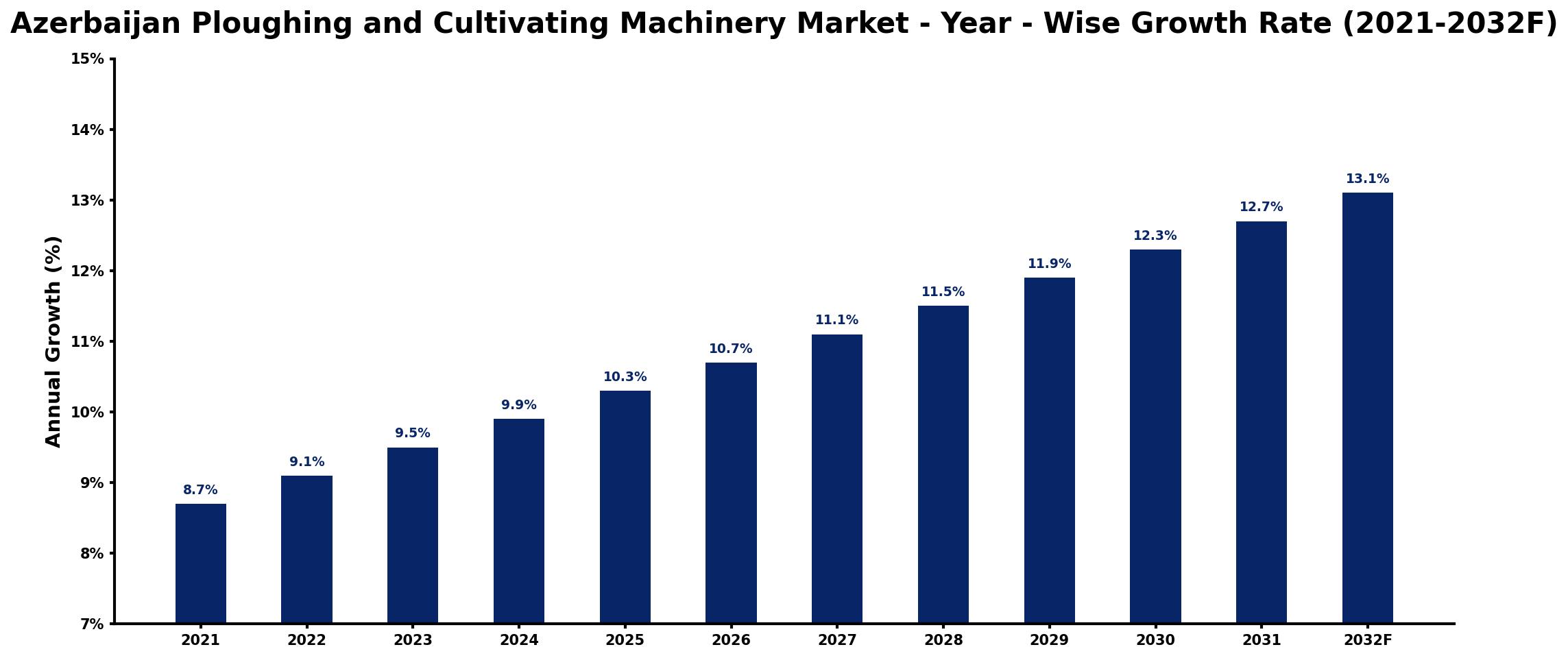
The table below presents the year‑wise growth rates along with the key drivers influencing the market
| Year | Growth Rate | Major Drivers |
| 2021 | 8.7% | Rising agricultural investment trends |
| 2022 | 9.1% | Increased demand for automation |
| 2023 | 9.5% | Growing interest in precision farming |
| 2024 | 9.9% | Expansion of rural development programs |
| 2025 | 10.3% | Technological advancements in equipment |
| 2026 | 10.7% | Higher crop yield expectations |
| 2027 | 11.1% | Boost in exports of produce |
| 2028 | 11.5% | Government support for agribusiness |
| 2029 | 11.9% | Emergence of sustainable practices |
| 2030 | 12.3% | Enhanced financing options available |
| 2031 | 12.7% | Rising global food consumption rates |
| 2032 | 13.1% | Diversification of agricultural operations |
Note: Market size estimations and growth projections presented in this report are based on 6Wresearch's proprietary forecasting methodology, utilizing the latest available industry data, government publications, and primary research inputs.
Azerbaijan Ploughing and Cultivating Machinery Market Synopsis
Azerbaijan's ploughing and cultivating machinery market is currently in a phase of dynamic transformation, heavily influenced by the country's commitment to enhancing agricultural efficiency. As local and international manufacturers introduce more sophisticated machinery, the landscape is becoming increasingly competitive and innovative.
The markets evolution is characterized by a surge in the adoption of advanced technologies, including precision farming tools that enable better crop management and resource use. With both local and global players striving to meet this demand, opportunities for growth abound, positioning Azerbaijan as a significant player in the agricultural machinery sector.
Azerbaijan Ploughing and Cultivating Machinery Market Key Takeaways
- The market is projected to grow significantly, driven by mechanization trends and technological adoption.
- Increased government support and incentives are facilitating investments in modern agricultural machinery.
- There is a notable shift towards precision farming technologies, enhancing operational efficiency.
- Demand for eco-friendly solutions is on the rise, reflecting global agricultural sustainability trends.
- Investment opportunities exist in high-quality machinery and after-sales support services.
Evaluation of Restraints in Azerbaijan Ploughing and Cultivating Machinery Market
Despite the promising outlook, the Azerbaijan Ploughing and Cultivating Machinery Market faces several constraints that hinder its progress. Limited access to modern technology and machinery poses a challenge for many farmers, who may lack the financial resources needed for substantial investments. Infrastructure inadequacies further complicate agricultural operations, impacting efficiency and productivity. Additionally, the fluctuating prices of agricultural products may deter farmers from upgrading their equipment, coupled with a shortage of skilled labor adept at operating contemporary agricultural machinery.
Azerbaijan Ploughing and Cultivating Machinery Market Trends
The market is witnessing a pronounced shift towards advanced machinery equipped with precision technologies. Farmers increasingly embrace GPS guidance systems and automated controls to optimize efficiency and yield. As environmental awareness rises, the demand for sustainable machinery solutions that mitigate soil erosion and improve land usage is gaining traction. This trend reflects a broader shift towards responsible farming practices aimed at long-term agricultural sustainability.
Azerbaijan Ploughing and Cultivating Machinery Market Opportunities
Opportunities abound within the Azerbaijan ploughing and cultivating machinery market, particularly as the government prioritizes agricultural modernization. Investors can capitalize on the need for innovative, technology-driven solutions tailored for precision agriculture. The rising demand for quality after-sales support and technical assistance further presents avenues for growth. Collaborations with local agricultural businesses can enhance the market presence, while government initiatives provide a conducive environment for investment and development.
Government Initiatives in the Azerbaijan Ploughing and Cultivating Machinery Market
The Azerbaijani government has embarked on a series of initiatives designed to support the ploughing and cultivating machinery market. These initiatives include subsidies and financial incentives aimed at encouraging farmers to invest in modern equipment. Furthermore, the government promotes research and development within the sector and fosters partnerships with international firms to facilitate technology transfer. Such policies reflect a comprehensive strategy to enhance agricultural productivity while ensuring quality and safety standards for machinery.
Future Insights of the Azerbaijan Ploughing and Cultivating Machinery Market
Looking ahead to the period from 2026 to 2032, the Azerbaijan Ploughing and Cultivating Machinery Market is poised for robust growth. The ongoing commitment to agricultural mechanization and technological advancements will likely drive demand for innovative machinery. Additionally, the emphasis on food security and productivity enhancement will motivate further investments, creating a conducive environment for both local and foreign companies to thrive within this evolving landscape.
Azerbaijan Ploughing and Cultivating Machinery Market Latest Developments (2025 - 2026)
Recent developments indicate a strategic pivot in the Azerbaijan ploughing and cultivating machinery market towards the integration of digital technologies and sustainable practices. Industry stakeholders are increasingly focused on developing machinery that meets the modern demands of efficiency and environmental responsibility. Ongoing collaborations between local manufacturers and international entities are fostering innovation and enhancing the overall quality of agricultural equipment available in the market.
Azerbaijan Ploughing and Cultivating Machinery Market - Key Attractiveness of the Report
- 10 Years of Market Numbers
- Historical Data Starting from 2022 to 2025
- Base Year: 2025
- Forecast Data until 2032
- Key Performance Indicators Impacting the Market
- Major Upcoming Developments and Projects
Key Highlights of the Report:
- Azerbaijan Ploughing and Cultivating Machinery Market Outlook
- Market Size of Azerbaijan Ploughing and Cultivating Machinery Market, 2025
- Forecast of Azerbaijan Ploughing and Cultivating Machinery Market, 2032
- Historical Data and Forecast of Azerbaijan Ploughing and Cultivating Machinery Revenues & Volume for the Period 2022-2032F
- Azerbaijan Ploughing and Cultivating Machinery Market Trend Evolution
- Azerbaijan Ploughing and Cultivating Machinery Market Drivers and Challenges
- Azerbaijan Ploughing and Cultivating Machinery Price Trends
- Azerbaijan Ploughing and Cultivating Machinery Porter's Five Forces
- Azerbaijan Ploughing and Cultivating Machinery Industry Life Cycle
- Historical Data and Forecast of Azerbaijan Ploughing and Cultivating Machinery Market Revenues & Volume By Type for the Period 2022-2032F
- Historical Data and Forecast of Azerbaijan Ploughing and Cultivating Machinery Market Revenues & Volume By Ploughs for the Period 2022-2032F
- Historical Data and Forecast of Azerbaijan Ploughing and Cultivating Machinery Market Revenues & Volume By Harrows for the Period 2022-2032F
- Historical Data and Forecast of Azerbaijan Ploughing and Cultivating Machinery Market Revenues & Volume By Others for the Period 2022-2032F
- Historical Data and Forecast of Azerbaijan Ploughing and Cultivating Machinery Market Revenues & Volume By Application for the Period 2022-2032F
- Historical Data and Forecast of Azerbaijan Ploughing and Cultivating Machinery Market Revenues & Volume By Soil Loosening for the Period 2022-2032F
- Historical Data and Forecast of Azerbaijan Ploughing and Cultivating Machinery Market Revenues & Volume By Clod Size Reduction for the Period 2022-2032F
- Historical Data and Forecast of Azerbaijan Ploughing and Cultivating Machinery Market Revenues & Volume By Clod Sorting for the Period 2022-2032F
- Historical Data and Forecast of Azerbaijan Ploughing and Cultivating Machinery Market Revenues & Volume By Others for the Period 2022-2032F
- Azerbaijan Ploughing and Cultivating Machinery Import Export Trade Statistics
- Market Opportunity Assessment By Type
- Market Opportunity Assessment By Application
- Azerbaijan Ploughing and Cultivating Machinery Top Companies Market Share
- Azerbaijan Ploughing and Cultivating Machinery Competitive Benchmarking By Technical and Operational Parameters
- Azerbaijan Ploughing and Cultivating Machinery Company Profiles
- Azerbaijan Ploughing and Cultivating Machinery Key Strategic Recommendations






































