Azerbaijan Policy Management in Telecom Market Size & Growth Rate (2026-2032)
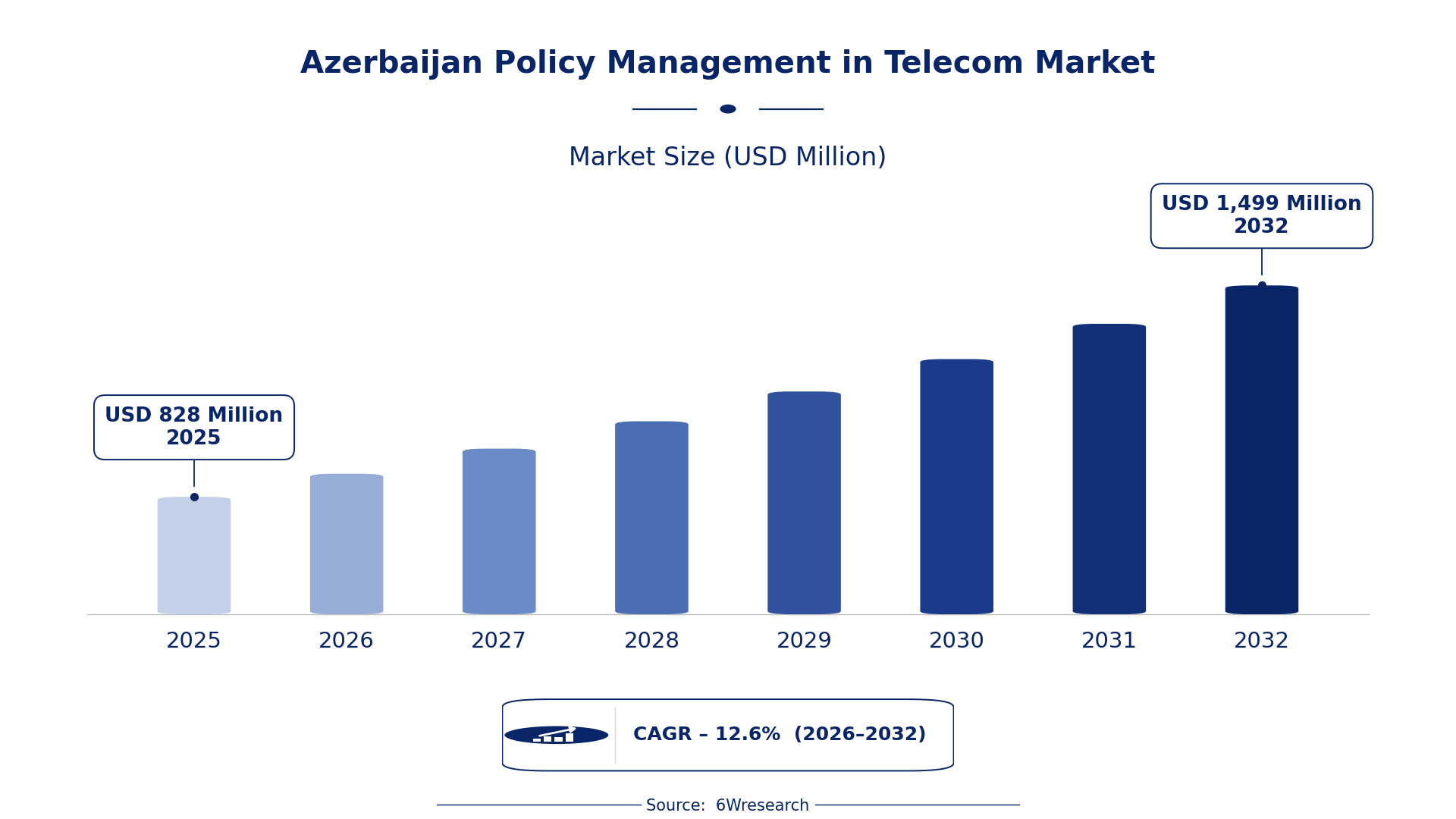
The Azerbaijan Policy Management in Telecom Market was estimated at USD 828 Million in 2025 and is projected to reach USD 1499 Million by 2032, growing at a CAGR of 12.6% from 2026 to 2032.
Azerbaijan Policy Management in Telecom Market Synopsis
The Azerbaijan Policy Management in Telecom Market has gained considerable momentum in recent years, driven by a unique blend of regulatory changes and technological shifts. Currently, telecom operators are under pressure to innovate while maintaining compliance with increasingly complex policies.
Looking ahead, the market is set to evolve significantly, shaped by consumer demands for personalized services and the rapid deployment of 5G technologies. As operators adapt their strategies to meet these challenges, the emphasis on sophisticated policy management solutions will become even more critical.
Azerbaijan Policy Management in Telecom Market Year-wise Growth Rate and Key Drivers
This graph illustrates the annual growth rates of the Azerbaijan Policy Management in Telecom Market from 2021 to 2032, highlighting a steady upward trajectory and projected expansion over the forecast period.
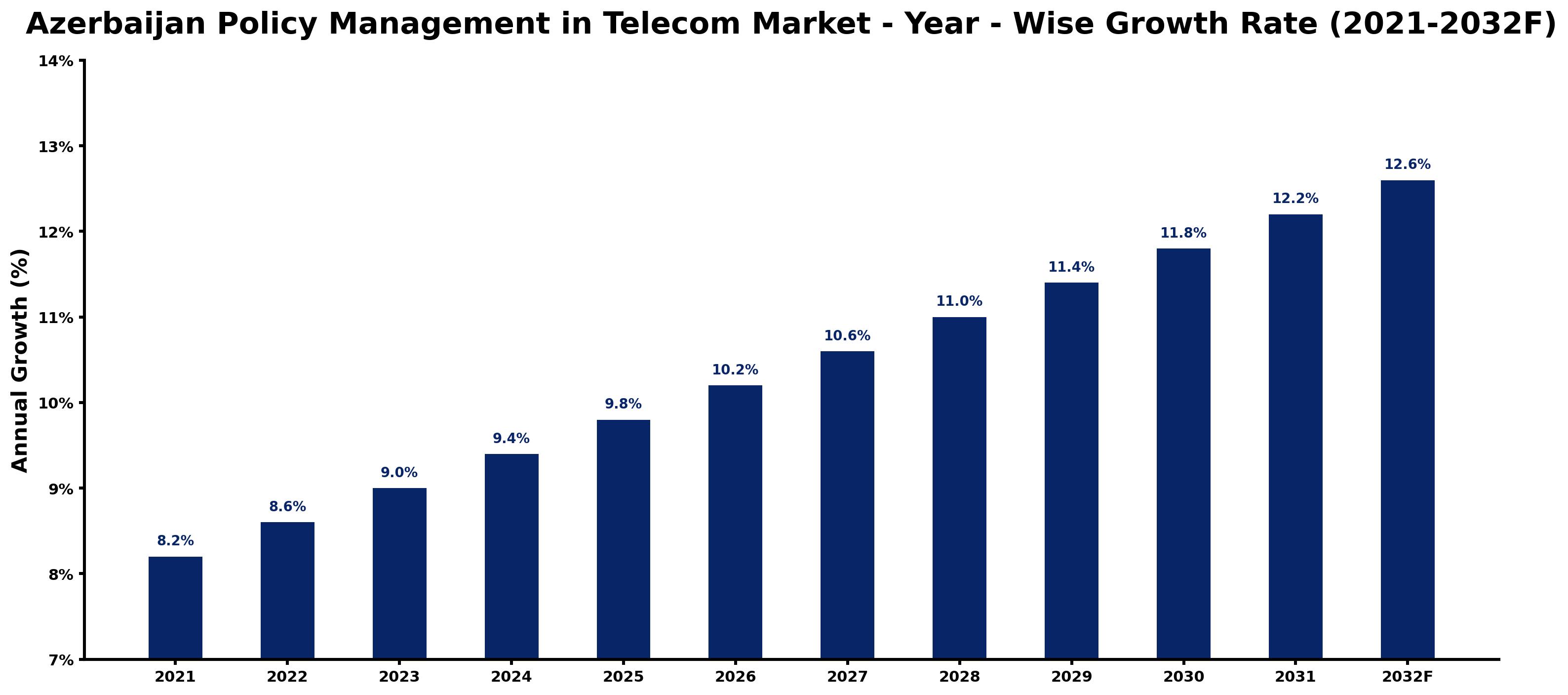
The table below presents the year‑wise growth rates along with the key drivers influencing the market
| Year | Growth Rate | Major Drivers |
| 2021 | 8.2% | Regulatory guidance from the Ministry of Transport for telecom. |
| 2022 | 8.6% | Adoption of e-government services boosting telecom engagement. |
| 2023 | 9.0% | Increased competition among telecom providers driving innovation. |
| 2024 | 9.4% | Investment in cybersecurity by local telecom operators rising. |
| 2025 | 9.8% | Telecom sector benefited from Azerbaijan's digital economy strategy. |
| 2026 | 10.2% | Emerging demand for 5G services in urban areas. |
| 2027 | 10.6% | Government support for telecom infrastructure through subsidies. |
| 2028 | 11.0% | Rise in smartphone usage enhancing mobile data consumption. |
| 2029 | 11.4% | Collaborations between telecom and fintech improving service delivery. |
| 2030 | 11.8% | Local startups entering telecom market with innovative solutions. |
| 2031 | 12.2% | Introduction of new policies promoting mobile virtual network operators. |
| 2032 | 12.6% | Growing consumer preference for bundled telecom service packages. |
Note: Market size estimations and growth projections presented in this report are based on 6Wresearch's proprietary forecasting methodology, utilizing the latest available industry data, government publications, and primary research inputs.
Azerbaijan Policy Management in Telecom Market Key Takeaways
Below are some of the specific key takeaways from the market, including:
- The growing complexity of regulatory requirements is pushing telecom operators to invest heavily in policy management systems.
- Technological advancements, particularly in mobile broadband and IoT, are fueling demand for real-time policy enforcement solutions.
- Government initiatives aimed at enhancing digital infrastructure are creating further opportunities for market expansion.
- Competition among telecom operators is intensifying, leading to greater focus on innovative policy management solutions.
- Consumer demand for enhanced quality of service is compelling operators to refine their network management strategies.
Evaluation of Restraints in Azerbaijan Policy Management in Telecom Market
A number of factors are currently restraining growth in the Azerbaijan Policy Management in Telecom Market. First and foremost, the intricate web of regulatory compliance remains a daunting challenge for telecom operators. Navigating various licensing requirements, data privacy laws, and consumer protection regulations requires not just vigilance but also agility in operations.
The rapid evolution of technology, particularly with the advent of 5G, presents another layer of difficulty. Operators are compelled to invest in dynamic policy management solutions that can address the increasing volume of network traffic and evolving consumer needs. This scenario inevitably raises questions about resource allocation and operational efficiency.
Azerbaijan Policy Management in Telecom Market Trends
Several trends are reshaping the Azerbaijan Policy Management in Telecom Market. A notable trend is the demand for personalized services that require advanced policy management systems to enable tailored customer experiences. Operators are increasingly looking to implement real-time charging systems to enhance customer satisfaction and loyalty.
In addition, the integration of artificial intelligence and machine learning in policy management tools is gaining traction. This allows for more efficient data analysis, predictive modeling, and proactive network management. The drive toward automation in policy enforcement is expected to become a defining feature of the market.
Azerbaijan Policy Management in Telecom Market Opportunities
The potential for growth in the Azerbaijan Policy Management in Telecom Market is significant, particularly as digital transformation accelerates. Investment opportunities are abundant in sectors such as IoT connectivity and mobile broadband, where policy management solutions can be effectively applied.
Furthermore, partnerships between telecom operators and technology vendors can lead to innovative solutions tailored to the unique challenges of Azerbaijan's regulatory environment. The increasing emphasis on data privacy and consumer protection presents an avenue for policy management systems that can ensure compliance while optimizing performance.
Government Initiatives in the Azerbaijan Policy Management in Telecom Market
The Azerbaijani government is actively involved in shaping the future of its telecommunications sector. Through various policy initiatives, the government is fostering a competitive environment that supports the growth of policy management solutions. As digital inclusion and consumer protection remain high on the agenda, these initiatives are vital for the market's evolution.
- A regulatory framework established in 2024 aimed at enhancing consumer rights in telecommunications, promoting transparency and accountability.
- A national digital infrastructure upgrade programme currently underway, designed to improve connectivity and access across urban and rural areas.
- An investment incentive scheme introduced in early 2025 to attract private investment in telecom infrastructure development.
- A planned regulatory review process in 2026 intended to streamline licensing and spectrum allocation procedures for telecom operators.
Future Insights of the Azerbaijan Policy Management in Telecom Market
From 2026 to 2032, the Azerbaijan Policy Management in Telecom Market is anticipated to undergo transformative changes. The focus will increasingly shift toward compliance and quality of service, supported by advanced policy management systems that cater to the rapid advancements in technology.
Operators will need to prioritize flexibility and adaptability, as new consumer expectations and regulatory requirements emerge. A forward-thinking approach that embraces innovation will determine market success, providing opportunities for those willing to invest in the future.
Azerbaijan Policy Management in Telecom Market Latest Developments
Recent developments in the Azerbaijan Policy Management in Telecom Market indicate a vibrant period of activity. In the last year, several telecom operators have started implementing enhanced policy management systems to adapt to regulatory changes and consumer demands.
- A major technology vendor launched an advanced policy management solution in Q3 2025, aimed at improving operational efficiency for telecom operators.
- A regional operator commenced an ongoing initiative in early 2025 to automate their policy enforcement capabilities, enhancing network performance.
- An upcoming rollout is planned for mid-2026, focusing on integrating AI-driven analytics into existing policy management systems to better respond to customer needs.
- By late 2025, a leading telecom operator completed a nationwide deployment of a unified platform for real-time billing and service quality monitoring.
Azerbaijan Policy Management in Telecom Market - Key Attractiveness of the Report
- 10 Years of Market Numbers
- Historical Data Starting from 2022 to 2025
- Base Year: 2025
- Forecast Data until 2032
- Key Performance Indicators Impacting the Market
- Major Upcoming Developments and Projects
Key Highlights of the Report:
- Azerbaijan Policy Management in Telecom Market Outlook
- Market Size of Azerbaijan Policy Management in Telecom Market, 2025
- Forecast of Azerbaijan Policy Management in Telecom Market, 2032
- Historical Data and Forecast of Azerbaijan Policy Management in Telecom Revenues & Volume for the Period 2022-2032F
- Azerbaijan Policy Management in Telecom Market Trend Evolution
- Azerbaijan Policy Management in Telecom Market Drivers and Challenges
- Azerbaijan Policy Management in Telecom Price Trends
- Azerbaijan Policy Management in Telecom Porter's Five Forces
- Azerbaijan Policy Management in Telecom Industry Life Cycle
- Historical Data and Forecast of Azerbaijan Policy Management in Telecom Market Revenues & Volume By Network for the Period 2022-2032F
- Historical Data and Forecast of Azerbaijan Policy Management in Telecom Market Revenues & Volume By Fixed for the Period 2022-2032F
- Historical Data and Forecast of Azerbaijan Policy Management in Telecom Market Revenues & Volume By Wireless for the Period 2022-2032F
- Historical Data and Forecast of Azerbaijan Policy Management in Telecom Market Revenues & Volume By Component for the Period 2022-2032F
- Historical Data and Forecast of Azerbaijan Policy Management in Telecom Market Revenues & Volume By Solutions for the Period 2022-2032F
- Historical Data and Forecast of Azerbaijan Policy Management in Telecom Market Revenues & Volume By Services for the Period 2022-2032F
- Historical Data and Forecast of Azerbaijan Policy Management in Telecom Market Revenues & Volume By Deployment for the Period 2022-2032F
- Historical Data and Forecast of Azerbaijan Policy Management in Telecom Market Revenues & Volume By Cloud for the Period 2022-2032F
- Historical Data and Forecast of Azerbaijan Policy Management in Telecom Market Revenues & Volume By On-Premises for the Period 2022-2032F
- Azerbaijan Policy Management in Telecom Import Export Trade Statistics
- Market Opportunity Assessment By Network
- Market Opportunity Assessment By Component
- Market Opportunity Assessment By Deployment
- Azerbaijan Policy Management in Telecom Top Companies Market Share
- Azerbaijan Policy Management in Telecom Competitive Benchmarking By Technical and Operational Parameters
- Azerbaijan Policy Management in Telecom Company Profiles
- Azerbaijan Policy Management in Telecom Key Strategic Recommendations






































