Azerbaijan Polio Vaccine Market Size, Share & Growth Rate
The Azerbaijan Polio Vaccine Market was estimated at USD 998 Million in 2025 and is projected to reach USD 1729 Million by 2032, growing at a CAGR of 8.2% from 2026 to 2032. This growth trajectory is largely driven by Azerbaijan's robust vaccination campaigns and public health initiatives aimed at eradicating poliomyelitis. The governments strategic focus on routine immunization programs, complemented by international support from organizations such as the Global Polio Eradication Initiative (GPEI), underscores the urgent need to reach vulnerable populations across the nation.
Azerbaijan Polio Vaccine Market Year-wise Growth Rate and Key Drivers
This graph highlights how the Azerbaijan Polio Vaccine Market has steadily grown over the years, supported by major growth factors.
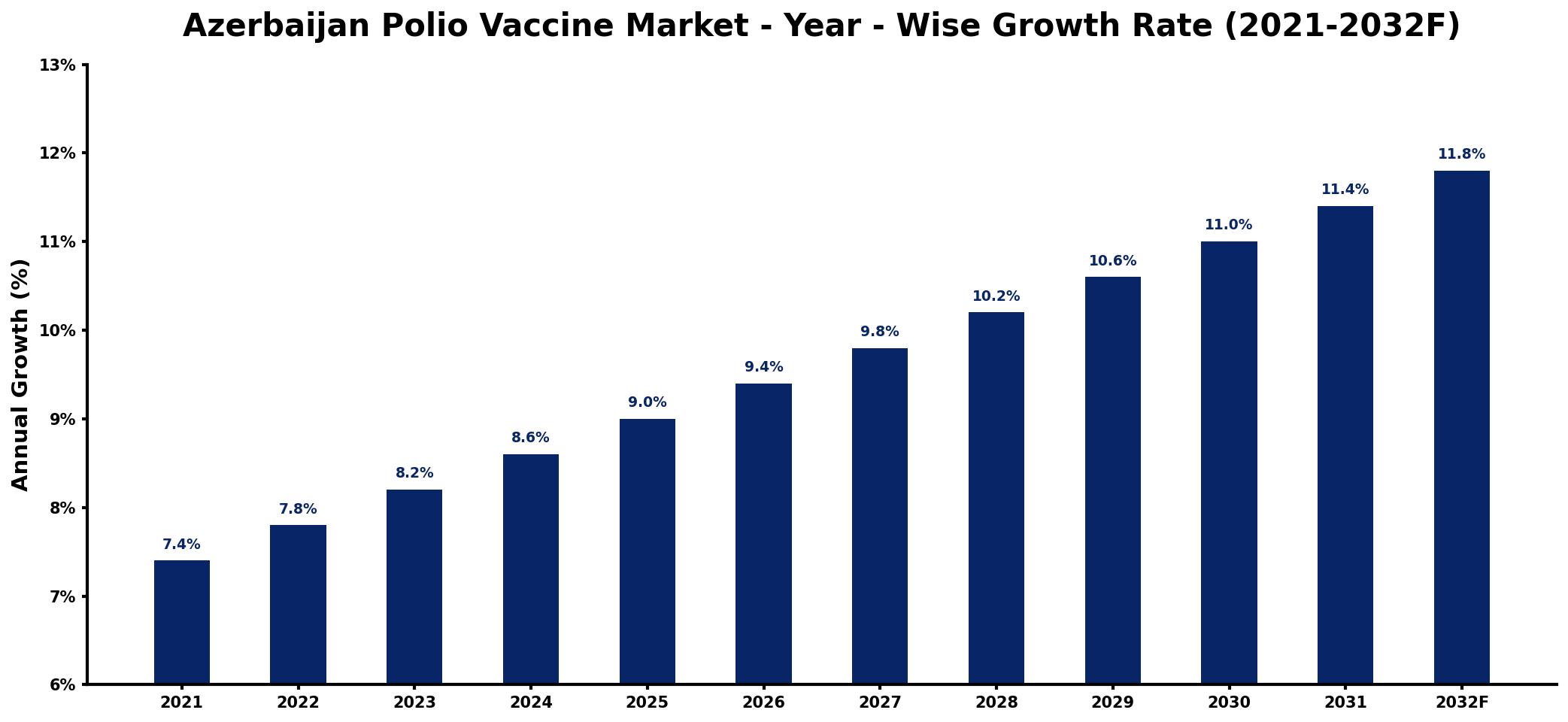
The table below presents the year‑wise growth rates along with the key drivers influencing the market
| Year | Growth Rate | Major Drivers |
| 2021 | 7.4% | Increased healthcare investment initiatives |
| 2022 | 7.8% | Rising public health awareness campaigns |
| 2023 | 8.2% | Expansion of healthcare infrastructure projects |
| 2024 | 8.6% | Growing international funding support |
| 2025 | 9.0% | Enhanced vaccination program outreach |
| 2026 | 9.4% | Strengthened collaboration with NGOs |
| 2027 | 9.8% | Innovative delivery method advancements |
| 2028 | 10.2% | Boost in local manufacturing capabilities |
| 2029 | 10.6% | Increased government health spending |
| 2030 | 11.0% | Growing private sector participation |
| 2031 | 11.4% | Heightened community engagement efforts |
| 2032 | 11.8% | Wider distribution network development |
Note: Market size estimations and growth projections presented in this report are based on 6Wresearch's proprietary forecasting methodology, utilizing the latest available industry data, government publications, and primary research inputs.
Azerbaijan Polio Vaccine Market Synopsis
The polio vaccine market in Azerbaijan is characterized by a strong emphasis on accessibility and outreach. Vaccination campaigns are increasingly targeting remote and underserved areas to ensure that no child is left unprotected against poliovirus. Furthermore, with rising public awareness and the governments proactive measures, there has been an uptick in vaccine acceptance among various communities.
Azerbaijans healthcare system plays a critical role in administering polio vaccines, supported by advancements in cold chain logistics and distribution strategies. This robust infrastructure is essential for maintaining high vaccination coverage rates, especially as new challenges arise in vaccine procurement and community engagement efforts.
Azerbaijan Polio Vaccine Market Key Takeaways
- Significant growth projected with a CAGR of 8.2% from 2026 to 2032, driven by comprehensive vaccination campaigns.
- Increased collaboration with international organizations enhances vaccine delivery and outreach programs.
- Focus on reducing vaccine hesitancy through community engagement is a priority for achieving immunization goals.
- Cold chain logistics improvements are vital to ensure timely vaccine distribution across diverse regions.
- Continued government support underscores the strategic importance of immunization in public health policy.
Evaluation of Restraints in Azerbaijan Polio Vaccine Market
Despite its growth, the Azerbaijan Polio Vaccine Market faces notable restraints that could impede progress. One pressing issue is the challenge of sustaining high vaccination coverage amidst fluctuating public health priorities. This is compounded by the necessity of ongoing campaigns to reach hard-to-access populations. Addressing the barriers to vaccine accessibility, particularly in remote areas, demands innovative strategies and greater resource allocation. Furthermore, the logistics surrounding vaccine procurement and supply chains must be effectively managed to maintain a steady supply of both oral and injectable vaccines.
Azerbaijan Polio Vaccine Market Trends
Current trends in the Azerbaijan Polio Vaccine Market include an increasing reliance on digital health technologies for monitoring vaccination rates and enhancing public engagement. The use of mobile health applications and data analytics is becoming pivotal in tracking immunization coverage and identifying gaps. Additionally, a stronger emphasis on collaboration between local healthcare authorities and international organizations is fostering innovative solutions for vaccine distribution and community education. These trends signify a shift towards a more data-driven and collaborative approach in public health initiatives.
Azerbaijan Polio Vaccine Market Opportunities
There are several areas of genuine growth within the Azerbaijan Polio Vaccine Market. Opportunities exist in enhancing local vaccine manufacturing capabilities, which would reduce dependency on imports and strengthen the supply chain. Additionally, investment in educational programs designed to combat vaccine hesitancy represents a significant avenue for fostering public trust. Leveraging international partnerships can also bring in additional funding and technical expertise to bolster vaccination initiatives, particularly in underserved areas.
Government Initiatives in the Azerbaijan Polio Vaccine Market
The government of Azerbaijan has established comprehensive policies supporting the polio vaccine market, focusing on enhancing immunization coverage across all demographics. Initiatives include nationwide vaccination programs targeting children, financial subsidies for vaccine procurement, and public awareness campaigns aimed at highlighting the importance of vaccination. These efforts are integral to the nations strategy of achieving and maintaining polio eradication, in alignment with global health standards.
Future Insights of the Azerbaijan Polio Vaccine Market
Looking ahead to 2026-2032, the Azerbaijan Polio Vaccine Market is poised for transformative growth. As international cooperation strengthens and innovative vaccine delivery methods are adopted, the country aims to achieve higher vaccination coverage and effectively reach vulnerable populations. Continuous investments in healthcare infrastructure and a commitment to addressing public concerns surrounding vaccines will be essential for sustaining momentum towards polio eradication.
Azerbaijan Polio Vaccine Market Latest Developments (2025 - 2026)
Recent developments in the Azerbaijan Polio Vaccine Market have centered on the enhancement of vaccination outreach programs, particularly in rural areas. Efforts are underway to improve logistical frameworks for vaccine distribution, ensuring timely delivery to healthcare facilities. Collaborative projects with international public health organizations are increasingly becoming common, focusing on tackling vaccine hesitancy through localized educational campaigns. These initiatives reflect a renewed commitment to achieving comprehensive immunization across the nation.
Azerbaijan Polio Vaccine Market - Key Attractiveness of the Report
- 10 Years of Market Numbers
- Historical Data Starting from 2022 to 2025
- Base Year: 2025
- Forecast Data until 2032
- Key Performance Indicators Impacting the Market
- Major Upcoming Developments and Projects
Key Highlights of the Report:
- Azerbaijan Polio Vaccine Market Outlook
- Market Size of Azerbaijan Polio Vaccine Market, 2025
- Forecast of Azerbaijan Polio Vaccine Market, 2032
- Historical Data and Forecast of Azerbaijan Polio Vaccine Revenues & Volume for the Period 2022-2032F
- Azerbaijan Polio Vaccine Market Trend Evolution
- Azerbaijan Polio Vaccine Market Drivers and Challenges
- Azerbaijan Polio Vaccine Price Trends
- Azerbaijan Polio Vaccine Porter's Five Forces
- Azerbaijan Polio Vaccine Industry Life Cycle
- Historical Data and Forecast of Azerbaijan Polio Vaccine Market Revenues & Volume By Type for the Period 2022-2032F
- Historical Data and Forecast of Azerbaijan Polio Vaccine Market Revenues & Volume By Oral Polio Vaccine (OPV) for the Period 2022-2032F
- Historical Data and Forecast of Azerbaijan Polio Vaccine Market Revenues & Volume By Inactivated Poliomyelitis Vaccine (IPV) for the Period 2022-2032F
- Historical Data and Forecast of Azerbaijan Polio Vaccine Market Revenues & Volume By Application for the Period 2022-2032F
- Historical Data and Forecast of Azerbaijan Polio Vaccine Market Revenues & Volume By Public for the Period 2022-2032F
- Historical Data and Forecast of Azerbaijan Polio Vaccine Market Revenues & Volume By Private for the Period 2022-2032F
- Azerbaijan Polio Vaccine Import Export Trade Statistics
- Market Opportunity Assessment By Type
- Market Opportunity Assessment By Application
- Azerbaijan Polio Vaccine Top Companies Market Share
- Azerbaijan Polio Vaccine Competitive Benchmarking By Technical and Operational Parameters
- Azerbaijan Polio Vaccine Company Profiles
- Azerbaijan Polio Vaccine Key Strategic Recommendations






































