Azerbaijan Potato Starch Market Size Growth Rate
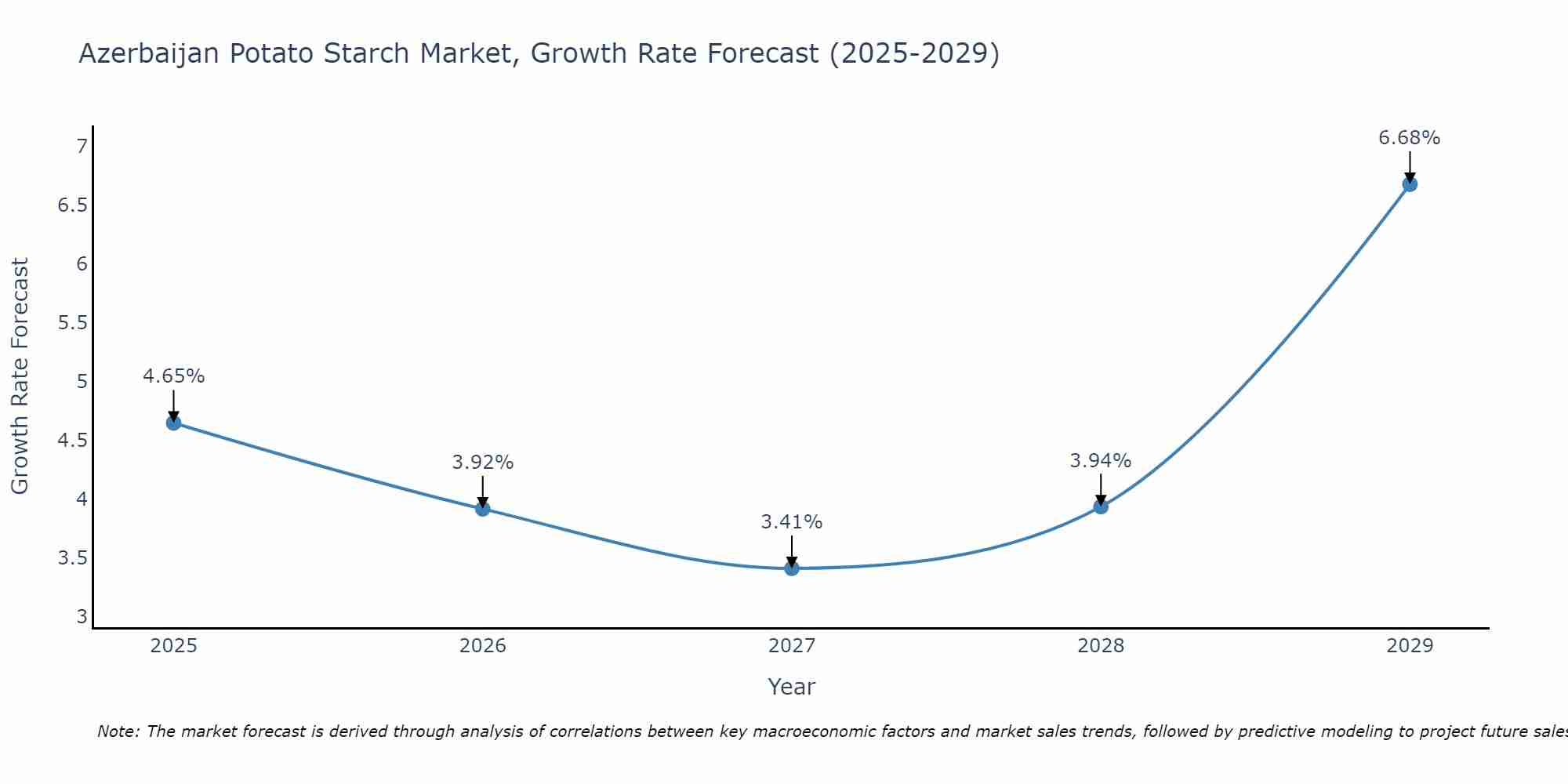
The Azerbaijan Potato Starch Market is projected to witness mixed growth rate patterns during 2025 to 2029. From 4.65% in 2025, the growth rate steadily ascends to 6.68% in 2029.
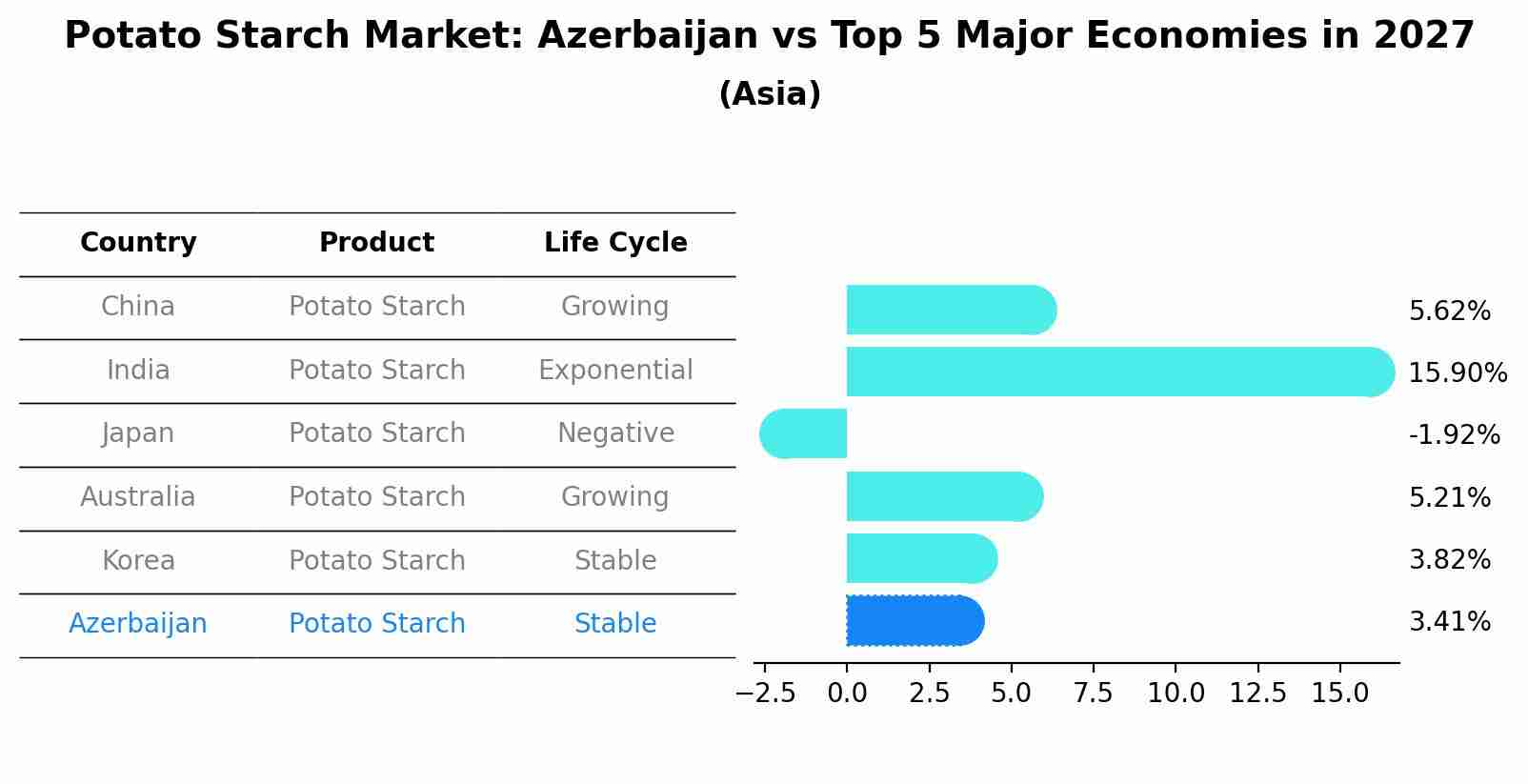
Potato Starch Market: Azerbaijan vs Top 5 Major Economies in 2027 (Asia)
The Potato Starch market in Azerbaijan is projected to grow at a stable growth rate of 3.41% by 2027, highlighting the country's increasing focus on advanced technologies within the Asia region, where China holds the dominant position, followed closely by India, Japan, Australia and South Korea, shaping overall regional demand.
Azerbaijan Potato Starch Market Synopsis
The potato starch market in Azerbaijan encompasses the production, import, and utilization of a carbohydrate polymer derived from potatoes used as a thickening, binding, and stabilizing agent in food processing applications. Potato starch is used in various food products such as soups, sauces, gravies, bakery goods, and noodles to improve texture, consistency, and shelf life in Azerbaijan food industry.
Drivers of the market
The potato starch market in Azerbaijan is experiencing robust growth, driven by several key factors. Firstly, the increasing demand for potato starch as a thickening, binding, and gelling agent in various food and industrial applications is driving market expansion. Additionally, potato starch offers advantages such as gluten-free properties, clean labeling, and versatility in food formulations, further boosting market growth. Moreover, investments in food processing infrastructure and the expanding food manufacturing sector are contributing to the growth of the potato starch market in Azerbaijan. Furthermore, technological advancements leading to the development of sustainable and high-quality potato starch production methods are driving market innovation and adoption.
Challenges of the market
The potato starch market in Azerbaijan faces challenges such as agricultural practices, processing efficiency, and market dynamics. Optimizing potato cultivation practices for starch extraction requires selecting suitable potato varieties, managing soil fertility, and implementing sustainable farming practices. Moreover, enhancing processing efficiency and yield during starch extraction and purification processes requires continuous improvement in equipment, technology, and operational practices. Additionally, market dynamics such as fluctuating demand, pricing pressures, and regulatory changes pose challenges for market forecasting and strategic planning.
Government Policy of the market
To support agricultural diversification and promote industrial applications of agricultural products, the Azerbaijan government has implemented policies to support the potato starch market. These policies include support for potato farming through agricultural subsidies and technical assistance programs, investment incentives for starch processing facilities, and initiatives to promote the use of potato starch in food, textile, and pharmaceutical industries.
Key Highlights of the Report:
- Azerbaijan Potato Starch Market Outlook
- Market Size of Azerbaijan Potato Starch Market, 2024
- Forecast of Azerbaijan Potato Starch Market, 2031
- Historical Data and Forecast of Azerbaijan Potato Starch Revenues & Volume for the Period 2021-2031
- Azerbaijan Potato Starch Market Trend Evolution
- Azerbaijan Potato Starch Market Drivers and Challenges
- Azerbaijan Potato Starch Price Trends
- Azerbaijan Potato Starch Porter's Five Forces
- Azerbaijan Potato Starch Industry Life Cycle
- Historical Data and Forecast of Azerbaijan Potato Starch Market Revenues & Volume By Nature for the Period 2021-2031
- Historical Data and Forecast of Azerbaijan Potato Starch Market Revenues & Volume By Organic for the Period 2021-2031
- Historical Data and Forecast of Azerbaijan Potato Starch Market Revenues & Volume By Conventional for the Period 2021-2031
- Historical Data and Forecast of Azerbaijan Potato Starch Market Revenues & Volume By End-users for the Period 2021-2031
- Historical Data and Forecast of Azerbaijan Potato Starch Market Revenues & Volume By Textile & Paper for the Period 2021-2031
- Historical Data and Forecast of Azerbaijan Potato Starch Market Revenues & Volume By Food & Beverages for the Period 2021-2031
- Historical Data and Forecast of Azerbaijan Potato Starch Market Revenues & Volume By Pharmaceuticals for the Period 2021-2031
- Azerbaijan Potato Starch Import Export Trade Statistics
- Market Opportunity Assessment By Nature
- Market Opportunity Assessment By End-users
- Azerbaijan Potato Starch Top Companies Market Share
- Azerbaijan Potato Starch Competitive Benchmarking By Technical and Operational Parameters
- Azerbaijan Potato Starch Company Profiles
- Azerbaijan Potato Starch Key Strategic Recommendations






































