Azerbaijan Power Generation Market Size, Share & Growth Rate
The Azerbaijan Power Generation Market was estimated at USD 1000 Million in 2025 and is projected to reach USD 1695 Million by 2032, growing at a CAGR of 7.8% from 2026 to 2032. This growth is driven by the government's strategic initiatives to diversify the energy mix, particularly through the development of renewable energy sources like solar and hydropower. Furthermore, increasing foreign investments aimed at modernizing infrastructure are likely to enhance capacity and reliability, thus supporting this positive trajectory.
Azerbaijan Power Generation Market Year-wise Growth Rate and Key Drivers
This graph highlights how the Azerbaijan Power Generation Market has steadily grown over the years, supported by major growth factors.
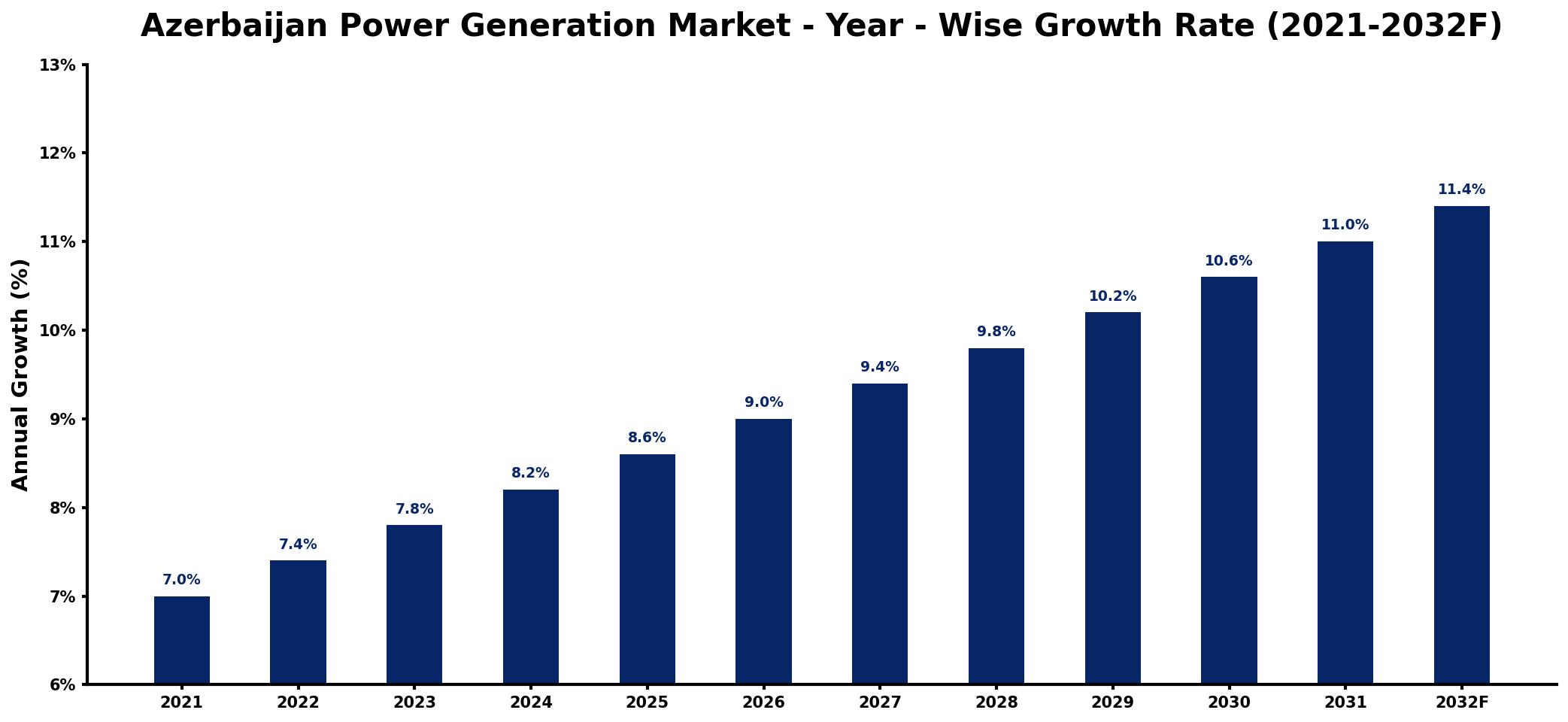
The table below presents the year‑wise growth rates along with the key drivers influencing the market
| Year | Growth Rate | Major Drivers |
| 2021 | 7.0% | Rising energy demand from industry |
| 2022 | 7.4% | Increased investments in infrastructure |
| 2023 | 7.8% | Expansion of renewable energy projects |
| 2024 | 8.2% | Government incentives for energy efficiency |
| 2025 | 8.6% | Growing urban population and consumption |
| 2026 | 9.0% | Technological advancements in energy management |
| 2027 | 9.4% | Strengthening regional energy partnerships |
| 2028 | 9.8% | Demand from electric vehicle sector |
| 2029 | 10.2% | Investment in smart grid technologies |
| 2030 | 10.6% | Focus on energy diversification strategies |
| 2031 | 11.0% | Expanding commercial energy services market |
| 2032 | 11.4% | Increasing cross-border electricity trading |
Note: Market size estimations and growth projections presented in this report are based on 6Wresearch's proprietary forecasting methodology, utilizing the latest available industry data, government publications, and primary research inputs.
Azerbaijan Power Generation Market Synopsis
The landscape of the Azerbaijan Power Generation Market is shifting, with significant movement towards incorporating renewable energy alongside traditional fossil fuels. This transition is being bolstered by governmental efforts to reduce reliance on imported energy and enhance local energy security.
Natural gas continues to be the cornerstone of power generation in Azerbaijan, yet the country is increasingly exploring solar and wind projects. As a result, this diverse energy mix not only reflects a national commitment to sustainability but also positions Azerbaijan as a potential energy hub connecting Europe and Asia.
Azerbaijan Power Generation Market Key Takeaways
- The Azerbaijan Power Generation Market is poised for substantial growth, fueled by a shift towards renewable energy sources.
- Investment in modernizing existing infrastructure is crucial for improving energy efficiency and reliability.
- Government policies are actively promoting private sector engagement and competition in the energy space.
- Renewable energy initiatives are projected to enhance the country's energy security and environmental sustainability.
- Strategic geographic positioning offers Azerbaijan unique opportunities for energy transit between Europe and Asia.
Evaluation of Restraints in Azerbaijan Power Generation Market
Despite the positive outlook, the Azerbaijan Power Generation Market grapples with several limitations. Aging infrastructure remains a significant concern, with many power plants requiring urgent upgrades to meet increasing electricity demand. Furthermore, an overreliance on natural gas poses risks associated with price volatility and supply disruptions. Addressing these challenges is vital for creating a more stable and resilient energy sector. The urgency of diversifying energy sources and enhancing grid infrastructure cannot be overstated, especially given geopolitical uncertainties that could affect energy imports.
Azerbaijan Power Generation Market Trends
A growing trend within the Azerbaijan Power Generation Market is the surge in large-scale renewable energy projects, particularly in solar and wind power. The government's proactive stance on sustainability is leading to an uptick in private investments aimed at these energy sources. Moreover, there's a concerted effort to modernize existing power facilities, focusing on improving operational efficiencies and reducing carbon footprints. Technological advancements and innovative financing solutions are also emerging, making investments in renewable energy more accessible and appealing.
Azerbaijan Power Generation Market Opportunities
The evolving landscape of the Azerbaijan Power Generation Market presents numerous investment opportunities for stakeholders. With a clear governmental push towards increasing the share of renewables, investors have a chance to engage in developing innovative solar and wind projects. There is also potential in retrofitting and upgrading existing thermal power plants to enhance their efficiency and environmental performance. Furthermore, the ongoing privatization of state-owned assets is ripe for attracting domestic and international investment, providing avenues for growth in the sector.
Government Initiatives in the Azerbaijan Power Generation Market
The Azerbaijani government has instituted several policies to bolster the power generation market. A key initiative is the feed-in tariff system, which incentivizes investments in renewable energy projects such as solar and wind. Regulations are also in place to encourage private sector participation, thus fostering competition and improving overall market efficiency. Additionally, there are comprehensive measures aimed at promoting energy efficiency and conservation, ensuring that the push towards renewable sources is balanced with sustainable consumption practices.
Future Insights of the Azerbaijan Power Generation Market
Looking ahead to the period from 2026 to 2032, the Azerbaijan Power Generation Market is set to experience a transformative phase. The ongoing efforts to diversify the energy mix will likely lead to an increased reliance on renewables, significantly contributing to national energy security. The government's commitment to attracting foreign investment and modernizing infrastructure is expected to further catalyze market growth, paving the way for Azerbaijan to emerge as a regional leader in sustainable energy generation.
Azerbaijan Power Generation Market Latest Developments (2025 - 2026)
In recent months, the Azerbaijan Power Generation Market has witnessed a surge in initiatives aimed at enhancing renewable energy capacities. Several large-scale solar and wind projects have been announced, underscoring the commitment to reduce carbon emissions and improve energy security. Additionally, the government has ramped up efforts to attract foreign investments to modernize existing power facilities, which is anticipated to lead to greater efficiencies and reliability in the sector.
Azerbaijan Power Generation Market - Key Attractiveness of the Report
- 10 Years of Market Numbers
- Historical Data Starting from 2022 to 2025
- Base Year: 2025
- Forecast Data until 2032
- Key Performance Indicators Impacting the Market
- Major Upcoming Developments and Projects
Key Highlights of the Report:
- Azerbaijan Power Generation Market Outlook
- Market Size of Azerbaijan Power Generation Market, 2025
- Forecast of Azerbaijan Power Generation Market, 2032
- Historical Data and Forecast of Azerbaijan Power Generation Revenues & Volume for the Period 2022-2032F
- Azerbaijan Power Generation Market Trend Evolution
- Azerbaijan Power Generation Market Drivers and Challenges
- Azerbaijan Power Generation Price Trends
- Azerbaijan Power Generation Porter's Five Forces
- Azerbaijan Power Generation Industry Life Cycle
- Historical Data and Forecast of Azerbaijan Power Generation Market Revenues & Volume By Application for the Period 2022-2032F
- Historical Data and Forecast of Azerbaijan Power Generation Market Revenues & Volume By Commercial for the Period 2022-2032F
- Historical Data and Forecast of Azerbaijan Power Generation Market Revenues & Volume By Industrial for the Period 2022-2032F
- Historical Data and Forecast of Azerbaijan Power Generation Market Revenues & Volume By Residential for the Period 2022-2032F
- Historical Data and Forecast of Azerbaijan Power Generation Market Revenues & Volume By Source for the Period 2022-2032F
- Historical Data and Forecast of Azerbaijan Power Generation Market Revenues & Volume By Non-Renewable for the Period 2022-2032F
- Historical Data and Forecast of Azerbaijan Power Generation Market Revenues & Volume By Renewable for the Period 2022-2032F
- Azerbaijan Power Generation Import Export Trade Statistics
- Market Opportunity Assessment By Application
- Market Opportunity Assessment By Source
- Azerbaijan Power Generation Top Companies Market Share
- Azerbaijan Power Generation Competitive Benchmarking By Technical and Operational Parameters
- Azerbaijan Power Generation Company Profiles
- Azerbaijan Power Generation Key Strategic Recommendations






































