Azerbaijan Power Supply Market Summary
The azerbaijan power supply market was estimated at USD 540 Million in 2025 and is projected to reach USD 930 Million by 2032, growing at a CAGR of 9.3% from 2026 to 2032.
Azerbaijan Power Supply Market Year-wise Growth Rate and Key Drivers
This graph highlights how the Azerbaijan Power Supply Market has steadily grown over the past five years, supported by major growth factors.
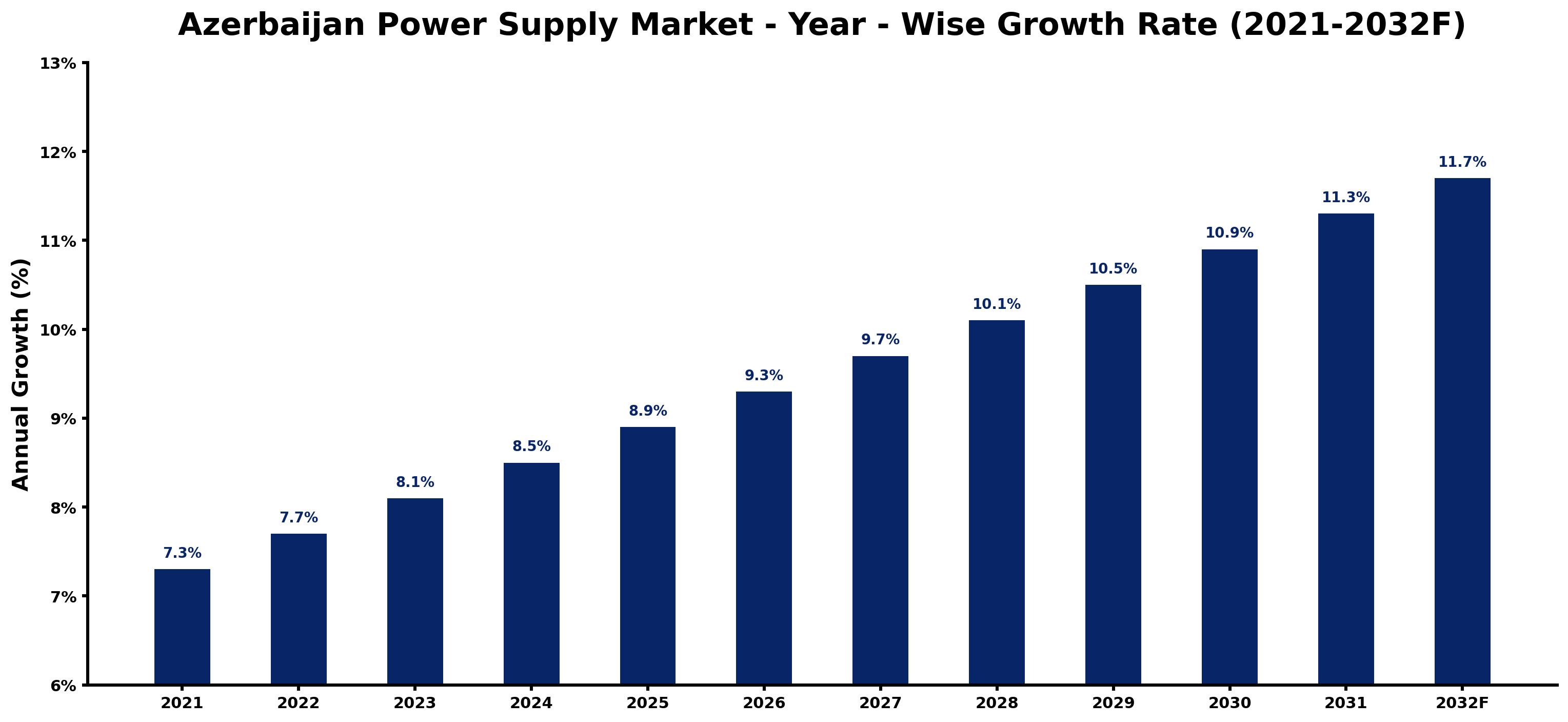
The table below presents the year wise growth rates along with the key drivers influencing the market
| Year | Growth Rate | Major Drivers |
| 2021 | 7.3% | Investment in power generation infrastructure aligns with regional energy transition goals. |
| 2022 | 7.7% | Local energy companies focus on modernizing grid technology to improve efficiency. |
| 2023 | 8.1% | A push for renewable energy sources impacts traditional fossil fuel reliance significantly. |
| 2024 | 8.5% | The influx of foreign investments supports large-scale solar power projects nationwide. |
| 2025 | 8.9% | Energy diversification strategies become essential to reduce dependency on natural gas. |
| 2026 | 9.3% | Technological innovations in energy storage enhance reliability for renewable power sources. |
| 2027 | 9.7% | Urbanization trends increase demand for consistent power supply in emerging cities. |
| 2028 | 10.1% | Partnerships with international firms boost local expertise in energy management solutions. |
| 2029 | 10.5% | Environmental concerns prompt investments in cleaner technologies across the energy sector. |
| 2030 | 10.9% | Regional collaboration on cross-border energy projects enhances energy security and stability. |
| 2031 | 11.3% | Public awareness campaigns highlight the importance of energy efficiency and sustainability. |
| 2032 | 11.7% | Growing electric vehicle adoption necessitates upgrades in charging infrastructure nationwide. |
Note - Market size estimations and growth projections presented in this report are based on 6Wresearch's advanced forecasting approach, validated with industry datasets as of June 2026.
Azerbaijan Power Supply Market Synopsis
The Azerbaijan Power Supply Market is projected to reach 9.3% and witness significant growth during the forecast period (2026-2032). This market encompasses the production, import, and distribution of crucial electrical equipment, including transformers, switchgear, circuit breakers, and power converters, essential for delivering electricity to end-users. Reliable power supply systems are vital for ensuring safe, efficient, and consistent electricity distribution across various sectors in Azerbaijan, ranging from residential to commercial and industrial applications.
Azerbaijan Power Supply Market Growth Drivers
The Azerbaijan Power Supply Market is experiencing robust growth, influenced by several interrelated factors. Firstly, the burgeoning demand for dependable and efficient power supply solutions is evident across residential, commercial, and industrial sectors. The necessity for constant power supply is becoming increasingly critical as the economy expands and urbanization accelerates.
- The drive for higher efficiency in power delivery has led to the adoption of advanced power supply technologies, which include voltage regulation and power factor correction. These technologies are essential for mitigating electrical disturbances and ensuring operational reliability.
- Investment in energy infrastructure is rapidly increasing. The government's commitment to enhancing the national grid and integrating renewable energy sources is pivotal for expanding overall capacity and improving service quality.
- Technological advancements have enabled the development of compact and eco-friendly power supply products. These innovations are attracting interest from the market and leading to increased adoption rates among consumers and businesses alike.
- The growing awareness regarding energy efficiency and sustainability is driving demand for cutting-edge solutions that not only meet current needs but also align with international environmental standards.
- Moreover, the ongoing construction and modernization of infrastructure contribute significantly to the need for a reliable power supply, underpinning the overall market growth.
Azerbaijan Power Supply Market Challenges and Restraints
While the Azerbaijan Power Supply Market is positioned for growth, it does face notable challenges that could impede progress. Key among these are infrastructure development and reliability concerns that demand urgent attention.
- The existing power infrastructure is often strained, with aging equipment posing challenges related to reliability and efficiency. Frequent outages and voltage fluctuations are common, impacting consumer trust and satisfaction.
- Affordability remains a pressing issue, as investments required to upgrade infrastructure must be balanced with maintaining reasonable electricity prices for consumers. This creates tension between utilities and policymakers.
- The transition towards renewable energy, while beneficial in the long term, requires substantial upfront investments and a recalibration of existing systems, leading to potential short-term disruptions.
- Investors might be hesitant due to the perceived risks associated with infrastructure projects, particularly in light of potential regulatory changes that could affect return on investment.
- Finally, ensuring the workforce is adequately trained to manage and implement new technologies is an ongoing challenge that needs to be addressed to maintain market momentum.
Azerbaijan Power Supply Market Government Investment and Initiatives
The Azerbaijan government is committed to bolstering the power supply market through various strategic investments and initiatives designed to enhance energy security and sustainability. These policies focus on expanding generation capacity and modernizing grid infrastructure. Significant funding is allocated towards the development of renewable energy projects, which are viewed as crucial for diversifying the country's energy mix.
Regulatory frameworks are evolving to promote competition and transparency within the electricity sector. This aims to create a more dynamic market that can better respond to consumer needs. Additionally, initiatives are in place to involve private sector investment in infrastructure projects, which is seen as essential for achieving long-term sustainability and efficiency.
Azerbaijan Power Supply Market Latest Developments (May 2025 - June 2026)
Recent advances in the Azerbaijan Power Supply Market reflect a proactive approach to addressing both consumer demand and infrastructural challenges. During the period from May 2025 to June 2026, there has been a noticeable shift towards integrating renewable energy solutions into the national grid. The government is actively supporting pilot projects that leverage solar and wind energy, which serve to diversify the energy portfolio and enhance energy security.
Additionally, public-private partnerships have gained traction, fostering collaboration between sectors to expedite infrastructure upgrades. Enhanced focus on energy efficiency and eco-friendly technologies is emerging as a critical trend, driven by both consumer preferences and regulatory incentives. These developments indicate a commitment to advancing the capabilities of the power supply market while aligning with global sustainability goals.
Azerbaijan Power Supply Market - Key Attractiveness of the Report
- 10 Years of Market Numbers
- Historical Data Starting from 2022 to 2025
- Base Year: 2025
- Forecast Data until 2032
- Key Performance Indicators Impacting the Market
- Major Upcoming Developments and Projects
Key Highlights of the Report:
- Azerbaijan Power Supply Market Outlook
- Market Size of Azerbaijan Power Supply Market, 2025
- Forecast of Azerbaijan Power Supply Market, 2032
- Historical Data and Forecast of Azerbaijan Power Supply Revenues & Volume for the Period 2022-2032F
- Azerbaijan Power Supply Market Trend Evolution
- Azerbaijan Power Supply Market Drivers and Challenges
- Azerbaijan Power Supply Price Trends
- Azerbaijan Power Supply Porter's Five Forces
- Azerbaijan Power Supply Industry Life Cycle
- Historical Data and Forecast of Azerbaijan Power Supply Market Revenues & Volume By Output Power for the Period 2022-2032F
- Historical Data and Forecast of Azerbaijan Power Supply Market Revenues & Volume By Power Supply With Low Output (500 W and Below) for the Period 2022-2032F
- Historical Data and Forecast of Azerbaijan Power Supply Market Revenues & Volume By Power Supply With Medium Output (500?1,000 W) for the Period 2022-2032F
- Historical Data and Forecast of Azerbaijan Power Supply Market Revenues & Volume By Power Supply With High Output (More Than 1,000 W) for the Period 2022-2032F
- Historical Data and Forecast of Azerbaijan Power Supply Market Revenues & Volume By Type for the Period 2022-2032F
- Historical Data and Forecast of Azerbaijan Power Supply Market Revenues & Volume By AC-DC Power Supply for the Period 2022-2032F
- Historical Data and Forecast of Azerbaijan Power Supply Market Revenues & Volume By DC-DC Power Supply for the Period 2022-2032F
- Historical Data and Forecast of Azerbaijan Power Supply Market Revenues & Volume By Vertical for the Period 2022-2032F
- Historical Data and Forecast of Azerbaijan Power Supply Market Revenues & Volume By Medical & Healthcare for the Period 2022-2032F
- Historical Data and Forecast of Azerbaijan Power Supply Market Revenues & Volume By Military & Aerospace for the Period 2022-2032F
- Historical Data and Forecast of Azerbaijan Power Supply Market Revenues & Volume By Telecommunications for the Period 2022-2032F
- Historical Data and Forecast of Azerbaijan Power Supply Market Revenues & Volume By Consumer Electronics for the Period 2022-2032F
- Historical Data and Forecast of Azerbaijan Power Supply Market Revenues & Volume By Transportation for the Period 2022-2032F
- Historical Data and Forecast of Azerbaijan Power Supply Market Revenues & Volume By Lighting for the Period 2022-2032F
- Historical Data and Forecast of Azerbaijan Power Supply Market Revenues & Volume By Food & Beverages for the Period 2022-2032F
- Historical Data and Forecast of Azerbaijan Power Supply Market Revenues & Volume By Industrial for the Period 2022-2032F
- Azerbaijan Power Supply Import Export Trade Statistics
- Market Opportunity Assessment By Output Power
- Market Opportunity Assessment By Type
- Market Opportunity Assessment By Vertical
- Azerbaijan Power Supply Top Companies Market Share
- Azerbaijan Power Supply Competitive Benchmarking By Technical and Operational Parameters
- Azerbaijan Power Supply Company Profiles
- Azerbaijan Power Supply Key Strategic Recommendations






































