Azerbaijan Predictive Maintenance Market Size & Growth Rate (2026-2032)
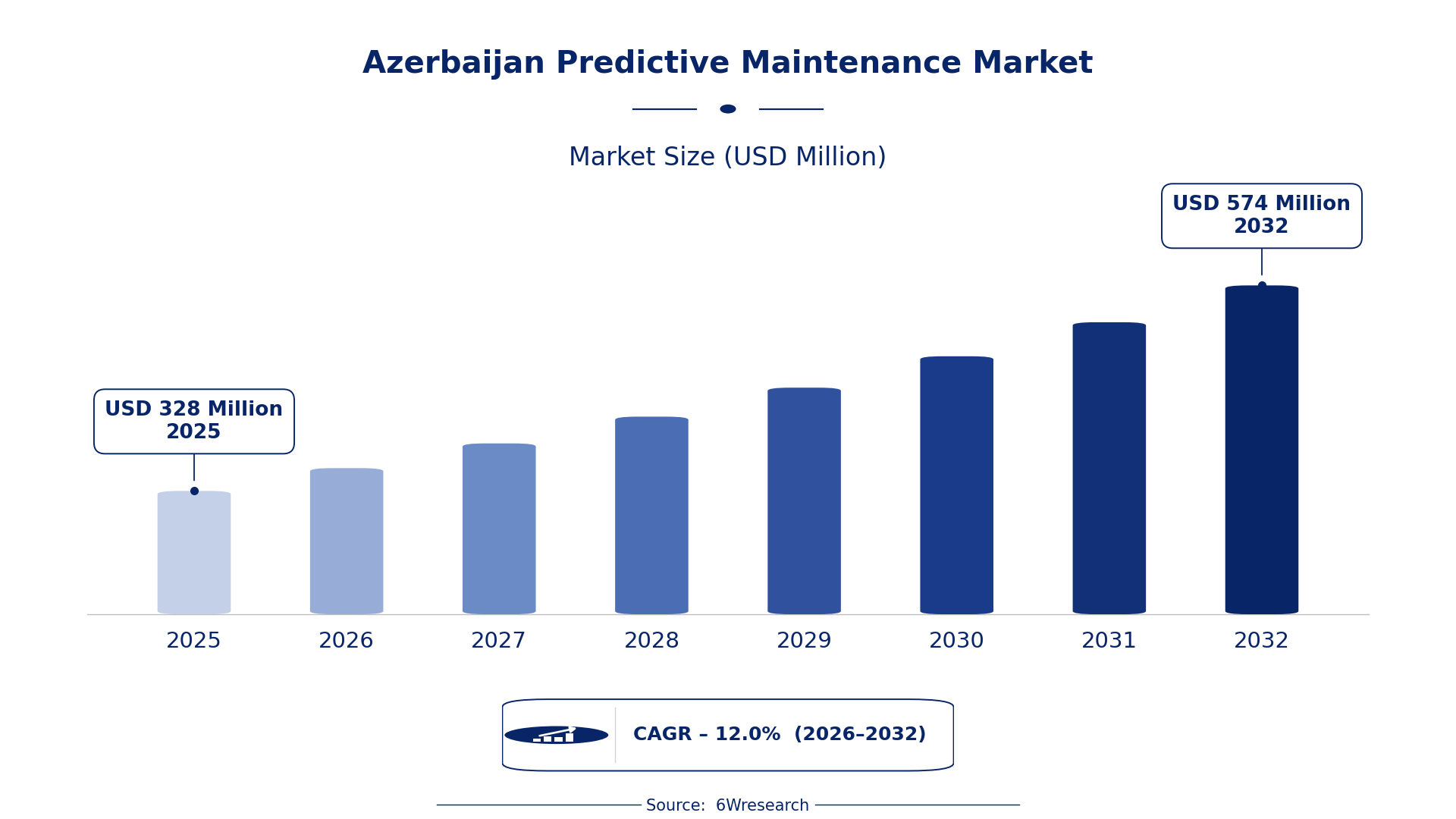
The Azerbaijan Predictive Maintenance Market was estimated at USD 328 Million in 2025 and is projected to reach USD 574 Million by 2032, growing at a CAGR of 12.0% from 2026 to 2032.
Azerbaijan Predictive Maintenance Market Synopsis
The most influential factor driving the Azerbaijan Predictive Maintenance Market is the increasing adoption of advanced technologies across key industrial sectors. Manufacturing, oil and gas, and utilities are at the forefront of this shift, as companies seek to enhance operational efficiency and minimize costs.
As a result, there’s a surge in investments aimed at integrating predictive maintenance solutions. These innovations are not merely about technology for technology's sake; they are fundamentally reshaping how maintenance is approached in Azerbaijan, enabling companies to predict failures and optimize their maintenance schedules effectively.
Azerbaijan Predictive Maintenance Market Year-wise Growth Rate and Key Drivers
This graph illustrates the annual growth rates of the Azerbaijan Predictive Maintenance Market from 2021 to 2032, highlighting a steady upward trajectory and projected expansion over the forecast period.
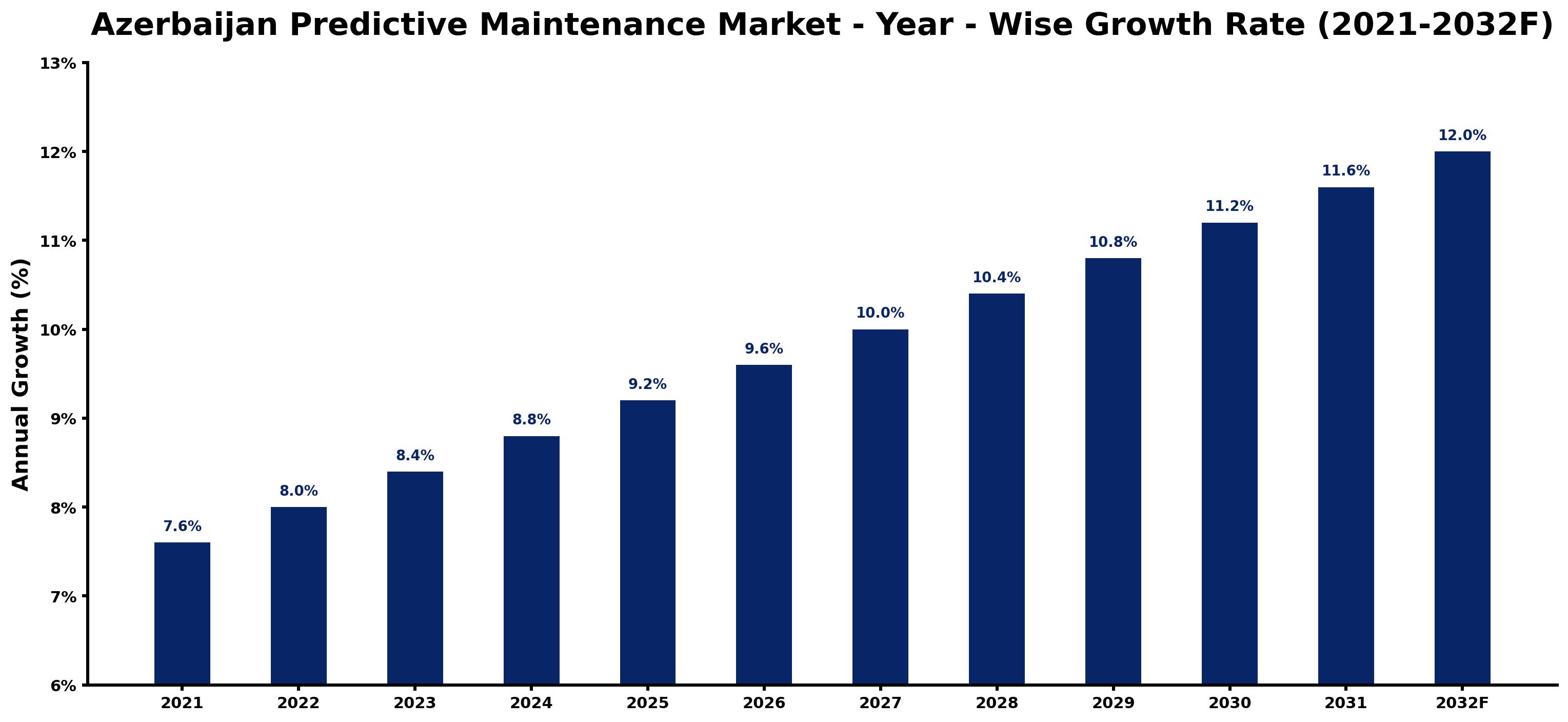
The table below presents the year‑wise growth rates along with the key drivers influencing the market
| Year | Growth Rate | Major Drivers |
| 2021 | 7.6% | SOCAR investment in predictive analytics technology advancements. |
| 2022 | 8.0% | Adoption of Industry 4.0 practices by Azerbaijani manufacturers. |
| 2023 | 8.4% | Government support for digital transformation initiatives in industry. |
| 2024 | 8.8% | Increased interest from oil sector in predictive tools. |
| 2025 | 9.2% | Growing awareness of cost savings from predictive maintenance. |
| 2026 | 9.6% | Emergence of local startups in predictive maintenance solutions. |
| 2027 | 10.0% | Public transportation improvements driving demand for diagnostics. |
| 2028 | 10.4% | Rise in infrastructure projects needing predictive analytics. |
| 2029 | 10.8% | Collaborations between tech firms and local industries increasing. |
| 2030 | 11.2% | Focus on energy efficiency policies bolstering maintenance technologies. |
| 2031 | 11.6% | Downstream oil industry shift towards data analytics. |
| 2032 | 12.0% | Regulatory push for improved asset reliability and monitoring. |
Note: Market size estimations and growth projections presented in this report are based on 6Wresearch's proprietary forecasting methodology, utilizing the latest available industry data, government publications, and primary research inputs.
Azerbaijan Predictive Maintenance Market Key Takeaways
Below are some of the specific key takeaways from the market, including:
- The market is characterized by significant investment in machine learning and IoT technologies for enhanced predictive analytics.
- Companies are increasingly focusing on integrating real-time monitoring systems to mitigate equipment downtime.
- Collaborations between technology providers and industry stakeholders are on the rise, leading to tailored predictive maintenance solutions.
- Government policies are favorably influencing market dynamics by promoting technological innovation and workforce development.
- As digitization accelerates, businesses are increasingly prioritizing predictive maintenance strategies as part of their operational frameworks.
Evaluation of Restraints in Azerbaijan Predictive Maintenance Market
Despite its potential, the Azerbaijan Predictive Maintenance Market faces several constraints. One of the most significant hurdles is the limited awareness regarding advanced predictive maintenance technologies among companies. This knowledge gap translates into a slower adoption rate, which impacts overall market growth.
on top of that, there is a notable shortage of skilled professionals capable of implementing and managing these systems. The integration of predictive maintenance solutions with existing legacy systems also presents challenges, often leading to operational disruptions. Addressing these issues will require concerted efforts in education and training, alongside strategic partnerships with technology providers.
Azerbaijan Predictive Maintenance Market Trends
A key trend in the Azerbaijan Predictive Maintenance Market is the growing reliance on advanced data analytics and machine learning technologies. These tools are crucial for enhancing equipment reliability and proactively planning maintenance activities. Industries are increasingly integrating IoT sensors to facilitate real-time monitoring and data collection.
on top of that, the adoption of cloud-based platforms is becoming prevalent, allowing for remote monitoring and analysis. This shift towards data-driven maintenance approaches is indicative of a broader movement towards automation and efficiency, reflecting the industry’s commitment to leveraging technology for operational excellence.
Azerbaijan Predictive Maintenance Market Opportunities
The market presents considerable investment opportunities, particularly as industries seek to modernize their maintenance processes. Areas such as predictive maintenance software development, sensor technology, and data analytics services are ripe for growth. The government’s initiatives aimed at industrial modernization further enhance the investment climate, creating a fertile ground for innovation.
Investors can capitalize on the increasing demand for solutions that offer not just efficiency but also cost savings. As businesses continue to shift their focus towards proactive maintenance strategies, opportunities for consulting services and tailored software solutions will likely expand.
Government Initiatives in the Azerbaijan Predictive Maintenance Market
The Azerbaijani government is actively fostering an environment conducive to the growth of the predictive maintenance market. With policies aimed at promoting technological innovation, the government plays a critical role in shaping market dynamics. By providing incentives and focusing on workforce development, they are making strides in enhancing the sector's competitive edge.
- A recently launched initiative offers tax breaks for companies investing in advanced predictive maintenance technologies.
- A current workforce development program is underway, designed to equip professionals with the necessary skills to implement predictive maintenance solutions.
- A planned public-private partnership aims to enhance digital infrastructure across various sectors by 2026.
- New regulatory frameworks have been introduced to support the integration of innovative technologies in industrial processes.
- Upcoming initiatives will focus on establishing industry-academic collaborations to drive research and innovation in predictive maintenance.
Future Insights of the Azerbaijan Predictive Maintenance Market
Looking ahead to 2026-2032, the Azerbaijan Predictive Maintenance Market is set for notable expansion. The continuous adoption of advanced technologies across diverse industries will serve as a cornerstone for growth. Companies will increasingly prioritize predictive maintenance to avoid equipment failures and optimize operations.
Government initiatives promoting digital transformation and Industry 4.0 practices will likely accelerate this trend. As businesses invest in automation and IoT capabilities, the market will experience a paradigm shift, steering towards innovative maintenance strategies that enhance asset reliability and operational performance.
Azerbaijan Predictive Maintenance Market Latest Developments
Recent activity in the Azerbaijan Predictive Maintenance Market indicates a vibrant landscape filled with innovation and growth. Over the past year, companies have been eager to adopt new technologies that enhance their operational efficiency while aligning with government policies promoting modernization.
- A major technology vendor launched an AI-driven predictive maintenance platform in early 2025, enhancing predictive capabilities for industrial operators.
- Ongoing collaborations between local firms and international tech providers are currently developing customized predictive maintenance solutions tailored to regional needs.
- A public sector initiative aimed at upgrading industrial facilities with IoT sensors is currently underway, expected to enhance data collection and analysis capabilities.
- Plans for a comprehensive training program targeting predictive maintenance skills are set to begin in mid-2026, in partnership with educational institutions.
- A new cloud-based analytics service is scheduled for rollout in late 2025, aimed at facilitating real-time decision-making for maintenance strategies.
Azerbaijan Predictive Maintenance Market - Key Attractiveness of the Report
- 10 Years of Market Numbers
- Historical Data Starting from 2022 to 2025
- Base Year: 2025
- Forecast Data until 2032
- Key Performance Indicators Impacting the Market
- Major Upcoming Developments and Projects
There are considerable opportunities in software development, sensor technology, and data analytics services. The government’s focus on industrial modernization further enhances the investment landscape.
Key Highlights of the Report:
- Azerbaijan Predictive Maintenance Market Outlook
- Market Size of Azerbaijan Predictive Maintenance Market, 2025
- Forecast of Azerbaijan Predictive Maintenance Market, 2032
- Historical Data and Forecast of Azerbaijan Predictive Maintenance Revenues & Volume for the Period 2022-2032F
- Azerbaijan Predictive Maintenance Market Trend Evolution
- Azerbaijan Predictive Maintenance Market Drivers and Challenges
- Azerbaijan Predictive Maintenance Price Trends
- Azerbaijan Predictive Maintenance Porter's Five Forces
- Azerbaijan Predictive Maintenance Industry Life Cycle
- Historical Data and Forecast of Azerbaijan Predictive Maintenance Market Revenues & Volume By Component for the Period 2022-2032F
- Historical Data and Forecast of Azerbaijan Predictive Maintenance Market Revenues & Volume By Solutions for the Period 2022-2032F
- Historical Data and Forecast of Azerbaijan Predictive Maintenance Market Revenues & Volume By Services for the Period 2022-2032F
- Historical Data and Forecast of Azerbaijan Predictive Maintenance Market Revenues & Volume By Organization Size for the Period 2022-2032F
- Historical Data and Forecast of Azerbaijan Predictive Maintenance Market Revenues & Volume By Large Enterprises for the Period 2022-2032F
- Historical Data and Forecast of Azerbaijan Predictive Maintenance Market Revenues & Volume By SME for the Period 2022-2032F
- Historical Data and Forecast of Azerbaijan Predictive Maintenance Market Revenues & Volume By Deployment Mode for the Period 2022-2032F
- Historical Data and Forecast of Azerbaijan Predictive Maintenance Market Revenues & Volume By On-premises for the Period 2022-2032F
- Historical Data and Forecast of Azerbaijan Predictive Maintenance Market Revenues & Volume By Cloud for the Period 2022-2032F
- Historical Data and Forecast of Azerbaijan Predictive Maintenance Market Revenues & Volume By Vertical for the Period 2022-2032F
- Historical Data and Forecast of Azerbaijan Predictive Maintenance Market Revenues & Volume By Government and Defense for the Period 2022-2032F
- Historical Data and Forecast of Azerbaijan Predictive Maintenance Market Revenues & Volume By Manufacturing for the Period 2022-2032F
- Historical Data and Forecast of Azerbaijan Predictive Maintenance Market Revenues & Volume By Energy and Utilities for the Period 2022-2032F
- Historical Data and Forecast of Azerbaijan Predictive Maintenance Market Revenues & Volume By Transportation and Logistics for the Period 2022-2032F
- Historical Data and Forecast of Azerbaijan Predictive Maintenance Market Revenues & Volume By Healthcare and Life Sciences for the Period 2022-2032F
- Azerbaijan Predictive Maintenance Import Export Trade Statistics
- Market Opportunity Assessment By Component
- Market Opportunity Assessment By Organization Size
- Market Opportunity Assessment By Deployment Mode
- Market Opportunity Assessment By Vertical
- Azerbaijan Predictive Maintenance Top Companies Market Share
- Azerbaijan Predictive Maintenance Competitive Benchmarking By Technical and Operational Parameters
- Azerbaijan Predictive Maintenance Company Profiles
- Azerbaijan Predictive Maintenance Key Strategic Recommendations






































