Azerbaijan Prepaid Cards Market Size, Share & Growth Rate
The Azerbaijan Prepaid Cards Market was estimated at USD 1177 Million in 2025 and is projected to reach USD 2006 Million by 2032, growing at a CAGR of 7.9% from 2026 to 2032. This upward trajectory is largely fueled by the rising acceptance of electronic payment systems and the convenience that prepaid cards provide for consumers. Additionally, the need for financial inclusion among unbanked populations is driving the demand, with prepaid cards offering a secure and accessible option for managing money.
Azerbaijan Prepaid Cards Market Year-wise Growth Rate and Key Drivers
This graph highlights how the Azerbaijan Prepaid Cards Market has steadily grown over the years, supported by major growth factors.
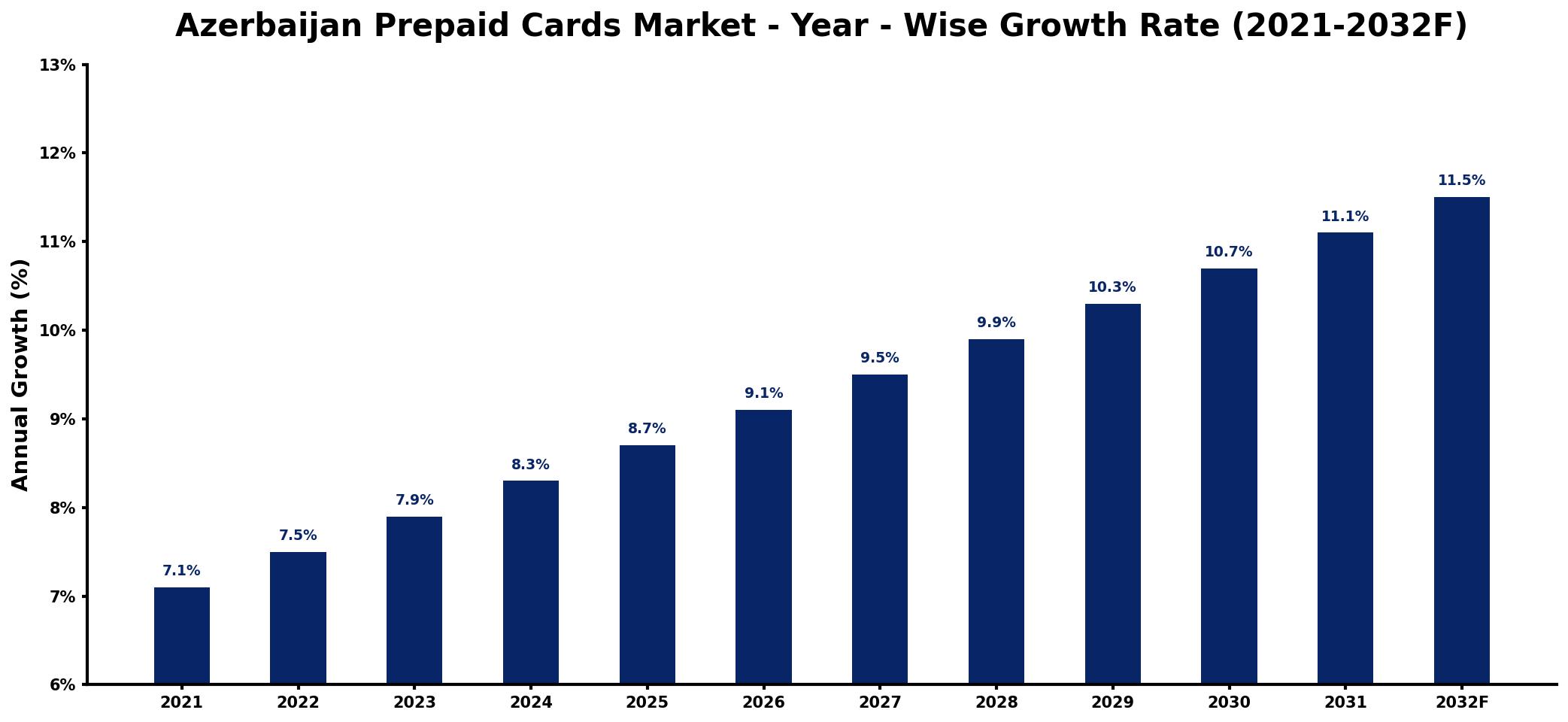
The table below presents the year‑wise growth rates along with the key drivers influencing the market
| Year | Growth Rate | Major Drivers |
| 2021 | 7.1% | Rising digital payment adoption |
| 2022 | 7.5% | Increased consumer spending habits |
| 2023 | 7.9% | Expansion of online services |
| 2024 | 8.3% | Growth in e-commerce transactions |
| 2025 | 8.7% | Enhanced financial technology solutions |
| 2026 | 9.1% | Wider acceptance by merchants |
| 2027 | 9.5% | Improved consumer awareness campaigns |
| 2028 | 9.9% | Increase in cross-border transactions |
| 2029 | 10.3% | Adoption of mobile payment systems |
| 2030 | 10.7% | Investment in digital infrastructure |
| 2031 | 11.1% | Development of loyalty programs |
| 2032 | 11.5% | strengthening international trade flows |
Note: Market size estimations and growth projections presented in this report are based on 6Wresearch's proprietary forecasting methodology, utilizing the latest available industry data, government publications, and primary research inputs.
Azerbaijan Prepaid Cards Market Synopsis
The prepaid cards market in Azerbaijan is currently experiencing robust growth, propelled by a surge in electronic payment adoption and a shift towards cashless transactions. As this momentum builds, the market is expected to evolve with the introduction of innovative prepaid products and enhanced security features, aligning with global trends in financial technology.
Looking ahead, the Azerbaijan Prepaid Cards Market is poised for further expansion. Government initiatives supporting digital payments and financial inclusion will catalyze this growth, while advancements in payment processing technology promise to enhance user experience and trust in prepaid solutions.
Azerbaijan Prepaid Cards Market Key Takeaways
- Strong growth trajectory with projected market size increasing from USD 1177 Million in 2025 to USD 2006 Million by 2032.
- Key drivers include rising electronic payment adoption and a focus on financial inclusion for underserved populations.
- Technological advancements are enhancing the appeal of prepaid cards, bolstering security and transaction efficiency.
- Regulatory frameworks are being strengthened to promote consumer protection and transparent practices in prepaid card transactions.
- Opportunities for market penetration exist in previously unbanked demographics, supported by government initiatives.
Evaluation of Restraints in Azerbaijan Prepaid Cards Market
Despite its promising outlook, the Azerbaijan Prepaid Cards Market faces several challenges. Financial inclusion remains a critical issue, particularly in reaching unbanked and underbanked populations who may lack the necessary documentation and financial literacy to engage with prepaid products. Furthermore, the industry must address consumer protection concerns regarding the transparency of fees and terms associated with prepaid cards. In a competitive landscape, differentiation from alternative payment methods poses an additional challenge for market players striving for greater penetration.
Azerbaijan Prepaid Cards Market Trends
Several trends are currently shaping the Azerbaijan Prepaid Cards Market. The increasing integration of digital wallets and mobile payment solutions is enhancing the functionality of prepaid cards. Additionally, there is a growing consumer preference for cards that offer rewards and loyalty programs. Technological innovation is evident in the implementation of contactless payment systems and biometric security features, making transactions more convenient and secure.
Azerbaijan Prepaid Cards Market Opportunities
Opportunities for growth within the Azerbaijan Prepaid Cards Market lie significantly in expanding services to the unbanked and underbanked populations. Financial institutions can invest in tailored products that cater to these demographics, promoting financial literacy and trust in prepaid solutions. Furthermore, leveraging partnerships with retail and online merchants can enhance acceptance and visibility of prepaid cards, driving consumer engagement and usage.
Government Initiatives in the Azerbaijan Prepaid Cards Market
The Azerbaijani government is actively fostering an environment conducive to the growth of prepaid cards by implementing various policies. These initiatives are designed to enhance financial inclusion and promote the adoption of digital payment systems. Regulations aimed at ensuring consumer protection and transparency in prepaid transactions are being established, while efforts to extend prepaid card services into underserved regions further support the market's development.
Future Insights of the Azerbaijan Prepaid Cards Market
Looking towards 2026-2032, the Azerbaijan Prepaid Cards Market is set to evolve, reflecting shifts in consumer behavior and technological advancements. The market will likely experience enhanced integration with fintech solutions, driving further adoption of prepaid products. Additionally, as financial literacy improves among previously underserved populations, the demand for prepaid cards will continue to rise, creating a fertile landscape for innovation and growth.
Azerbaijan Prepaid Cards Market Latest Developments (2025 - 2026)
Recent developments in the Azerbaijan Prepaid Cards Market indicate a growing trend towards the inclusion of advanced security features in prepaid card offerings. Alongside this, institutions are exploring partnerships with local merchants to enhance the usability of prepaid cards, thereby expanding their market reach. Regulatory enhancements aimed at improving consumer protection standards are also being established, which will further bolster public trust in prepaid payment solutions.
Azerbaijan Prepaid Cards Market - Key Attractiveness of the Report
- 10 Years of Market Numbers
- Historical Data Starting from 2022 to 2025
- Base Year: 2025
- Forecast Data until 2032
- Key Performance Indicators Impacting the Market
- Major Upcoming Developments and Projects
Key Highlights of the Report:
- Azerbaijan Prepaid Cards Market Outlook
- Market Size of Azerbaijan Prepaid Cards Market, 2025
- Forecast of Azerbaijan Prepaid Cards Market, 2032
- Historical Data and Forecast of Azerbaijan Prepaid Cards Revenues & Volume for the Period 2022-2032F
- Azerbaijan Prepaid Cards Market Trend Evolution
- Azerbaijan Prepaid Cards Market Drivers and Challenges
- Azerbaijan Prepaid Cards Price Trends
- Azerbaijan Prepaid Cards Porter's Five Forces
- Azerbaijan Prepaid Cards Industry Life Cycle
- Historical Data and Forecast of Azerbaijan Prepaid Cards Market Revenues & Volume By Offering for the Period 2022-2032F
- Historical Data and Forecast of Azerbaijan Prepaid Cards Market Revenues & Volume By General Purpose Card for the Period 2022-2032F
- Historical Data and Forecast of Azerbaijan Prepaid Cards Market Revenues & Volume By Gift Card for the Period 2022-2032F
- Historical Data and Forecast of Azerbaijan Prepaid Cards Market Revenues & Volume By Government Benefit/Disbursement Card for the Period 2022-2032F
- Historical Data and Forecast of Azerbaijan Prepaid Cards Market Revenues & Volume By Incentive/Payroll Card for the Period 2022-2032F
- Historical Data and Forecast of Azerbaijan Prepaid Cards Market Revenues & Volume By Others for the Period 2022-2032F
- Historical Data and Forecast of Azerbaijan Prepaid Cards Market Revenues & Volume By Card Type for the Period 2022-2032F
- Historical Data and Forecast of Azerbaijan Prepaid Cards Market Revenues & Volume By Closed Loop Card for the Period 2022-2032F
- Historical Data and Forecast of Azerbaijan Prepaid Cards Market Revenues & Volume By Open Loop Card for the Period 2022-2032F
- Historical Data and Forecast of Azerbaijan Prepaid Cards Market Revenues & Volume By End User for the Period 2022-2032F
- Historical Data and Forecast of Azerbaijan Prepaid Cards Market Revenues & Volume By Retail for the Period 2022-2032F
- Historical Data and Forecast of Azerbaijan Prepaid Cards Market Revenues & Volume By Corporate for the Period 2022-2032F
- Historical Data and Forecast of Azerbaijan Prepaid Cards Market Revenues & Volume By Government/Public Sector for the Period 2022-2032F
- Azerbaijan Prepaid Cards Import Export Trade Statistics
- Market Opportunity Assessment By Offering
- Market Opportunity Assessment By Card Type
- Market Opportunity Assessment By End User
- Azerbaijan Prepaid Cards Top Companies Market Share
- Azerbaijan Prepaid Cards Competitive Benchmarking By Technical and Operational Parameters
- Azerbaijan Prepaid Cards Company Profiles
- Azerbaijan Prepaid Cards Key Strategic Recommendations






































