Azerbaijan Process Automation And Instrumentation Market Size, Share & Growth Rate
The Azerbaijan Process Automation And Instrumentation Market was estimated at USD 1252 Million in 2025 and is projected to reach USD 2099 Million by 2032, growing at a CAGR of 7.7% from 2026 to 2032. This robust growth trajectory is driven by the escalating demand for automation across critical sectors such as manufacturing, energy, and infrastructure, where operational efficiency and safety are paramount. Additionally, ongoing investments in industrial digitization and the push towards Industry 4.0 initiatives are catalyzing the market's expansion.
Azerbaijan Process Automation And Instrumentation Market Year-wise Growth Rate and Key Drivers
This graph highlights how the Azerbaijan Process Automation And Instrumentation Market has steadily grown over the years, supported by major growth factors.
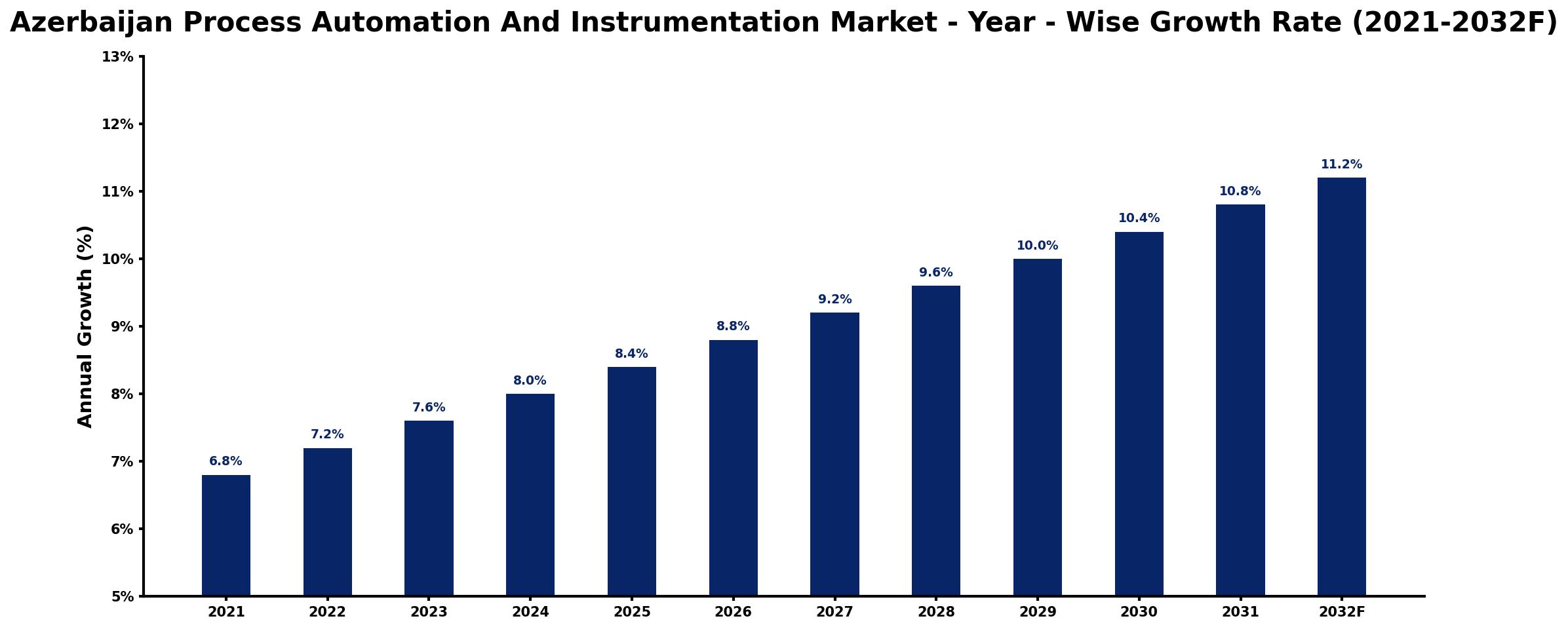
The table below presents the year‑wise growth rates along with the key drivers influencing the market
| Year | Growth Rate | Major Drivers |
| 2021 | 6.8% | Rising demand for industrial efficiency |
| 2022 | 7.2% | Increased investments in technology upgrades |
| 2023 | 7.6% | Growth in energy sector projects |
| 2024 | 8.0% | Expansion of manufacturing capabilities |
| 2025 | 8.4% | Emerging trends in smart technologies |
| 2026 | 8.8% | Focus on sustainability and compliance |
| 2027 | 9.2% | Advancements in digital technologies adoption |
| 2028 | 9.6% | Surge in construction and infrastructure |
| 2029 | 10.0% | Growing emphasis on safety regulations |
| 2030 | 10.4% | Enhanced data analytics applications usage |
| 2031 | 10.8% | Strengthened international trade agreements |
| 2032 | 11.2% | Widespread integration of IoT solutions |
Note: Market size estimations and growth projections presented in this report are based on 6Wresearch's proprietary forecasting methodology, utilizing the latest available industry data, government publications, and primary research inputs.
Azerbaijan Process Automation And Instrumentation Market Synopsis
The strongest force shaping the Azerbaijan Process Automation and Instrumentation Market is the increasing emphasis on enhancing operational efficiency and productivity across various industries. With the nation striving to modernize its industrial landscape, the adoption of advanced automation solutions has become a strategic priority.
Process automation technologies such as PLCs, SCADA systems, and DCS are becoming integral to optimizing manufacturing and energy processes. As industries invest in these technologies, they not only boost their productivity but also ensure compliance with stringent safety and quality standards.
Azerbaijan Process Automation And Instrumentation Market Key Takeaways
- Strong growth trajectory driven by rising demand for automation in key sectors.
- Technologies like PLCs, SCADA, and DCS are essential for operational efficiency.
- Government policies are fostering industrial automation investments.
- Challenges such as cybersecurity and skill shortages must be addressed.
- Industry 4.0 initiatives are reshaping the competitive landscape.
Evaluation of Restraints in Azerbaijan Process Automation And Instrumentation Market
While the Azerbaijan Process Automation and Instrumentation Market is poised for significant growth, it faces several restraints that could hinder its full potential. One primary concern is interoperability among diverse automation systems from various vendors. Ensuring that these systems can communicate effectively is crucial for seamless operations. Moreover, as cyber threats become increasingly sophisticated, protecting automation systems from potential breaches is essential. Companies must implement rigorous cybersecurity measures, which can be resource-intensive. Finally, a persistent skill gap in automation-related fields hampers the industry's ability to fully realize its potential, creating a pressing need for targeted training initiatives.
Azerbaijan Process Automation And Instrumentation Market Trends
The Azerbaijan Process Automation and Instrumentation Market is currently witnessing several transformative trends. The integration of artificial intelligence and machine learning into automation solutions is enhancing predictive maintenance capabilities, thereby reducing downtime and costs. Furthermore, the increasing focus on sustainability is pushing companies to adopt green technologies in their automation processes. Additionally, remote monitoring and control systems are gaining traction, allowing for more efficient operations and real-time data analysis, which can significantly boost decision-making processes.
Azerbaijan Process Automation And Instrumentation Market Opportunities
Opportunities abound in the Azerbaijan Process Automation and Instrumentation Market, particularly in sectors ripe for digital transformation. The energy sector, in particular, offers immense potential for automation solutions to optimize operations and enhance safety. Furthermore, as Azerbaijan invests in infrastructure projects, there is a growing demand for automation technologies that can streamline construction and operations. Companies that can leverage Industry 4.0 trends, such as IoT and big data analytics, will find themselves well-positioned to capture emerging market opportunities.
Government Initiatives in the Azerbaijan Process Automation And Instrumentation Market
The Azerbaijani government has recognized the critical role that process automation and instrumentation play in boosting industrial productivity and safety. In response, it has instituted various policies designed to support this market. These include financial incentives for businesses that invest in automation technologies, regulations aimed at ensuring interoperability and cybersecurity standards, and initiatives focused on enhancing the skills of the workforce through specialized training programs. Such policies not only promote technological advancement but also aim to build a robust ecosystem conducive to sustainable industrial growth.
Future Insights of the Azerbaijan Process Automation And Instrumentation Market
Looking ahead to 2026-2032, the Azerbaijan Process Automation and Instrumentation Market is expected to flourish as industries continue to embrace digital transformation. The growing integration of smart technologies will likely redefine operational paradigms, with businesses focusing on achieving greater automation and real-time data utilization. Moreover, as international standards for process safety and quality evolve, Azerbaijani companies will be compelled to upgrade their systems, further driving demand for advanced automation solutions. The momentum towards sustainable practices will also contribute significantly to market growth, establishing Azerbaijan as a competitive player in the global arena.
Azerbaijan Process Automation And Instrumentation Market Latest Developments (2025 - 2026)
Recent developments in the Azerbaijan Process Automation and Instrumentation Market indicate a strong alignment with global technological trends. As companies increasingly adopt AI-driven automation solutions, there have been notable advancements in predictive maintenance and remote monitoring capabilities. Additionally, collaborative efforts between industry stakeholders and educational institutions have emerged to address skill gaps, fostering a new generation of automation professionals. These developments reflect a dynamic response to both market demands and technological advancements, positioning the market for sustained growth.
Azerbaijan Process Automation And Instrumentation Market - Key Attractiveness of the Report
- 10 Years of Market Numbers
- Historical Data Starting from 2022 to 2025
- Base Year: 2025
- Forecast Data until 2032
- Key Performance Indicators Impacting the Market
- Major Upcoming Developments and Projects
Key Highlights of the Report:
- Azerbaijan Process Automation And Instrumentation Market Outlook
- Market Size of Azerbaijan Process Automation And Instrumentation Market, 2025
- Forecast of Azerbaijan Process Automation And Instrumentation Market, 2032
- Historical Data and Forecast of Azerbaijan Process Automation And Instrumentation Revenues & Volume for the Period 2022-2032F
- Azerbaijan Process Automation And Instrumentation Market Trend Evolution
- Azerbaijan Process Automation And Instrumentation Market Drivers and Challenges
- Azerbaijan Process Automation And Instrumentation Price Trends
- Azerbaijan Process Automation And Instrumentation Porter's Five Forces
- Azerbaijan Process Automation And Instrumentation Industry Life Cycle
- Historical Data and Forecast of Azerbaijan Process Automation And Instrumentation Market Revenues & Volume By Instrument for the Period 2022-2032F
- Historical Data and Forecast of Azerbaijan Process Automation And Instrumentation Market Revenues & Volume By Field Instruments for the Period 2022-2032F
- Historical Data and Forecast of Azerbaijan Process Automation And Instrumentation Market Revenues & Volume By Control Valve for the Period 2022-2032F
- Historical Data and Forecast of Azerbaijan Process Automation And Instrumentation Market Revenues & Volume By Analytical Instruments for the Period 2022-2032F
- Historical Data and Forecast of Azerbaijan Process Automation And Instrumentation Market Revenues & Volume By Solution for the Period 2022-2032F
- Historical Data and Forecast of Azerbaijan Process Automation And Instrumentation Market Revenues & Volume By Advanced Process Control (APC) for the Period 2022-2032F
- Historical Data and Forecast of Azerbaijan Process Automation And Instrumentation Market Revenues & Volume By Distributed Control System (DCS) for the Period 2022-2032F
- Historical Data and Forecast of Azerbaijan Process Automation And Instrumentation Market Revenues & Volume By Human Machine Interaction (HMI) for the Period 2022-2032F
- Historical Data and Forecast of Azerbaijan Process Automation And Instrumentation Market Revenues & Volume By Manufacturing Execution System (MES) for the Period 2022-2032F
- Historical Data and Forecast of Azerbaijan Process Automation And Instrumentation Market Revenues & Volume By Programmable Logic Controller (PLC) for the Period 2022-2032F
- Historical Data and Forecast of Azerbaijan Process Automation And Instrumentation Market Revenues & Volume By Safety Automation for the Period 2022-2032F
- Historical Data and Forecast of Azerbaijan Process Automation And Instrumentation Market Revenues & Volume By Supervisory Control and Data Acquisition (SCADA) for the Period 2022-2032F
- Historical Data and Forecast of Azerbaijan Process Automation And Instrumentation Market Revenues & Volume By End-user Industry for the Period 2022-2032F
- Historical Data and Forecast of Azerbaijan Process Automation And Instrumentation Market Revenues & Volume By Oil and Gas for the Period 2022-2032F
- Historical Data and Forecast of Azerbaijan Process Automation And Instrumentation Market Revenues & Volume By Food and Beverage for the Period 2022-2032F
- Historical Data and Forecast of Azerbaijan Process Automation And Instrumentation Market Revenues & Volume By Pharmaceutical and Biopharma for the Period 2022-2032F
- Historical Data and Forecast of Azerbaijan Process Automation And Instrumentation Market Revenues & Volume By Chemical and Petrochemical for the Period 2022-2032F
- Historical Data and Forecast of Azerbaijan Process Automation And Instrumentation Market Revenues & Volume By Other End-user Industries for the Period 2022-2032F
- Azerbaijan Process Automation And Instrumentation Import Export Trade Statistics
- Market Opportunity Assessment By Instrument
- Market Opportunity Assessment By Solution
- Market Opportunity Assessment By End-user Industry
- Azerbaijan Process Automation And Instrumentation Top Companies Market Share
- Azerbaijan Process Automation And Instrumentation Competitive Benchmarking By Technical and Operational Parameters
- Azerbaijan Process Automation And Instrumentation Company Profiles
- Azerbaijan Process Automation And Instrumentation Key Strategic Recommendations






































