Azerbaijan Public Cloud Market Size & Growth Rate (2026-2032)
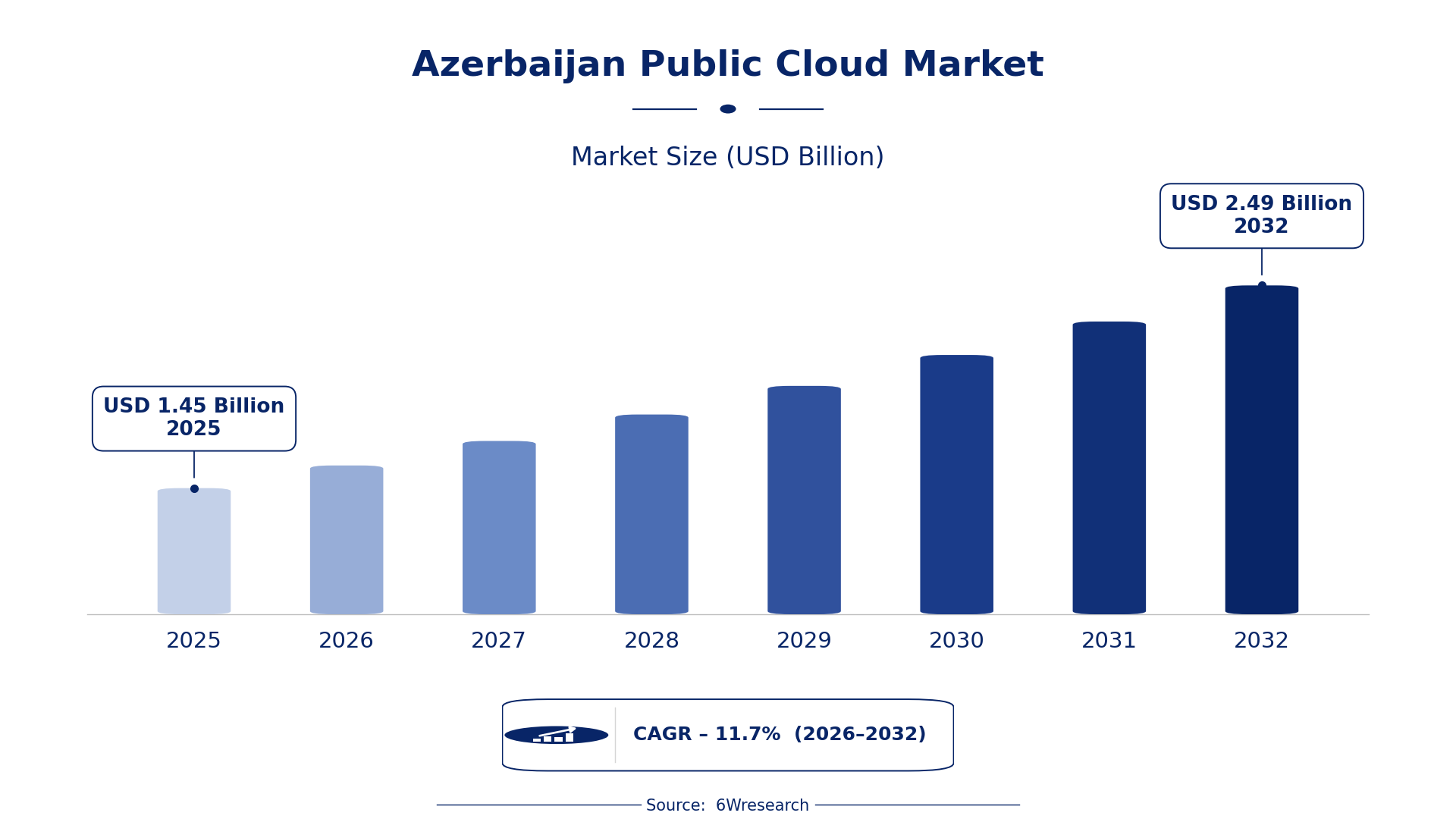
The Azerbaijan Public Cloud Market was estimated at USD 1445 Million in 2025 and is projected to reach USD 2490 Million by 2032, growing at a CAGR of 11.7% from 2026 to 2032.
Azerbaijan Public Cloud Market Synopsis
The Azerbaijan Public Cloud Market is rapidly expanding as various sectors, particularly finance and government, increasingly adopt cloud solutions. Businesses are recognizing the advantages of scalable, cost-efficient IT operations, driving demand for Infrastructure as a Service (IaaS), Platform as a Service (PaaS), and Software as a Service (SaaS) offerings.
Government initiatives aimed at fostering digital transformation are further propelling this market's growth. By promoting cloud adoption, the Azerbaijani government is creating an environment conducive to innovation and operational efficiency for both private and public entities.
Azerbaijan Public Cloud Market Year-wise Growth Rate and Key Drivers
This graph illustrates the annual growth rates of the Azerbaijan Public Cloud Market from 2021 to 2032, highlighting a steady upward trajectory and projected expansion over the forecast period.
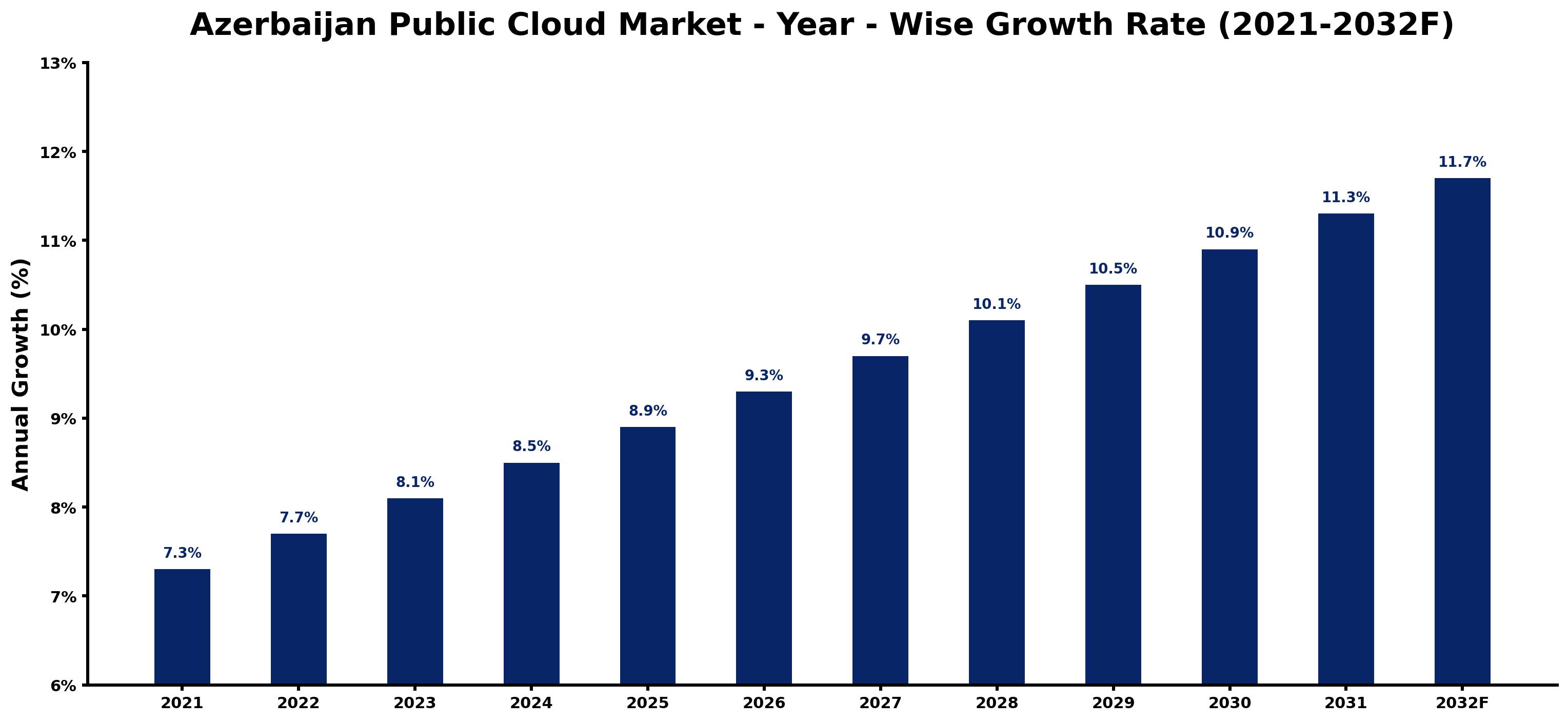
The table below presents the year‑wise growth rates along with the key drivers influencing the market
| Year | Growth Rate | Major Drivers |
| 2021 | 7.3% | Azerbaijan’s digital transformation strategy boosts cloud adoption. |
| 2022 | 7.7% | Growing interest in online education drives cloud services demand. |
| 2023 | 8.1% | Government incentives promote local startups utilizing cloud solutions. |
| 2024 | 8.5% | Increased mobile internet penetration enhances cloud accessibility. |
| 2025 | 8.9% | Corporate digitalization facilitates migration to public cloud platforms. |
| 2026 | 9.3% | Local data privacy regulations encourage cloud service compliance. |
| 2027 | 9.7% | Emergence of fintech companies reliant on cloud infrastructures. |
| 2028 | 10.1% | Rising e-commerce trends necessitate robust cloud technology. |
| 2029 | 10.5% | Growth of video streaming services increases bandwidth and storage needs. |
| 2030 | 10.9% | Government-funded tech hubs stimulate public cloud innovations. |
| 2031 | 11.3% | Enhanced cybersecurity measures support public cloud expansion. |
| 2032 | 11.7% | Development in artificial intelligence applications fosters cloud utilization. |
Note: Market size estimations and growth projections presented in this report are based on 6Wresearch's proprietary forecasting methodology, utilizing the latest available industry data, government publications, and primary research inputs.
Azerbaijan Public Cloud Market Key Takeaways
Below are some of the specific key takeaways from the market, including:
- The market is driven by increasing cloud adoption across various sectors, including IT, finance, and government.
- Key trends include a shift towards hybrid cloud solutions and growing interest in SaaS applications.
- Government policies are promoting digital transformation and enhancing data protection regulations.
- Challenges include limited local awareness of cloud technologies and underdeveloped internet infrastructure in certain areas.
- Investment opportunities are emerging in data centers and cloud service providers as demand rises.
Evaluation of Restraints in Azerbaijan Public Cloud Market
Despite its growth potential, the Azerbaijan Public Cloud Market faces notable restraints. A lack of awareness among businesses regarding cloud technologies hampers adoption rates. Concerns about data security and compliance with evolving regulations further complicate the landscape. Additionally, the internet infrastructure remains underdeveloped in several regions, which can deter businesses from transitioning to cloud solutions. The cultural preference for traditional on-premises IT setups also presents a barrier to widespread cloud acceptance.
Azerbaijan Public Cloud Market Trends
Several trends are emerging within the Azerbaijan Public Cloud Market. The growing popularity of SaaS solutions is evident as businesses seek more efficient customer relationship management and collaboration tools. There’s a noticeable shift towards hybrid cloud environments, allowing organizations to tailor their IT solutions to specific needs. Additionally, heightened focus on data security measures is prompting investments aimed at ensuring compliance and protecting sensitive information.
Azerbaijan Public Cloud Market Opportunities
The market presents several investment opportunities, particularly for businesses and government agencies looking to enhance operational efficiency. The ongoing digital transformation initiatives are creating demand for cloud infrastructure and services. Investors can capitalize on the need for local data centers and cloud management solutions. on top of that, Azerbaijan's strategic geographic location can serve as a gateway for cloud service providers aiming to expand into neighboring regions.
Government Initiatives in the Azerbaijan Public Cloud Market
The Azerbaijani government is actively shaping the public cloud market through various initiatives aimed at fostering innovation and enhancing data security. By implementing supportive regulations, the government seeks to encourage cloud adoption among businesses and public institutions. These policies are essential for establishing a secure and efficient cloud ecosystem in the country.
- A recently completed initiative introduced a regulatory framework to enhance data protection measures for cloud services.
- A current program promotes tax incentives for cloud service providers and users to stimulate market growth.
- A planned public-private partnership is expected to upgrade national digital infrastructure by 2028.
- An ongoing project focuses on developing educational resources to improve awareness and understanding of cloud technologies among businesses.
- A government-backed initiative aims to establish a certification program for local cloud service providers to ensure quality and compliance.
Future Insights of the Azerbaijan Public Cloud Market
Looking ahead to 2026-2032, the Azerbaijan Public Cloud Market is set for significant growth. Digitalization across various sectors will continue to drive demand for cloud services, as companies recognize the value of agility and cost-effectiveness. With advancements in technologies like artificial intelligence and big data analytics, cloud adoption is expected to gain further momentum. The government's sustained efforts to foster a supportive regulatory environment will also play a crucial role in shaping the future of this market.
Azerbaijan Public Cloud Market Latest Developments
In the past year, the Azerbaijan Public Cloud Market has seen notable developments that signal a growing commitment to cloud technologies. Various stakeholders are actively engaging in initiatives that enhance service delivery and infrastructure. These advancements reflect a broader trend towards digital transformation within the country.
- A major technology vendor launched a new suite of cloud-based solutions in early 2025, targeting local businesses.
- An ongoing initiative to establish a national cloud service framework is currently in its implementation phase, enhancing standardization and compliance.
- A leading regional operator announced plans for a data center expansion expected to commence in mid-2026, aimed at increasing service capacity.
- In Q3 2025, a collaborative project was initiated to provide training programs for IT professionals on cloud management and security.
- A rollout of a public sector cloud service platform is scheduled for late 2026, designed to streamline government operations and services.
Azerbaijan Public Cloud Market - Key Attractiveness of the Report
- 10 Years of Market Numbers
- Historical Data Starting from 2022 to 2025
- Base Year: 2025
- Forecast Data until 2032
- Key Performance Indicators Impacting the Market
- Major Upcoming Developments and Projects
Key Highlights of the Report:
- Azerbaijan Public Cloud Market Outlook
- Market Size of Azerbaijan Public Cloud Market, 2025
- Forecast of Azerbaijan Public Cloud Market, 2032
- Historical Data and Forecast of Azerbaijan Public Cloud Revenues & Volume for the Period 2022-2032F
- Azerbaijan Public Cloud Market Trend Evolution
- Azerbaijan Public Cloud Market Drivers and Challenges
- Azerbaijan Public Cloud Price Trends
- Azerbaijan Public Cloud Porter's Five Forces
- Azerbaijan Public Cloud Industry Life Cycle
- Historical Data and Forecast of Azerbaijan Public Cloud Market Revenues & Volume By Service Model for the Period 2022-2032F
- Historical Data and Forecast of Azerbaijan Public Cloud Market Revenues & Volume By Infrastructure as a Service for the Period 2022-2032F
- Historical Data and Forecast of Azerbaijan Public Cloud Market Revenues & Volume By Platform as a Service for the Period 2022-2032F
- Historical Data and Forecast of Azerbaijan Public Cloud Market Revenues & Volume By Software as a Service for the Period 2022-2032F
- Historical Data and Forecast of Azerbaijan Public Cloud Market Revenues & Volume By Organization Size Large enterprises for the Period 2022-2032F
- Historical Data and Forecast of Azerbaijan Public Cloud Market Revenues & Volume By Small for the Period 2022-2032F
- Historical Data and Forecast of Azerbaijan Public Cloud Market Revenues & Volume By Medium Enterprises SMEs for the Period 2022-2032F
- Historical Data and Forecast of Azerbaijan Public Cloud Market Revenues & Volume By Verticals for the Period 2022-2032F
- Historical Data and Forecast of Azerbaijan Public Cloud Market Revenues & Volume By BFSI for the Period 2022-2032F
- Historical Data and Forecast of Azerbaijan Public Cloud Market Revenues & Volume By Telecommunication for the Period 2022-2032F
- Historical Data and Forecast of Azerbaijan Public Cloud Market Revenues & Volume By IT & ITeS for the Period 2022-2032F
- Historical Data and Forecast of Azerbaijan Public Cloud Market Revenues & Volume By Government & Public Sector for the Period 2022-2032F
- Historical Data and Forecast of Azerbaijan Public Cloud Market Revenues & Volume By Retail & Consumer Goods for the Period 2022-2032F
- Historical Data and Forecast of Azerbaijan Public Cloud Market Revenues & Volume By Manufacturing for the Period 2022-2032F
- Historical Data and Forecast of Azerbaijan Public Cloud Market Revenues & Volume By Energy & Utility for the Period 2022-2032F
- Historical Data and Forecast of Azerbaijan Public Cloud Market Revenues & Volume By Media & Entertainment for the Period 2022-2032F
- Azerbaijan Public Cloud Import Export Trade Statistics
- Market Opportunity Assessment By Service Model
- Market Opportunity Assessment By Organization Size Large enterprises
- Market Opportunity Assessment By Verticals
- Azerbaijan Public Cloud Top Companies Market Share
- Azerbaijan Public Cloud Competitive Benchmarking By Technical and Operational Parameters
- Azerbaijan Public Cloud Company Profiles
- Azerbaijan Public Cloud Key Strategic Recommendations






































