Azerbaijan Pulses Market Size, Share & Growth Rate
The Azerbaijan Pulses Market was estimated at USD 313 Million in 2025 and is projected to reach USD 545 Million by 2032, growing at a CAGR of 8.2% from 2026 to 2032. This growth trajectory is driven largely by the increasing incorporation of pulses into daily diets, as they are an essential component of traditional Azerbaijani cuisine. Furthermore, heightened awareness regarding the nutritional benefits of pulses—such as their high protein content and dietary fiber—continues to fuel consumer interest, reinforcing their role as a staple in both local and international dishes.
Azerbaijan Pulses Market Year-wise Growth Rate and Key Drivers
This graph highlights how the Azerbaijan Pulses Market has steadily grown over the years, supported by major growth factors.
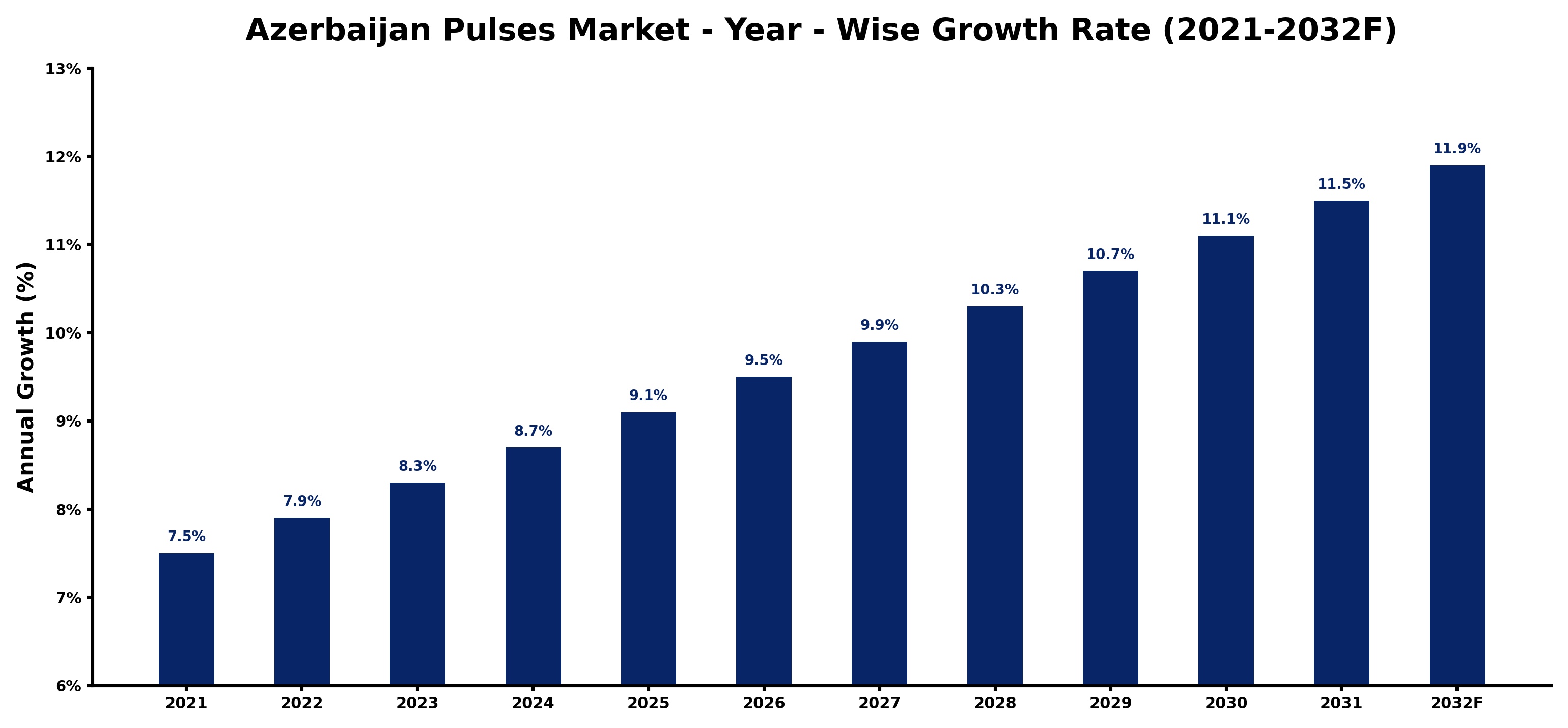
The table below presents the year‑wise growth rates along with the key drivers influencing the market
| Year | Growth Rate | Major Drivers |
| 2021 | 7.5% | Increased health awareness drove demand |
| 2022 | 7.9% | Local production capacity expanded significantly |
| 2023 | 8.3% | Consumer preferences shifted towards pulses |
| 2024 | 8.7% | Export opportunities enhanced market growth |
| 2025 | 9.1% | Sustainable farming practices gained traction |
| 2026 | 9.5% | Nutritional benefits promoted widely |
| 2027 | 9.9% | Culinary innovation attracted new consumers |
| 2028 | 10.3% | Plant-based diets gained popularity rapidly |
| 2029 | 10.7% | Government support for agriculture increased |
| 2030 | 11.1% | Food security initiatives boosted consumption |
| 2031 | 11.5% | Cultural integration of pulses expanded |
| 2032 | 11.9% | Technological advancements improved yields |
Note - Market size estimations and growth projections presented in this report are based on 6Wresearch's advanced forecasting approach, validated with industry datasets as of June 2026.
Azerbaijan Pulses Market Synopsis
The pulses market in Azerbaijan encompasses the cultivation, importation, and consumption of various legumes, including chickpeas, lentils, beans, and peas. These legumes are integral to many traditional dishes, enhancing both flavor and nutritional value. The local cuisine's rich culinary practices and reliance on pulses have ensured a steady demand for these products.
In addition to local consumption, pulses are gaining traction in export markets as health-conscious consumers globally recognize their versatility and health benefits. Enhanced agricultural practices and government support are expected to further boost production efficiency, contributing to greater market availability and variety for consumers.
Azerbaijan Pulses Market Key Takeaways
- The market is projected to grow significantly, highlighting the rising consumption and production of pulses.
- Nutritional awareness is driving demand, as consumers seek healthier dietary options.
- Government policies are enhancing agricultural output and food security within the pulses sector.
- Technological advancements in farming practices are improving the overall quality of pulse products.
- Challenges related to production variability and trade regulations necessitate strategic market management.
Evaluation of Restraints in Azerbaijan Pulses Market
Despite its growth potential, the Azerbaijan Pulses Market faces several real restraints that could impede progress. A significant concern is production variability, heavily influenced by adverse weather conditions and agronomic factors that can lead to unpredictable yield fluctuations. Additionally, stringent trade regulations and tariff barriers complicate market access for both local producers and international traders. These factors, coupled with the need for effective supply chain management to address changing consumer preferences and price volatility, highlight the importance of strategic planning within the sector.
Azerbaijan Pulses Market Trends
Current trends indicate a rising popularity of plant-based diets, with pulses serving as a fundamental protein source for health-conscious consumers. Innovations in packaging and product presentation are also becoming more prevalent, making pulses more appealing to a wider audience. Additionally, sustainability concerns are fostering greater interest in legumes, as they are known for their environmental benefits, such as improving soil health and reducing carbon footprints. These trends are shaping demand and encouraging investment in the pulses sector.
Azerbaijan Pulses Market Opportunities
There are notable opportunities within the Azerbaijan Pulses Market that can be leveraged for growth and investment. Expanding export markets for Azerbaijani pulses can enhance revenue streams, particularly in regions where demand for plant-based products is surging. Moreover, the integration of technology in farming practices presents an avenue for improving productivity and quality, making local products more competitive. Collaborations between government entities and agricultural cooperatives could further empower farmers and ensure a steady supply of high-quality pulses to meet both domestic and international demands.
Government Initiatives in the Azerbaijan Pulses Market
The Azerbaijani government has recognized the importance of developing the pulses market as part of its agricultural diversification strategy. Policies promoting subsidies for pulse crop production are intended to enhance farmer profitability and output levels. Investments in research and extension services aim to improve cultivation practices and yield. Additionally, infrastructure development initiatives focus on facilitating market access for pulse farmers, enhancing their ability to reach both local and international markets.
Future Insights of the Azerbaijan Pulses Market
Looking ahead to 2026-2032, the Azerbaijan Pulses Market is expected to experience sustained growth driven by rising consumer awareness and demand for healthful food options. Increased production and distribution efficiencies, coupled with ongoing government support, will likely enable the sector to capitalize on new market opportunities. As international interest in Azerbaijani pulses grows, the market can anticipate a shift toward more robust export strategies and diversified product offerings that cater to emerging culinary trends.
Azerbaijan Pulses Market Latest Developments (May 2025 - June 2026)
Recent developments in the Azerbaijan Pulses Market reflect a dynamic landscape, with increased focus on sustainability and innovation in cultivation methods. The introduction of new pulse varieties that enhance yield and disease resistance has gained attention, promising to bolster production capacities. Additionally, collaborative initiatives between agricultural stakeholders aim to promote education and resources for farmers, ensuring they are equipped to meet the growing market demands. Overall, the sector appears poised for a promising future as it adapts to both local and global trends.
Azerbaijan Pulses Market - Key Attractiveness of the Report
- 10 Years of Market Numbers
- Historical Data Starting from 2022 to 2025
- Base Year: 2025
- Forecast Data until 2032
- Key Performance Indicators Impacting the Market
- Major Upcoming Developments and Projects
Key Highlights of the Report:
- Azerbaijan Pulses Market Outlook
- Market Size of Azerbaijan Pulses Market, 2025
- Forecast of Azerbaijan Pulses Market, 2032
- Historical Data and Forecast of Azerbaijan Pulses Revenues & Volume for the Period 2022-2032F
- Azerbaijan Pulses Market Trend Evolution
- Azerbaijan Pulses Market Drivers and Challenges
- Azerbaijan Pulses Price Trends
- Azerbaijan Pulses Porter's Five Forces
- Azerbaijan Pulses Industry Life Cycle
- Historical Data and Forecast of Azerbaijan Pulses Market Revenues & Volume By Type for the Period 2022-2032F
- Historical Data and Forecast of Azerbaijan Pulses Market Revenues & Volume By Chick Peas for the Period 2022-2032F
- Historical Data and Forecast of Azerbaijan Pulses Market Revenues & Volume By Kaspa Peas for the Period 2022-2032F
- Historical Data and Forecast of Azerbaijan Pulses Market Revenues & Volume By Lentils for the Period 2022-2032F
- Historical Data and Forecast of Azerbaijan Pulses Market Revenues & Volume By Pigeon Peas for the Period 2022-2032F
- Historical Data and Forecast of Azerbaijan Pulses Market Revenues & Volume By Fava Beans for the Period 2022-2032F
- Historical Data and Forecast of Azerbaijan Pulses Market Revenues & Volume By Black Gram for the Period 2022-2032F
- Historical Data and Forecast of Azerbaijan Pulses Market Revenues & Volume By Mung Beans for the Period 2022-2032F
- Historical Data and Forecast of Azerbaijan Chick Peas Pulses Market Revenues & Volume By Others for the Period 2022-2032F
- Historical Data and Forecast of Azerbaijan Pulses Market Revenues & Volume By End-use for the Period 2022-2032F
- Historical Data and Forecast of Azerbaijan Pulses Market Revenues & Volume By Home Use for the Period 2022-2032F
- Historical Data and Forecast of Azerbaijan Pulses Market Revenues & Volume By Snack Food Industry for the Period 2022-2032F
- Historical Data and Forecast of Azerbaijan Pulses Market Revenues & Volume By Flour Industry for the Period 2022-2032F
- Historical Data and Forecast of Azerbaijan Pulses Market Revenues & Volume By Others for the Period 2022-2032F
- Azerbaijan Pulses Import Export Trade Statistics
- Market Opportunity Assessment By Type
- Market Opportunity Assessment By End-use
- Azerbaijan Pulses Top Companies Market Share
- Azerbaijan Pulses Competitive Benchmarking By Technical and Operational Parameters
- Azerbaijan Pulses Company Profiles
- Azerbaijan Pulses Key Strategic Recommendations






































