Azerbaijan Quinine Market Size, Share & Growth Rate
The Azerbaijan Quinine Market was estimated at USD 438 Million in 2025 and is projected to reach USD 775 Million by 2032, growing at a CAGR of 8.5% from 2026 to 2032. This upward trajectory is underpinned by a combination of increasing malaria cases in specific regions and a proactive healthcare infrastructure committed to improving public health outcomes. The robust investment in pharmaceutical manufacturing capabilities further fuels this growth, ensuring the availability of essential quinine-based medications and products.
Azerbaijan Quinine Market Year-wise Growth Rate and Key Drivers
This graph highlights how the Azerbaijan Quinine Market has steadily grown over the years, supported by major growth factors.
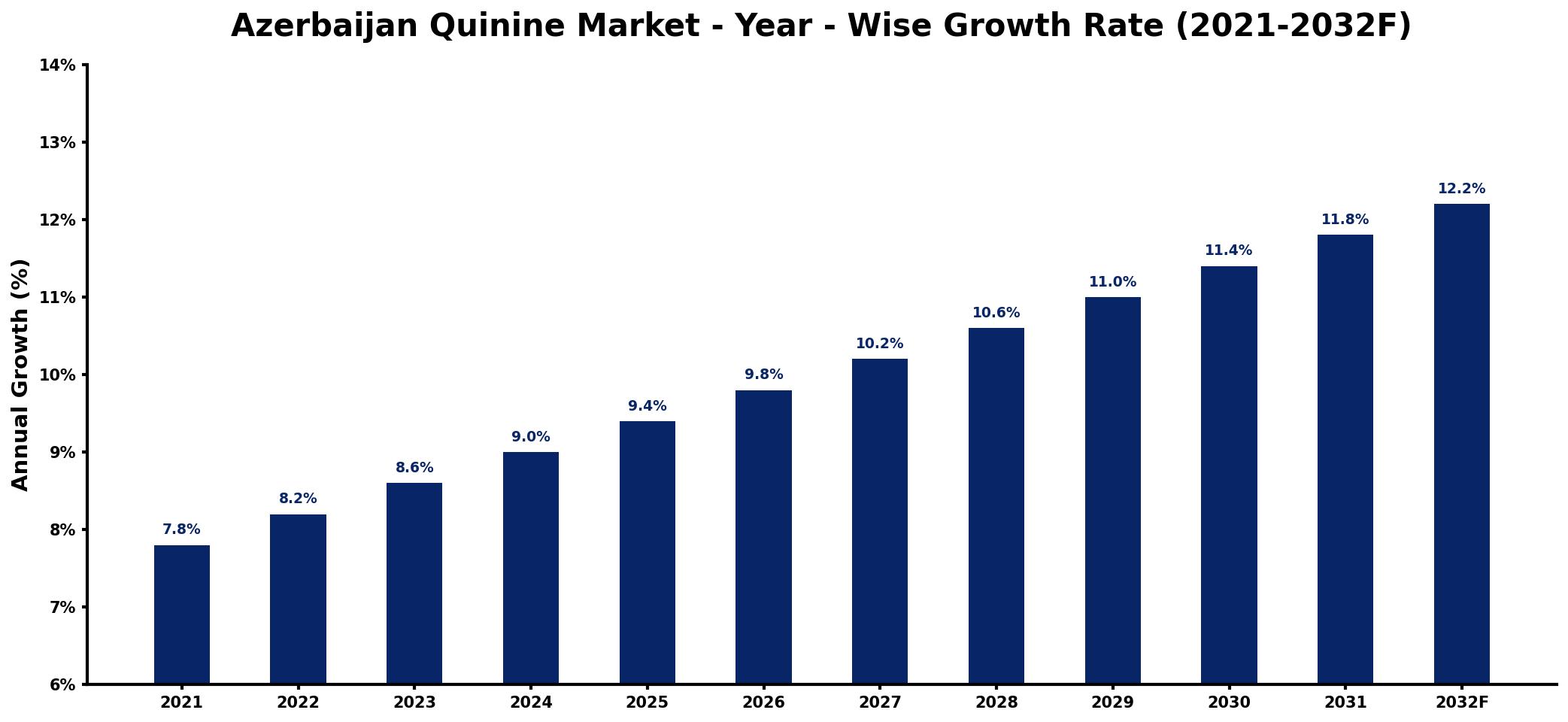
The table below presents the year‑wise growth rates along with the key drivers influencing the market
| Year | Growth Rate | Major Drivers |
| 2021 | 7.8% | increased healthcare investments observed |
| 2022 | 8.2% | growing pharmaceutical production capacity |
| 2023 | 8.6% | rising consumer health awareness trends |
| 2024 | 9.0% | expansion in global supply chains |
| 2025 | 9.4% | emerging markets driving demand |
| 2026 | 9.8% | enhanced research and development funding |
| 2027 | 10.2% | increased exports boosting revenue |
| 2028 | 10.6% | growing herbal medicine popularity |
| 2029 | 11.0% | innovative product offerings launched |
| 2030 | 11.4% | stronger regulatory support initiatives |
| 2031 | 11.8% | increased partnership opportunities created |
| 2032 | 12.2% | higher investment in biotechnology |
Note: Market size estimations and growth projections presented in this report are based on 6Wresearch's proprietary forecasting methodology, utilizing the latest available industry data, government publications, and primary research inputs.
Azerbaijan Quinine Market Synopsis
The Azerbaijan quinine market is experiencing a significant evolution, with rising demand stemming from the pharmaceutical sector's focus on effective malaria treatments. The unique role of quinine, not only as a medicinal compound but also as an ingredient in beverages, reflects its dual importance in healthcare and consumer markets alike.
Derived predominantly from the bark of cinchona trees, quinine's therapeutic applications are critical, especially given the current challenges in managing malaria within certain demographic regions of Azerbaijan. This duality reinforces the importance of maintaining a steady supply of quinine and highlights the need for comprehensive strategies to meet both healthcare and consumer demands.
Azerbaijan Quinine Market Key Takeaways
- The market's growth is significantly driven by the rising prevalence of malaria and the need for effective treatments.
- Investment in local pharmaceutical manufacturing is enhancing the availability and quality of quinine products.
- Quinines utilization in beverages, such as tonic water, is contributing to its sustained demand in the consumer market.
- Government initiatives aimed at disease prevention are further propelling market dynamics and expansion.
- Regulatory frameworks are evolving to ensure quality and safety in quinine production and distribution.
Evaluation of Restraints in Azerbaijan Quinine Market
Despite its promising growth, the Azerbaijan quinine market faces several restraints. Supply chain disruptions, especially related to sourcing raw materials from cinchona bark, are a constant concern. Variability in harvest yields, environmental factors, and international trade restrictions can significantly affect the availability of quinine. Additionally, navigating complex regulatory compliance—focused on safety and purity standards—adds layers of challenge for manufacturers. This multifaceted landscape requires stakeholders to adopt adaptive strategies to manage demand fluctuations effectively while ensuring consistent product availability.
Azerbaijan Quinine Market Trends
Several trends are emerging that are reshaping the Azerbaijan quinine market. A notable shift towards more natural and plant-derived remedies is influencing consumer preferences, pushing both producers and pharmaceutical companies to innovate. The growing interest in health and wellness is leading to increased incorporation of quinine in beverage formulations, with tonic water gaining popularity as a health-oriented drink. Furthermore, digital health solutions are becoming integral in malaria management, creating a new platform for quinine products and education about their usage.
Azerbaijan Quinine Market Opportunities
There are substantial opportunities for growth within the Azerbaijan quinine market. The expansion of healthcare infrastructure provides a pathway for enhanced distribution of quinine-based medications, directly addressing the need for effective malaria treatments. Moreover, the increasing popularity of quinine in beverages presents an attractive niche for product innovation. Collaborations between pharmaceutical firms and beverage companies could lead to diversified product lines that meet both health needs and consumer demand. Overall, investments in R&D to develop new quinine applications can yield significant returns.
Government Initiatives in the Azerbaijan Quinine Market
The Azerbaijani government is actively involved in regulating the quinine market to address healthcare challenges, particularly regarding malaria. Initiatives include stringent registration and licensing requirements for quinine pharmaceutical products and implementing regulations to guarantee quality and safety standards. Additionally, there are government programs aimed at promoting awareness of responsible use of quinine-based medications, aligning with medical guidelines and treatment protocols. Such policies are pivotal in ensuring effective disease management and healthcare improvement.
Future Insights of the Azerbaijan Quinine Market
Looking forward to the period from 2026 to 2032, the Azerbaijan quinine market is set for remarkable evolution. As the prevalence of malaria remains a significant public health concern, demand for quinine will likely grow, supported by ongoing healthcare improvements. Innovations in production processes and quality assurance will enhance the market's ability to meet the rising needs. Furthermore, collaboration between sectors will likely drive new opportunities in beverage applications, ultimately contributing to the market's robust growth trajectory.
Azerbaijan Quinine Market Latest Developments (2025 - 2026)
Recent developments in the Azerbaijan quinine market indicate a strategic focus on enhancing production capacities and ensuring consistent quality in quinine-based products. Ongoing efforts are directed towards establishing better supply chain frameworks that mitigate disruptions while securing sustainable sources of cinchona bark. Additionally, collaborations between healthcare providers and pharmaceutical manufacturers are intensifying, emphasizing the critical importance of effective malaria treatments in community health initiatives.
Azerbaijan Quinine Market - Key Attractiveness of the Report
- 10 Years of Market Numbers
- Historical Data Starting from 2022 to 2025
- Base Year: 2025
- Forecast Data until 2032
- Key Performance Indicators Impacting the Market
- Major Upcoming Developments and Projects
Key Highlights of the Report:
- Azerbaijan Quinine Market Outlook
- Market Size of Azerbaijan Quinine Market, 2025
- Forecast of Azerbaijan Quinine Market, 2032
- Historical Data and Forecast of Azerbaijan Quinine Revenues & Volume for the Period 2022-2032F
- Azerbaijan Quinine Market Trend Evolution
- Azerbaijan Quinine Market Drivers and Challenges
- Azerbaijan Quinine Price Trends
- Azerbaijan Quinine Porter's Five Forces
- Azerbaijan Quinine Industry Life Cycle
- Historical Data and Forecast of Azerbaijan Quinine Market Revenues & Volume By Mode of Administration for the Period 2022-2032F
- Historical Data and Forecast of Azerbaijan Quinine Market Revenues & Volume By Oral Administration for the Period 2022-2032F
- Historical Data and Forecast of Azerbaijan Quinine Market Revenues & Volume By Intravenous Administration for the Period 2022-2032F
- Historical Data and Forecast of Azerbaijan Quinine Market Revenues & Volume By Intramuscular Administration for the Period 2022-2032F
- Historical Data and Forecast of Azerbaijan Quinine Market Revenues & Volume By Others for the Period 2022-2032F
- Historical Data and Forecast of Azerbaijan Quinine Market Revenues & Volume By Application for the Period 2022-2032F
- Historical Data and Forecast of Azerbaijan Quinine Market Revenues & Volume By Antimalarial for the Period 2022-2032F
- Historical Data and Forecast of Azerbaijan Quinine Market Revenues & Volume By Antipyretic for the Period 2022-2032F
- Historical Data and Forecast of Azerbaijan Quinine Market Revenues & Volume By Others for the Period 2022-2032F
- Historical Data and Forecast of Azerbaijan Quinine Market Revenues & Volume By End-user for the Period 2022-2032F
- Historical Data and Forecast of Azerbaijan Quinine Market Revenues & Volume By Hospitals for the Period 2022-2032F
- Historical Data and Forecast of Azerbaijan Quinine Market Revenues & Volume By Clinics for the Period 2022-2032F
- Historical Data and Forecast of Azerbaijan Quinine Market Revenues & Volume By Ambulatory Surgical Centers for the Period 2022-2032F
- Historical Data and Forecast of Azerbaijan Quinine Market Revenues & Volume By Others for the Period 2022-2032F
- Azerbaijan Quinine Import Export Trade Statistics
- Market Opportunity Assessment By Mode of Administration
- Market Opportunity Assessment By Application
- Market Opportunity Assessment By End-user
- Azerbaijan Quinine Top Companies Market Share
- Azerbaijan Quinine Competitive Benchmarking By Technical and Operational Parameters
- Azerbaijan Quinine Company Profiles
- Azerbaijan Quinine Key Strategic Recommendations






































