Azerbaijan Refined Petroleum Products Market Size, Share & Growth Rate
The Azerbaijan Refined Petroleum Products Market was estimated at USD 626 Million in 2025 and is projected to reach USD 1096 Million by 2032, growing at a CAGR of 8.3% from 2026 to 2032. This growth is largely propelled by Azerbaijan's rich oil and gas reserves, which position the country as a pivotal player in global energy markets. The ongoing modernization of refinery infrastructure and expansion projects are also critical drivers, ensuring that domestic production can meet both local demand and international export opportunities.
Azerbaijan Refined Petroleum Products Market Year-wise Growth Rate and Key Drivers
This graph highlights how the Azerbaijan Refined Petroleum Products Market has steadily grown over the years, supported by major growth factors.
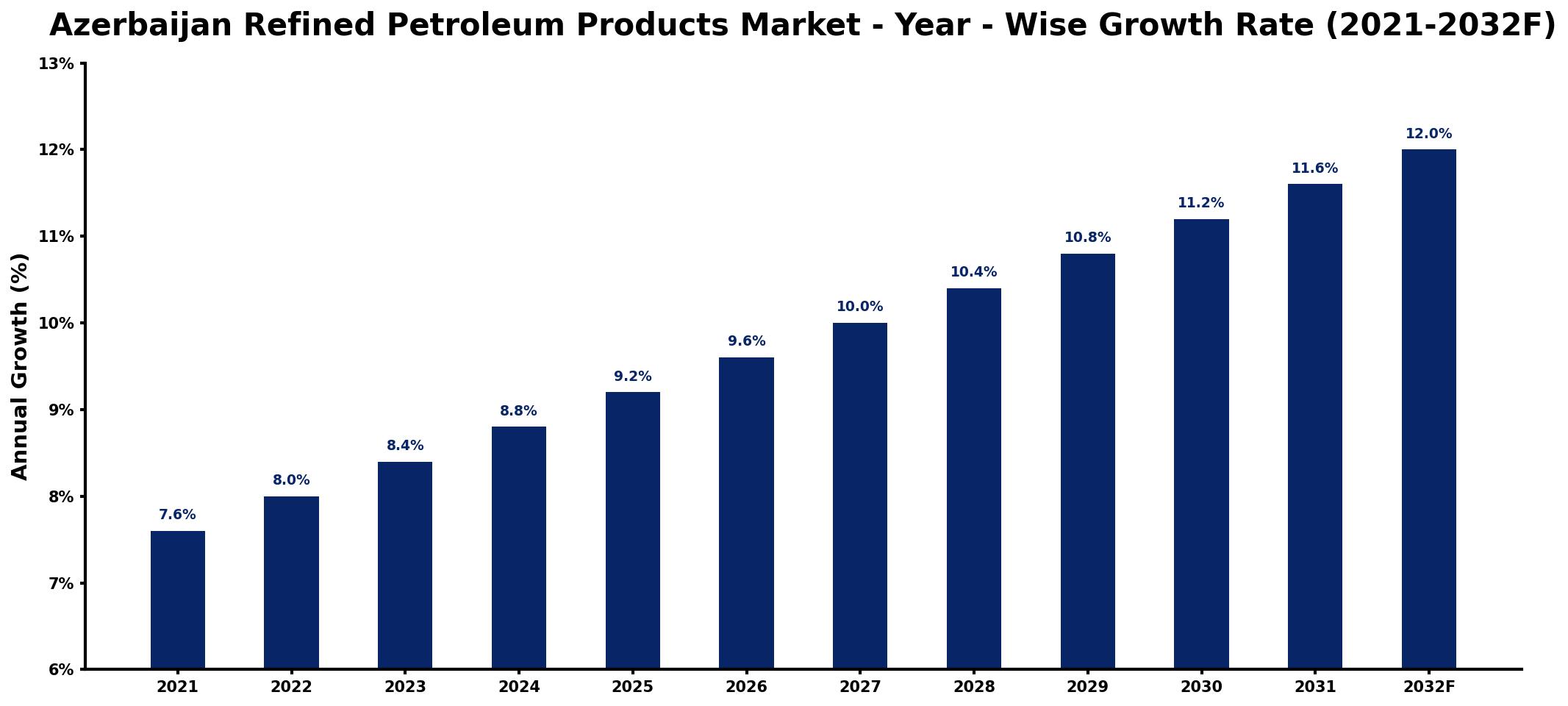
The table below presents the year‑wise growth rates along with the key drivers influencing the market
| Year | Growth Rate | Major Drivers |
| 2021 | 7.6% | Rising industrial energy consumption |
| 2022 | 8.0% | Increased transportation sector demand |
| 2023 | 8.4% | Expansion of regional infrastructure projects |
| 2024 | 8.8% | Growing urbanization and population |
| 2025 | 9.2% | Investment in renewable energy initiatives |
| 2026 | 9.6% | Strengthening regional trade agreements |
| 2027 | 10.0% | Technological advancements in logistics |
| 2028 | 10.4% | Higher consumer spending patterns |
| 2029 | 10.8% | Increased foreign direct investments |
| 2030 | 11.2% | Development of new energy markets |
| 2031 | 11.6% | Enhanced regulatory support frameworks |
| 2032 | 12.0% | Growing emphasis on energy security |
Note: Market size estimations and growth projections presented in this report are based on 6Wresearch's proprietary forecasting methodology, utilizing the latest available industry data, government publications, and primary research inputs.
Azerbaijan Refined Petroleum Products Market Synopsis
Azerbaijan's refined petroleum products market is crucial for meeting the energy needs of the country and its neighbors. The presence of the State Oil Company of Azerbaijan Republic (SOCAR) underlines the sector's significance, as it oversees a significant share of production and distribution, ensuring high-quality outputs for both domestic and export markets.
In addition to traditional products like gasoline and diesel, there is a marked shift towards cleaner fuels and innovative production techniques. This evolution reflects Azerbaijan's commitment to sustainability while adapting to global trends, positioning the country for increased relevance on the international stage.
Azerbaijan Refined Petroleum Products Market Key Takeaways
- The market is projected to grow significantly, reflecting Azerbaijan's strategic energy position.
- A focus on cleaner and more sustainable fuel production is transforming operational practices.
- Expansion in refinery capacity is critical for meeting both domestic and export demands.
- Government initiatives are fostering a competitive landscape that encourages foreign investments.
- Digitalization is enhancing operational efficiency within the supply chain.
Evaluation of Restraints in Azerbaijan Refined Petroleum Products Market
Despite the positive outlook, the Azerbaijan Refined Petroleum Products Market faces several limitations that could impact growth. Fluctuations in global oil prices can lead to unstable profitability for local refineries, while limited refining capacity occasionally forces reliance on imports to satisfy domestic needs. Moreover, regulatory constraints can impede competition, posing a challenge for new entrants in the market. Geopolitical tensions in the region also introduce a layer of uncertainty, making risk management and strategic planning crucial for all market players.
Azerbaijan Refined Petroleum Products Market Trends
The market is witnessing several transformative trends. The emphasis on sustainability is prompting refineries to adopt cleaner technologies and fuels, significantly reducing emissions. Alongside this, digitalization is becoming paramount, with companies increasingly automating production and distribution processes to enhance efficiency and ensure quality. Moreover, there is an emerging interest in renewable energy initiatives, reflecting a broader global shift towards sustainable energy solutions, which is influencing investments in research and development.
Azerbaijan Refined Petroleum Products Market Opportunities
Investment opportunities abound in the Azerbaijan Refined Petroleum Products Market, driven by the countrys strategic geographical location and abundant energy resources. There are promising prospects in the modernization of existing refineries to boost capacity and efficiency. Furthermore, enhancing distribution networks is vital for logistics improvements, thereby reaching new markets and expanding reach. With rising demand for refined petroleum products in neighboring countries, investments in storage and transportation infrastructure are also poised to yield considerable returns.
Government Initiatives in the Azerbaijan Refined Petroleum Products Market
The Azerbaijani government is actively engaged in regulating the refined petroleum products market through various policies aimed at ensuring quality and safety. These regulations align with international standards, promoting a competitive environment that encourages foreign investment. Additionally, the government is focused on diversifying the economy and boosting energy security, which is evident in the strategic planning of refinery and pipeline developments. Regular policy reviews allow for adaptation to the dynamic global energy landscape.
Future Insights of the Azerbaijan Refined Petroleum Products Market
Looking ahead to 2026-2032, the Azerbaijan Refined Petroleum Products Market is set for substantial growth. As the global demand for oil and gas products continues to rise, Azerbaijan's strategic position as a key supplier will become increasingly advantageous. Ongoing investments in both infrastructure and technology will support this upward trajectory. However, stakeholders must navigate the challenges posed by market volatility and environmental concerns, ensuring robust strategies are in place to capitalize on the available opportunities.
Azerbaijan Refined Petroleum Products Market Latest Developments (2025 - 2026)
Recent developments in the Azerbaijan Refined Petroleum Products Market indicate a robust focus on expansion and modernization initiatives. This includes new infrastructure projects aimed at enhancing refining capacity and improving distribution efficiency. Companies are increasingly integrating advanced technologies to streamline operations, reflecting a broader trend of digital transformation within the sector. Additionally, there is a growing interest in partnerships aimed at fostering innovation, particularly in the realm of sustainable energy solutions.
Azerbaijan Refined Petroleum Products Market - Key Attractiveness of the Report
- 10 Years of Market Numbers
- Historical Data Starting from 2022 to 2025
- Base Year: 2025
- Forecast Data until 2032
- Key Performance Indicators Impacting the Market
- Major Upcoming Developments and Projects
Key Highlights of the Report:
- Azerbaijan Refined Petroleum Products Market Outlook
- Market Size of Azerbaijan Refined Petroleum Products Market, 2025
- Forecast of Azerbaijan Refined Petroleum Products Market, 2032
- Historical Data and Forecast of Azerbaijan Refined Petroleum Products Revenues & Volume for the Period 2022-2032F
- Azerbaijan Refined Petroleum Products Market Trend Evolution
- Azerbaijan Refined Petroleum Products Market Drivers and Challenges
- Azerbaijan Refined Petroleum Products Price Trends
- Azerbaijan Refined Petroleum Products Porter's Five Forces
- Azerbaijan Refined Petroleum Products Industry Life Cycle
- Historical Data and Forecast of Azerbaijan Refined Petroleum Products Market Revenues & Volume By Product Type for the Period 2022-2032F
- Historical Data and Forecast of Azerbaijan Refined Petroleum Products Market Revenues & Volume By Diesel for the Period 2022-2032F
- Historical Data and Forecast of Azerbaijan Refined Petroleum Products Market Revenues & Volume By Gasoline for the Period 2022-2032F
- Historical Data and Forecast of Azerbaijan Refined Petroleum Products Market Revenues & Volume By Fuel Oils for the Period 2022-2032F
- Historical Data and Forecast of Azerbaijan Refined Petroleum Products Market Revenues & Volume By Kerosene for the Period 2022-2032F
- Historical Data and Forecast of Azerbaijan Refined Petroleum Products Market Revenues & Volume By Others for the Period 2022-2032F
- Historical Data and Forecast of Azerbaijan Refined Petroleum Products Market Revenues & Volume By Application for the Period 2022-2032F
- Historical Data and Forecast of Azerbaijan Refined Petroleum Products Market Revenues & Volume By Fuel for the Period 2022-2032F
- Historical Data and Forecast of Azerbaijan Refined Petroleum Products Market Revenues & Volume By Chemical for the Period 2022-2032F
- Historical Data and Forecast of Azerbaijan Refined Petroleum Products Market Revenues & Volume By Others for the Period 2022-2032F
- Historical Data and Forecast of Azerbaijan Refined Petroleum Products Market Revenues & Volume By Fraction for the Period 2022-2032F
- Historical Data and Forecast of Azerbaijan Refined Petroleum Products Market Revenues & Volume By Light Distillates for the Period 2022-2032F
- Historical Data and Forecast of Azerbaijan Refined Petroleum Products Market Revenues & Volume By Middle Distillates for the Period 2022-2032F
- Historical Data and Forecast of Azerbaijan Refined Petroleum Products Market Revenues & Volume By Heavy Oils for the Period 2022-2032F
- Azerbaijan Refined Petroleum Products Import Export Trade Statistics
- Market Opportunity Assessment By Product Type
- Market Opportunity Assessment By Application
- Market Opportunity Assessment By Fraction
- Azerbaijan Refined Petroleum Products Top Companies Market Share
- Azerbaijan Refined Petroleum Products Competitive Benchmarking By Technical and Operational Parameters
- Azerbaijan Refined Petroleum Products Company Profiles
- Azerbaijan Refined Petroleum Products Key Strategic Recommendations






































