Azerbaijan Residential Boiler Market Size, Share & Growth Rate
The Azerbaijan Residential Boiler Market was estimated at USD 993 Million in 2025 and is projected to reach USD 1778 Million by 2032, growing at a CAGR of 8.7% from 2026 to 2032. This robust growth trajectory is being propelled by the increasing urbanization and rising demand for efficient heating solutions, particularly in light of the countrys cold winters. The government's commitment to promoting energy-efficient technologies further enhances the market's expansion.
Azerbaijan Residential Boiler Market Year-wise Growth Rate and Key Drivers
This graph highlights how the Azerbaijan Residential Boiler Market has steadily grown over the years, supported by major growth factors.
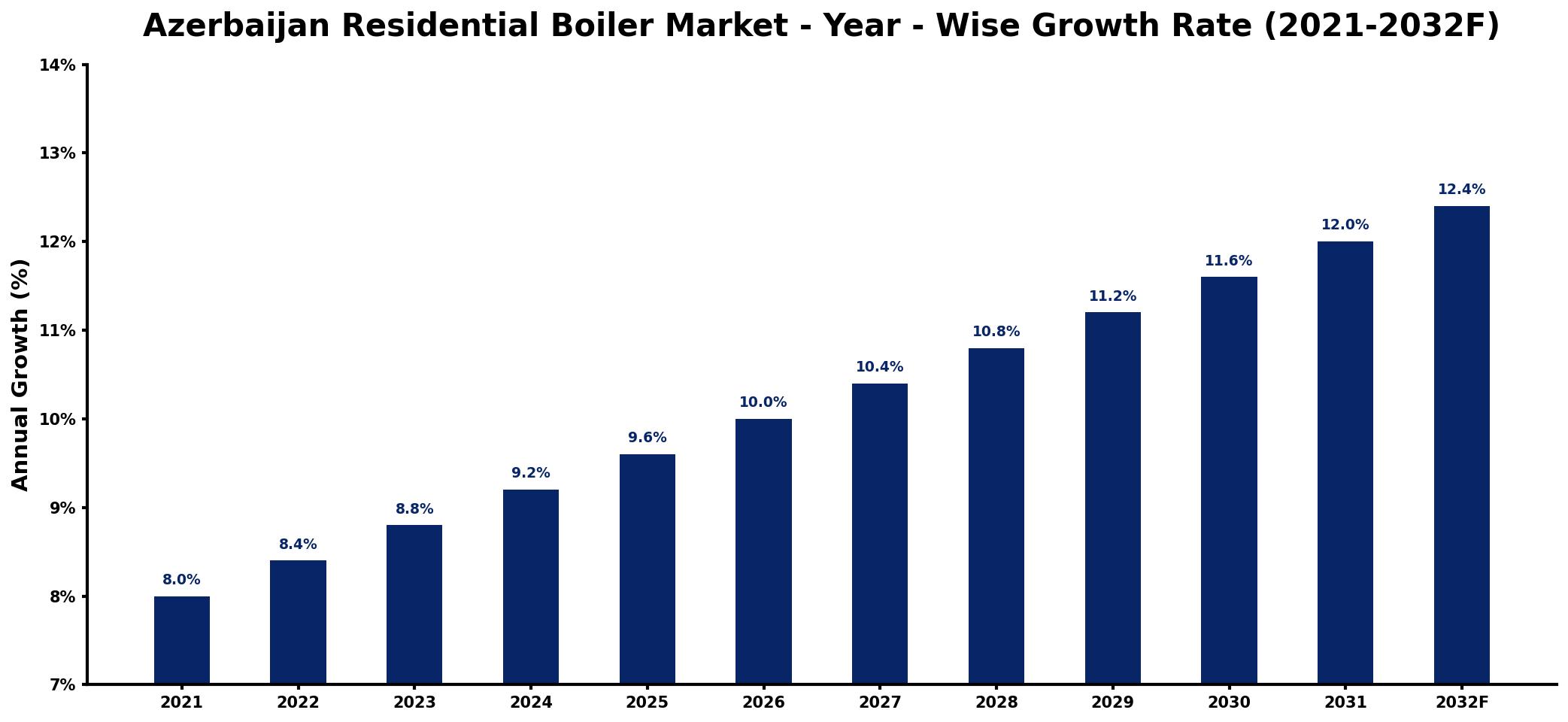
The table below presents the year‑wise growth rates along with the key drivers influencing the market
| Year | Growth Rate | Major Drivers |
| 2021 | 8.0% | increased energy efficiency standards |
| 2022 | 8.4% | growing demand for sustainable solutions |
| 2023 | 8.8% | rising investments in infrastructure |
| 2024 | 9.2% | expansion of renewable energy projects |
| 2025 | 9.6% | advancements in smart technology integration |
| 2026 | 10.0% | increased urbanization and population growth |
| 2027 | 10.4% | enhanced government incentives programs |
| 2028 | 10.8% | growing focus on environmental regulations |
| 2029 | 11.2% | increased consumer awareness on efficiency |
| 2030 | 11.6% | rising disposable income and spending |
| 2031 | 12.0% | expanding healthcare application demand |
| 2032 | 12.4% | development of innovative financing options |
Note: Market size estimations and growth projections presented in this report are based on 6Wresearch's proprietary forecasting methodology, utilizing the latest available industry data, government publications, and primary research inputs.
Azerbaijan Residential Boiler Market Synopsis
In Azerbaijan, the residential boiler market is largely driven by the urgent need for reliable heating solutions to combat harsh winter conditions. Consumers are increasingly leaning towards boilers that not only provide warmth but also align with sustainability goals. As urban areas continue to expand, so does the demand for advanced heating systems that ensure both comfort and efficiency.
The market is witnessing an influx of innovative products, including smart boilers that integrate modern technology to enhance user experience. With a growing focus on reducing carbon footprints, homeowners are gravitating towards eco-friendly options, presenting a pivotal shift in consumer behavior. This evolving landscape offers opportunities for businesses to tailor their offerings to meet these emerging needs.
Azerbaijan Residential Boiler Market Key Takeaways
- The demand for energy-efficient and environmentally friendly boilers is on the rise.
- Smart technology integration in heating systems is becoming increasingly prevalent among consumers.
- Hybrid systems that utilize renewable energy sources are gaining traction.
- Government initiatives are boosting the adoption of efficient boiler technologies.
- The market is adapting to consumer preferences for sustainability and cost-effectiveness.
Evaluation of Restraints in Azerbaijan Residential Boiler Market
Despite its growth potential, the Azerbaijan Residential Boiler Market faces notable restraints. A significant barrier is the high initial investment costs associated with purchasing and installing advanced boiler systems. Additionally, there is a shortage of skilled technicians available for maintenance and repairs, which can deter potential buyers. Consumer awareness regarding the benefits of energy-efficient boilers remains limited, often leading to a preference for more traditional heating solutions. Fluctuations in fuel prices, coupled with reliance on imported natural gas, also pose risks to cost stability, while competition from alternative heating sources further complicates market dynamics.
Azerbaijan Residential Boiler Market Trends
The market is currently witnessing a pronounced shift towards energy-efficient boilers, particularly condensing models that promise higher efficiency and lower emissions. The integration of smart technology is revolutionizing how homeowners interact with their heating systems, enabling remote control and monitoring that enhances energy savings. Furthermore, there is a growing interest in hybrid heating solutions, combining conventional boilers with renewable energy sources like solar panels, fostering a more sustainable approach to residential heating.
Azerbaijan Residential Boiler Market Opportunities
Investment opportunities abound in the Azerbaijan Residential Boiler Market, driven by factors such as rapid urbanization and ongoing construction projects. The shift towards modern, environmentally friendly boilers presents a lucrative avenue for manufacturers and investors alike. Developing and distributing high-efficiency, smart boilers equipped with advanced technologies like IoT can yield significant returns. Furthermore, forming collaborations with local manufacturers and construction firms could enhance market penetration and profitability in this burgeoning sector.
Government Initiatives in the Azerbaijan Residential Boiler Market
The Azerbaijani government is actively promoting energy efficiency and environmental sustainability through various policies related to the residential boiler market. Regulations are being implemented that mandate certain efficiency standards for boilers, with the goal of reducing energy consumption and emissions. Additionally, incentives such as subsidies and tax benefits are available to encourage homeowners to invest in energy-efficient systems. The government is also pushing for the integration of renewable energy sources in heating solutions, further solidifying its commitment to sustainable practices.
Future Insights of the Azerbaijan Residential Boiler Market
Looking ahead to 2026-2032, the Azerbaijan Residential Boiler Market is expected to witness continued growth, fueled by urban expansion and rising disposable incomes. The modernization of infrastructure and housing will drive demand for high-performance residential boilers that emphasize energy efficiency. With government initiatives advocating for sustainable heating solutions and technological advancements on the rise, manufacturers are likely to innovate further, offering products that cater to a more environmentally conscious consumer base. Overall, the market is positioned for steady expansion, presenting abundant opportunities for both local and international stakeholders.
Azerbaijan Residential Boiler Market Latest Developments (2025 - 2026)
Recent trends indicate a shift towards increased investment in smart technology for residential boilers, as consumers seek enhanced control over their heating systems. Manufacturers are exploring partnerships with technology firms to integrate IoT capabilities into their products, aiming to streamline user experience and energy efficiency. Additionally, growing public awareness of environmental issues is prompting more households to consider eco-friendly heating options, further influencing market dynamics in the upcoming years.
Azerbaijan Residential Boiler Market - Key Attractiveness of the Report
- 10 Years of Market Numbers
- Historical Data Starting from 2022 to 2025
- Base Year: 2025
- Forecast Data until 2032
- Key Performance Indicators Impacting the Market
- Major Upcoming Developments and Projects
Key Highlights of the Report:
- Azerbaijan Residential Boiler Market Outlook
- Market Size of Azerbaijan Residential Boiler Market, 2025
- Forecast of Azerbaijan Residential Boiler Market, 2032
- Historical Data and Forecast of Azerbaijan Residential Boiler Revenues & Volume for the Period 2022-2032F
- Azerbaijan Residential Boiler Market Trend Evolution
- Azerbaijan Residential Boiler Market Drivers and Challenges
- Azerbaijan Residential Boiler Price Trends
- Azerbaijan Residential Boiler Porter's Five Forces
- Azerbaijan Residential Boiler Industry Life Cycle
- Historical Data and Forecast of Azerbaijan Residential Boiler Market Revenues & Volume By Type for the Period 2022-2032F
- Historical Data and Forecast of Azerbaijan Residential Boiler Market Revenues & Volume By Water Tube Boiler for the Period 2022-2032F
- Historical Data and Forecast of Azerbaijan Residential Boiler Market Revenues & Volume By Fire Tube Boiler for the Period 2022-2032F
- Historical Data and Forecast of Azerbaijan Residential Boiler Market Revenues & Volume By Electric Boiler for the Period 2022-2032F
- Historical Data and Forecast of Azerbaijan Residential Boiler Market Revenues & Volume By Fuel Type for the Period 2022-2032F
- Historical Data and Forecast of Azerbaijan Residential Boiler Market Revenues & Volume By Coal Fired for the Period 2022-2032F
- Historical Data and Forecast of Azerbaijan Residential Boiler Market Revenues & Volume By Oil Fired for the Period 2022-2032F
- Historical Data and Forecast of Azerbaijan Residential Boiler Market Revenues & Volume By Gas Fired for the Period 2022-2032F
- Historical Data and Forecast of Azerbaijan Residential Boiler Market Revenues & Volume By Others for the Period 2022-2032F
- Historical Data and Forecast of Azerbaijan Residential Boiler Market Revenues & Volume By Technology for the Period 2022-2032F
- Historical Data and Forecast of Azerbaijan Residential Boiler Market Revenues & Volume By Condensing for the Period 2022-2032F
- Historical Data and Forecast of Azerbaijan Residential Boiler Market Revenues & Volume By Non-condensing for the Period 2022-2032F
- Azerbaijan Residential Boiler Import Export Trade Statistics
- Market Opportunity Assessment By Type
- Market Opportunity Assessment By Fuel Type
- Market Opportunity Assessment By Technology
- Azerbaijan Residential Boiler Top Companies Market Share
- Azerbaijan Residential Boiler Competitive Benchmarking By Technical and Operational Parameters
- Azerbaijan Residential Boiler Company Profiles
- Azerbaijan Residential Boiler Key Strategic Recommendations






































