Azerbaijan Retail And Wholesale Market Size, Share & Growth Rate
The Azerbaijan Retail And Wholesale Market was estimated at USD 940 Million in 2025 and is projected to reach USD 1559 Million by 2032, growing at a CAGR of 7.5% from 2026 to 2032. This growth trajectory is driven by a rising middle class with increased disposable income, alongside a shift in consumer preferences towards modern retail formats. Additionally, urbanization is facilitating the expansion of retail infrastructure, further supporting market expansion.
Azerbaijan Retail And Wholesale Market Year-wise Growth Rate and Key Drivers
This graph highlights how the Azerbaijan Retail And Wholesale Market has steadily grown over the years, supported by major growth factors.
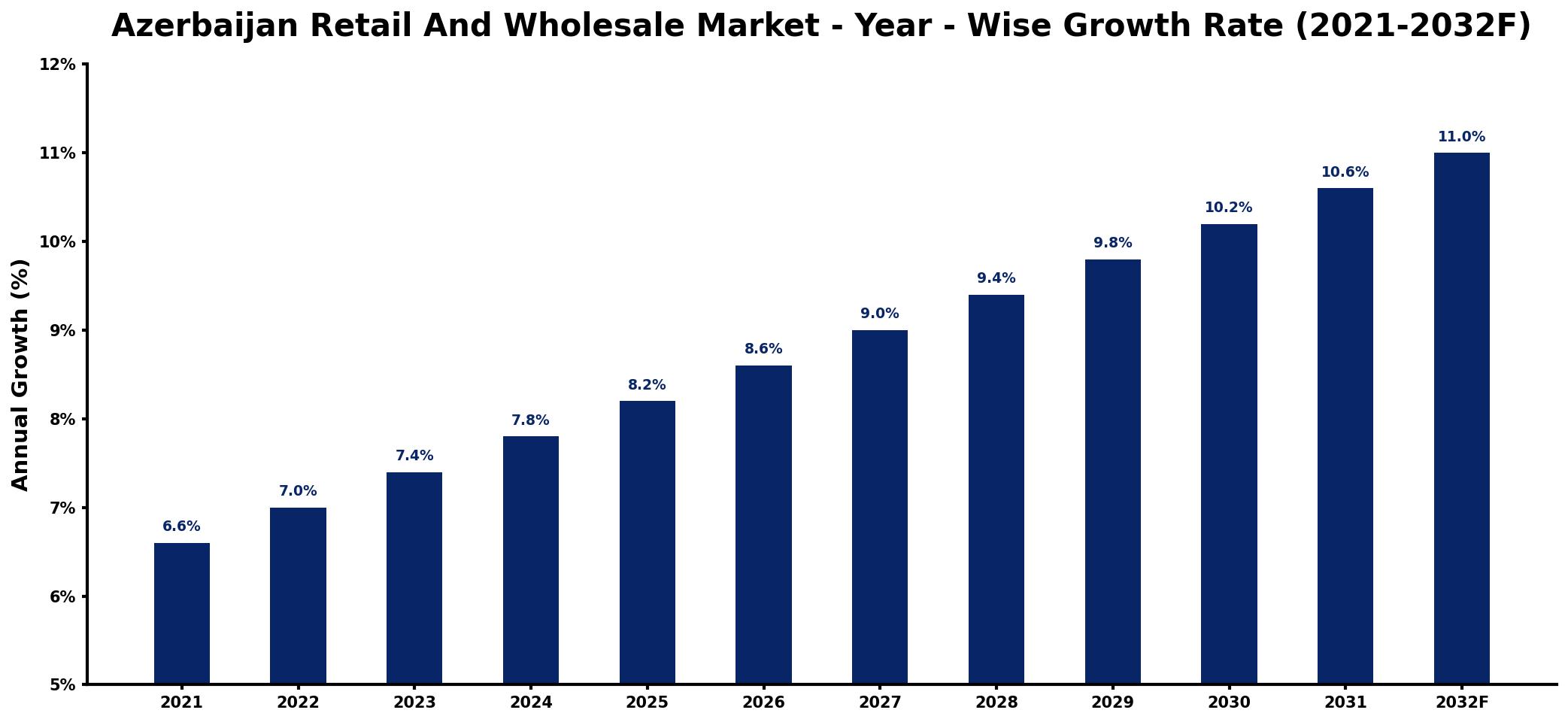
The table below presents the year‑wise growth rates along with the key drivers influencing the market
| Year | Growth Rate | Major Drivers |
| 2021 | 6.6% | rising consumer spending patterns |
| 2022 | 7.0% | increased digital commerce adoption |
| 2023 | 7.4% | expansion of logistics infrastructure |
| 2024 | 7.8% | growth in e-commerce platforms |
| 2025 | 8.2% | enhanced supply chain efficiency |
| 2026 | 8.6% | influx of foreign investments |
| 2027 | 9.0% | diversification of product offerings |
| 2028 | 9.4% | improvement in consumer confidence |
| 2029 | 9.8% | development of local brands |
| 2030 | 10.2% | improved raw material availability |
| 2031 | 10.6% | increase in disposable incomes |
| 2032 | 11.0% | growth of sustainable practices |
Note: Market size estimations and growth projections presented in this report are based on 6Wresearch's proprietary forecasting methodology, utilizing the latest available industry data, government publications, and primary research inputs.
Azerbaijan Retail And Wholesale Market Synopsis
Azerbaijan's retail and wholesale market is experiencing a noteworthy transition as consumers increasingly gravitate toward supermarkets and e-commerce platforms. This shift is reflective of broader global trends, yet it is uniquely shaped by local cultural and economic dynamics. Traditional retail, including independent shops and local markets, still plays a significant role, catering to consumer loyalty and community relationships.
Key product segments fueling demand encompass food and beverages, electronics, clothing, and household goods. With urban populations expanding and income levels on the rise, retailers are adapting their strategies to align with changing consumer expectations, particularly regarding quality and convenience.
Azerbaijan Retail And Wholesale Market Key Takeaways
- Urbanization and increasing disposable income are key drivers of market growth.
- Consumers show a growing preference for modern retail formats and online shopping options.
- International brands are becoming more prominent, appealing to the evolving tastes of consumers.
- Sustainability is emerging as a critical factor influencing purchasing decisions.
- The government is fostering a favorable environment for foreign investment in the retail sector.
Evaluation of Restraints in Azerbaijan Retail And Wholesale Market
Despite the promising outlook, the Azerbaijan retail and wholesale market contends with several constraints. Inadequate infrastructure and logistics pose significant challenges, hindering efficient supply chain management. Furthermore, local businesses face intense competition from international players, which can strain pricing strategies. Economic fluctuations, largely tied to the oil sector, can also impact consumer purchasing power. Regulatory complexities may complicate market entry for foreign investors, requiring strategic navigation to successfully capitalize on growth opportunities.
Azerbaijan Retail And Wholesale Market Trends
A notable trend is the accelerated digitalization within the retail sector, driven by increased internet penetration and consumer demand for online shopping. Traditional brick-and-mortar formats are increasingly competing with e-commerce, which offers variety and convenience. Additionally, consumers are prioritizing quality and affordability in fast-moving consumer goods (FMCG), prompting retailers to adapt their inventories. There is a rising emphasis on sustainability, with an increasing number of consumers seeking eco-friendly products.
Azerbaijan Retail And Wholesale Market Opportunities
The evolving landscape of the Azerbaijan retail and wholesale market reveals numerous investment opportunities. As the population grows and the middle class expands, demand for diverse product categories, particularly in food and beverage, clothing, and electronics, presents potential for revenue generation. The governments initiatives to enhance infrastructure and promote foreign investment further bolster market attractiveness. Retailers can explore various entry strategies, including partnerships with local businesses or establishing franchise operations to effectively navigate the market.
Government Initiatives in the Azerbaijan Retail And Wholesale Market
Azerbaijans government actively supports the retail sector through favorable policies aimed at attracting foreign investment. Initiatives include allowing 100% foreign ownership of retail businesses and enforcing consumer protection regulations to ensure product quality. The promotion of fair competition through antitrust laws further establishes a stable market environment. These government measures are designed to stimulate growth, enhance infrastructure, and ultimately drive the retail and wholesale sectors toward greater sustainability and efficiency.
Future Insights of the Azerbaijan Retail And Wholesale Market
Looking ahead to 2026-2032, the Azerbaijan retail and wholesale market is positioned for continued growth, driven by increasing urbanization and a shift towards non-oil sectors. Retailers are expected to adapt to evolving consumer needs, particularly around convenience and sustainability. E-commerce is likely to expand further, creating new channels for customer engagement. Although infrastructure challenges persist, ongoing government efforts to address these issues will play a critical role in shaping the future landscape of the market.
Azerbaijan Retail And Wholesale Market Latest Developments (2025 - 2026)
Recent trends indicate a heightened focus on sustainability within the Azerbaijan retail market, with several retailers beginning to integrate eco-friendly practices into their business models. Moreover, there has been a noticeable increase in international brands entering the market, attracted by the growing consumer base and rising disposable incomes. Technological advancements in logistics and supply chain management are also gaining traction, aimed at improving efficiency and reducing costs in retail operations.
Azerbaijan Retail And Wholesale Market - Key Attractiveness of the Report
- 10 Years of Market Numbers
- Historical Data Starting from 2022 to 2025
- Base Year: 2025
- Forecast Data until 2032
- Key Performance Indicators Impacting the Market
- Major Upcoming Developments and Projects
Key Highlights of the Report:
- Azerbaijan Retail And Wholesale Market Outlook
- Market Size of Azerbaijan Retail And Wholesale Market, 2025
- Forecast of Azerbaijan Retail And Wholesale Market, 2032
- Historical Data and Forecast of Azerbaijan Retail And Wholesale Revenues & Volume for the Period 2022-2032F
- Azerbaijan Retail And Wholesale Market Trend Evolution
- Azerbaijan Retail And Wholesale Market Drivers and Challenges
- Azerbaijan Retail And Wholesale Price Trends
- Azerbaijan Retail And Wholesale Porter's Five Forces
- Azerbaijan Retail And Wholesale Industry Life Cycle
- Historical Data and Forecast of Azerbaijan Retail And Wholesale Market Revenues & Volume By Type for the Period 2022-2032F
- Historical Data and Forecast of Azerbaijan Retail And Wholesale Market Revenues & Volume By Retail for the Period 2022-2032F
- Historical Data and Forecast of Azerbaijan Retail And Wholesale Market Revenues & Volume By Wholesale for the Period 2022-2032F
- Historical Data and Forecast of Azerbaijan Retail And Wholesale Market Revenues & Volume By Ownership for the Period 2022-2032F
- Historical Data and Forecast of Azerbaijan Retail And Wholesale Market Revenues & Volume By Retail Chain/Wholesale Chain for the Period 2022-2032F
- Historical Data and Forecast of Azerbaijan Retail And Wholesale Market Revenues & Volume By Independent Retailer/Independent Wholesalers for the Period 2022-2032F
- Historical Data and Forecast of Azerbaijan Retail And Wholesale Market Revenues & Volume By Price Range for the Period 2022-2032F
- Historical Data and Forecast of Azerbaijan Retail And Wholesale Market Revenues & Volume By Premium for the Period 2022-2032F
- Historical Data and Forecast of Azerbaijan Retail And Wholesale Market Revenues & Volume By Mid-Range for the Period 2022-2032F
- Historical Data and Forecast of Azerbaijan Retail And Wholesale Market Revenues & Volume By Economy for the Period 2022-2032F
- Historical Data and Forecast of Azerbaijan Retail And Wholesale Market Revenues & Volume By Distribution Channel for the Period 2022-2032F
- Historical Data and Forecast of Azerbaijan Retail And Wholesale Market Revenues & Volume By Supermarkets/Hypermarkets for the Period 2022-2032F
- Historical Data and Forecast of Azerbaijan Retail And Wholesale Market Revenues & Volume By Convenience Stores for the Period 2022-2032F
- Historical Data and Forecast of Azerbaijan Retail And Wholesale Market Revenues & Volume By Department Stores for the Period 2022-2032F
- Historical Data and Forecast of Azerbaijan Retail And Wholesale Market Revenues & Volume By Specialty Stores for the Period 2022-2032F
- Azerbaijan Retail And Wholesale Import Export Trade Statistics
- Market Opportunity Assessment By Type
- Market Opportunity Assessment By Ownership
- Market Opportunity Assessment By Price Range
- Market Opportunity Assessment By Distribution Channel
- Azerbaijan Retail And Wholesale Top Companies Market Share
- Azerbaijan Retail And Wholesale Competitive Benchmarking By Technical and Operational Parameters
- Azerbaijan Retail And Wholesale Company Profiles
- Azerbaijan Retail And Wholesale Key Strategic Recommendations






































