Azerbaijan Safety and Protective Doors and Windows Market Summary
The azerbaijan safety and protective doors and windows market was estimated at USD 364 Million in 2025 and is projected to reach USD 673 Million by 2032, growing at a CAGR of 10.6% from 2026 to 2032.
Azerbaijan Safety and Protective Doors and Windows Market Year-wise Growth Rate and Key Drivers
This graph highlights how the Azerbaijan Safety and Protective Doors and Windows Market has steadily grown over the past five years, supported by major growth factors.
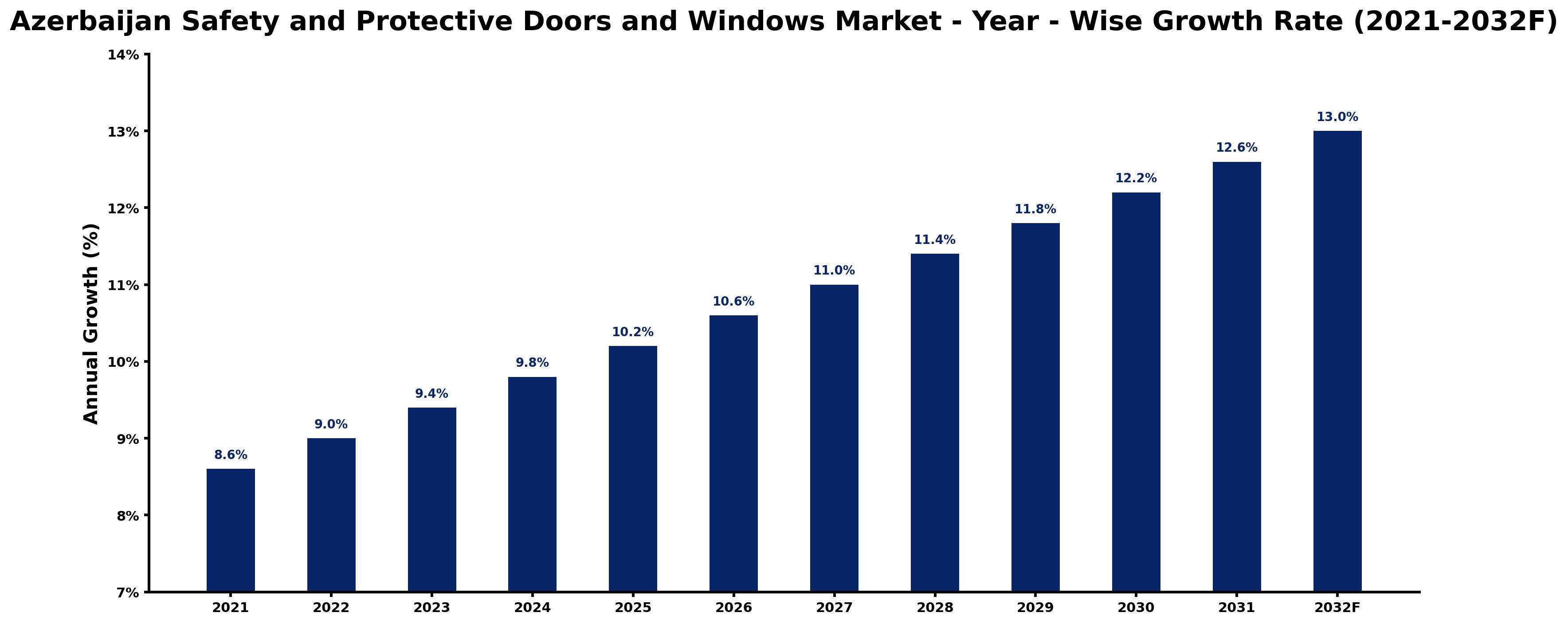
The table below presents the year wise growth rates along with the key drivers influencing the market
| Year | Growth Rate | Major Drivers |
| 2021 | 8.6% | Post-lockdown retail projects see increased investment in building safety features. |
| 2022 | 9.0% | Real estate developments emphasize improved security in residential and commercial properties. |
| 2023 | 9.4% | Emerging threats in urban areas highlight the need for better protective installations. |
| 2024 | 9.8% | Local manufacturers enhance product quality to meet regional safety standards effectively. |
| 2025 | 10.2% | Urbanization trends drive demand for advanced door and window solutions in cities. |
| 2026 | 10.6% | Technological innovations in materials lead to lighter, more durable safety products. |
| 2027 | 11.0% | Increased awareness of home security motivates consumers to upgrade existing installations. |
| 2028 | 11.4% | Integration of smart technologies into safety products captures consumer interest. |
| 2029 | 11.8% | Investment in public infrastructure creates demand for bulk safety door and window contracts. |
| 2030 | 12.2% | Environmental considerations push for eco-friendly materials in protective installations. |
| 2031 | 12.6% | Economic recovery stimulates residential renovations, boosting market growth for safety features. |
| 2032 | 13.0% | Rising insurance premiums encourage homeowners to prioritize security upgrades in renovations. |
Note - Market size estimations and growth projections presented in this report are based on 6Wresearch's advanced forecasting approach, validated with industry datasets as of June 2026.
Azerbaijan Safety and Protective Doors and Windows Market Synopsis
The Azerbaijan Safety and Protective Doors and Windows Market is projected to reach 10.6% and witness significant growth during the forecast period (2026-2032). This market encompasses the manufacturing, installation, and retrofitting of doors, windows, and barriers specifically designed to enhance security and safety against intrusion, impact, fire, and environmental hazards. A notable focus within the construction sector in Azerbaijan is on products that incorporate reinforced frames, impact-resistant glazing, and advanced locking mechanisms, all aimed at improving building security and occupant safety.
Azerbaijan Safety and Protective Doors and Windows Market Growth Drivers
Several factors are propelling the growth of the Azerbaijan Safety and Protective Doors and Windows Market. Chief among these is the increasing public concern regarding safety, security, and environmental protection, which drives the demand for high-performance doors and windows across various building types including residential, commercial, and industrial facilities. Additionally, advancements in material sciences and technologies have enabled the development of doors and windows that not only meet but exceed safety requirements, enhancing durability and energy efficiency.
- The rising incidence of security threats has led to a heightened demand for safer building solutions, significantly influencing market dynamics.
- Innovations in glazing technologies facilitate the production of impact-resistant windows, which further consolidate market growth.
- Increased urbanization and subsequent infrastructure projects are driving the need for more robust safety installations within new constructions.
- The collaborative efforts between manufacturers and construction firms yield customized solutions that align well with contemporary safety standards.
- Government incentives aimed at improving construction safety measures are also propelling market demand for upgraded protective installations.
Azerbaijan Safety and Protective Doors and Windows Market Challenges and Restraints
The Azerbaijan Safety and Protective Doors and Windows Market does encounter various challenges that can impede its growth trajectory. Compliance with building codes and safety regulations is paramount, necessitating collaboration between manufacturers and regulatory bodies to ensure that products meet stringent standards. Additionally, obtaining necessary certifications for features such as ballistic resistance and blast mitigation presents hurdles for manufacturers.
- Regulatory compliance issues can delay product launches and increase costs for manufacturers.
- The lack of awareness among consumers regarding the benefits of safety doors and windows limits market penetration.
- Obtaining third-party validations can be time-consuming and resource-intensive.
- The initial investment cost for high-performance safety solutions can deter potential buyers.
- Fluctuations in raw material prices may disrupt production costs, impacting overall pricing strategies.
Azerbaijan Safety and Protective Doors and Windows Market Government Investment and Initiatives
The Azerbaijani government has acknowledged the critical importance of safety and security in building infrastructures and has initiated several regulations and standards specifically for safety and protective doors and windows. These regulations encompass various key areas, including requirements for impact resistance, fire safety measures, and energy efficiency protocols.
In addition to regulatory frameworks, the government has introduced public spending on urban development projects that prioritize enhancing safety features in buildings. These initiatives include the allocation of funds for retrofitting older structures with modern safety installations and providing incentives for construction companies to utilize high-performance materials that meet national standards.
Azerbaijan Safety and Protective Doors and Windows Market Latest Developments (May 2025 - June 2026)
Recent industry developments indicate a strong movement towards innovation within the Azerbaijan Safety and Protective Doors and Windows Market. The push for environmentally friendly installations has gained momentum, with a rising number of manufacturers adopting sustainable practices in their production processes. Furthermore, collaborative projects between public and private sectors have emerged, focusing on integrating advanced safety technologies into new building designs.
Market players are increasingly exploring strategic partnerships aimed at enhancing product portfolios to include smart technology features, catering to evolving consumer preferences. The emphasis on energy-efficient solutions is also shaping product development, aligning with global sustainability trends.
Azerbaijan Safety and Protective Doors and Windows Market - Key Attractiveness of the Report
- 10 Years of Market Numbers
- Historical Data Starting from 2022 to 2025
- Base Year: 2025
- Forecast Data until 2032
- Key Performance Indicators Impacting the Market
- Major Upcoming Developments and Projects
Key Highlights of the Report:
- Azerbaijan Safety and Protective Doors and Windows Market Outlook
- Market Size of Azerbaijan Safety and Protective Doors and Windows Market, 2025
- Forecast of Azerbaijan Safety and Protective Doors and Windows Market, 2032
- Historical Data and Forecast of Azerbaijan Safety and Protective Doors and Windows Revenues & Volume for the Period 2022-2032F
- Azerbaijan Safety and Protective Doors and Windows Market Trend Evolution
- Azerbaijan Safety and Protective Doors and Windows Market Drivers and Challenges
- Azerbaijan Safety and Protective Doors and Windows Price Trends
- Azerbaijan Safety and Protective Doors and Windows Porter's Five Forces
- Azerbaijan Safety and Protective Doors and Windows Industry Life Cycle
- Historical Data and Forecast of Azerbaijan Safety and Protective Doors and Windows Market Revenues & Volume By Types for the Period 2022-2032F
- Historical Data and Forecast of Azerbaijan Safety and Protective Doors and Windows Market Revenues & Volume By Windows for the Period 2022-2032F
- Historical Data and Forecast of Azerbaijan Safety and Protective Doors and Windows Market Revenues & Volume By Doors for the Period 2022-2032F
- Historical Data and Forecast of Azerbaijan Safety and Protective Doors and Windows Market Revenues & Volume By Material for the Period 2022-2032F
- Historical Data and Forecast of Azerbaijan Safety and Protective Doors and Windows Market Revenues & Volume By Steel for the Period 2022-2032F
- Historical Data and Forecast of Azerbaijan Safety and Protective Doors and Windows Market Revenues & Volume By Plastic for the Period 2022-2032F
- Historical Data and Forecast of Azerbaijan Safety and Protective Doors and Windows Market Revenues & Volume By Aluminium for the Period 2022-2032F
- Historical Data and Forecast of Azerbaijan Safety and Protective Doors and Windows Market Revenues & Volume By Others for the Period 2022-2032F
- Historical Data and Forecast of Azerbaijan Safety and Protective Doors and Windows Market Revenues & Volume By End-Users for the Period 2022-2032F
- Historical Data and Forecast of Azerbaijan Safety and Protective Doors and Windows Market Revenues & Volume By Residential for the Period 2022-2032F
- Historical Data and Forecast of Azerbaijan Safety and Protective Doors and Windows Market Revenues & Volume By Non-Residential for the Period 2022-2032F
- Azerbaijan Safety and Protective Doors and Windows Import Export Trade Statistics
- Market Opportunity Assessment By Types
- Market Opportunity Assessment By Material
- Market Opportunity Assessment By End-Users
- Azerbaijan Safety and Protective Doors and Windows Top Companies Market Share
- Azerbaijan Safety and Protective Doors and Windows Competitive Benchmarking By Technical and Operational Parameters
- Azerbaijan Safety and Protective Doors and Windows Company Profiles
- Azerbaijan Safety and Protective Doors and Windows Key Strategic Recommendations






































