Azerbaijan Seafood Processing Market Size, Share & Growth Rate
The Azerbaijan Seafood Processing Market was estimated at USD 1380 Million in 2025 and is projected to reach USD 2567 Million by 2032, growing at a CAGR of 9.3% from 2026 to 2032. This robust growth is largely driven by an increasing domestic demand for diverse seafood products, coupled with Azerbaijans strategic geographical advantage of being situated along the Caspian Sea. The modernization of processing facilities and government initiatives focused on sustainability are also contributing significantly to the market's upward trajectory.
Azerbaijan Seafood Processing Market Year-wise Growth Rate and Key Drivers
This graph highlights how the Azerbaijan Seafood Processing Market has steadily grown over the years, supported by major growth factors.
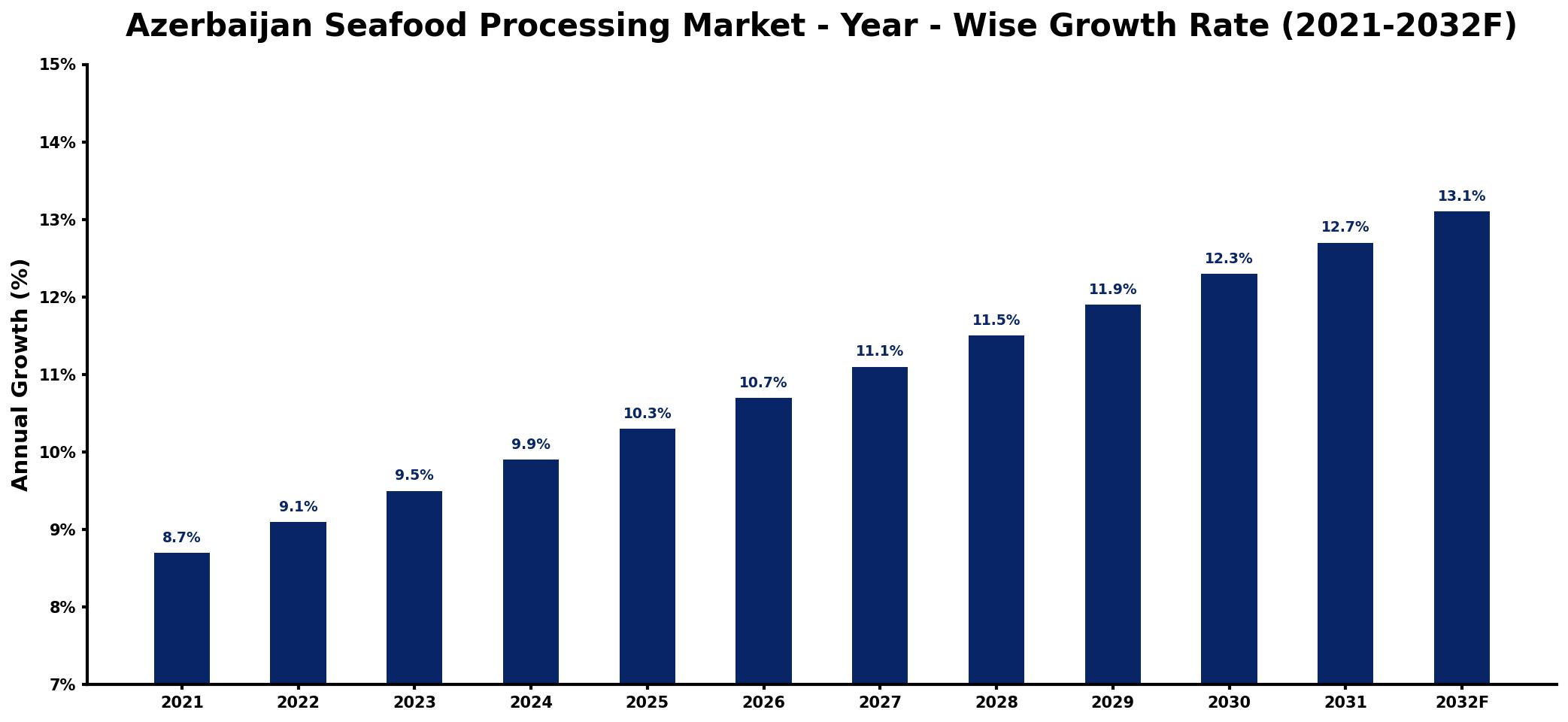
The table below presents the year‑wise growth rates along with the key drivers influencing the market
| Year | Growth Rate | Major Drivers |
| 2021 | 8.7% | increased consumer health awareness |
| 2022 | 9.1% | growing export market potential |
| 2023 | 9.5% | rising disposable income levels |
| 2024 | 9.9% | expansion of distribution networks |
| 2025 | 10.3% | advancements in technology adoption |
| 2026 | 10.7% | increased investment in infrastructure |
| 2027 | 11.1% | growing popularity of sustainable practices |
| 2028 | 11.5% | enhanced product variety offerings |
| 2029 | 11.9% | strengthened international trade agreements |
| 2030 | 12.3% | increased focus on food safety |
| 2031 | 12.7% | rising demand for convenience products |
| 2032 | 13.1% | growing interest in premium products |
Note: Market size estimations and growth projections presented in this report are based on 6Wresearch's proprietary forecasting methodology, utilizing the latest available industry data, government publications, and primary research inputs.
Azerbaijan Seafood Processing Market Synopsis
At the forefront of the Azerbaijan seafood processing market is the burgeoning consumer demand for high-quality seafood products. With a rich fishing heritage and a coastline that provides access to a variety of marine resources, Azerbaijan is poised to meet both local and international needs effectively.
The market is marked by a blend of small to medium-sized processing operations that are increasingly adopting modern techniques. This shift is aimed at enhancing product quality and operational efficiency, while also accommodating growing trends towards sustainability and responsible sourcing practices.
Azerbaijan Seafood Processing Market Key Takeaways
- The market is benefitting from a strategic location with easy access to the Caspian Sea.
- Consumer preferences are shifting towards organic and locally sourced seafood products.
- Investment in technology is crucial for improving processing standards and efficiency.
- Government initiatives are enhancing infrastructure and sustainability practices in the sector.
- Value-added seafood products are gaining traction, responding to evolving consumer lifestyles.
Evaluation of Restraints in Azerbaijan Seafood Processing Market
Despite the potential for growth, the Azerbaijan seafood processing market faces several challenges. Issues related to logistics and transportation can impede the efficient distribution of seafood from processing facilities to markets. Additionally, limited access to modern processing technology can restrict the ability to compete on a global scale. Environmental concerns, including fluctuating seafood supply driven by overfishing and climate variability, further complicate the landscape, necessitating strategic investments and collaborative efforts to enhance sustainability and compliance with international quality standards.
Azerbaijan Seafood Processing Market Trends
Emerging trends in the Azerbaijan seafood processing market include a notable shift towards sustainable practices, spurred by consumer awareness and regulatory push. There is an increasing demand for products that emphasize traceability and certification, reflecting a consumer base that prioritizes responsible sourcing. Additionally, processors are innovating in product offerings, such as ready-to-cook meals and seafood snacks, catering to the convenience-oriented consumer segment. This transformation is not only enhancing the market's appeal but also improving the overall quality and value of seafood products.
Azerbaijan Seafood Processing Market Opportunities
Investment opportunities abound within the Azerbaijan seafood processing market. As demand for high-quality seafood continues to rise, there is a significant potential for modern processing facilities and innovative technology integration. Furthermore, developing sustainable fishing practices and enhancing supply chain logistics can yield considerable returns. Companies can also benefit from exploring innovative packaging solutions tailored for both local and international markets. Understanding consumer preferences through comprehensive market research can help businesses tailor their product offerings effectively.
Government Initiatives in the Azerbaijan Seafood Processing Market
The Azerbaijani government plays a proactive role in supporting the seafood processing market through various policies aimed at fostering industry growth. These include financial incentives and subsidies to stimulate investment in the sector, as well as stringent regulations to promote the sustainability of seafood resources. Initiatives to improve infrastructure and enhance export potential are also in place, positioning the Azerbaijani seafood processing industry for competitive advantage in the global market.
Future Insights of the Azerbaijan Seafood Processing Market
Looking ahead to 2026-2032, the Azerbaijan seafood processing market is set to expand significantly, driven by heightened consumer awareness of the health benefits associated with seafood consumption and shifting dietary trends. As the population continues to grow and distribution channels evolve, the market is likely to witness substantial changes. Advancements in processing technology and an emphasis on value-added products will be pivotal in meeting consumer demands, while sustainability will remain a crucial focus. Nonetheless, industry stakeholders must navigate regulatory hurdles and competition from imports to fully realize their growth potential.
Azerbaijan Seafood Processing Market Latest Developments (2025 - 2026)
The Azerbaijan seafood processing industry has recently seen a flurry of activity aimed at modernization and sustainability. Initiatives focusing on upgrading facilities and technology are gaining momentum, with several companies exploring partnerships to enhance product offerings. Furthermore, the industry is witnessing a rise in collaborative efforts among stakeholders to address supply chain challenges and improve quality control measures, setting a robust foundation for future growth.
Azerbaijan Seafood Processing Market - Key Attractiveness of the Report
- 10 Years of Market Numbers
- Historical Data Starting from 2022 to 2025
- Base Year: 2025
- Forecast Data until 2032
- Key Performance Indicators Impacting the Market
- Major Upcoming Developments and Projects
Key Highlights of the Report:
- Azerbaijan Seafood Processing Market Outlook
- Market Size of Azerbaijan Seafood Processing Market, 2025
- Forecast of Azerbaijan Seafood Processing Market, 2032
- Historical Data and Forecast of Azerbaijan Seafood Processing Revenues & Volume for the Period 2022-2032F
- Azerbaijan Seafood Processing Market Trend Evolution
- Azerbaijan Seafood Processing Market Drivers and Challenges
- Azerbaijan Seafood Processing Price Trends
- Azerbaijan Seafood Processing Porter's Five Forces
- Azerbaijan Seafood Processing Industry Life Cycle
- Historical Data and Forecast of Azerbaijan Seafood Processing Market Revenues & Volume By Equipment Type for the Period 2022-2032F
- Historical Data and Forecast of Azerbaijan Seafood Processing Market Revenues & Volume By Gutting Equipment for the Period 2022-2032F
- Historical Data and Forecast of Azerbaijan Seafood Processing Market Revenues & Volume By Sealing Equipment for the Period 2022-2032F
- Historical Data and Forecast of Azerbaijan Seafood Processing Market Revenues & Volume By Filleting Equipment for the Period 2022-2032F
- Historical Data and Forecast of Azerbaijan Seafood Processing Market Revenues & Volume By Deboning Equipment for the Period 2022-2032F
- Historical Data and Forecast of Azerbaijan Seafood Processing Market Revenues & Volume By other Equipment for the Period 2022-2032F
- Historical Data and Forecast of Azerbaijan Seafood Processing Market Revenues & Volume By Category for the Period 2022-2032F
- Historical Data and Forecast of Azerbaijan Seafood Processing Market Revenues & Volume By Single-Function Equipment for the Period 2022-2032F
- Historical Data and Forecast of Azerbaijan Seafood Processing Market Revenues & Volume By Multi-Function Equipment for the Period 2022-2032F
- Historical Data and Forecast of Azerbaijan Seafood Processing Market Revenues & Volume By Seafood Type for the Period 2022-2032F
- Historical Data and Forecast of Azerbaijan Seafood Processing Market Revenues & Volume By Fish for the Period 2022-2032F
- Historical Data and Forecast of Azerbaijan Seafood Processing Market Revenues & Volume By Crustaceans for the Period 2022-2032F
- Historical Data and Forecast of Azerbaijan Seafood Processing Market Revenues & Volume By Mollusks for the Period 2022-2032F
- Historical Data and Forecast of Azerbaijan Seafood Processing Market Revenues & Volume By others for the Period 2022-2032F
- Azerbaijan Seafood Processing Import Export Trade Statistics
- Market Opportunity Assessment By Equipment Type
- Market Opportunity Assessment By Category
- Market Opportunity Assessment By Seafood Type
- Azerbaijan Seafood Processing Top Companies Market Share
- Azerbaijan Seafood Processing Competitive Benchmarking By Technical and Operational Parameters
- Azerbaijan Seafood Processing Company Profiles
- Azerbaijan Seafood Processing Key Strategic Recommendations






































