Azerbaijan Smart Building Market Size, Share & Growth Rate
The Azerbaijan Smart Building Market was estimated at USD 926 Million in 2025 and is projected to reach USD 1613 Million by 2032, growing at a CAGR of 8.3% from 2026 to 2032. This growth is predominantly driven by an increasing emphasis on energy efficiency and sustainability within the construction sector, spurred by urbanization and government support. As the market evolves, the integration of advanced technologies such as IoT systems and smart sensors is expected to reshape building management, enhancing both operational efficiency and user comfort.
Azerbaijan Smart Building Market Year-wise Growth Rate and Key Drivers
This graph highlights how the Azerbaijan Smart Building Market has steadily grown over the years, supported by major growth factors.
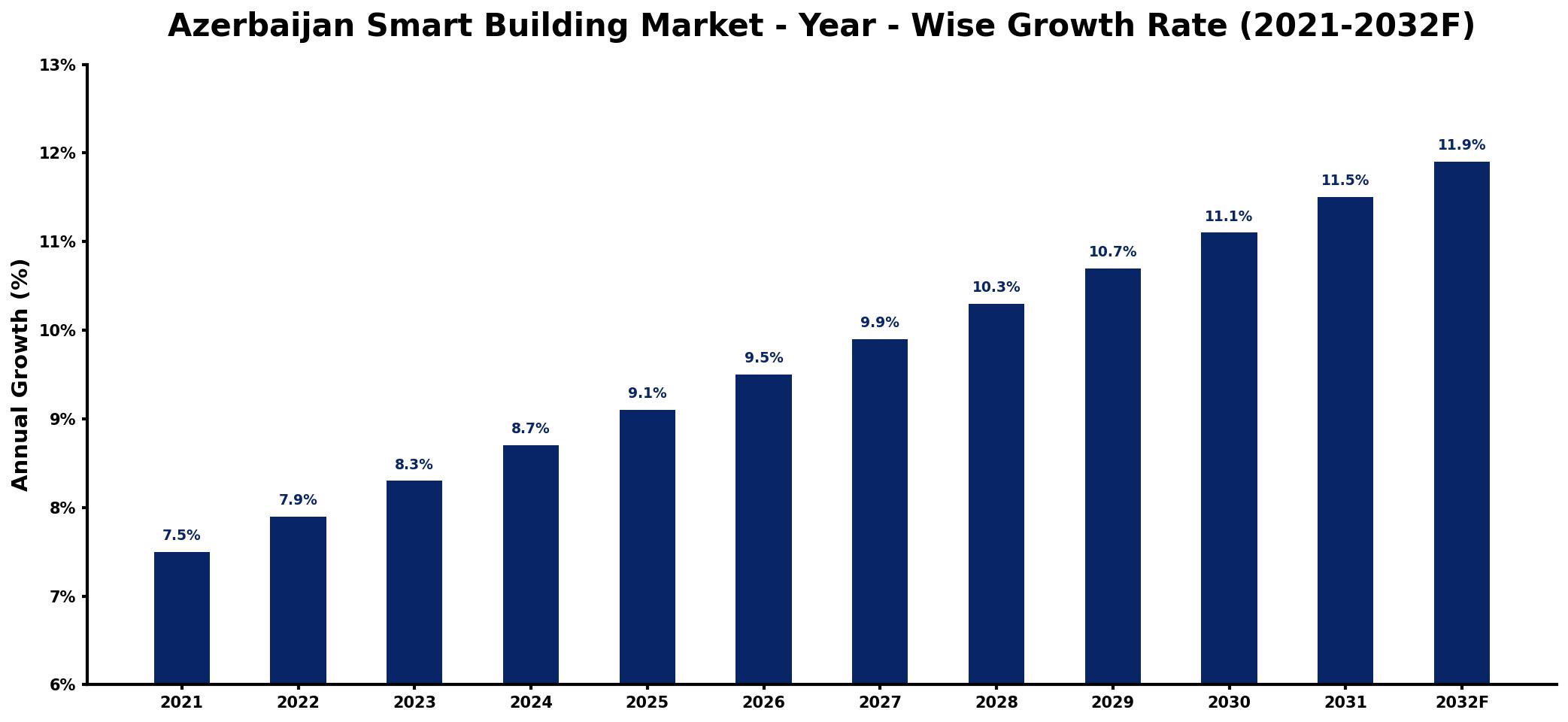
The table below presents the year‑wise growth rates along with the key drivers influencing the market
| Year | Growth Rate | Major Drivers |
| 2021 | 7.5% | increased demand for automation solutions |
| 2022 | 7.9% | growing investments in energy efficiency |
| 2023 | 8.3% | expansion of IoT technology adoption |
| 2024 | 8.7% | rising focus on sustainability initiatives |
| 2025 | 9.1% | enhanced integration of AI systems |
| 2026 | 9.5% | improved raw material availability |
| 2027 | 9.9% | growing interest in remote monitoring |
| 2028 | 10.3% | increased regulatory support for innovation |
| 2029 | 10.7% | expanding industrial usage applications |
| 2030 | 11.1% | advancements in data analytics applications |
| 2031 | 11.5% | higher consumer awareness on efficiency |
| 2032 | 11.9% | increased collaboration among tech firms |
Note: Market size estimations and growth projections presented in this report are based on 6Wresearch's proprietary forecasting methodology, utilizing the latest available industry data, government publications, and primary research inputs.
Azerbaijan Smart Building Market Synopsis
The Azerbaijan smart building market is gaining momentum as stakeholders recognize the advantages of smart technologies. Enhanced efficiency, reduced operational costs, and improved sustainability are some of the driving forces steering this transition. Looking ahead, the market is poised for a transformative shift, with increasing adoption of smart solutions that align with both governmental initiatives and global sustainability trends.
With smart building technology adoption on the rise, Azerbaijan is positioned to become a regional leader in sustainable building practices. The combination of urban growth and government support for innovative infrastructure developments is expected to further accelerate market growth, ensuring that both residential and commercial sectors reap the benefits of modern technology.
Azerbaijan Smart Building Market Key Takeaways
- The market is set for significant growth, projected to reach USD 1613 Million by 2032.
- Government policies are actively promoting sustainable building practices and smart city initiatives.
- Adoption of IoT-enabled devices is transforming building management and enhancing energy efficiency.
- Home automation solutions are increasingly in demand, driven by the desire for convenience and security.
- There are considerable investment opportunities in smart energy management and security solutions.
Evaluation of Restraints in Azerbaijan Smart Building Market
Despite its potential, the Azerbaijan smart building market encounters several restraints that could impede its growth trajectory. A notable barrier is the general lack of awareness regarding smart building technologies among potential users, which can significantly slow adoption rates. Furthermore, the high initial costs associated with smart system implementation present a challenge, particularly for smaller enterprises and individuals. The market also faces a shortage of skilled professionals capable of managing and maintaining these sophisticated systems, adding another layer of complexity to the landscape. Addressing these issues through education and strategic partnerships is essential for unlocking the market's full potential.
Azerbaijan Smart Building Market Trends
Several key trends are shaping the Azerbaijan smart building market. A significant rise in urbanization is increasing the demand for energy-efficient solutions, pushing the integration of smart building management systems for optimized control over lighting, heating, and security. The merging of renewable energy sources into building designs is also becoming more prevalent, aligning with broader environmental goals. Home automation is gaining traction as well, with consumers seeking enhanced convenience and security through technology. Overall, these trends indicate a shift towards more connected and efficient living spaces in Azerbaijan.
Azerbaijan Smart Building Market Opportunities
The Azerbaijan smart building market presents a wealth of investment opportunities across various sectors. Innovative technologies such as smart energy management systems and advanced security solutions are at the forefront of this growth. Furthermore, there is a burgeoning demand for smart home automation technologies that enhance user comfort and safety. Collaborating with local construction firms and tech providers can unlock new avenues for growth, allowing businesses to provide customized solutions tailored to the specific needs of the Azerbaijani market. Overall, investing in this landscape promises long-term benefits as the market continues to expand.
Government Initiatives in the Azerbaijan Smart Building Market
The Azerbaijani government is actively fostering the growth of smart building technologies through a series of initiatives aimed at promoting sustainable infrastructure. These efforts include the State Program on Socio-Economic Development of the Regions, which emphasizes enhancing building energy efficiency while incorporating smart technologies. Additionally, tax incentives and subsidies have been introduced for developers and homeowners who adopt smart building solutions. These regulations not only ensure the safety and reliability of smart systems but also create a favorable environment for investment in the sector.
Future Insights of the Azerbaijan Smart Building Market
Looking towards 2026 and beyond, the Azerbaijan smart building market is on track for robust growth. Factors such as ongoing urbanization, government commitment to infrastructure development, and heightened focus on energy efficiency and sustainability will drive this trend. The increasing demand for technologies that provide enhanced occupant comfort and security, alongside remote monitoring capabilities, will further propel the market. As smart city initiatives gain traction, the synergy between technological advancement and urban planning will create a fertile ground for innovative building solutions in Azerbaijan.
Azerbaijan Smart Building Market Latest Developments (2025 - 2026)
In recent months, there has been a noticeable uptick in project announcements focusing on smart building implementations across Azerbaijan. Noteworthy developments include partnerships between technology providers and construction firms aimed at integrating smart technologies into new residential and commercial projects. Additionally, public awareness campaigns launched by the government are aimed at educating the populace on the benefits of smart building solutions, helping to drive adoption and interest in this rapidly evolving market landscape.
Azerbaijan Smart Building Market - Key Attractiveness of the Report
- 10 Years of Market Numbers
- Historical Data Starting from 2022 to 2025
- Base Year: 2025
- Forecast Data until 2032
- Key Performance Indicators Impacting the Market
- Major Upcoming Developments and Projects
Key Highlights of the Report:
- Azerbaijan Smart Building Market Outlook
- Market Size of Azerbaijan Smart Building Market, 2025
- Forecast of Azerbaijan Smart Building Market, 2032
- Historical Data and Forecast of Azerbaijan Smart Building Revenues & Volume for the Period 2022-2032F
- Azerbaijan Smart Building Market Trend Evolution
- Azerbaijan Smart Building Market Drivers and Challenges
- Azerbaijan Smart Building Price Trends
- Azerbaijan Smart Building Porter's Five Forces
- Azerbaijan Smart Building Industry Life Cycle
- Historical Data and Forecast of Azerbaijan Smart Building Market Revenues & Volume By Component for the Period 2022-2032F
- Historical Data and Forecast of Azerbaijan Smart Building Market Revenues & Volume By Solution for the Period 2022-2032F
- Historical Data and Forecast of Azerbaijan Smart Building Market Revenues & Volume By Services for the Period 2022-2032F
- Historical Data and Forecast of Azerbaijan Smart Building Market Revenues & Volume By Application for the Period 2022-2032F
- Historical Data and Forecast of Azerbaijan Smart Building Market Revenues & Volume By Residential for the Period 2022-2032F
- Historical Data and Forecast of Azerbaijan Smart Building Market Revenues & Volume By Commercial for the Period 2022-2032F
- Azerbaijan Smart Building Import Export Trade Statistics
- Market Opportunity Assessment By Component
- Market Opportunity Assessment By Application
- Azerbaijan Smart Building Top Companies Market Share
- Azerbaijan Smart Building Competitive Benchmarking By Technical and Operational Parameters
- Azerbaijan Smart Building Company Profiles
- Azerbaijan Smart Building Key Strategic Recommendations






































