Azerbaijan Submarine Market Size, Share & Growth Rate
The Azerbaijan Submarine Market was estimated at USD 845 Million in 2025 and is projected to reach USD 1440 Million by 2032, growing at a CAGR of 7.9% from 2026 to 2032. This upward trajectory is largely influenced by Azerbaijan's strategic initiatives to enhance its naval capabilities amid growing maritime security concerns in the Caspian Sea. The country is focused on modernizing its submarine fleet and integrating advanced underwater technology, which is driving significant investment and interest from international defense suppliers.
Azerbaijan Submarine Market Year-wise Growth Rate and Key Drivers
This graph highlights how the Azerbaijan Submarine Market has steadily grown over the years, supported by major growth factors.
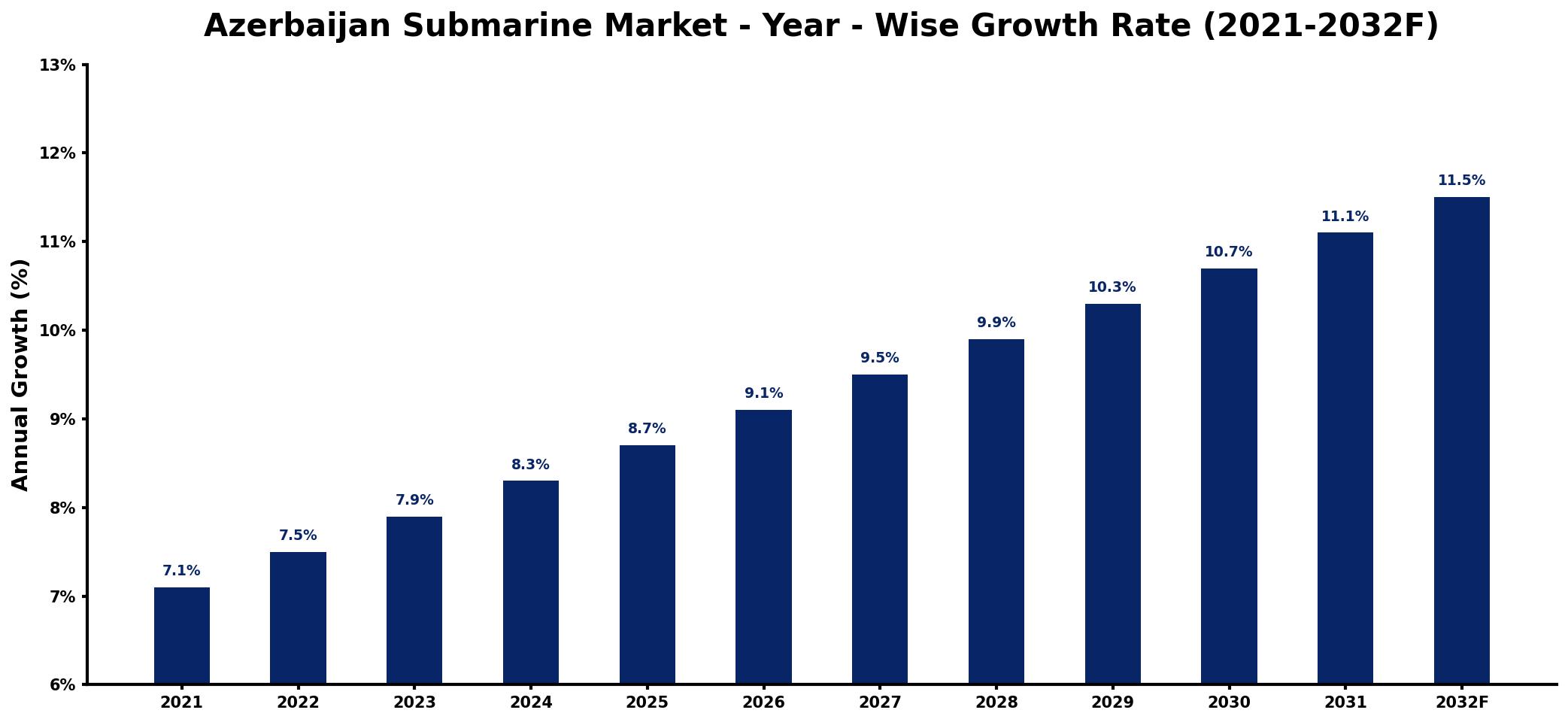
The table below presents the year‑wise growth rates along with the key drivers influencing the market
| Year | Growth Rate | Major Drivers |
| 2021 | 7.1% | increased military spending initiatives |
| 2022 | 7.5% | growing defense technology advancements |
| 2023 | 7.9% | rising geopolitical tensions globally |
| 2024 | 8.3% | expanding naval modernization programs |
| 2025 | 8.7% | enhanced maritime security collaborations |
| 2026 | 9.1% | growing demand for underwater capabilities |
| 2027 | 9.5% | increased focus on naval strategy |
| 2028 | 9.9% | rising investments in defense infrastructure |
| 2029 | 10.3% | emerging technology integration trends |
| 2030 | 10.7% | growing international defense partnerships |
| 2031 | 11.1% | enhanced training and simulation investments |
| 2032 | 11.5% | enhanced product quality standards |
Note: Market size estimations and growth projections presented in this report are based on 6Wresearch's proprietary forecasting methodology, utilizing the latest available industry data, government publications, and primary research inputs.
Azerbaijan Submarine Market Synopsis
The Azerbaijan submarine market has recently gained momentum, driven by the governments commitment to strengthening its naval defense infrastructure. This sector is moving toward a more sophisticated operational framework, with an emphasis on acquiring technologically advanced submarines from global suppliers.
Looking ahead, the market is poised for growth as Azerbaijan continues to prioritize maritime security. The emphasis on collaboration with foreign defense contractors and technology transfer agreements will be key to modernizing the fleet and addressing the evolving security dynamics in the region.
Azerbaijan Submarine Market Key Takeaways
- The Azerbaijan submarine market is transitioning towards advanced submarine technology and capabilities.
- Significant investments are being funneled into modernizing the existing naval fleet.
- Collaborations with international defense contractors are on the rise.
- The market is shaped by the need to protect offshore energy resources and ensure maritime security.
- Incorporation of unmanned underwater vehicles (UUVs) is becoming a priority for surveillance missions.
Evaluation of Restraints in Azerbaijan Submarine Market
Despite its growth potential, the Azerbaijan submarine market faces significant restraints. Limited access to advanced submarine technology, largely due to international sanctions, hampers the procurement process. Furthermore, there is a notable reliance on foreign suppliers for critical components, which can complicate supply chains. The geopolitical landscape may also influence defense budget allocations and strategic procurement decisions, posing challenges to sustained market growth. Additionally, the relatively smaller size of Azerbaijans domestic defense industry presents difficulties in competing against more established international submarine manufacturers.
Azerbaijan Submarine Market Trends
Several trends are shaping the Azerbaijan submarine market, most notably the drive toward modernization. As Azerbaijan seeks to secure its maritime interests, the focus on acquiring next-generation submarines is increasingly evident. Additionally, the integration of advanced technologies, such as autonomous systems and underwater surveillance capabilities, is becoming a standard requirement. The burgeoning interest in unmanned underwater vehicles (UUVs) signifies a pivotal shift towards leveraging modern technology for reconnaissance missions, enhancing operational efficiency.
Azerbaijan Submarine Market Opportunities
Investment opportunities abound in the Azerbaijan submarine market, particularly for companies specializing in submarine technology. The growing demand for modern submarines opens avenues in submarine construction and maintenance. Collaborating with local shipyards can provide significant advantages for foreign investors seeking to penetrate this niche market. Furthermore, the government's commitment to expanding maritime security infrastructures presents opportunities for joint ventures in training programs and equipment procurement.
Government Initiatives in the Azerbaijan Submarine Market
The Azerbaijani government is actively fostering policies aimed at enhancing naval capabilities and protecting maritime borders. This includes allocating substantial resources to upgrade the submarine fleet and acquire cutting-edge technology. Additionally, initiatives to promote domestic production are in place to encourage local firms to engage in submarine construction projects. By strengthening international partnerships, Azerbaijan seeks to bolster knowledge exchange and improve security cooperation in the defense sector.
Future Insights of the Azerbaijan Submarine Market
Looking toward the future, the Azerbaijan submarine market is set for robust growth driven by increasing investments in naval defense. The nations focus on safeguarding its offshore assets in the Caspian Sea will remain a primary catalyst for demand. As Azerbaijan undertakes modernization efforts and establishes collaborations with foreign defense contractors, the market is expected to evolve, resulting in a more capable and technologically advanced fleet. This strategic focus positions Azerbaijan to effectively respond to emerging maritime threats.
Azerbaijan Submarine Market Latest Developments (2025 - 2026)
Recent developments in the Azerbaijan submarine market indicate a growing interest in acquiring modern submarines and related technologies. The government is increasingly engaging with international defense suppliers to explore procurement opportunities. There has also been a push toward enhancing local capabilities through training and partnerships, reflecting a commitment to building a robust domestic defense industry.
Azerbaijan Submarine Market - Key Attractiveness of the Report
- 10 Years of Market Numbers
- Historical Data Starting from 2022 to 2025
- Base Year: 2025
- Forecast Data until 2032
- Key Performance Indicators Impacting the Market
- Major Upcoming Developments and Projects
Key Highlights of the Report:
- Azerbaijan Submarine Market Outlook
- Market Size of Azerbaijan Submarine Market, 2025
- Forecast of Azerbaijan Submarine Market, 2032
- Historical Data and Forecast of Azerbaijan Submarine Revenues & Volume for the Period 2022-2032F
- Azerbaijan Submarine Market Trend Evolution
- Azerbaijan Submarine Market Drivers and Challenges
- Azerbaijan Submarine Price Trends
- Azerbaijan Submarine Porter's Five Forces
- Azerbaijan Submarine Industry Life Cycle
- Historical Data and Forecast of Azerbaijan Submarine Market Revenues & Volume By Type for the Period 2022-2032F
- Historical Data and Forecast of Azerbaijan Submarine Market Revenues & Volume By Nuclear Powered Submarine for the Period 2022-2032F
- Historical Data and Forecast of Azerbaijan Submarine Market Revenues & Volume By Diesel Electric Submarine & Ballistic Missile Submarine for the Period 2022-2032F
- Historical Data and Forecast of Azerbaijan Submarine Market Revenues & Volume By Application for the Period 2022-2032F
- Historical Data and Forecast of Azerbaijan Submarine Market Revenues & Volume By Surveillance for the Period 2022-2032F
- Historical Data and Forecast of Azerbaijan Submarine Market Revenues & Volume By Combat for the Period 2022-2032F
- Historical Data and Forecast of Azerbaijan Submarine Market Revenues & Volume By Marine Environmental Monitoring for the Period 2022-2032F
- Historical Data and Forecast of Azerbaijan Submarine Market Revenues & Volume By Detection Of Oil Resources for the Period 2022-2032F
- Historical Data and Forecast of Azerbaijan Submarine Market Revenues & Volume By Scientific Research for the Period 2022-2032F
- Historical Data and Forecast of Azerbaijan Submarine Market Revenues & Volume By Others for the Period 2022-2032F
- Historical Data and Forecast of Azerbaijan Submarine Market Revenues & Volume By Platform for the Period 2022-2032F
- Historical Data and Forecast of Azerbaijan Submarine Market Revenues & Volume By Commercial for the Period 2022-2032F
- Historical Data and Forecast of Azerbaijan Submarine Market Revenues & Volume By Military for the Period 2022-2032F
- Azerbaijan Submarine Import Export Trade Statistics
- Market Opportunity Assessment By Type
- Market Opportunity Assessment By Application
- Market Opportunity Assessment By Platform
- Azerbaijan Submarine Top Companies Market Share
- Azerbaijan Submarine Competitive Benchmarking By Technical and Operational Parameters
- Azerbaijan Submarine Company Profiles
- Azerbaijan Submarine Key Strategic Recommendations






































