Azerbaijan Sulphur Market Size, Share & Growth Rate
The Azerbaijan Sulphur Market was estimated at USD 941 Million in 2025 and is projected to reach USD 1694 Million by 2032, growing at a CAGR of 8.8% from 2026 to 2032. This robust growth trajectory is driven by Azerbaijan's pivotal role as a major oil and gas producer, with sulphur being a significant by-product of these industries. As global demand for sulphur surges—particularly in agriculture for fertilizers, and in chemical manufacturing—the market is well-positioned to capitalize on increasing industrial activities and export opportunities.
Azerbaijan Sulphur Market Year-wise Growth Rate and Key Drivers
This graph highlights how the Azerbaijan Sulphur Market has steadily grown over the years, supported by major growth factors.
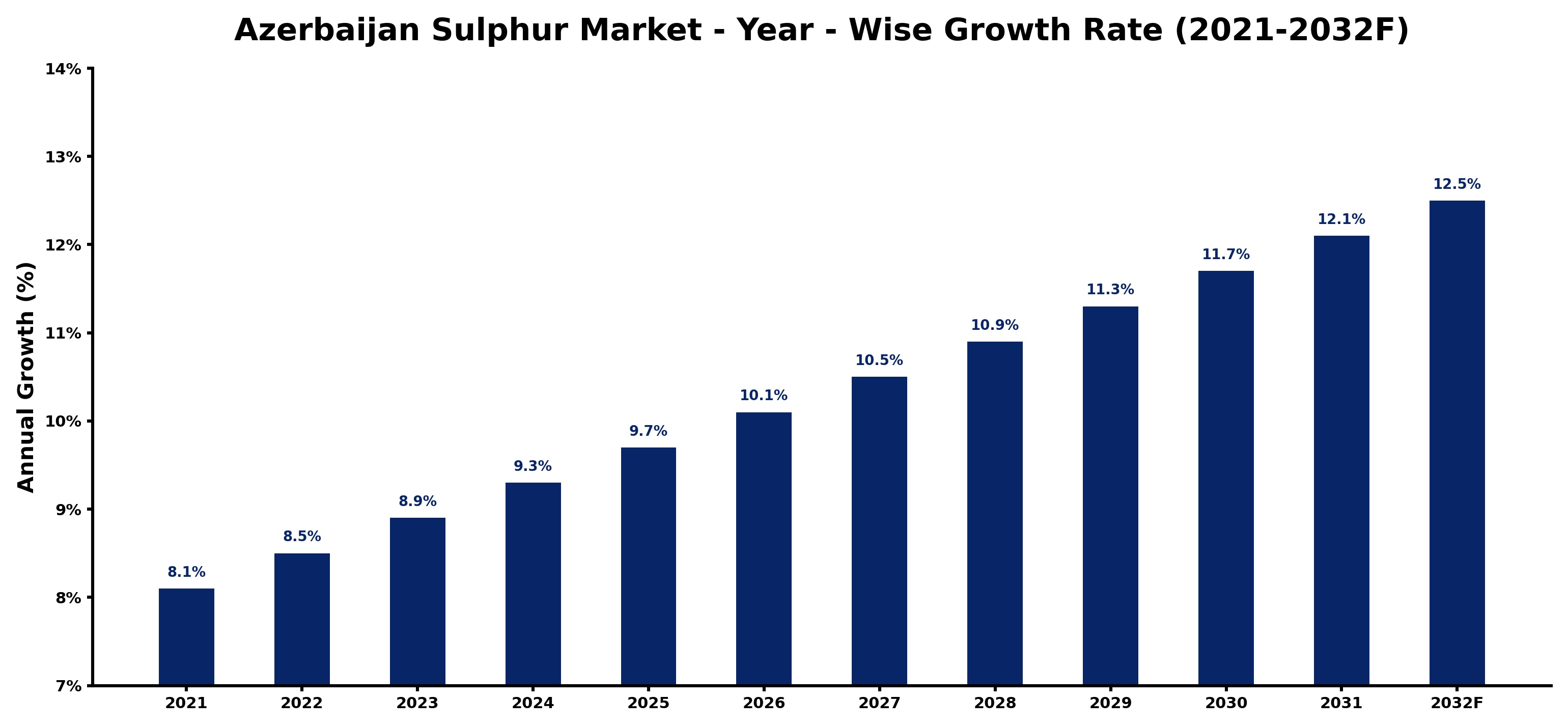
The table below presents the year‑wise growth rates along with the key drivers influencing the market
| Year | Growth Rate | Major Drivers |
| 2021 | 8.1% | Increased industrial applications demand |
| 2022 | 8.5% | Growing agricultural sector utilization |
| 2023 | 8.9% | Rising construction industry requirements |
| 2024 | 9.3% | Enhanced energy sector investments |
| 2025 | 9.7% | Expansion of chemical manufacturing facilities |
| 2026 | 10.1% | Improved mining technology advancements |
| 2027 | 10.5% | Growing environmental regulations enforcement |
| 2028 | 10.9% | Increased exports to neighboring markets |
| 2029 | 11.3% | Rising demand for fertilizers globally |
| 2030 | 11.7% | Technological innovations in production |
| 2031 | 12.1% | Strengthened partnerships with distributors |
| 2032 | 12.5% | Emerging markets adoption of sulphur |
Note - Market size estimations and growth projections presented in this report are based on 6Wresearch's advanced forecasting approach, validated with industry datasets as of June 2026.
Azerbaijan Sulphur Market Synopsis
Azerbaijan's sulphur production is largely generated as a by-product from extensive oil and gas extraction processes, positioning the country as a vital contributor to the global sulphur supply. The strategic location along the Caspian Sea enhances its export capabilities, allowing for easy access to lucrative markets in Western Europe, Asia, and the Americas.
The demand for sulphur in Azerbaijan is notably propelled by the agricultural sector, which utilizes sulphur for soil enhancement and crop yield improvement. Growing awareness of the environmental benefits of sustainable sulphur practices is steering the industry towards more eco-friendly production methods, reflecting a broader trend towards sustainability across global markets.
Azerbaijan Sulphur Market Key Takeaways
- Azerbaijan is a significant global sulphur exporter, leveraging its oil and gas production capabilities.
- Demand from agriculture, chemicals, and pharmaceuticals is driving market growth and diversification.
- Technological advancements are enhancing sulphur mining and processing efficiency.
- Government policies focus on sustainable resource management and infrastructure development.
- The market is set for continuous growth, despite potential challenges from global price fluctuations.
Evaluation of Restraints in Azerbaijan Sulphur Market
Several factors impose constraints on the Azerbaijan Sulphur Market. Fluctuations in global demand and prices remain a significant risk, as the market is intricately tied to international economic conditions. Moreover, competition from other sulphur-producing nations necessitates continuous innovation and investment in extraction and processing technologies to maintain competitiveness. Environmental regulations are also becoming more stringent, pushing companies to adopt sustainable practices, which can require substantial capital investment. Infrastructure challenges, particularly concerning transportation and storage, can complicate the logistics of sulphur distribution both domestically and for export.
Azerbaijan Sulphur Market Trends
Currently, the Azerbaijan Sulphur Market is characterized by an increasing shift towards environmentally sustainable production methods, reflecting a global trend towards greener industrial practices. Innovations in sulphur extraction technologies are being developed to optimize yields and minimize environmental impacts. Additionally, there is a growing recognition of sulphur's vital role in enhancing agricultural productivity, which is further driving demand within that sector. As the market evolves, the focus on sustainable practices is expected to reshape operational strategies across the sulphur supply chain.
Azerbaijan Sulphur Market Opportunities
Investors looking into the Azerbaijan Sulphur Market will find a wealth of opportunities stemming from the country's rich sulphur reserves and proximity to key global markets. There is considerable potential for investment in sulphur mining and extraction technologies that could yield more efficient operations. Furthermore, enhancing processing infrastructure can significantly improve the country's export capabilities, allowing Azerbaijan to meet rising global demand. As industries like agriculture and chemicals expand, the need for reliable sulphur supplies will create long-term growth prospects, making it an attractive market for stakeholders.
Government Initiatives in the Azerbaijan Sulphur Market
The Azerbaijani government plays a crucial role in the sulphur market through a range of policies designed to promote sustainable resource management and economic development. Regulations governing sulphur production and export aim to ensure environmental sustainability while maximizing economic benefits. Furthermore, the government supports infrastructural enhancements to facilitate better transportation and storage of sulphur. Initiatives focused on trade policies also aim to boost export revenues, reinforcing the significance of sulphur as a vital contributor to the national economy.
Future Insights of the Azerbaijan Sulphur Market
Looking ahead to 2026-2032, the Azerbaijan Sulphur Market is poised for steady growth, supported by increasing industrial activities and heightened demand from sectors such as agriculture and chemicals. The advancement of production technologies will likely play a pivotal role in enhancing operational efficiency and reducing costs, further propelling market expansion. Despite challenges like price volatility and regulatory pressures, the overall outlook remains optimistic, underpinned by Azerbaijan's strategic advantages in sulphur production and export.
Azerbaijan Sulphur Market Latest Developments (May 2025 - June 2026)
In recent months, the Azerbaijan sulphur market has seen increased investment in sustainable production methods, as companies adapt to growing environmental regulations. There has been a focus on improving transportation infrastructure to enhance distribution efficiency, which is crucial for meeting rising demand from key export markets. Industry stakeholders are also exploring partnerships to innovate in sulphur processing techniques, reflecting a broader trend towards collaboration for operational improvements.
Azerbaijan Sulphur Market - Key Attractiveness of the Report
- 10 Years of Market Numbers
- Historical Data Starting from 2022 to 2025
- Base Year: 2025
- Forecast Data until 2032
- Key Performance Indicators Impacting the Market
- Major Upcoming Developments and Projects
Key Highlights of the Report:
- Azerbaijan Sulphur Market Outlook
- Market Size of Azerbaijan Sulphur Market, 2025
- Forecast of Azerbaijan Sulphur Market, 2032
- Historical Data and Forecast of Azerbaijan Sulphur Revenues & Volume for the Period 2022-2032F
- Azerbaijan Sulphur Market Trend Evolution
- Azerbaijan Sulphur Market Drivers and Challenges
- Azerbaijan Sulphur Price Trends
- Azerbaijan Sulphur Porter's Five Forces
- Azerbaijan Sulphur Industry Life Cycle
- Historical Data and Forecast of Azerbaijan Sulphur Market Revenues & Volume By Product Type for the Period 2022-2032F
- Historical Data and Forecast of Azerbaijan Sulphur Market Revenues & Volume By Natural Gas for the Period 2022-2032F
- Historical Data and Forecast of Azerbaijan Sulphur Market Revenues & Volume By Crude Oil for the Period 2022-2032F
- Historical Data and Forecast of Azerbaijan Sulphur Market Revenues & Volume By Others for the Period 2022-2032F
- Historical Data and Forecast of Azerbaijan Sulphur Market Revenues & Volume By End Users for the Period 2022-2032F
- Historical Data and Forecast of Azerbaijan Sulphur Market Revenues & Volume By Sulfuric Acid (Fertilizers) for the Period 2022-2032F
- Historical Data and Forecast of Azerbaijan Sulphur Market Revenues & Volume By Sulfuric Acid (Metal Manufacturing) for the Period 2022-2032F
- Historical Data and Forecast of Azerbaijan Sulphur Market Revenues & Volume By Chemical Processing for the Period 2022-2032F
- Azerbaijan Sulphur Import Export Trade Statistics
- Market Opportunity Assessment By Product Type
- Market Opportunity Assessment By End Users
- Azerbaijan Sulphur Top Companies Market Share
- Azerbaijan Sulphur Competitive Benchmarking By Technical and Operational Parameters
- Azerbaijan Sulphur Company Profiles
- Azerbaijan Sulphur Key Strategic Recommendations






































