Azerbaijan Telecom Service Assurance Market Size, Share & Growth Rate
The Azerbaijan Telecom Service Assurance Market was estimated at USD 343 Million in 2025 and is projected to reach USD 610 Million by 2032, growing at a CAGR of 8.6% from 2026 to 2032. This growth trajectory is propelled by an expanding mobile subscriber base and an increasing demand for high-quality telecommunications services as the region embraces digital transformation. Moreover, the advent of 5G technology is further catalyzing investments in service assurance solutions, vital for ensuring seamless connectivity and superior customer experiences.
Azerbaijan Telecom Service Assurance Market Year-wise Growth Rate and Key Drivers
This graph highlights how the Azerbaijan Telecom Service Assurance Market has steadily grown over the years, supported by major growth factors.
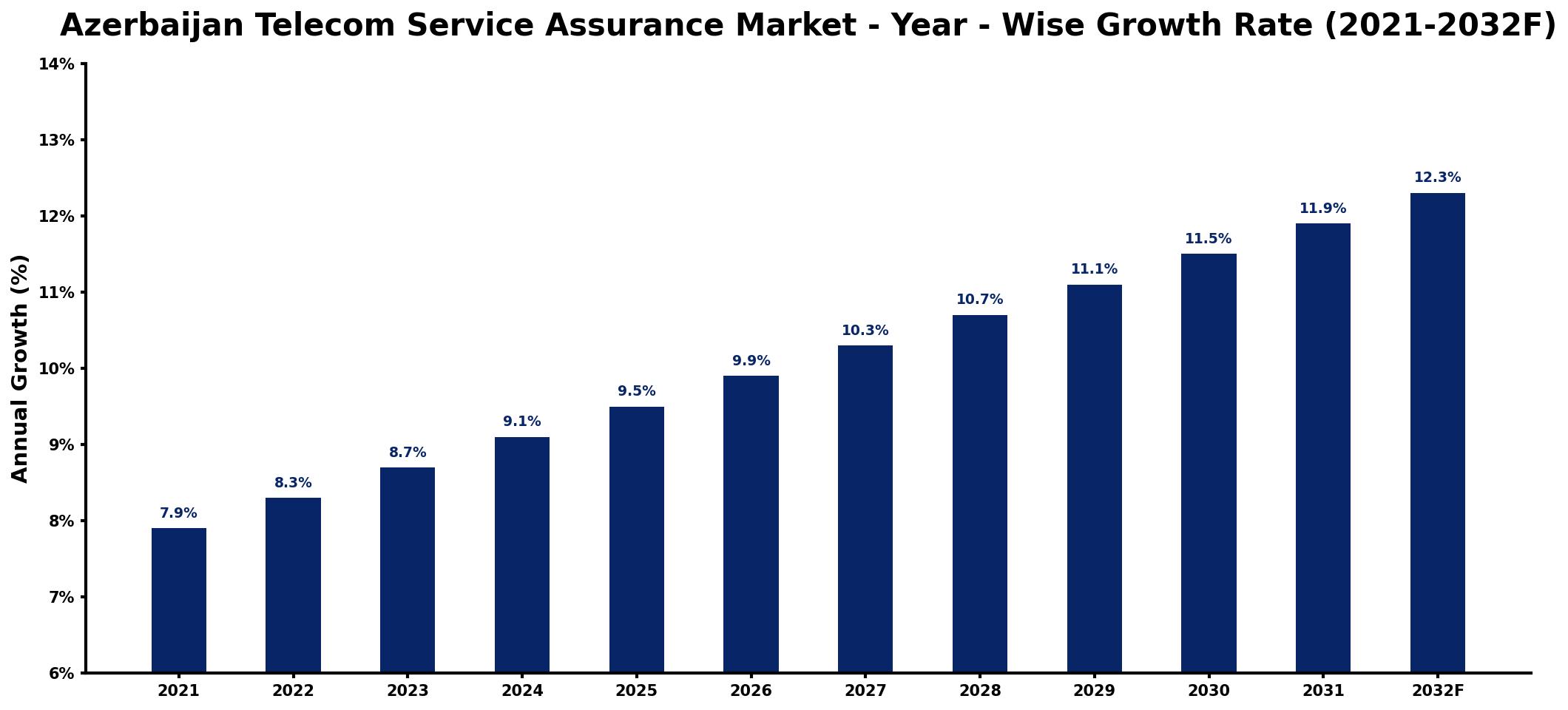
The table below presents the year‑wise growth rates along with the key drivers influencing the market
| Year | Growth Rate | Major Drivers |
| 2021 | 7.9% | Increased mobile data consumption trends |
| 2022 | 8.3% | Rising demand for digital connectivity |
| 2023 | 8.7% | Expansion of 5G network infrastructure |
| 2024 | 9.1% | Growth in smart device adoption |
| 2025 | 9.5% | Surge in online entertainment platforms |
| 2026 | 9.9% | Investment in digital transformation initiatives |
| 2027 | 10.3% | Emergence of IoT applications |
| 2028 | 10.7% | Increased focus on cybersecurity investments |
| 2029 | 11.1% | growing downstream application demand |
| 2030 | 11.5% | Development of smart city projects |
| 2031 | 11.9% | Enhanced customer experience expectations |
| 2032 | 12.3% | Adoption of advanced analytics technologies |
Note: Market size estimations and growth projections presented in this report are based on 6Wresearch's proprietary forecasting methodology, utilizing the latest available industry data, government publications, and primary research inputs.
Azerbaijan Telecom Service Assurance Market Synopsis
In Azerbaijan, the demand for robust telecom service assurance solutions is intensifying, driven by a growing reliance on digital services and mobile connectivity. As telecom operators strive to enhance their service offerings, the integration of advanced monitoring and performance management tools has become crucial for maintaining service excellence.
Operators are increasingly prioritizing customer experience by leveraging real-time analytics to preemptively address service issues. The rise of 5G technologies presents new opportunities, necessitating sophisticated service assurance frameworks to manage the complexity of network operations and ensure reliable connectivity for users.
Azerbaijan Telecom Service Assurance Market Key Takeaways
- The market is experiencing rapid growth, driven by the demand for reliable telecom services and advanced digital technologies.
- Operators are adopting AI and machine learning to enhance network monitoring and performance management capabilities.
- Cloud-based service assurance solutions are gaining traction for their scalability and ability to manage complex networks effectively.
- Integrated service assurance platforms are emerging to offer comprehensive visibility across multi-vendor environments.
- Investment opportunities exist in consulting services to help operators optimize their service assurance implementations.
Evaluation of Restraints in Azerbaijan Telecom Service Assurance Market
Despite the promising growth prospects, the Azerbaijan Telecom Service Assurance Market faces several constraints that may inhibit progress. One of the most pressing challenges is ensuring network reliability across a geographically diverse landscape, where varying terrain can complicate service delivery. Additionally, as telecom services become increasingly complex, operators struggle to maintain high standards of service quality while navigating the demands for enhanced customer support. Cybersecurity threats and data privacy issues present further hurdles, necessitating ongoing investment in technology and infrastructure to safeguard networks and user information. These challenges call for a strategic approach to innovation, resource allocation, and risk management to maintain competitive advantage.
Azerbaijan Telecom Service Assurance Market Trends
The current trends in the Azerbaijan Telecom Service Assurance Market are largely shaped by advancements in technology and shifting consumer expectations. The integration of artificial intelligence and machine learning is becoming commonplace, enabling operators to preemptively identify and resolve issues within the network. Furthermore, there is an increasing focus on real-time analytics, allowing operators to enhance customer experience through data-driven decision-making. Additionally, the migration to cloud-based solutions is on the rise, providing greater agility and scalability, which are essential for managing the complexities of modern telecommunications infrastructures. Overall, these trends point toward a more intelligent and efficient approach to service assurance in the sector.
Azerbaijan Telecom Service Assurance Market Opportunities
As the demand for superior telecommunications services continues to grow, numerous investment opportunities are emerging within the Azerbaijan Telecom Service Assurance Market. Operators stand to benefit from investing in advanced service assurance technologies that focus on enhancing network performance and customer satisfaction. Additionally, there is a notable market potential for consulting services aimed at assisting telecom companies in implementing effective service assurance frameworks. With the increasing complexity of telecom environments and the rapid adoption of digital solutions, organizations that capitalize on these trends are likely to secure a significant competitive edge in the market.
Government Initiatives in the Azerbaijan Telecom Service Assurance Market
Government policies in Azerbaijan play a pivotal role in fostering a conducive environment for the Telecom Service Assurance Market. Regulations aimed at promoting fair competition among service providers are in place, helping to mitigate anti-competitive practices. Additionally, the government emphasizes investment in infrastructure development to enhance the quality and coverage of telecommunications services across the nation. Consumer protection remains a priority, with regulations ensuring transparency and safeguarding users' rights. These initiatives are integral to stimulating growth, innovation, and improved service delivery within the sector.
Future Insights of the Azerbaijan Telecom Service Assurance Market
Looking ahead to 2026-2032, the Azerbaijan Telecom Service Assurance Market is poised for substantial growth, supported by an increasing demand for high-quality communication services. The rapid deployment of 5G networks, along with the expansion of IoT and cloud-based services, will further stimulate market dynamics. With ongoing government initiatives aimed at enhancing digital infrastructure and connectivity, service assurance providers will have ample opportunities to deliver innovative solutions that align with evolving customer needs. By focusing on enhancing network performance and minimizing service disruptions, companies in this sector can capitalize on the burgeoning demand for reliable telecom services.
Azerbaijan Telecom Service Assurance Market Latest Developments (2025 - 2026)
Recent developments within the Azerbaijan Telecom Service Assurance Market indicate a growing trend toward adopting integrated service assurance platforms. These platforms are being increasingly recognized for their ability to provide comprehensive visibility and control over multi-vendor environments. Additionally, a marked shift toward proactive service management is evident, with telecom operators focusing on real-time analytics to enhance operational efficiency. As the market evolves, there is a notable emphasis on ensuring that service quality meets the heightened expectations of consumers amidst the ongoing rollout of advanced technologies.
Azerbaijan Telecom Service Assurance Market - Key Attractiveness of the Report
- 10 Years of Market Numbers
- Historical Data Starting from 2022 to 2025
- Base Year: 2025
- Forecast Data until 2032
- Key Performance Indicators Impacting the Market
- Major Upcoming Developments and Projects
Key Highlights of the Report:
- Azerbaijan Telecom Service Assurance Market Outlook
- Market Size of Azerbaijan Telecom Service Assurance Market, 2025
- Forecast of Azerbaijan Telecom Service Assurance Market, 2032
- Historical Data and Forecast of Azerbaijan Telecom Service Assurance Revenues & Volume for the Period 2022-2032F
- Azerbaijan Telecom Service Assurance Market Trend Evolution
- Azerbaijan Telecom Service Assurance Market Drivers and Challenges
- Azerbaijan Telecom Service Assurance Price Trends
- Azerbaijan Telecom Service Assurance Porter's Five Forces
- Azerbaijan Telecom Service Assurance Industry Life Cycle
- Historical Data and Forecast of Azerbaijan Telecom Service Assurance Market Revenues & Volume By Component for the Period 2022-2032F
- Historical Data and Forecast of Azerbaijan Telecom Service Assurance Market Revenues & Volume By Solutions (Fault and Event Management, Performance Management, and Quality and Service Management) for the Period 2022-2032F
- Historical Data and Forecast of Azerbaijan Telecom Service Assurance Market Revenues & Volume By Services (Professional, Managed) for the Period 2022-2032F
- Historical Data and Forecast of Azerbaijan Telecom Service Assurance Market Revenues & Volume By Operator Type for the Period 2022-2032F
- Historical Data and Forecast of Azerbaijan Telecom Service Assurance Market Revenues & Volume By Mobile Operator for the Period 2022-2032F
- Historical Data and Forecast of Azerbaijan Telecom Service Assurance Market Revenues & Volume By Fixed Operator for the Period 2022-2032F
- Historical Data and Forecast of Azerbaijan Telecom Service Assurance Market Revenues & Volume By Deployment Type for the Period 2022-2032F
- Historical Data and Forecast of Azerbaijan Telecom Service Assurance Market Revenues & Volume By On-Premises for the Period 2022-2032F
- Historical Data and Forecast of Azerbaijan Telecom Service Assurance Market Revenues & Volume By Cloud for the Period 2022-2032F
- Historical Data and Forecast of Azerbaijan Telecom Service Assurance Market Revenues & Volume By Organization Size for the Period 2022-2032F
- Historical Data and Forecast of Azerbaijan Telecom Service Assurance Market Revenues & Volume By Small and Medium Enterprises for the Period 2022-2032F
- Historical Data and Forecast of Azerbaijan Telecom Service Assurance Market Revenues & Volume By Large Enterprises for the Period 2022-2032F
- Azerbaijan Telecom Service Assurance Import Export Trade Statistics
- Market Opportunity Assessment By Component
- Market Opportunity Assessment By Operator Type
- Market Opportunity Assessment By Deployment Type
- Market Opportunity Assessment By Organization Size
- Azerbaijan Telecom Service Assurance Top Companies Market Share
- Azerbaijan Telecom Service Assurance Competitive Benchmarking By Technical and Operational Parameters
- Azerbaijan Telecom Service Assurance Company Profiles
- Azerbaijan Telecom Service Assurance Key Strategic Recommendations






































