Azerbaijan Textile Market Summary
The azerbaijan textile market was estimated at USD 1335 Million in 2025 and is projected to reach USD 2443 Million by 2032, growing at a CAGR of 10.4% from 2026 to 2032.
Azerbaijan Textile Market Year-wise Growth Rate and Key Drivers
This graph highlights how the Azerbaijan Textile Market has steadily grown over the past five years, supported by major growth factors.
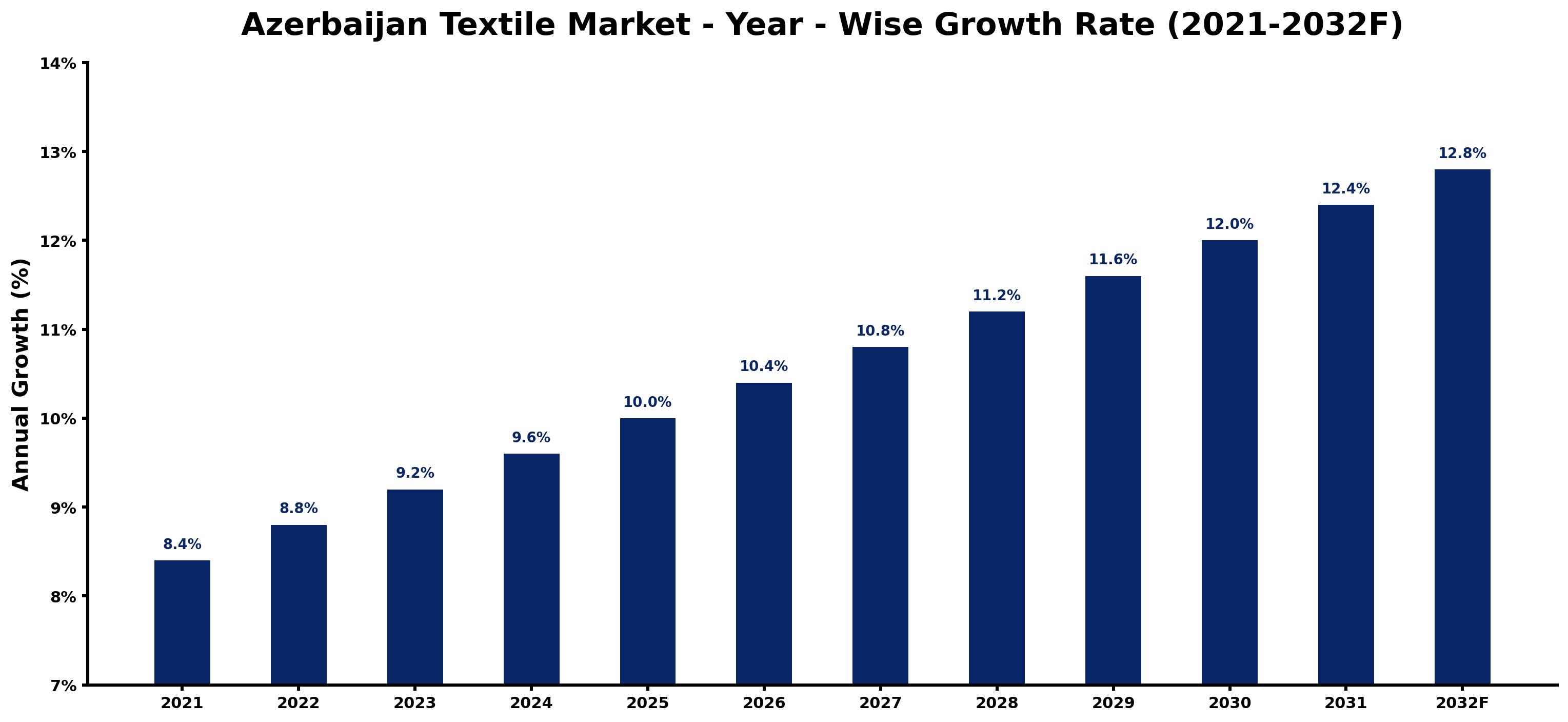
The table below presents the year wise growth rates along with the key drivers influencing the market
| Year | Growth Rate | Major Drivers |
| 2021 | 8.4% | Local artisans began leveraging online platforms, boosting handmade textile visibility. |
| 2022 | 8.8% | International collaborations emerged, enhancing design innovation in the local textile sector. |
| 2023 | 9.2% | Economic diversification efforts stimulated investments in sustainable textile production methods. |
| 2024 | 9.6% | Revamped educational programs improved workforce skills tailored for modern textile technologies. |
| 2025 | 10.0% | Demand for eco-friendly fabrics increased, aligning with global sustainability trends. |
| 2026 | 10.4% | Technological adoption accelerated, optimizing supply chains and production efficiency significantly. |
| 2027 | 10.8% | Regional trade agreements facilitated broader market access for Azerbaijani textile exports. |
| 2028 | 11.2% | Consumer preference shifted towards locally sourced products, enhancing domestic textile sales. |
| 2029 | 11.6% | Infrastructural improvements bolstered logistics, reducing costs for textile distribution networks. |
| 2030 | 12.0% | Cultural heritage initiatives attracted tourism, further popularizing traditional Azerbaijani textiles. |
| 2031 | 12.4% | Joint ventures with foreign brands cultivated knowledge-sharing and advanced textile production. |
| 2032 | 12.8% | Investments in sustainable practices positioned Azerbaijan as a regional textile leader. |
Note - Market size estimations and growth projections presented in this report are based on 6Wresearch's advanced forecasting approach, validated with industry datasets as of June 2026.
Azerbaijan Textile Market Synopsis
The Azerbaijan Textile Market is projected to reach 10.4% and witness significant growth during the forecast period (2026-2032). This expansion is primarily driven by a combination of increasing domestic demand across various textile applications, including apparel and industrial textiles, alongside supportive government policies aimed at boosting local production capabilities.
Azerbaijan Textile Market Growth Drivers
Several factors are propelling the growth of the Azerbaijan Textile Market. The rising population is creating greater demand for clothing and home textiles, while the increase in disposable incomes among consumers is influencing purchasing patterns towards higher-quality textile products.
- The growth in retail infrastructure is making textile products more accessible to consumers, enhancing market reach and encouraging sales.
- Government initiatives aimed at reducing import dependency are stimulating local production, thereby creating job opportunities and strengthening the overall economy.
- Innovations in textile manufacturing techniques are improving product quality and variety, appealing to both domestic and international markets.
- There is a heightened awareness and demand for sustainable textiles, which has prompted local manufacturers to adopt eco-friendly practices.
- Collaboration between local artisans and international brands is fostering the development of unique textiles that reflect cultural heritage and cater to diverse consumer preferences.
Azerbaijan Textile Market Trends and Opportunities
The Azerbaijan Textile Market is undergoing several transformative trends that present significant opportunities. The shift towards sustainability is encouraging companies to explore organic and recycled materials, a trend that aligns with global consumer preferences.
- Digitalization of the textile sector is increasingly evident, with businesses investing in e-commerce platforms that facilitate direct-to-consumer sales, thus expanding their customer base.
- There is growing interest in technical textiles for specialized applications, which could enhance market diversification and open new avenues for growth.
- The burgeoning interest in local fashion design is paving the way for unique product offerings that resonate with culturally conscious consumers.
- Investment in research and development is becoming critical for companies looking to innovate and remain competitive in the evolving textile landscape.
- Strong mentorship programs focusing on skill development in textile-related fields are gradually improving the industry's workforce capabilities.
Azerbaijan Textile Market Challenges and Restraints
While the Azerbaijan Textile Market shows promise, it faces several challenges. The competition from imported textiles, particularly from nations with lower production costs, places considerable pressure on local manufacturers.
- Fluctuations in raw material prices, such as cotton and synthetic fibers, can lead to unpredictable production costs, impacting overall profit margins within the textile industry.
- The limited access to advanced machinery and technology restricts efficiency and quality improvements, hindering competitive capabilities.
- Environmental regulations, while beneficial in promoting sustainability, may impose additional costs on manufacturers already facing tight profit margins.
- Branding and consumer perception can be challenging, as locally produced textiles often struggle against the established reputation of imported goods.
- Market entry barriers for foreign investors can limit opportunities for international partnerships and knowledge exchange.
Azerbaijan Textile Market Investment Opportunities
The Azerbaijan Textile Market presents various investment opportunities for stakeholders looking to enter or expand within this growing sector. The ongoing demand for high-quality textiles and clothing provides a robust landscape for establishing manufacturing facilities.
- Establishing textile production units focused on specific segments, such as technical textiles, offers potential for robust returns on investment.
- Investing in advanced technologies can enhance production capabilities, improve efficiency, and elevate product quality, offering a significant competitive advantage.
- Collaboration with local fashion designers to create culturally relevant and innovative textiles can increase market appeal and customer loyalty.
- Developing eco-friendly production methods can attract environmentally conscious consumers and differentiate offerings in the marketplace.
- Exploring export opportunities to neighboring countries can expand market reach and diversify revenue streams for local textile manufacturers.
Azerbaijan Textile Market Government Investment and Initiatives
The Azerbaijani government has taken substantial steps to bolster the textile sector through various policies and initiatives. Financial incentives, tax breaks, and subsidies are being offered to local manufacturers to enhance production capabilities and competitiveness.
- Investment in the development of industrial zones dedicated to textiles is designed to create clusters that foster collaboration and efficiency among businesses.
- The government is pushing for compliance with environmental standards, ensuring that textile production aligns with sustainable practices.
- Initiatives aimed at strengthening intellectual property rights are being implemented to protect local innovations and combat counterfeit products in the market.
- A focus on vocational training programs is enhancing the skill set of the workforce, thereby improving labor quality in the textile industry.
- Public spending on infrastructure improvements, such as transportation networks, is expected to facilitate better logistics for textile distribution, enhancing overall market efficiency.
Azerbaijan Textile Market Latest Developments (May 2025 - June 2026)
Recent developments in the Azerbaijan Textile Market indicate a proactive approach towards innovation and sustainability. Notably, many businesses have begun to invest heavily in digital solutions to streamline operations and enhance customer engagement.
- Enhancements in supply chain management through technology adoption are expected to improve overall efficiency and reduce delivery times.
- The government has introduced new regulations aimed at promoting sustainable practices among textile manufacturers, which are gaining traction across the industry.
- Trade shows and exhibitions focusing on textiles have reported increased participation, reflecting the industry's growing interest in showcasing local capabilities on an international stage.
- There has been a surge in local start-ups focused on textile innovation, leveraging cultural designs and eco-friendly materials to attract niche markets.
- Partnerships between educational institutions and textile firms are being established to facilitate knowledge transfer and address skills shortages in the workforce.
Azerbaijan Textile Market - Key Attractiveness of the Report
- 10 Years of Market Numbers
- Historical Data Starting from 2022 to 2025
- Base Year: 2025
- Forecast Data until 2032
- Key Performance Indicators Impacting the Market
- Major Upcoming Developments and Projects
Key Highlights of the Report:
- Azerbaijan Textile Market Outlook
- Market Size of Azerbaijan Textile Market, 2025
- Forecast of Azerbaijan Textile Market, 2032F
- Historical Data and Forecast of Azerbaijan Textile Revenues & Volume for the Period 2022-2032F
- Azerbaijan Textile Market Trend Evolution
- Azerbaijan Textile Market Drivers and Challenges
- Azerbaijan Textile Price Trends
- Azerbaijan Textile Porter's Five Forces
- Azerbaijan Textile Industry Life Cycle
- Historical Data and Forecast of Azerbaijan Textile Market Revenues & Volume By Raw Material Types for the Period 2022-2032F
- Historical Data and Forecast of Azerbaijan Textile Market Revenues & Volume By Cotton for the Period 2022-2032F
- Historical Data and Forecast of Azerbaijan Textile Market Revenues & Volume By Chemical for the Period 2022-2032F
- Historical Data and Forecast of Azerbaijan Textile Market Revenues & Volume By Wool for the Period 2022-2032F
- Historical Data and Forecast of Azerbaijan Textile Market Revenues & Volume By Silk for the Period 2022-2032F
- Historical Data and Forecast of Azerbaijan Textile Market Revenues & Volume By Others for the Period 2022-2032F
- Historical Data and Forecast of Azerbaijan Textile Market Revenues & Volume By Product Types for the Period 2022-2032F
- Historical Data and Forecast of Azerbaijan Textile Market Revenues & Volume By Natural Fibers for the Period 2022-2032F
- Historical Data and Forecast of Azerbaijan Textile Market Revenues & Volume By Polyesters for the Period 2022-2032F
- Historical Data and Forecast of Azerbaijan Textile Market Revenues & Volume By Nylon for the Period 2022-2032F
- Historical Data and Forecast of Azerbaijan Textile Market Revenues & Volume By Others for the Period 2022-2032F
- Historical Data and Forecast of Azerbaijan Textile Market Revenues & Volume By Applications for the Period 2022-2032F
- Historical Data and Forecast of Azerbaijan Textile Market Revenues & Volume By Household for the Period 2022-2032F
- Historical Data and Forecast of Azerbaijan Textile Market Revenues & Volume By Technical for the Period 2022-2032F
- Historical Data and Forecast of Azerbaijan Textile Market Revenues & Volume By Fashion & Clothing for the Period 2022-2032F
- Historical Data and Forecast of Azerbaijan Textile Market Revenues & Volume By Others for the Period 2022-2032F
- Azerbaijan Textile Import Export Trade Statistics
- Market Opportunity Assessment By Raw Material Types
- Market Opportunity Assessment By Product Types
- Market Opportunity Assessment By Applications
- Azerbaijan Textile Top Companies Market Share
- Azerbaijan Textile Competitive Benchmarking By Technical and Operational Parameters
- Azerbaijan Textile Company Profiles
- Azerbaijan Textile Key Strategic Recommendations






































