Azerbaijan Transaction Monitoring Market Size & Growth Rate (2026-2032)
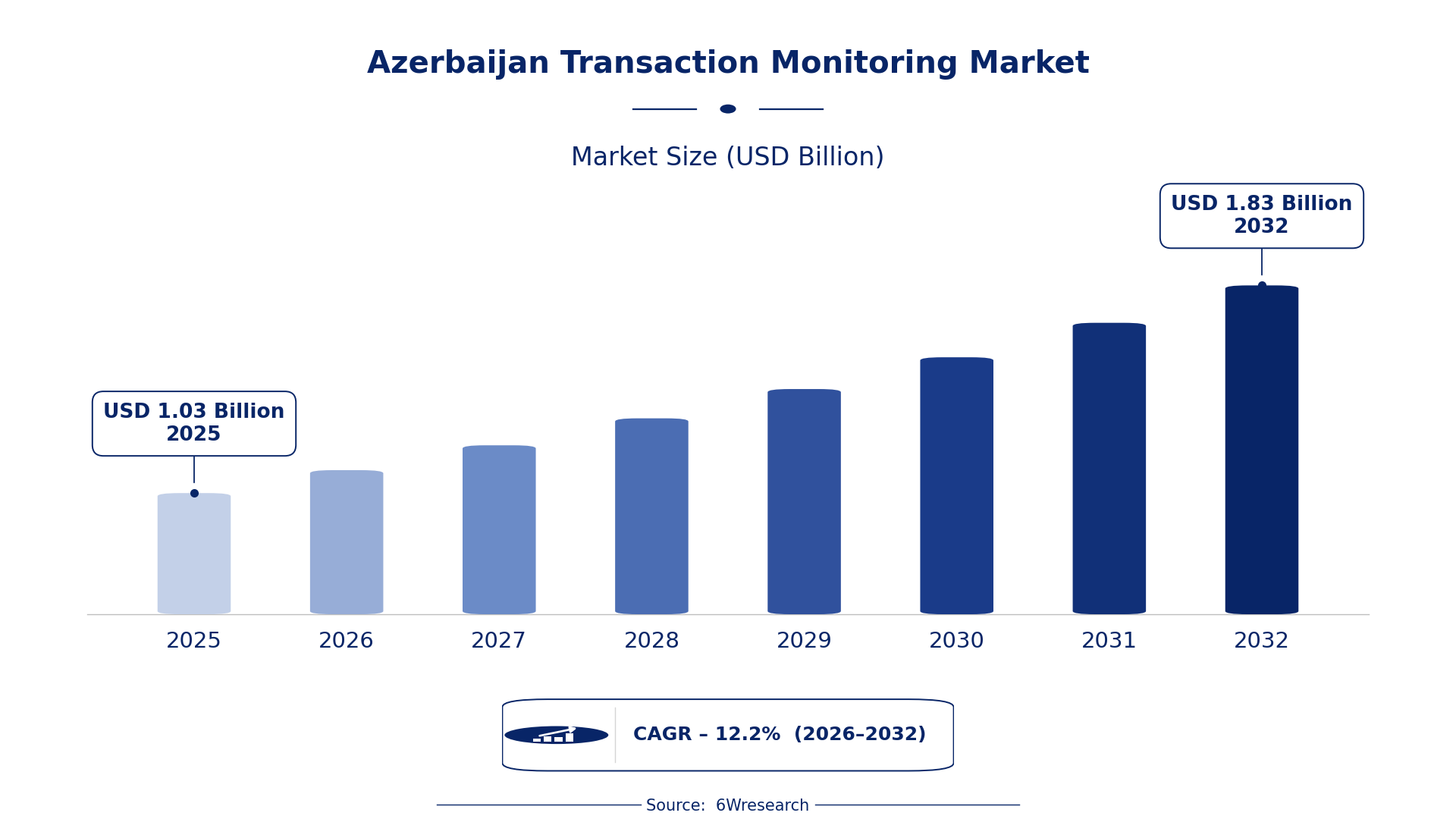
The Azerbaijan Transaction Monitoring Market was estimated at USD 1032 Million in 2025 and is projected to reach USD 1828 Million by 2032, growing at a CAGR of 12.2% from 2026 to 2032.
Azerbaijan Transaction Monitoring Market Synopsis
In recent years, Azerbaijan has experienced a surge in its transaction monitoring market, driven primarily by the need for robust anti-money laundering (AML) and counter-terrorism financing (CTF) frameworks. As financial institutions adopt advanced technologies to meet these stringent regulatory requirements, the market is set for substantial growth, reflecting both increased investment and technological sophistication.
The adoption of machine learning and data analytics is not just a trend; it's a necessity for financial entities in Azerbaijan. With the threat of financial crimes on the rise, the focus on effective transaction monitoring systems has never been more crucial. This evolution signifies a departure from traditional methods to a more dynamic and responsive approach in combating financial malfeasance.
Azerbaijan Transaction Monitoring Market Year-wise Growth Rate and Key Drivers
This graph illustrates the annual growth rates of the Azerbaijan Transaction Monitoring Market from 2021 to 2032, highlighting a steady upward trajectory and projected expansion over the forecast period.
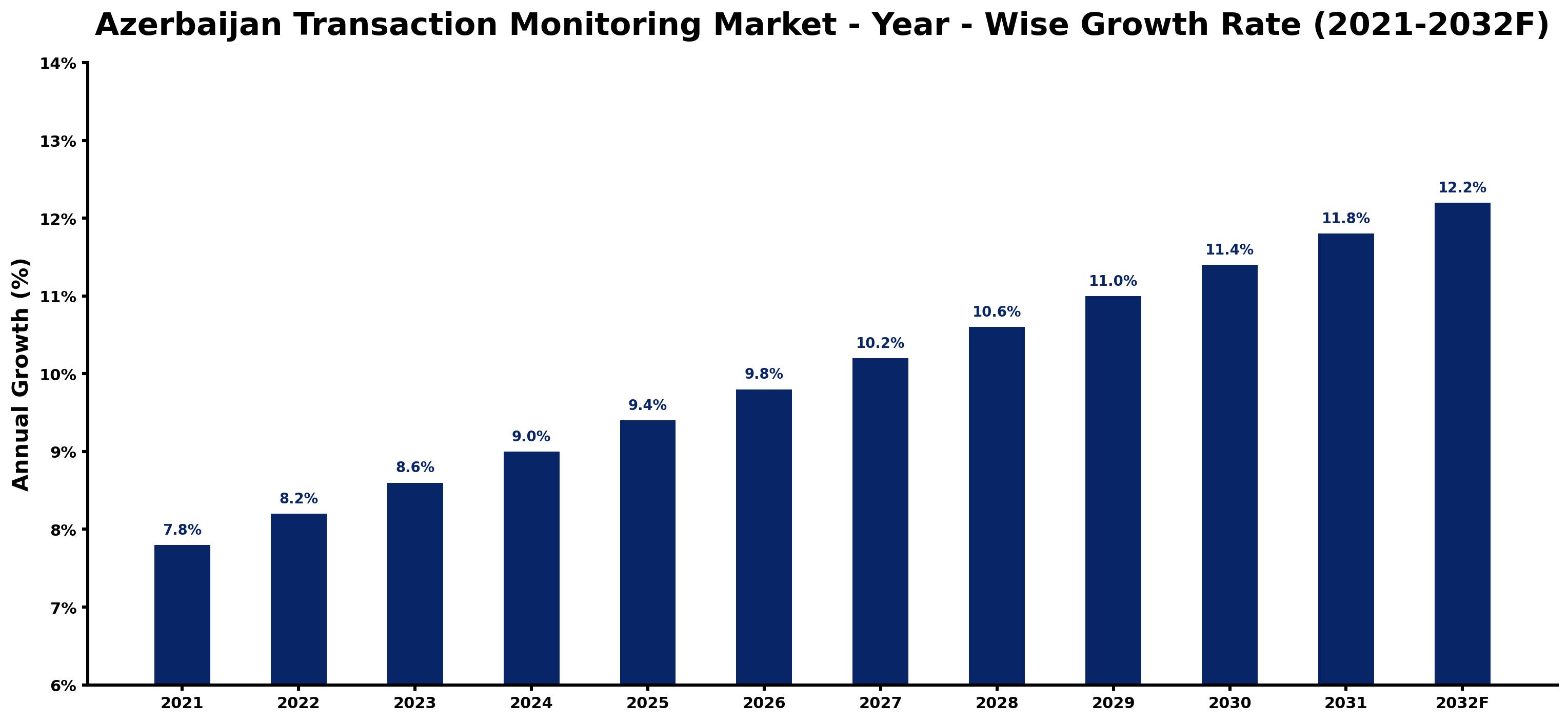
The table below presents the year‑wise growth rates along with the key drivers influencing the market
| Year | Growth Rate | Major Drivers |
| 2021 | 7.8% | Central Bank of Azerbaijan enhances anti-money laundering regulations. |
| 2022 | 8.2% | Increased focus on KYC compliance by financial institutions. |
| 2023 | 8.6% | Growth of digital wallets prompts stricter transaction oversight. |
| 2024 | 9.0% | Government push for financial transparency boosts demand. |
| 2025 | 9.4% | Rising foreign investments heighten scrutiny of financial transactions. |
| 2026 | 9.8% | Emergence of fintech firms increases monitoring technology adoption. |
| 2027 | 10.2% | Cybersecurity threats drive demand for enhanced monitoring solutions. |
| 2028 | 10.6% | Legislative reforms support modernization of financial monitoring practices. |
| 2029 | 11.0% | Public awareness of financial fraud fuels transaction monitoring needs. |
| 2030 | 11.4% | Bilateral trade agreements necessitate robust compliance measures. |
| 2031 | 11.8% | International partnerships enhance local surveillance capabilities. |
| 2032 | 12.2% | Regional economic growth demands sophisticated monitoring technologies. |
Note: Market size estimations and growth projections presented in this report are based on 6Wresearch's proprietary forecasting methodology, utilizing the latest available industry data, government publications, and primary research inputs.
Azerbaijan Transaction Monitoring Market Key Takeaways
Below are some of the specific key takeaways from the market, including:
- The Azerbaijan Transaction Monitoring Market is projected to grow significantly, reflecting a rising emphasis on compliance.
- Technological advancements such as AI and big data are enhancing the efficiency of transaction monitoring systems.
- Financial institutions are compelled to adapt to increasing regulatory scrutiny to avoid penalties.
- Reduction of false positives remains a critical challenge for system operators in the market.
- The government’s initiatives in AML and CTF compliance are fostering a favorable environment for market growth.
Evaluation of Restraints in Azerbaijan Transaction Monitoring Market
The transaction monitoring landscape in Azerbaijan faces several significant restraints that could impede its development. One notable challenge is the high rate of false positives, which can overwhelm institutions and divert resources. Additionally, financial crime detection requires increasingly sophisticated algorithms that must continuously evolve to adapt to new tactics employed by criminals. Regulatory scrutiny adds another layer of complexity, as institutions must navigate an intricate web of compliance requirements, increasing the burden on operational capabilities.
Azerbaijan Transaction Monitoring Market Trends
Emerging trends indicate a strong shift towards integrating artificial intelligence in transaction monitoring systems. This technology is proving invaluable for identifying patterns that might elude traditional methods. on top of that, the focus is on developing more user-friendly interfaces that empower analysts to make swift decisions based on real-time data. The collaboration between public and private sectors is also becoming more prevalent, enhancing capabilities through shared resources and expertise.
Azerbaijan Transaction Monitoring Market Opportunities
There exists a wealth of opportunities in the transaction monitoring market, particularly for technology providers offering innovative solutions. As financial institutions race to enhance their compliance measures, there is a growing demand for customized transaction monitoring systems tailored to specific needs. Additionally, ongoing regulatory changes present a chance for market players to introduce new products that address these evolving requirements effectively.
Government Initiatives in the Azerbaijan Transaction Monitoring Market
The Azerbaijan government is actively shaping the transaction monitoring market through strategic regulatory frameworks and initiatives aimed at bolstering AML and CTF compliance. With a clear focus on enhancing financial integrity, recent policy shifts reflect a commitment to both innovation and security. This regulatory posture not only mandates compliance but also encourages the adoption of advanced technologies within the sector.
- A recently completed initiative involved the introduction of stricter AML compliance standards for financial institutions, enhancing regulatory oversight.
- A current ongoing project aims to upgrade the digital infrastructure of financial institutions to better support transaction monitoring systems.
- A planned initiative is set to launch a public-private partnership by 2026, aimed at developing a centralized database for suspicious transaction reporting.
- A government-led program is underway to enhance training for compliance officers within banks to better understand and implement transaction monitoring protocols.
- The introduction of a framework in 2025 requiring all financial institutions to utilize machine learning technologies for transaction monitoring.
Future Insights of the Azerbaijan Transaction Monitoring Market
Looking ahead to 2026-2032, the Azerbaijan transaction monitoring market is set for transformative growth. As regulatory bodies continue to emphasize compliance, institutions will increasingly rely on advanced technologies to meet these standards. The integration of machine learning and real-time analytics will not only boost detection capabilities but will also streamline operations, leading to greater efficiency across the sector. With a strong emphasis on security, the future will demand innovation and adaptability from all market players.
Azerbaijan Transaction Monitoring Market Latest Developments
In the past year, the Azerbaijan transaction monitoring market has seen notable developments, reflecting a proactive approach to combat financial crimes. The sector has actively embraced technology and partnerships to enhance compliance capabilities. As institutions strive to keep pace with regulatory requirements, the momentum for innovation continues to build.
- A new technology vendor launched an AI-driven transaction monitoring system in early 2025, aimed at reducing false positive rates significantly.
- A major regional bank is currently implementing a comprehensive upgrade to its transaction monitoring systems, expected to be fully operational by mid-2026.
- A pilot program initiated in late 2025 explores collaborative efforts between government entities and financial institutions to share intelligence on suspicious transactions.
- A service upgrade offering enhanced analytics features for existing transaction monitoring systems is underway, set for rollout by Q4 2026.
- A planned integration of blockchain technology into transaction monitoring systems is anticipated to commence in early 2027, aiming to bolster data integrity.
Azerbaijan Transaction Monitoring Market - Key Attractiveness of the Report
- 10 Years of Market Numbers
- Historical Data Starting from 2022 to 2025
- Base Year: 2025
- Forecast Data until 2032
- Key Performance Indicators Impacting the Market
- Major Upcoming Developments and Projects
Government initiatives, particularly those focusing on AML and CTF compliance, are crucial for shaping the market. Recent regulations mandate that financial institutions adopt robust transaction monitoring systems, reflecting the government’s commitment to enhancing financial integrity.
Key Highlights of the Report:
- Azerbaijan Transaction Monitoring Market Outlook
- Market Size of Azerbaijan Transaction Monitoring Market, 2025
- Forecast of Azerbaijan Transaction Monitoring Market, 2032
- Historical Data and Forecast of Azerbaijan Transaction Monitoring Revenues & Volume for the Period 2022-2032F
- Azerbaijan Transaction Monitoring Market Trend Evolution
- Azerbaijan Transaction Monitoring Market Drivers and Challenges
- Azerbaijan Transaction Monitoring Price Trends
- Azerbaijan Transaction Monitoring Porter's Five Forces
- Azerbaijan Transaction Monitoring Industry Life Cycle
- Historical Data and Forecast of Azerbaijan Transaction Monitoring Market Revenues & Volume By Application Area for the Period 2022-2032F
- Historical Data and Forecast of Azerbaijan Transaction Monitoring Market Revenues & Volume By AML for the Period 2022-2032F
- Historical Data and Forecast of Azerbaijan Transaction Monitoring Market Revenues & Volume By FDP for the Period 2022-2032F
- Historical Data and Forecast of Azerbaijan Transaction Monitoring Market Revenues & Volume By Compliance Management for the Period 2022-2032F
- Historical Data and Forecast of Azerbaijan Transaction Monitoring Market Revenues & Volume By Customer Identity Management for the Period 2022-2032F
- Historical Data and Forecast of Azerbaijan Transaction Monitoring Market Revenues & Volume By Component for the Period 2022-2032F
- Historical Data and Forecast of Azerbaijan Transaction Monitoring Market Revenues & Volume By Solution for the Period 2022-2032F
- Historical Data and Forecast of Azerbaijan Transaction Monitoring Market Revenues & Volume By Services for the Period 2022-2032F
- Historical Data and Forecast of Azerbaijan Transaction Monitoring Market Revenues & Volume By Function for the Period 2022-2032F
- Historical Data and Forecast of Azerbaijan Transaction Monitoring Market Revenues & Volume By Case Management for the Period 2022-2032F
- Historical Data and Forecast of Azerbaijan Transaction Monitoring Market Revenues & Volume By KYC/Customer Onboarding for the Period 2022-2032F
- Historical Data and Forecast of Azerbaijan Transaction Monitoring Market Revenues & Volume By Dashboard and Reporting for the Period 2022-2032F
- Historical Data and Forecast of Azerbaijan Transaction Monitoring Market Revenues & Volume By Watch List Screening for the Period 2022-2032F
- Historical Data and Forecast of Azerbaijan Transaction Monitoring Market Revenues & Volume By Deployment Mode for the Period 2022-2032F
- Historical Data and Forecast of Azerbaijan Transaction Monitoring Market Revenues & Volume By On-Premises for the Period 2022-2032F
- Historical Data and Forecast of Azerbaijan Transaction Monitoring Market Revenues & Volume By Cloud for the Period 2022-2032F
- Historical Data and Forecast of Azerbaijan Transaction Monitoring Market Revenues & Volume By Organization Size for the Period 2022-2032F
- Historical Data and Forecast of Azerbaijan Transaction Monitoring Market Revenues & Volume By SMEs for the Period 2022-2032F
- Historical Data and Forecast of Azerbaijan Transaction Monitoring Market Revenues & Volume By Large Enterprises for the Period 2022-2032F
- Historical Data and Forecast of Azerbaijan Transaction Monitoring Market Revenues & Volume By Vertical for the Period 2022-2032F
- Historical Data and Forecast of Azerbaijan Transaction Monitoring Market Revenues & Volume By Banking, Financial Services, and Insurance for the Period 2022-2032F
- Historical Data and Forecast of Azerbaijan Transaction Monitoring Market Revenues & Volume By Government and Defense for the Period 2022-2032F
- Historical Data and Forecast of Azerbaijan Transaction Monitoring Market Revenues & Volume By IT and Telecom for the Period 2022-2032F
- Historical Data and Forecast of Azerbaijan Transaction Monitoring Market Revenues & Volume By Retail for the Period 2022-2032F
- Historical Data and Forecast of Azerbaijan Transaction Monitoring Market Revenues & Volume By Healthcare for the Period 2022-2032F
- Historical Data and Forecast of Azerbaijan Transaction Monitoring Market Revenues & Volume By Energy and Utilities for the Period 2022-2032F
- Historical Data and Forecast of Azerbaijan Transaction Monitoring Market Revenues & Volume By Manufacturing for the Period 2022-2032F
- Historical Data and Forecast of Azerbaijan Transaction Monitoring Market Revenues & Volume By Others for the Period 2022-2032F
- Azerbaijan Transaction Monitoring Import Export Trade Statistics
- Market Opportunity Assessment By Application Area
- Market Opportunity Assessment By Component
- Market Opportunity Assessment By Function
- Market Opportunity Assessment By Deployment Mode
- Market Opportunity Assessment By Organization Size
- Market Opportunity Assessment By Vertical
- Azerbaijan Transaction Monitoring Top Companies Market Share
- Azerbaijan Transaction Monitoring Competitive Benchmarking By Technical and Operational Parameters
- Azerbaijan Transaction Monitoring Company Profiles
- Azerbaijan Transaction Monitoring Key Strategic Recommendations






































