Azerbaijan Trolley Market Size, Share & Growth Rate
The Azerbaijan Trolley Market was estimated at USD 1235 Million in 2025 and is projected to reach USD 2128 Million by 2032, growing at a CAGR of 8.1% from 2026 to 2032. This growth trajectory is significantly influenced by the rising demand for efficient material handling solutions across various sectors, including retail and logistics. The ongoing urbanization and expansion of commercial activities in Azerbaijan are further fueling this demand, as businesses seek reliable tools to enhance operational efficiency.
Azerbaijan Trolley Market Year-wise Growth Rate and Key Drivers
This graph highlights how the Azerbaijan Trolley Market has steadily grown over the years, supported by major growth factors.
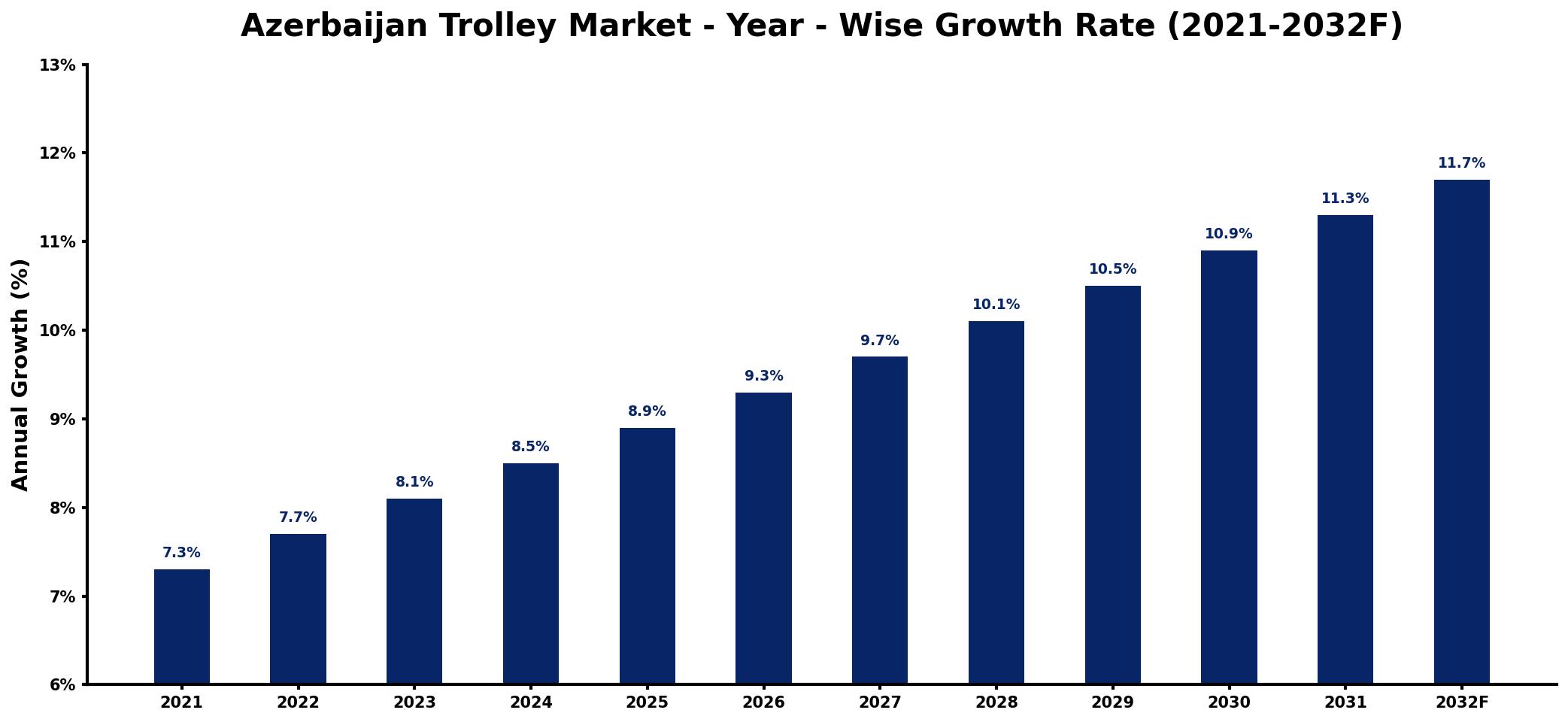
The table below presents the year‑wise growth rates along with the key drivers influencing the market
| Year | Growth Rate | Major Drivers |
| 2021 | 7.3% | increased urban transportation needs |
| 2022 | 7.7% | higher investment in infrastructure |
| 2023 | 8.1% | growing environmental sustainability focus |
| 2024 | 8.5% | expansion of public transit systems |
| 2025 | 8.9% | rising consumer preference for efficiency |
| 2026 | 9.3% | enhanced government support initiatives |
| 2027 | 9.7% | greater emphasis on green technologies |
| 2028 | 10.1% | increased population urban migration |
| 2029 | 10.5% | improvements in manufacturing capabilities |
| 2030 | 10.9% | development of smart mobility solutions |
| 2031 | 11.3% | surge in tourism and travel |
| 2032 | 11.7% | growing regional consumption patterns |
Note: Market size estimations and growth projections presented in this report are based on 6Wresearch's proprietary forecasting methodology, utilizing the latest available industry data, government publications, and primary research inputs.
Azerbaijan Trolley Market Synopsis
In Azerbaijan, the trolley market plays a vital role in supporting retail operations, with supermarkets and retail stores increasingly adopting wheeled carts for efficient customer service. The versatility of trolleys enables businesses to handle diverse product ranges, enhancing the shopping experience for consumers and streamlining logistics operations.
Moreover, innovations in trolley designs are gaining traction. For instance, foldable and electric trolleys are becoming popular due to their practicality and ease of use, catering to the evolving preferences of businesses and consumers alike.
Azerbaijan Trolley Market Key Takeaways
- The market is primarily driven by the increasing demand for trolleys in retail, hospitality, and logistics sectors.
- Urbanization and infrastructure investments are pivotal in boosting trolley demand and usage.
- Advancements in trolley design and materials contribute to product differentiation and innovation.
- Competitive pressures from alternative solutions necessitate continuous adaptation and marketing strategies.
- Government regulations on safety and standards create both challenges and opportunities for manufacturers.
Evaluation of Restraints in Azerbaijan Trolley Market
Despite the promising growth outlook, several restraints affect the Azerbaijan trolley market. The urban landscape poses challenges in terms of size and maneuverability, forcing manufacturers to continuously innovate to adapt products to compact environments. Additionally, shifts in consumer preferences towards sustainability necessitate a reassessment of materials and production processes. Competing with digital solutions and changing retail practices further complicates market dynamics, making it essential for companies to refine their strategies for sustained growth.
Azerbaijan Trolley Market Trends
Key trends shaping the Azerbaijan trolley market include the rise of eco-friendly trolleys, driven by consumer demand for sustainable products. Innovations such as lightweight aluminum trolleys and electric models are gaining popularity, as they enhance ease of use and reduce physical strain. Furthermore, the integration of technology, such as mobile app compatibility for tracking and managing inventory, is poised to revolutionize trolley functionality, making them indispensable tools in modern commercial settings.
Azerbaijan Trolley Market Opportunities
There are substantial growth opportunities within the Azerbaijan trolley market. The increasing focus on e-commerce and home delivery services creates a demand for specialized trolleys designed for logistics and transport efficiency. Moreover, the burgeoning hospitality sector presents an untapped market for trolleys designed specifically for hotels and airports, enhancing guest experiences and operational efficiency. Investment in research and development can also pave the way for innovative products that meet evolving consumer demands.
Government Initiatives in the Azerbaijan Trolley Market
The Azerbaijani government is actively promoting regulations that enhance the safety and efficiency of trolleys in commercial settings. This includes standards governing design and maintenance, aimed at protecting consumers and optimizing trolley use in retail and transportation sectors. Such policies not only ensure quality but also encourage manufacturers to innovate and adapt to the changing market landscape.
Future Insights of the Azerbaijan Trolley Market
Looking ahead to the period of 2026-2032, the Azerbaijan trolley market is poised for significant expansion. Driven by urbanization and advancements in logistics practices, the demand for efficient material handling solutions will continue to rise. As businesses increasingly recognize the importance of customer experience and operational efficiency, investment in innovative trolley designs will likely surge. Additionally, sustainability trends will push manufacturers to focus on environmentally friendly materials and production methods, further shaping the market's future trajectory.
Azerbaijan Trolley Market Latest Developments (2025 - 2026)
Recent developments in the Azerbaijan trolley market have highlighted a shift towards electric and foldable trolley designs, catering to the demands of urban environments. Companies are increasingly focusing on sustainability, with many introducing eco-friendly materials in their product lines. Moreover, collaborations between manufacturers and logistics firms are becoming more prevalent as both sectors seek to streamline operations through improved trolley functionalities.
Azerbaijan Trolley Market - Key Attractiveness of the Report
- 10 Years of Market Numbers
- Historical Data Starting from 2022 to 2025
- Base Year: 2025
- Forecast Data until 2032
- Key Performance Indicators Impacting the Market
- Major Upcoming Developments and Projects
Key Highlights of the Report:
- Azerbaijan Trolley Market Outlook
- Market Size of Azerbaijan Trolley Market, 2025
- Forecast of Azerbaijan Trolley Market, 2032
- Historical Data and Forecast of Azerbaijan Trolley Revenues & Volume for the Period 2022-2032F
- Azerbaijan Trolley Market Trend Evolution
- Azerbaijan Trolley Market Drivers and Challenges
- Azerbaijan Trolley Price Trends
- Azerbaijan Trolley Porter's Five Forces
- Azerbaijan Trolley Industry Life Cycle
- Historical Data and Forecast of Azerbaijan Trolley Market Revenues & Volume By Product for the Period 2022-2032F
- Historical Data and Forecast of Azerbaijan Trolley Market Revenues & Volume By Manual for the Period 2022-2032F
- Historical Data and Forecast of Azerbaijan Trolley Market Revenues & Volume By Electric for the Period 2022-2032F
- Historical Data and Forecast of Azerbaijan Trolley Market Revenues & Volume By Application for the Period 2022-2032F
- Historical Data and Forecast of Azerbaijan Trolley Market Revenues & Volume By Commercial for the Period 2022-2032F
- Historical Data and Forecast of Azerbaijan Trolley Market Revenues & Volume By Non-commercial for the Period 2022-2032F
- Historical Data and Forecast of Azerbaijan Trolley Market Revenues & Volume By Distribution for the Period 2022-2032F
- Historical Data and Forecast of Azerbaijan Trolley Market Revenues & Volume By Offline for the Period 2022-2032F
- Historical Data and Forecast of Azerbaijan Trolley Market Revenues & Volume By Online for the Period 2022-2032F
- Azerbaijan Trolley Import Export Trade Statistics
- Market Opportunity Assessment By Product
- Market Opportunity Assessment By Application
- Market Opportunity Assessment By Distribution
- Azerbaijan Trolley Top Companies Market Share
- Azerbaijan Trolley Competitive Benchmarking By Technical and Operational Parameters
- Azerbaijan Trolley Company Profiles
- Azerbaijan Trolley Key Strategic Recommendations






































