Azerbaijan Virtual Private Cloud Market Size & Growth Rate (2026-2032)
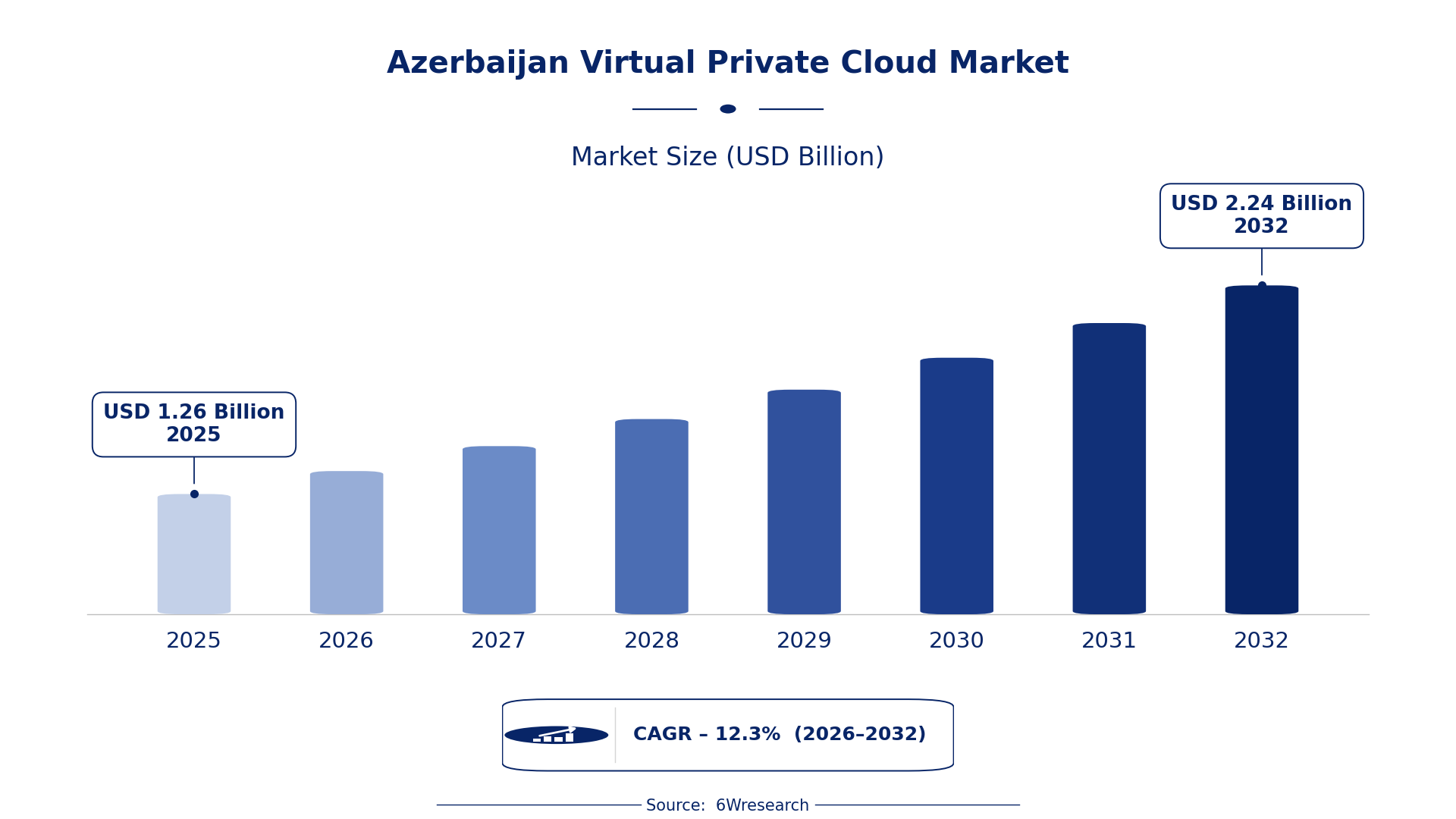
The Azerbaijan Virtual Private Cloud Market was estimated at USD 1259 Million in 2025 and is projected to reach USD 2242 Million by 2032, growing at a CAGR of 12.3% from 2026 to 2032.
Azerbaijan Virtual Private Cloud Market Synopsis
The driving force behind the Azerbaijan Virtual Private Cloud Market is the increasing concern over data privacy and regulatory compliance. As organizations seek to balance the benefits of public cloud solutions with stringent data protection requirements, virtual private clouds offer a secure and customizable environment that aligns well with these needs.
Additionally, as Azerbaijan's digital economy expands, there’s a heightened demand for scalable IT solutions that support business innovation. Virtual private clouds facilitate this growth by providing enterprises with the tools necessary to deploy applications securely, thereby enhancing operational efficiency while ensuring compliance with local regulations.
Azerbaijan Virtual Private Cloud Market Year-wise Growth Rate and Key Drivers
This graph illustrates the annual growth rates of the Azerbaijan Virtual Private Cloud Market from 2021 to 2032, highlighting a steady upward trajectory and projected expansion over the forecast period.
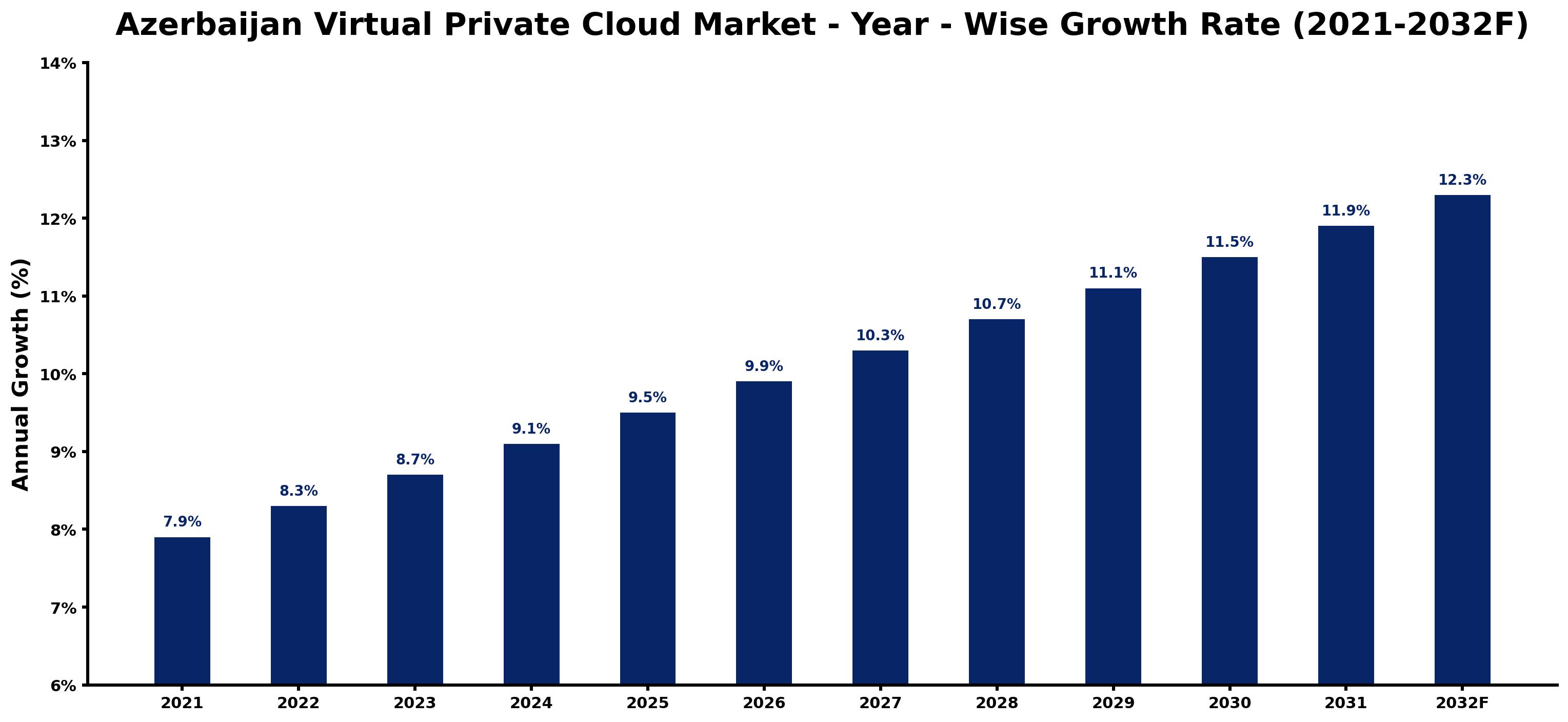
The table below presents the year‑wise growth rates along with the key drivers influencing the market
| Year | Growth Rate | Major Drivers |
| 2021 | 7.9% | Azerbaijan's IT Ministry promotes cloud adoption for businesses. |
| 2022 | 8.3% | Increased remote work driving demand for secure virtual environments. |
| 2023 | 8.7% | Local startups adopting cloud solutions for operational scalability. |
| 2024 | 9.1% | Tax incentives for tech companies encouraging virtual services adoption. |
| 2025 | 9.5% | Rising cybersecurity regulations push businesses to use private clouds. |
| 2026 | 9.9% | Government partnerships with tech firms to enhance cloud infrastructure. |
| 2027 | 10.3% | Demand for data sovereignty driving private cloud investments. |
| 2028 | 10.7% | Corporate migration to cloud platforms fueled by digital regulations. |
| 2029 | 11.1% | Increased foreign investment enhancing cloud service capabilities. |
| 2030 | 11.5% | Local educational programs boosting cloud skills in workforce. |
| 2031 | 11.9% | Enhanced internet penetration fueling virtual private cloud growth. |
| 2032 | 12.3% | Shift towards hybrid cloud models among large enterprises. |
Note: Market size estimations and growth projections presented in this report are based on 6Wresearch's proprietary forecasting methodology, utilizing the latest available industry data, government publications, and primary research inputs.
Azerbaijan Virtual Private Cloud Market Key Takeaways
Below are some of the specific key takeaways from the market, including:
- The Azerbaijan Virtual Private Cloud Market is experiencing robust growth driven by rising data security demands.
- Regulatory compliance is a critical factor influencing organizations' migration to VPC solutions.
- Integration of advanced security features is becoming essential for market players.
- Adoption of hybrid cloud models is on the rise as businesses seek flexibility.
- Local cloud service providers are gaining traction as they offer tailored solutions for specific market needs.
Evaluation of Restraints in Azerbaijan Virtual Private Cloud Market
The Azerbaijan Virtual Private Cloud Market faces several restraints that could hinder its growth. Data sovereignty remains a significant concern, with organizations needing to navigate complex regulations regarding data residency and protection. Many companies are hesitant to fully embrace cloud solutions due to apprehensions surrounding compliance and data security. on top of that, the technical complexities involved in migrating legacy systems to cloud environments can be daunting, requiring substantial expertise and resources. These factors contribute to a cautious approach towards adopting virtual private cloud services, impacting market expansion.
Azerbaijan Virtual Private Cloud Market Trends
A few notable trends are shaping the Azerbaijan Virtual Private Cloud Market. The integration of hybrid cloud architectures is becoming increasingly popular, as organizations seek to combine the benefits of both public and private clouds. Advanced security measures, such as enhanced encryption and access control mechanisms, are also gaining traction to address growing data privacy concerns. on top of that, businesses are prioritizing automation and AI-driven management solutions to optimize their cloud resources and improve operational efficiencies.
Azerbaijan Virtual Private Cloud Market Opportunities
The market presents numerous opportunities for growth and investment. As more businesses recognize the benefits of virtual private clouds, there is an increasing demand for customized solutions that cater to specific industry needs. Local providers can capitalize on this trend by offering specialized services that address compliance and security challenges unique to Azerbaijan. Additionally, as digital transformation initiatives gain momentum, companies are likely to invest in VPC solutions that support agile development and deployment of applications.
Government Initiatives in the Azerbaijan Virtual Private Cloud Market
The government of Azerbaijan is actively shaping the virtual private cloud market through various initiatives aimed at promoting cloud adoption and ensuring data security. By establishing regulatory frameworks that mandate compliance with data protection standards, the government is fostering an environment conducive to the growth of VPC services. These policies are crucial for local businesses looking to harness cloud technology while adhering to legal requirements.
- A regulatory framework introduced in 2025 mandating data protection standards for cloud services.
- A national digital infrastructure upgrade programme now in its rollout phase to improve connectivity and support cloud initiatives.
- Incentives for businesses migrating to cloud solutions, currently being evaluated by the Ministry of Digital Development.
- A planned public-private initiative expected to expand access to cloud services across various sectors by 2028.
- A recent workshop held in Q1 2025 aimed at educating businesses on the benefits and compliance requirements of VPC solutions.
Future Insights of the Azerbaijan Virtual Private Cloud Market
Looking ahead to 2026-2032, the Azerbaijan Virtual Private Cloud Market is expected to continue its upward trajectory. As more organizations prioritize digital transformation, the demand for scalable and secure cloud solutions will intensify. Companies that adapt to the evolving regulatory landscape and invest in advanced security technologies will likely emerge as leaders in this space. The integration of artificial intelligence and machine learning into cloud services will further enhance operational capabilities, driving innovation across industries.
Azerbaijan Virtual Private Cloud Market Latest Developments
Recent industry activity in the Azerbaijan Virtual Private Cloud Market has been marked by significant developments that reflect the growing interest in cloud solutions. Stakeholders are increasingly focusing on enhancing service offerings and addressing compliance challenges, which are critical for fostering trust in cloud technologies.
- A major technology vendor launched a new VPC service tailored for SMEs in early 2025, aimed at simplifying cloud adoption.
- An initiative that began in mid-2025 focuses on developing partnerships between local providers and international cloud experts to enhance service capabilities.
- A regional operator is currently upgrading its infrastructure to support advanced VPC features, expected to complete by late 2025.
- A planned promotional campaign set to kick off in Q3 2025 aims to increase awareness of the benefits of virtual private clouds among local businesses.
- A workshop series initiated in early 2025 to train IT professionals on managing VPC environments effectively is currently ongoing.
Azerbaijan Virtual Private Cloud Market - Key Attractiveness of the Report
- 10 Years of Market Numbers
- Historical Data Starting from 2022 to 2025
- Base Year: 2025
- Forecast Data until 2032
- Key Performance Indicators Impacting the Market
- Major Upcoming Developments and Projects
Key Highlights of the Report:
- Azerbaijan Virtual Private Cloud Market Outlook
- Market Size of Azerbaijan Virtual Private Cloud Market, 2025
- Forecast of Azerbaijan Virtual Private Cloud Market, 2032
- Historical Data and Forecast of Azerbaijan Virtual Private Cloud Revenues & Volume for the Period 2022-2032F
- Azerbaijan Virtual Private Cloud Market Trend Evolution
- Azerbaijan Virtual Private Cloud Market Drivers and Challenges
- Azerbaijan Virtual Private Cloud Price Trends
- Azerbaijan Virtual Private Cloud Porter's Five Forces
- Azerbaijan Virtual Private Cloud Industry Life Cycle
- Historical Data and Forecast of Azerbaijan Virtual Private Cloud Market Revenues & Volume By Component for the Period 2022-2032F
- Historical Data and Forecast of Azerbaijan Virtual Private Cloud Market Revenues & Volume By Software for the Period 2022-2032F
- Historical Data and Forecast of Azerbaijan Virtual Private Cloud Market Revenues & Volume By Services for the Period 2022-2032F
- Historical Data and Forecast of Azerbaijan Virtual Private Cloud Market Revenues & Volume By Vertical for the Period 2022-2032F
- Historical Data and Forecast of Azerbaijan Virtual Private Cloud Market Revenues & Volume By Banking, Financial Services, and Insurance for the Period 2022-2032F
- Historical Data and Forecast of Azerbaijan Virtual Private Cloud Market Revenues & Volume By IT and Telecom for the Period 2022-2032F
- Historical Data and Forecast of Azerbaijan Virtual Private Cloud Market Revenues & Volume By Government and Defense for the Period 2022-2032F
- Historical Data and Forecast of Azerbaijan Virtual Private Cloud Market Revenues & Volume By Healthcare for the Period 2022-2032F
- Historical Data and Forecast of Azerbaijan Virtual Private Cloud Market Revenues & Volume By Media and Entertainment for the Period 2022-2032F
- Historical Data and Forecast of Azerbaijan Virtual Private Cloud Market Revenues & Volume By Retail for the Period 2022-2032F
- Historical Data and Forecast of Azerbaijan Virtual Private Cloud Market Revenues & Volume By Manufacturing for the Period 2022-2032F
- Historical Data and Forecast of Azerbaijan Virtual Private Cloud Market Revenues & Volume By Others for the Period 2022-2032F
- Historical Data and Forecast of Azerbaijan Virtual Private Cloud Market Revenues & Volume By Service for the Period 2022-2032F
- Historical Data and Forecast of Azerbaijan Virtual Private Cloud Market Revenues & Volume By Training for the Period 2022-2032F
- Historical Data and Forecast of Azerbaijan Virtual Private Cloud Market Revenues & Volume By Consulting for the Period 2022-2032F
- Historical Data and Forecast of Azerbaijan Virtual Private Cloud Market Revenues & Volume By Integration for the Period 2022-2032F
- Historical Data and Forecast of Azerbaijan Virtual Private Cloud Market Revenues & Volume By Deployment for the Period 2022-2032F
- Historical Data and Forecast of Azerbaijan Virtual Private Cloud Market Revenues & Volume By Support for the Period 2022-2032F
- Historical Data and Forecast of Azerbaijan Virtual Private Cloud Market Revenues & Volume By Maintenance for the Period 2022-2032F
- Historical Data and Forecast of Azerbaijan Virtual Private Cloud Market Revenues & Volume By Managed Services for the Period 2022-2032F
- Historical Data and Forecast of Azerbaijan Virtual Private Cloud Market Revenues & Volume By Organization Size for the Period 2022-2032F
- Historical Data and Forecast of Azerbaijan Virtual Private Cloud Market Revenues & Volume By Small and Medium-Sized Enterprises for the Period 2022-2032F
- Historical Data and Forecast of Azerbaijan Virtual Private Cloud Market Revenues & Volume By Large Enterprises for the Period 2022-2032F
- Azerbaijan Virtual Private Cloud Import Export Trade Statistics
- Market Opportunity Assessment By Component
- Market Opportunity Assessment By Vertical
- Market Opportunity Assessment By Service
- Market Opportunity Assessment By Organization Size
- Azerbaijan Virtual Private Cloud Top Companies Market Share
- Azerbaijan Virtual Private Cloud Competitive Benchmarking By Technical and Operational Parameters
- Azerbaijan Virtual Private Cloud Company Profiles
- Azerbaijan Virtual Private Cloud Key Strategic Recommendations






































