Azerbaijan Wheel Loader Market Size, Share & Growth Rate
The Azerbaijan Wheel Loader Market was estimated at USD 361 Million in 2025 and is projected to reach USD 643 Million by 2032, growing at a CAGR of 8.6% from 2026 to 2032. This upward trajectory is primarily fueled by ambitious infrastructure projects and an increasing construction sector, reflecting the governments commitment to modernizing transport and building urban spaces. The demand from sectors like mining and agriculture further contributes to this robust growth, signaling a thriving market ahead.
Azerbaijan Wheel Loader Market Year-wise Growth Rate and Key Drivers
This graph highlights how the Azerbaijan Wheel Loader Market has steadily grown over the years, supported by major growth factors.
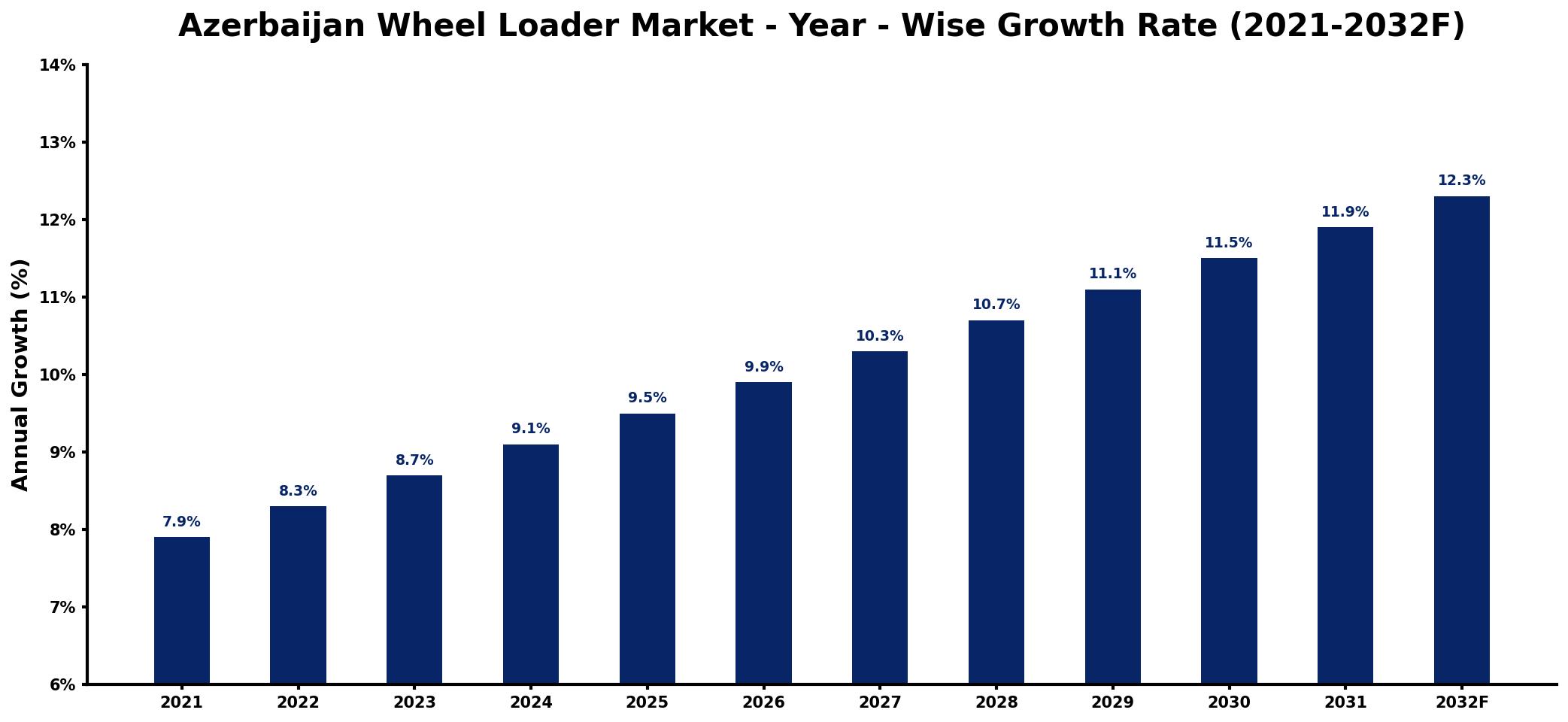
The table below presents the year‑wise growth rates along with the key drivers influencing the market
| Year | Growth Rate | Major Drivers |
| 2021 | 7.9% | increased construction sector activities |
| 2022 | 8.3% | growing infrastructure development projects |
| 2023 | 8.7% | rising demand for heavy machinery |
| 2024 | 9.1% | expansion of mining operations |
| 2025 | 9.5% | increased agricultural mechanization trends |
| 2026 | 9.9% | boost in real estate investments |
| 2027 | 10.3% | enhanced logistics and transportation needs |
| 2028 | 10.7% | growing urbanization and population density |
| 2029 | 11.1% | rising public sector investments |
| 2030 | 11.5% | emphasis on renewable energy projects |
| 2031 | 11.9% | strengthened regional trade partnerships |
| 2032 | 12.3% | growing commercial sector adoption |
Note: Market size estimations and growth projections presented in this report are based on 6Wresearch's proprietary forecasting methodology, utilizing the latest available industry data, government publications, and primary research inputs.
Azerbaijan Wheel Loader Market Synopsis
The Azerbaijan wheel loader market is currently witnessing an upsurge driven by substantial investments in infrastructure and construction. This growth is evidenced by the inflow of heavy machinery tailored to meet the diverse needs of sectors such as logistics and agriculture, highlighting a shift towards modernization and efficiency.
At the same time, competitive dynamics in the market are changing as international brands and local manufacturers strive to enhance their offerings through technological advancements. Features like fuel efficiency and automated systems are increasingly becoming the norm, catering to a more informed customer base looking for value in performance and sustainability.
Azerbaijan Wheel Loader Market Key Takeaways
- The market is set for significant growth, driven by government infrastructure initiatives and an expanding construction sector.
- Technological advancements in wheel loader designs are enhancing efficiency, leading to higher demand for sophisticated models.
- Environmentally friendly machinery is gaining traction, aligning with global trends towards sustainability.
- Local manufacturers are rising to prominence by focusing on customization to cater to specific Azerbaijani market needs.
- Opportunities abound for both domestic and international players as demand outpaces current supply capabilities.
Evaluation of Restraints in Azerbaijan Wheel Loader Market
Despite the positive outlook, the Azerbaijan wheel loader market faces several restraints that may hinder growth. Economic instability and fluctuating currency rates create uncertainty for import-dependent businesses. As the market heavily relies on imported wheel loaders, any changes in trade regulations or tariffs can significantly impact pricing and availability. Additionally, the existing local manufacturing capabilities are limited, making it challenging for the market to fully meet the escalating demand driven by infrastructure projects.
Azerbaijan Wheel Loader Market Trends
A notable trend in the Azerbaijan wheel loader market is the integration of advanced technologies aimed at improving productivity. GPS tracking and telematics systems are increasingly in demand, offering operators the tools they need to optimize performance. Furthermore, there is a marked shift towards more fuel-efficient models that comply with stringent environmental regulations, reflecting a growing awareness of sustainability among buyers. Manufacturers are also focusing on enhanced operator comfort and improved maneuverability, addressing the unique operational demands found in various work sites across Azerbaijan.
Azerbaijan Wheel Loader Market Opportunities
The Azerbaijan wheel loader market is ripe with investment opportunities, particularly given the governments focus on large-scale infrastructure projects. As urban development accelerates, so too does the need for versatile wheel loaders that can adapt to various applications, from construction to mining. Investors should consider avenues such as manufacturing partnerships or rental services to cater to this growing market. Additionally, the adoption of innovative technologies within wheel loaders presents a lucrative segment for investment, aligning with the market's shift towards efficiency and sustainability.
Government Initiatives in the Azerbaijan Wheel Loader Market
Government initiatives play a pivotal role in shaping the Azerbaijan wheel loader market. The authorities are actively promoting infrastructure development through various public spending programs, ensuring that projects related to road construction and urban planning are adequately funded. Moreover, import regulations and safety standards have been established to ensure that all machinery meets quality and performance benchmarks. This regulatory framework aims to support local manufacturers while also fostering a competitive market environment for international brands.
Future Insights of the Azerbaijan Wheel Loader Market
Looking ahead to 2026-2032, the Azerbaijan wheel loader market appears poised for sustained growth. The ongoing commitment to infrastructure development and urbanization will drive demand for heavy machinery. As government initiatives continue to unfold, the market is likely to see enhanced competition and innovation. Furthermore, advancements in technology will remain a key focus, with manufacturers seeking to offer more fuel-efficient and automated wheel loaders. These trends suggest a vibrant future for the market, characterized by greater efficiency and sustainability in operations.
Azerbaijan Wheel Loader Market Latest Developments (2025 - 2026)
Recent developments in the Azerbaijan wheel loader market indicate a strong push towards technological innovation. Companies are increasingly incorporating automation and smart features into their machinery to enhance operational efficiency. Additionally, partnerships between local and international manufacturers are becoming more common, aimed at developing products tailored to local market needs. This collaborative spirit is expected to enhance the competitiveness of domestic players while providing customers with high-quality options.
Azerbaijan Wheel Loader Market - Key Attractiveness of the Report
- 10 Years of Market Numbers
- Historical Data Starting from 2022 to 2025
- Base Year: 2025
- Forecast Data until 2032
- Key Performance Indicators Impacting the Market
- Major Upcoming Developments and Projects
Key Highlights of the Report:
- Azerbaijan Wheel Loader Market Outlook
- Market Size of Azerbaijan Wheel Loader Market, 2025
- Forecast of Azerbaijan Wheel Loader Market, 2032
- Historical Data and Forecast of Azerbaijan Wheel Loader Revenues & Volume for the Period 2022-2032F
- Azerbaijan Wheel Loader Market Trend Evolution
- Azerbaijan Wheel Loader Market Drivers and Challenges
- Azerbaijan Wheel Loader Price Trends
- Azerbaijan Wheel Loader Porter's Five Forces
- Azerbaijan Wheel Loader Industry Life Cycle
- Historical Data and Forecast of Azerbaijan Wheel Loader Market Revenues & Volume By Types for the Period 2022-2032F
- Historical Data and Forecast of Azerbaijan Wheel Loader Market Revenues & Volume By Armored Wheel Loaders for the Period 2022-2032F
- Historical Data and Forecast of Azerbaijan Wheel Loader Market Revenues & Volume By Tractor Front Loaders for the Period 2022-2032F
- Historical Data and Forecast of Azerbaijan Wheel Loader Market Revenues & Volume By Compact Front End Loaders for the Period 2022-2032F
- Historical Data and Forecast of Azerbaijan Wheel Loader Market Revenues & Volume By Skid Loaders & Track Loaders for the Period 2022-2032F
- Historical Data and Forecast of Azerbaijan Wheel Loader Market Revenues & Volume By Operating Power for the Period 2022-2032F
- Historical Data and Forecast of Azerbaijan Wheel Loader Market Revenues & Volume By 20 ?? 40 Hp for the Period 2022-2032F
- Historical Data and Forecast of Azerbaijan Wheel Loader Market Revenues & Volume By 40 ?? 80 Hp for the Period 2022-2032F
- Historical Data and Forecast of Azerbaijan Wheel Loader Market Revenues & Volume By 80 ?? 120 Hp for the Period 2022-2032F
- Historical Data and Forecast of Azerbaijan Wheel Loader Market Revenues & Volume By 120 ?? 160 Hp for the Period 2022-2032F
- Historical Data and Forecast of Azerbaijan Wheel Loader Market Revenues & Volume By 160 Hp for the Period 2022-2032F
- Historical Data and Forecast of Azerbaijan Wheel Loader Market Revenues & Volume By Above for the Period 2022-2032F
- Historical Data and Forecast of Azerbaijan Wheel Loader Market Revenues & Volume By Types Of Bucket for the Period 2022-2032F
- Historical Data and Forecast of Azerbaijan Wheel Loader Market Revenues & Volume By Bottom Bucket for the Period 2022-2032F
- Historical Data and Forecast of Azerbaijan Wheel Loader Market Revenues & Volume By Flat Bottom Bucket for the Period 2022-2032F
- Historical Data and Forecast of Azerbaijan Wheel Loader Market Revenues & Volume By Backhoe Bucket for the Period 2022-2032F
- Historical Data and Forecast of Azerbaijan Wheel Loader Market Revenues & Volume By Demolition Bucket for the Period 2022-2032F
- Historical Data and Forecast of Azerbaijan Wheel Loader Market Revenues & Volume By Excavating Buckets for the Period 2022-2032F
- Historical Data and Forecast of Azerbaijan Wheel Loader Market Revenues & Volume By Others for the Period 2022-2032F
- Historical Data and Forecast of Azerbaijan Wheel Loader Market Revenues & Volume By End-use Application for the Period 2022-2032F
- Historical Data and Forecast of Azerbaijan Wheel Loader Market Revenues & Volume By Stone Quarries for the Period 2022-2032F
- Historical Data and Forecast of Azerbaijan Wheel Loader Market Revenues & Volume By Mining Zones for the Period 2022-2032F
- Historical Data and Forecast of Azerbaijan Wheel Loader Market Revenues & Volume By Construction Sites for the Period 2022-2032F
- Historical Data and Forecast of Azerbaijan Wheel Loader Market Revenues & Volume By Military & Defense for the Period 2022-2032F
- Historical Data and Forecast of Azerbaijan Wheel Loader Market Revenues & Volume By Public Sectors for the Period 2022-2032F
- Azerbaijan Wheel Loader Import Export Trade Statistics
- Market Opportunity Assessment By Types
- Market Opportunity Assessment By Operating Power
- Market Opportunity Assessment By Types Of Bucket
- Market Opportunity Assessment By End-use Application
- Azerbaijan Wheel Loader Top Companies Market Share
- Azerbaijan Wheel Loader Competitive Benchmarking By Technical and Operational Parameters
- Azerbaijan Wheel Loader Company Profiles
- Azerbaijan Wheel Loader Key Strategic Recommendations






































