Azerbaijan Wireless Charging Market Size, Share & Growth Rate
The Azerbaijan Wireless Charging Market was estimated at USD 704 Million in 2025 and is projected to reach USD 1240 Million by 2032, growing at a CAGR of 8.4% from 2026 to 2032. This substantial growth is primarily driven by the rapid increase in smartphone and wearable device adoption, coupled with the rising consumer preference for convenient charging solutions. Technological advancements are enhancing the efficiency and speed of wireless charging, making it an attractive option for consumers and businesses alike in Azerbaijan.
Azerbaijan Wireless Charging Market Year-wise Growth Rate and Key Drivers
This graph highlights how the Azerbaijan Wireless Charging Market has steadily grown over the years, supported by major growth factors.
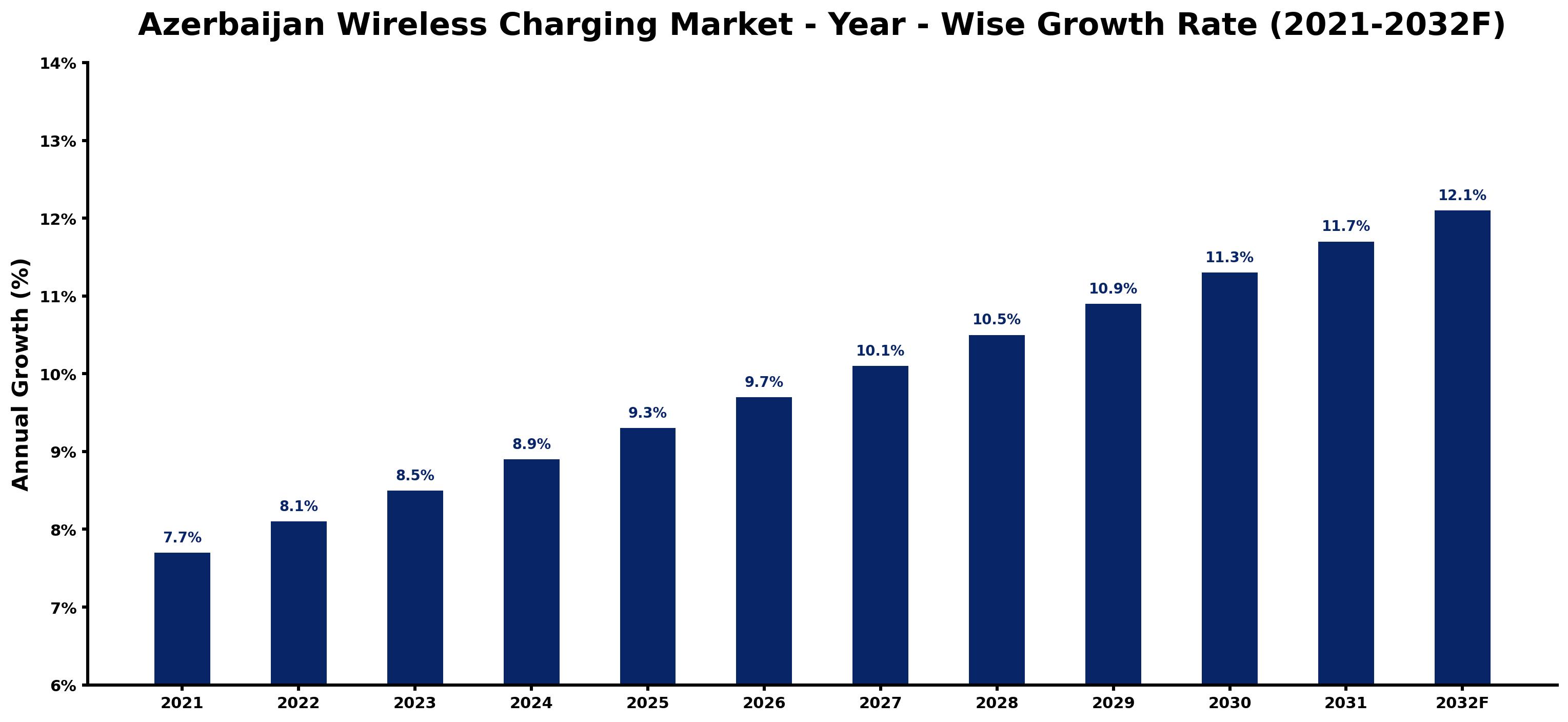
The table below presents the year‑wise growth rates along with the key drivers influencing the market
| Year | Growth Rate | Major Drivers |
| 2021 | 7.7% | Growing renewable energy integration projects |
| 2022 | 8.1% | Growing urbanization and commercial development |
| 2023 | 8.5% | Expansion of commercial construction activities |
| 2024 | 8.9% | Growing urbanization and commercial development |
| 2025 | 9.3% | Growing urbanization and commercial development |
| 2026 | 9.7% | Growing urbanization and commercial development |
| 2027 | 10.1% | Increasing adoption of advanced technologies |
| 2028 | 10.5% | Rising electricity demand across industries |
| 2029 | 10.9% | Rapid growth in telecom and data center sectors |
| 2030 | 11.3% | Increasing smart city development projects |
| 2031 | 11.7% | Expansion of commercial construction activities |
| 2032 | 12.1% | Growing renewable energy integration projects |
Note - Market size estimations and growth projections presented in this report are based on 6Wresearch’s advanced forecasting approach, validated with industry datasets as of June 2026.
Azerbaijan Wireless Charging Market Synopsis
In Azerbaijan, the integration of wireless charging stations in public venues is becoming a notable trend. Airports, cafes, and hotels are beginning to equip their facilities with wireless chargers, catering to the needs of tech-savvy consumers who prioritize convenience while on the move.
As the market expands, a growing number of electronic devices supporting wireless charging technology are hitting the shelves, further stimulating demand. This trend is expected to gain momentum as manufacturers continue to innovate, leading to more affordable and efficient solutions for consumers.
Azerbaijan Wireless Charging Market Key Takeaways
- The market is anticipated to see robust growth due to increasing consumer preferences for hassle-free charging options.
- Public infrastructure developments are paving the way for wider adoption of wireless charging technology.
- Technological innovations are improving charging efficiency and compatibility across various devices.
- There is a burgeoning interest in wireless charging solutions within the automotive sector, particularly for electric vehicles.
- Consumer awareness and education on the benefits of wireless charging are essential for sustained market growth.
Evaluation of Restraints in Azerbaijan Wireless Charging Market
Despite the promising outlook, the Azerbaijan Wireless Charging Market faces certain constraints that could impede its growth. Limited consumer awareness about the advantages of wireless charging remains a significant hurdle. Moreover, the initial investment required for infrastructure development can be prohibitive for many businesses. Compatibility issues among different device types can create confusion for consumers, potentially hindering adoption. Establishing industry standards is crucial to resolve these challenges and foster a more unified market environment.
Azerbaijan Wireless Charging Market Trends
Current trends indicate a strong movement towards integrating wireless charging capabilities in public locations, enhancing convenience for users. Additionally, there is a marked interest in advancing technology to provide faster charging speeds and greater efficiency, which are critical factors for consumer acceptance. The automotive sector is also evolving, with an increasing number of electric vehicles expected to support wireless charging, thereby amplifying demand across industries.
Azerbaijan Wireless Charging Market Opportunities
Investment opportunities abound in the Azerbaijan Wireless Charging Market. With the rising demand for efficient charging solutions, stakeholders can explore avenues in manufacturing wireless charging devices and infrastructure. Customized solutions tailored to specific industries, such as healthcare and transportation, present lucrative prospects. Moreover, collaborations with local enterprises and governmental initiatives aimed at technology adoption could yield significant returns on investment.
Government Initiatives in the Azerbaijan Wireless Charging Market
While the Azerbaijani government has yet to introduce specific policies directly addressing the wireless charging sector, its broader focus on technological advancements and digital infrastructure development indirectly supports market growth. Investments in public infrastructure and initiatives promoting renewable energy sources are likely to create a conducive environment for the adoption of wireless charging technologies, especially in electric vehicle applications.
Future Insights of the Azerbaijan Wireless Charging Market
Looking ahead to 2026-2032, the Azerbaijan Wireless Charging Market is positioned for significant expansion. As consumer awareness of wireless charging technology grows, alongside the continuing proliferation of smart devices and electric vehicles, the demand for innovative charging solutions will likely escalate. The government's commitment to sustainability and advancements in wireless charging infrastructure will further bolster market development, leading to a dynamic and evolving industry landscape.
Azerbaijan Wireless Charging Market Latest Developments (May 2025 - June 2026)
Recent industry developments highlight an increasing momentum towards integrating wireless charging solutions into everyday environments. More public spaces are adopting wireless charging technologies, with several initiatives aimed at enhancing user convenience. Additionally, companies are focusing on research and development to streamline production processes and improve product offerings, signaling a commitment to innovation and consumer satisfaction.
Azerbaijan Wireless Charging Market - Key Attractiveness of the Report
- 10 Years of Market Numbers
- Historical Data Starting from 2022 to 2025
- Base Year: 2025
- Forecast Data until 2032
- Key Performance Indicators Impacting the Market
- Major Upcoming Developments and Projects
Key Highlights of the Report:
- Azerbaijan Wireless Charging Market Outlook
- Market Size of Azerbaijan Wireless Charging Market, 2025
- Forecast of Azerbaijan Wireless Charging Market, 2032
- Historical Data and Forecast of Azerbaijan Wireless Charging Revenues & Volume for the Period 2022-2032F
- Azerbaijan Wireless Charging Market Trend Evolution
- Azerbaijan Wireless Charging Market Drivers and Challenges
- Azerbaijan Wireless Charging Price Trends
- Azerbaijan Wireless Charging Porter's Five Forces
- Azerbaijan Wireless Charging Industry Life Cycle
- Historical Data and Forecast of Azerbaijan Wireless Charging Market Revenues & Volume By Technology for the Period 2022-2032F
- Historical Data and Forecast of Azerbaijan Wireless Charging Market Revenues & Volume By Resonant for the Period 2022-2032F
- Historical Data and Forecast of Azerbaijan Wireless Charging Market Revenues & Volume By RF for the Period 2022-2032F
- Historical Data and Forecast of Azerbaijan Wireless Charging Market Revenues & Volume By Inductive for the Period 2022-2032F
- Historical Data and Forecast of Azerbaijan Wireless Charging Market Revenues & Volume By Others for the Period 2022-2032F
- Historical Data and Forecast of Azerbaijan Wireless Charging Market Revenues & Volume By Applications for the Period 2022-2032F
- Historical Data and Forecast of Azerbaijan Wireless Charging Market Revenues & Volume By Healthcare for the Period 2022-2032F
- Historical Data and Forecast of Azerbaijan Wireless Charging Market Revenues & Volume By Automotive for the Period 2022-2032F
- Historical Data and Forecast of Azerbaijan Wireless Charging Market Revenues & Volume By Consumer Electronics for the Period 2022-2032F
- Historical Data and Forecast of Azerbaijan Wireless Charging Market Revenues & Volume By Industrial for the Period 2022-2032F
- Historical Data and Forecast of Azerbaijan Wireless Charging Market Revenues & Volume By Others for the Period 2022-2032F
- Azerbaijan Wireless Charging Import Export Trade Statistics
- Market Opportunity Assessment By Technology
- Market Opportunity Assessment By Applications
- Azerbaijan Wireless Charging Top Companies Market Share
- Azerbaijan Wireless Charging Competitive Benchmarking By Technical and Operational Parameters
- Azerbaijan Wireless Charging Company Profiles
- Azerbaijan Wireless Charging Key Strategic Recommendations






































