Azerbaijan Wood Charcoal Market Size, Share & Growth Rate
The Azerbaijan Wood Charcoal Market was estimated at USD 160 Million in 2025 and is projected to reach USD 205 Million by 2032, growing at a CAGR of 3.6% from 2026 to 2032. This growth trajectory can be attributed to the increasing demand for sustainable cooking fuels and the rising popularity of barbecuing and grilling, particularly during the warmer months. Furthermore, the ongoing shift towards eco-friendly alternatives in both residential and commercial settings is fueling interest in wood charcoal products across Azerbaijan.
Azerbaijan Wood Charcoal Market Growth Rate Analysis (2021-2032)
The Azerbaijan wood charcoal market has been experiencing a gradual decline, with growth rates decreasing from 5.9% in 2021 to a projected 2.6% by 2032. This downward trend can be attributed to various factors, including shifting consumer preferences towards alternative fuels and increasing environmental regulations. As awareness of sustainable energy sources grows, the demand for traditional wood charcoal is pressured, leading to innovation in cleaner technologies. Furthermore, infrastructure limitations and the reliance on outdated production methods exacerbate this decline. While some efforts are being made to modernize the industry, the transition remains slow, complicating prospects for significant recovery in the coming years.
Azerbaijan Wood Charcoal Market Year-wise Growth Rate and Key Drivers
This graph highlights how the Azerbaijan Wood Charcoal Market has steadily grown over the past five years, supported by major growth factors.
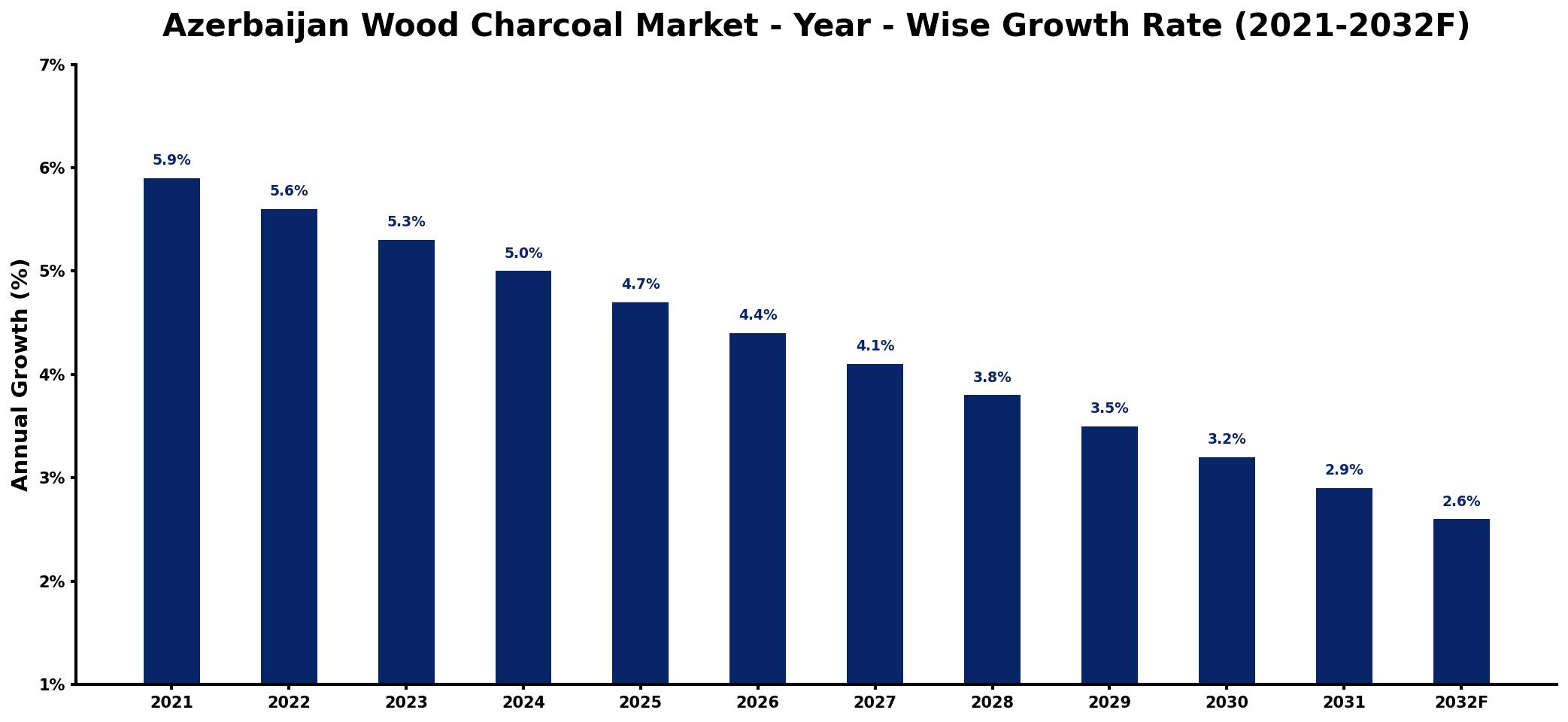
The table below presents the year‑wise growth rates along with the key drivers influencing the market
| Year | Growth Rate | Major Drivers |
| 2021 | 5.9% | increased outdoor cooking popularity |
| 2022 | 5.6% | growing demand for grilling products |
| 2023 | 5.3% | expansion of hospitality sector |
| 2024 | 5.0% | rising interest in eco-friendly fuels |
| 2025 | 4.7% | increased exports to neighboring markets |
| 2026 | 4.4% | surge in backyard entertainment trends |
| 2027 | 4.1% | growing focus on sustainable energy |
| 2028 | 3.8% | rising infrastructure development spending |
| 2029 | 3.5% | increased investment in renewable resources |
| 2030 | 3.2% | rise in culinary tourism activities |
| 2031 | 2.9% | growing popularity of outdoor events |
| 2032 | 2.6% | increased awareness of grilling culture |
Note: Market size estimations and growth projections presented in this report are based on 6Wresearch's proprietary forecasting methodology, utilizing the latest available industry data, government publications, and primary research inputs.
Azerbaijan Wood Charcoal Market Synopsis
The most significant force shaping the Azerbaijan Wood Charcoal Market is the rising consumer preference for traditional cooking methods that utilize wood charcoal. This trend is particularly pronounced in outdoor recreational cooking and among culinary enthusiasts who value the distinct flavors imparted by charcoal. Additionally, the market is benefiting from a growing awareness of sustainable and natural fuel sources, which aligns with broader environmental goals.
The market encompasses the production and distribution of charcoal derived from various wood sources, including hardwood, softwood, and bamboo. With innovations in eco-friendly production methods and packaging, the availability of high-quality charcoal products is increasing. These developments cater to diverse consumer needs, spanning households, restaurants, and industrial applications, reinforcing the market's potential for growth.
Azerbaijan Wood Charcoal Market Key Takeaways
- The market is poised for steady growth driven by a surge in demand for sustainable fuel alternatives.
- Traditional cooking practices are experiencing a renaissance, boosting wood charcoal consumption.
- Innovations in production and packaging are enhancing product quality and market appeal.
- Government regulations are shifting towards sustainable practices, influencing market dynamics.
- Increasing consumer awareness of environmental issues is fostering demand for eco-friendly products.
Evaluation of Restraints in Azerbaijan Wood Charcoal Market
Despite its growth prospects, the Azerbaijan Wood Charcoal Market faces several constraints that may impede its expansion. A significant concern is the pressure on forestry resources, which raises questions about sustainability and responsible sourcing practices. Producers must navigate the balance between meeting rising demand and ensuring that their practices do not contribute to deforestation. Additionally, achieving consistent quality while remaining price competitive remains a challenge, as variations in production methods can affect the final product. Furthermore, regulatory compliance and navigating trade restrictions can create additional hurdles for market participants.
Azerbaijan Wood Charcoal Market Trends
Several trends are currently influencing the Azerbaijan Wood Charcoal Market. The growing popularity of outdoor cooking and grilling experiences is enhancing the demand for wood charcoal among consumers looking to replicate traditional flavors. Additionally, there is an observable shift towards organic and responsibly sourced charcoal products, as consumers become more environmentally conscious. Technological advancements in charcoal production, including the adoption of sustainable practices, are also emerging, potentially increasing efficiency and product quality.
Azerbaijan Wood Charcoal Market Opportunities
Opportunities for investment and growth within the Azerbaijan Wood Charcoal Market are abundant. There is significant potential for developing innovative and sustainable production methods that could enhance product appeal. The hospitality sector, particularly restaurants focusing on traditional cooking, presents a ripe opportunity for charcoal suppliers. Furthermore, as more consumers gravitate toward outdoor activities, there are avenues for branding and marketing that emphasize the environmental benefits and unique flavor profiles of wood charcoal, tapping into the experience-driven consumer market.
Government Initiatives in the Azerbaijan Wood Charcoal Market
The government of Azerbaijan is actively involved in regulating the wood charcoal market through a series of initiatives aimed at promoting sustainable forestry practices. Policies encouraging responsible forest management and providing incentives for producers to adopt eco-friendly charcoal production methods are pivotal. Furthermore, initiatives supporting reforestation and the preservation of natural resources are instrumental in steering the market towards environmentally conscious practices, ensuring that growth aligns with conservation efforts.
Future Insights of the Azerbaijan Wood Charcoal Market
Looking ahead to the period from 2026 to 2032, the Azerbaijan Wood Charcoal Market is expected to continue evolving in response to consumer preferences and regulatory frameworks. As the demand for sustainable fuel sources grows, innovations in production and distribution will likely play a critical role in shaping the landscape. The integration of modern technologies and adherence to sustainable practices will not only bolster market competitiveness but also ensure that the wood charcoal industry aligns with the global push for environmental responsibility.
Azerbaijan Wood Charcoal Market Latest Developments (2025 - 2026)
In recent months, the Azerbaijan Wood Charcoal Market has witnessed a notable shift towards increased transparency in sourcing and production. Producers are responding to consumer demands for eco-friendly products, prompting a surge in the availability of sustainably sourced wood charcoal options. Concurrently, the government has been implementing stricter regulations aimed at protecting forestry resources, encouraging producers to adopt environmentally sound practices. This evolving landscape presents both challenges and opportunities for stakeholders in the market.
Azerbaijan Wood Charcoal Market - Key Attractiveness of the Report
- 10 Years of Market Numbers
- Historical Data Starting from 2022 to 2025
- Base Year: 2025
- Forecast Data until 2032
- Key Performance Indicators Impacting the Market
- Major Upcoming Developments and Projects
Key Highlights of the Report:
- Azerbaijan Wood Charcoal Market Outlook
- Market Size of Azerbaijan Wood Charcoal Market, 2025
- Forecast of Azerbaijan Wood Charcoal Market, 2032
- Historical Data and Forecast of Azerbaijan Wood Charcoal Revenues & Volume for the Period 2022-2032F
- Azerbaijan Wood Charcoal Market Trend Evolution
- Azerbaijan Wood Charcoal Market Drivers and Challenges
- Azerbaijan Wood Charcoal Price Trends
- Azerbaijan Wood Charcoal Porter's Five Forces
- Azerbaijan Wood Charcoal Industry Life Cycle
- Historical Data and Forecast of Azerbaijan Wood Charcoal Market Revenues & Volume By Product for the Period 2022-2032F
- Historical Data and Forecast of Azerbaijan Wood Charcoal Market Revenues & Volume By Charcoal Lumps for the Period 2022-2032F
- Historical Data and Forecast of Azerbaijan Wood Charcoal Market Revenues & Volume By Charcoal Briquettes for the Period 2022-2032F
- Historical Data and Forecast of Azerbaijan Wood Charcoal Market Revenues & Volume By Charcoal Powder for the Period 2022-2032F
- Historical Data and Forecast of Azerbaijan Wood Charcoal Market Revenues & Volume By Wood for the Period 2022-2032F
- Historical Data and Forecast of Azerbaijan Wood Charcoal Market Revenues & Volume By Softwood for the Period 2022-2032F
- Historical Data and Forecast of Azerbaijan Wood Charcoal Market Revenues & Volume By Hardwood for the Period 2022-2032F
- Historical Data and Forecast of Azerbaijan Wood Charcoal Market Revenues & Volume By Application for the Period 2022-2032F
- Historical Data and Forecast of Azerbaijan Wood Charcoal Market Revenues & Volume By Fuel Feedstock for the Period 2022-2032F
- Historical Data and Forecast of Azerbaijan Wood Charcoal Market Revenues & Volume By Reducing Agent for the Period 2022-2032F
- Historical Data and Forecast of Azerbaijan Wood Charcoal Market Revenues & Volume By Filtration Agent & Gas Masking for the Period 2022-2032F
- Historical Data and Forecast of Azerbaijan Wood Charcoal Market Revenues & Volume By Decolorizing Agent for the Period 2022-2032F
- Historical Data and Forecast of Azerbaijan Wood Charcoal Market Revenues & Volume By Gastric Medicine for the Period 2022-2032F
- Historical Data and Forecast of Azerbaijan Wood Charcoal Market Revenues & Volume By Sketches & Paints for the Period 2022-2032F
- Historical Data and Forecast of Azerbaijan Wood Charcoal Market Revenues & Volume By Soil Conditioning for the Period 2022-2032F
- Historical Data and Forecast of Azerbaijan Wood Charcoal Market Revenues & Volume By Others for the Period 2022-2032F
- Historical Data and Forecast of Azerbaijan Wood Charcoal Market Revenues & Volume By End Use for the Period 2022-2032F
- Historical Data and Forecast of Azerbaijan Wood Charcoal Market Revenues & Volume By Residential for the Period 2022-2032F
- Historical Data and Forecast of Azerbaijan Wood Charcoal Market Revenues & Volume By Cooking Fuel for the Period 2022-2032F
- Historical Data and Forecast of Azerbaijan Wood Charcoal Market Revenues & Volume By Gardening for the Period 2022-2032F
- Historical Data and Forecast of Azerbaijan Wood Charcoal Market Revenues & Volume By Commercial Paints & Sketches for the Period 2022-2032F
- Historical Data and Forecast of Azerbaijan Wood Charcoal Market Revenues & Volume By Water Treatment for the Period 2022-2032F
- Historical Data and Forecast of Azerbaijan Wood Charcoal Market Revenues & Volume By Industrial for the Period 2022-2032F
- Azerbaijan Wood Charcoal Import Export Trade Statistics
- Market Opportunity Assessment By Product
- Market Opportunity Assessment By Wood
- Market Opportunity Assessment By Application
- Market Opportunity Assessment By End Use
- Azerbaijan Wood Charcoal Top Companies Market Share
- Azerbaijan Wood Charcoal Competitive Benchmarking By Technical and Operational Parameters
- Azerbaijan Wood Charcoal Company Profiles
- Azerbaijan Wood Charcoal Key Strategic Recommendations






































