Azerbaijan Wooden Toys Market Size, Share & Growth Rate
The Azerbaijan Wooden Toys Market was estimated at USD 539 Million in 2025 and is projected to reach USD 894 Million by 2032, growing at a CAGR of 7.5% from 2026 to 2032. This upward trend is being driven by a remarkable shift in consumer preferences towards eco-friendly and safe play options for children. As parents increasingly prioritize sustainable materials and developmental benefits, the demand for wooden toys continues to rise across Azerbaijans toy retail and educational sectors.
Azerbaijan Wooden Toys Market Year-wise Growth Rate and Key Drivers
This graph highlights how the Azerbaijan Wooden Toys Market has steadily grown over the years, supported by major growth factors.
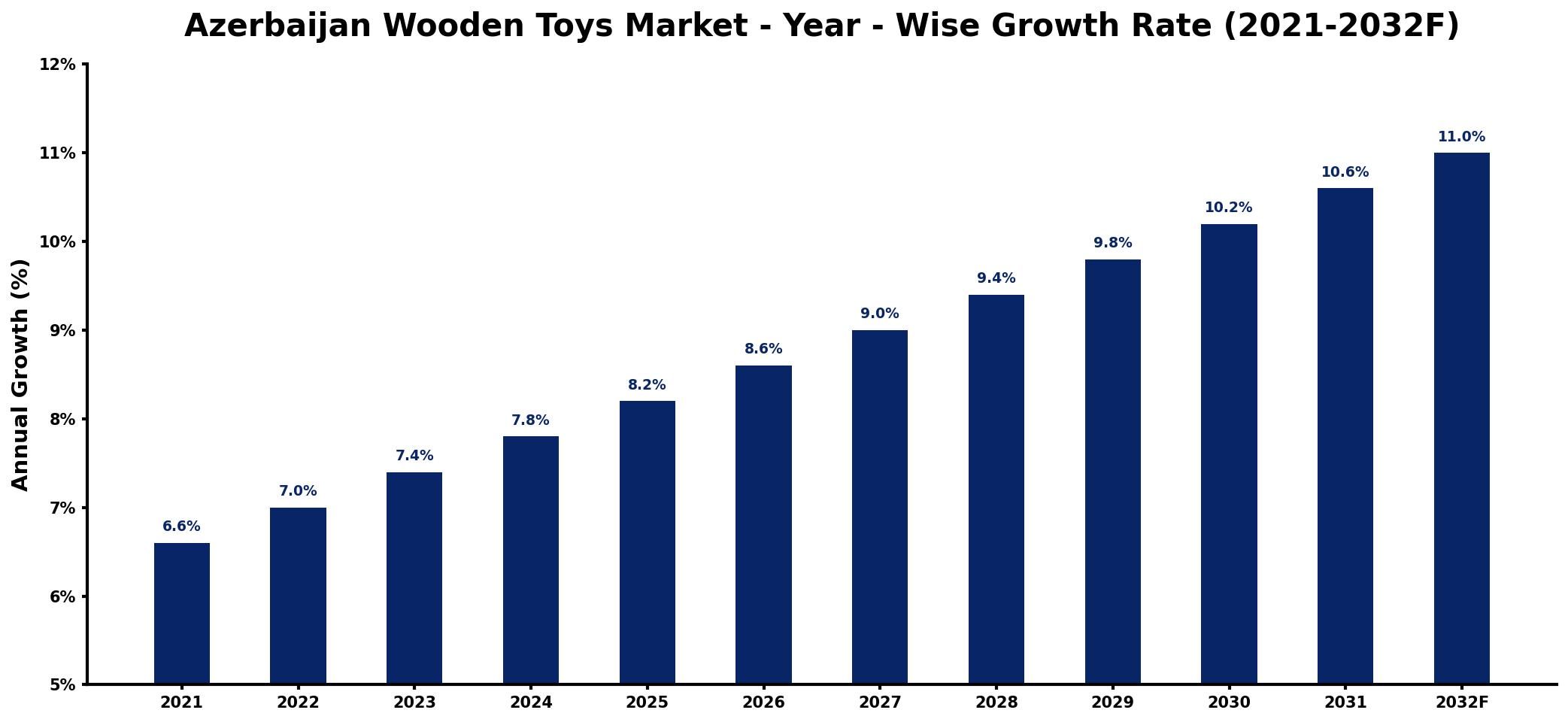
The table below presents the year‑wise growth rates along with the key drivers influencing the market
| Year | Growth Rate | Major Drivers |
| 2021 | 6.6% | Rising consumer interest in sustainability |
| 2022 | 7.0% | Increased investment in local manufacturing |
| 2023 | 7.4% | Growing demand for eco-friendly products |
| 2024 | 7.8% | Expansion of retail distribution channels |
| 2025 | 8.2% | Enhanced awareness of child development |
| 2026 | 8.6% | Surge in online shopping popularity |
| 2027 | 9.0% | Innovative designs attracting diverse consumers |
| 2028 | 9.4% | Strengthened partnerships with educational institutions |
| 2029 | 9.8% | Boost in disposable income levels |
| 2030 | 10.2% | Growing emphasis on quality craftsmanship |
| 2031 | 10.6% | Rise in family-oriented leisure activities |
| 2032 | 11.0% | growing emerging market penetration |
Note: Market size estimations and growth projections presented in this report are based on 6Wresearch's proprietary forecasting methodology, utilizing the latest available industry data, government publications, and primary research inputs.
Azerbaijan Wooden Toys Market Synopsis
The Azerbaijani market for wooden toys is characterized by a growing appreciation for craftsmanship and quality among consumers. As the country witnesses a cultural renaissance that values traditional practices, wooden toys stand out for their durability and sensory attributes, making them ideal for imaginative play in early childhood. Parents and educators alike are recognizing the developmental advantages these toys offer, reinforcing their presence in homes and schools throughout Azerbaijan.
Moreover, the market is supported by a global trend towards minimizing plastic usage and promoting sustainable lifestyles. Wooden toys made from natural materials such as beech, pine, and birch not only provide safe and tactile experiences for children but also resonate with parents who are increasingly concerned about the environmental impact of their purchases. This alignment of consumer values with product offerings positions the Azerbaijan wooden toys market for substantial growth.
Azerbaijan Wooden Toys Market Key Takeaways
- The market showcases a significant growth trajectory fueled by an increasing preference for eco-friendly products.
- Educational benefits and developmental value of wooden toys are leading to a shift in consumer buying behavior.
- Artisanal craftsmanship is becoming a key differentiator in the competitive landscape of childrens toys.
- Government policies are actively supporting traditional manufacturing practices and safety standards.
- Challenges remain in navigating safety regulations and distribution channels for broader market access.
Evaluation of Restraints in Azerbaijan Wooden Toys Market
Despite its promising outlook, the Azerbaijan wooden toys market faces certain restraints that could impede its growth. One major challenge is the stringent safety regulations that manufacturers must adhere to, which can complicate production processes and increase costs. Additionally, addressing potential concerns about choking hazards and chemical exposure is critical for maintaining consumer trust. Competing with the allure of electronic and plastic alternatives further complicates market acceptance, necessitating robust marketing strategies to educate parents on the benefits of wooden toys. Lastly, securing reliable distribution channels remains a challenge, as established retailers may be hesitant to diversify their offerings in the face of established market competition.
Azerbaijan Wooden Toys Market Trends
Several key trends are shaping the Azerbaijan wooden toys market, particularly in terms of design and consumer engagement. Firstly, the emphasis on educational toys that promote creativity, problem-solving, and motor skills is driving innovative product developments. Manufacturers are increasingly exploring collaborations with educational experts to design toys that align with early childhood education goals. Secondly, the rise of online retail is facilitating greater access to a variety of wooden toys, enabling parents to make informed purchases while providing convenience. Additionally, the integration of eco-friendly manufacturing practices, including the use of water-based paints, is becoming more prevalent, enhancing the appeal of wooden toys to environmentally conscious consumers.
Azerbaijan Wooden Toys Market Opportunities
The Azerbaijan wooden toys market presents numerous opportunities for growth and investment. The increasing demand for sustainably produced toys creates a fertile ground for new entrants focusing on eco-friendly materials and manufacturing processes. Additionally, as awareness about the benefits of unstructured play rises, there is potential for educational institutions to incorporate wooden toys into their curricula, driving bulk purchases from schools and daycare centers. Moreover, artisanal workshops that emphasize traditional craftsmanship can tap into the growing consumer interest in unique, handcrafted products, further expanding market reach and engagement.
Government Initiatives in the Azerbaijan Wooden Toys Market
The Azerbaijani government is proactively supporting the wooden toys market through various initiatives aimed at enhancing traditional craftsmanship and fostering the creative industries. Policies have been implemented to offer incentives for local toy manufacturers, alongside the establishment of regulations ensuring safety standards in toy production. Support for artisanal workshops and cultural events is also part of the broader strategy to revive and sustain traditional practices, promoting a vibrant landscape for wooden toy production that resonates with both local and international audiences.
Future Insights of the Azerbaijan Wooden Toys Market
Looking ahead, the Azerbaijan wooden toys market is poised for a bright future between 2026 and 2032. As consumer preferences continue to shift towards sustainable and educational products, the market will likely experience robust growth fueled by innovation and community engagement. The potential integration of technology into wooden toys, enhancing their educational value while maintaining their traditional appeal, could further expand consumer interest. Additionally, as regulations evolve to support safety and quality standards, the market can anticipate greater investment and participation from both domestic and international players.
Azerbaijan Wooden Toys Market Latest Developments (2025 - 2026)
In the latest developments within the Azerbaijan wooden toys market, there has been a notable shift towards incorporating educational themes into product designs. Manufacturers are responding to consumer demands by creating toys that not only entertain but also educate children on environmental conservation and cultural heritage. Furthermore, there is a growing emphasis on direct-to-consumer sales channels as online shopping experiences evolve, enhancing accessibility and customer engagement. Artisanal workshops are also gaining traction, leading to a revival of traditional craftsmanship that aligns with contemporary consumer values.
Azerbaijan Wooden Toys Market - Key Attractiveness of the Report
- 10 Years of Market Numbers
- Historical Data Starting from 2022 to 2025
- Base Year: 2025
- Forecast Data until 2032
- Key Performance Indicators Impacting the Market
- Major Upcoming Developments and Projects
Key Highlights of the Report:
- Azerbaijan Wooden Toys Market Outlook
- Market Size of Azerbaijan Wooden Toys Market, 2025
- Forecast of Azerbaijan Wooden Toys Market, 2032
- Historical Data and Forecast of Azerbaijan Wooden Toys Revenues & Volume for the Period 2022-2032F
- Azerbaijan Wooden Toys Market Trend Evolution
- Azerbaijan Wooden Toys Market Drivers and Challenges
- Azerbaijan Wooden Toys Price Trends
- Azerbaijan Wooden Toys Porter's Five Forces
- Azerbaijan Wooden Toys Industry Life Cycle
- Historical Data and Forecast of Azerbaijan Wooden Toys Market Revenues & Volume By Product Type for the Period 2022-2032F
- Historical Data and Forecast of Azerbaijan Wooden Toys Market Revenues & Volume By Educational Toys for the Period 2022-2032F
- Historical Data and Forecast of Azerbaijan Wooden Toys Market Revenues & Volume By Construction Toys for the Period 2022-2032F
- Historical Data and Forecast of Azerbaijan Wooden Toys Market Revenues & Volume By Musical Toys for the Period 2022-2032F
- Historical Data and Forecast of Azerbaijan Wooden Toys Market Revenues & Volume By Game Toys for the Period 2022-2032F
- Historical Data and Forecast of Azerbaijan Wooden Toys Market Revenues & Volume By Dolls & Miniatures for the Period 2022-2032F
- Historical Data and Forecast of Azerbaijan Wooden Toys Market Revenues & Volume By Automotive Toys for the Period 2022-2032F
- Historical Data and Forecast of Azerbaijan Wooden Toys Market Revenues & Volume By Pretend Play Toys for the Period 2022-2032F
- Historical Data and Forecast of Azerbaijan Wooden Toys Market Revenues & Volume By Wood Type for the Period 2022-2032F
- Historical Data and Forecast of Azerbaijan Wooden Toys Market Revenues & Volume By Softwood for the Period 2022-2032F
- Historical Data and Forecast of Azerbaijan Wooden Toys Market Revenues & Volume By Hardwood for the Period 2022-2032F
- Historical Data and Forecast of Azerbaijan Wooden Toys Market Revenues & Volume By Age Group for the Period 2022-2032F
- Historical Data and Forecast of Azerbaijan Wooden Toys Market Revenues & Volume By Below 1 Year for the Period 2022-2032F
- Historical Data and Forecast of Azerbaijan Wooden Toys Market Revenues & Volume By Age 1-3 for the Period 2022-2032F
- Historical Data and Forecast of Azerbaijan Wooden Toys Market Revenues & Volume By Age 3-5 for the Period 2022-2032F
- Historical Data and Forecast of Azerbaijan Wooden Toys Market Revenues & Volume By Age 5-12 for the Period 2022-2032F
- Historical Data and Forecast of Azerbaijan Wooden Toys Market Revenues & Volume By Age 12+ for the Period 2022-2032F
- Historical Data and Forecast of Azerbaijan Wooden Toys Market Revenues & Volume By Distribution Channel for the Period 2022-2032F
- Historical Data and Forecast of Azerbaijan Wooden Toys Market Revenues & Volume By Online for the Period 2022-2032F
- Historical Data and Forecast of Azerbaijan Wooden Toys Market Revenues & Volume By Offline for the Period 2022-2032F
- Azerbaijan Wooden Toys Import Export Trade Statistics
- Market Opportunity Assessment By Product Type
- Market Opportunity Assessment By Wood Type
- Market Opportunity Assessment By Age Group
- Market Opportunity Assessment By Distribution Channel
- Azerbaijan Wooden Toys Top Companies Market Share
- Azerbaijan Wooden Toys Competitive Benchmarking By Technical and Operational Parameters
- Azerbaijan Wooden Toys Company Profiles
- Azerbaijan Wooden Toys Key Strategic Recommendations






































